Go Out in a Blaze of Glory
|
|
|
 |
|
|
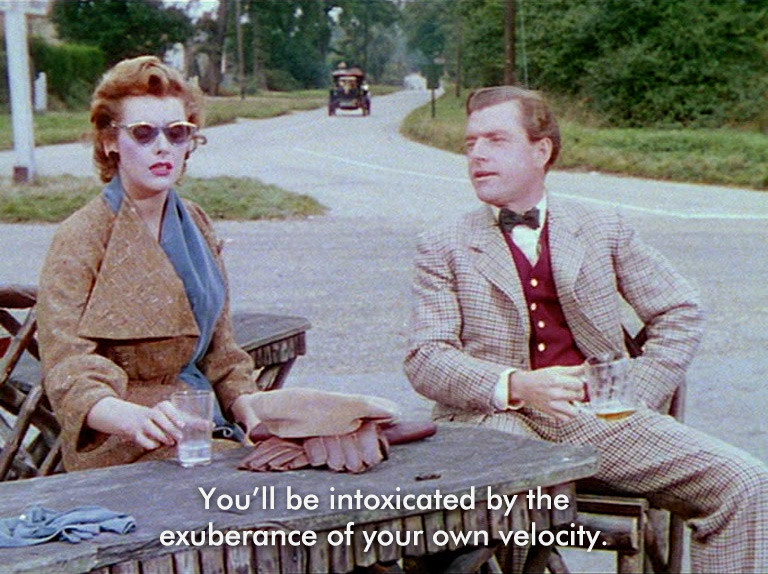
Here's a charming moment from Genevieve (1953).
|
|
|
|
|
|
|
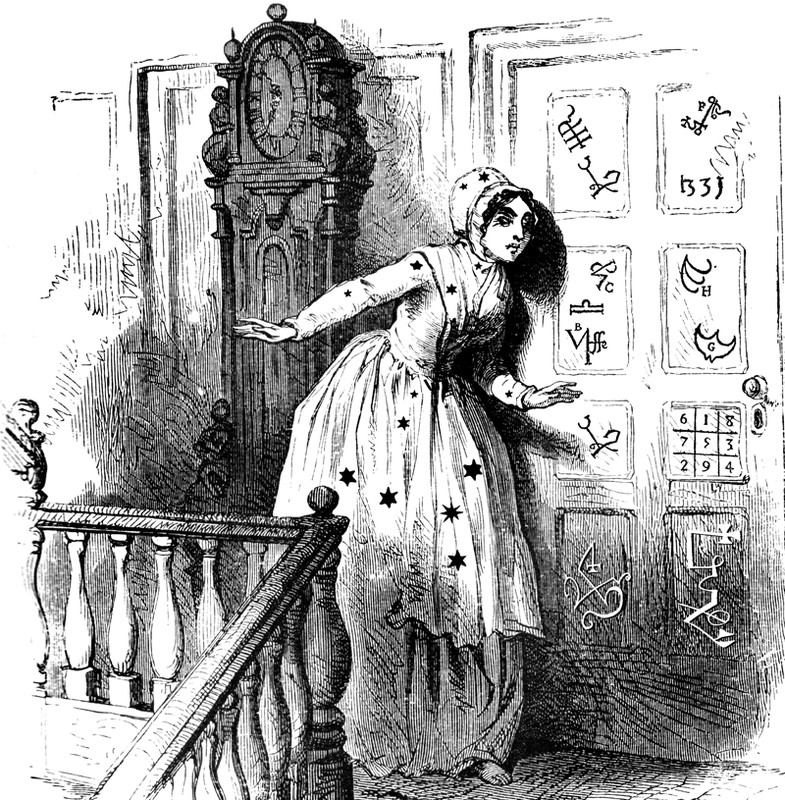
"At this moment, with all the Magic Arts thrashing at the outer door, she is etched with stars." —J. Karl Bogartte, " The Perfect Crime" (For Clint Marsh) |
|
|
|
|
|
|
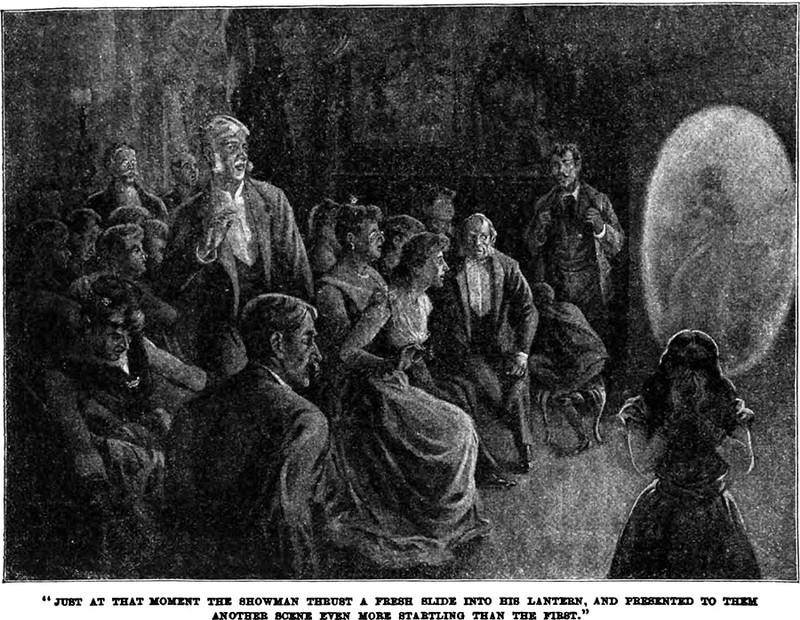
Ah, the good-old-days, when waiting for the next slide in a slide show was fraught with momentousness. The caption reads, "Just at that moment the showman thrust [emphasis ours] a fresh slide into his lantern, and presented to them another scene even more startling than the first." Today's Flash slide shows aren't nearly so flashy, eh? How can a showman thrust [emphasis ours again, though all this thrusting is admittedly wearing us out] a JPG? We're reminded of beloved British comedian Stewart Lee, who recently asked his audience if anyone was old enough to remember when there were actually things, like letters written on paper or music recorded onto plastic discs. This item from Frank Leslie's Illustrated, 1891, will forever make us pine for the nearly unbearable drama of magic lantern slides every time we open a lousy JPG. |
|
|
|
|
|
|
We discovered this curious "ghost in a candle" trick in an issue of The Strand from 1895.
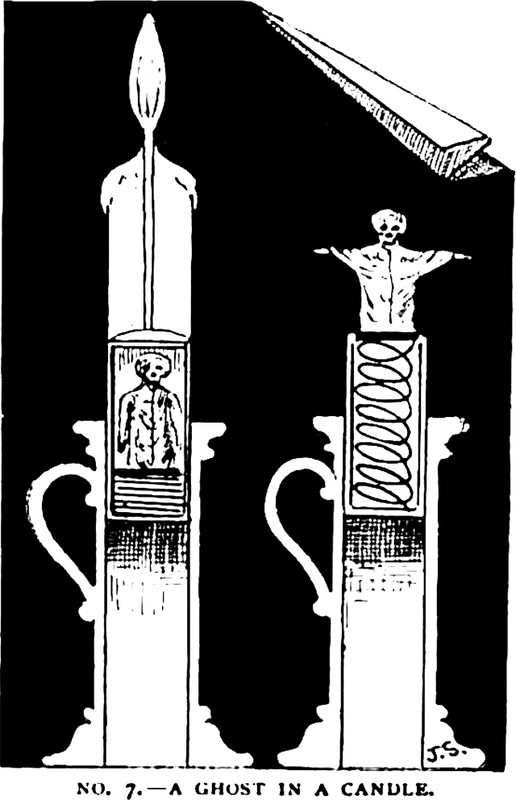
Here's the explanation of the trick candle, "invented by a man as a rather peculiar surprise for a friend. He made that friend a present of some coloured wax candles, one of which contained the affair shown. The receiver was very fond of having a few candles of the coloured kind placed about his drawing-room, in candelabra, and was intensely surprised one night when one of those which he had thankfully accepted from his friend exploded with a loud 'bang,' after having burnt down about half-way, and revealed to view a miniature ghost, with outstretched arms, which had issued from the remaining portion of the candle. To say that the man was puzzled by so extraordinary an apparition is to incompletely describe his feelings. I wonder how the reader would accept such a crisis. I know that I should have been very much astonished. Yet the effect was produced in an exceedingly simple manner, as can be understood by examining the drawings. The lower half of the candle really consisted of a thin cardboard case, containing a spring and a small 'ghost' with spring-arms, which would fly apart immediately upon being released from their bondage. A small portion of gunpowder, separated by a disc of paper from the head of the 'ghost,' completed the apparatus. The outside of the cylinder was waxed to appear as but the continuation of the candle. When the flame burnt to the powder it naturally caused it to explode, and simultaneously with the discharge the spring forced the little image upwards. This device would make an effective toy, I am inclined to think, as the cylinder could be used as often as required, by fixing a half-candle properly to the top of it and concealing the join."
|
|
|
|
|
|
|
"Let's do so well that it can't possibly be explained by our talent or our training." —the cruelly canceled yet deliriously hilarious Strangers with Candy |
|
|
|
|
|
|
At age 75, Katsuhika Hokusai timelined his artistic quest: "At the age of 73, I finally apprehended something of the true quality of birds, animals, insects, fishes, and of the vital nature of grasses and trees. Therefore at 80, I shall have made some progress, at 90 I shall have penetrated even further into the deeper meaning of things, at 100 I shall have become truly marvelous, and at 110, each dot, each line shall surely possess a life of its own." Vincent Van Gogh achieved Hokusai's dream at the age of 37. (Michael R. Zomber, Park Avenue, 2010) |
|
|
|
|
|
|
Playing on the old Zen chestnut, we ask: If a traffic light hangs at an intersection and there's no one there to see it, does it see red? Our favorite virtual traffic light answers this question here. (Thanks, Gordon!) |
|
|
|
|
|
|
We're honored to illustrate an article about L.A.'s mysterious public gardens. Our photo depicts the beautiful Descanso Gardens. |
|
|
|
|
|
|
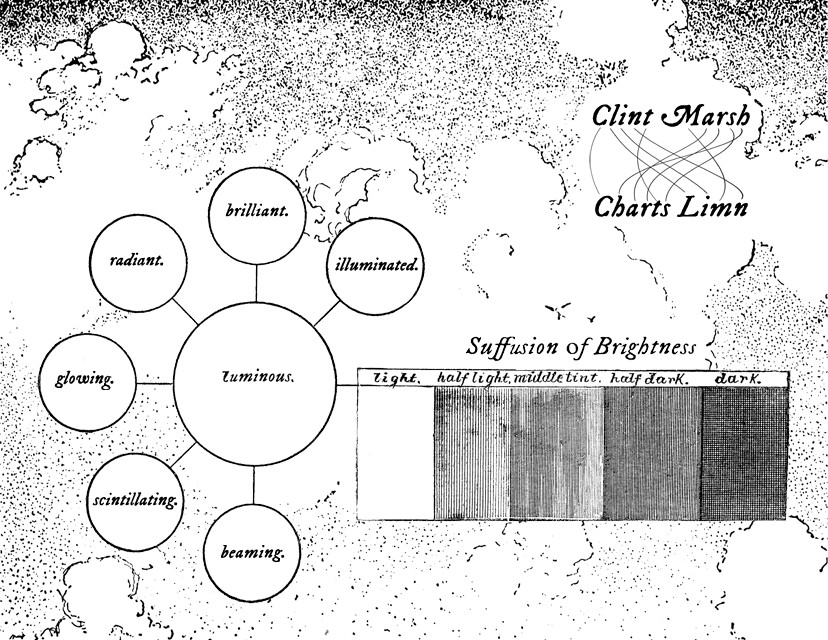
From Prof. Oddfellow's sketchbook: This item was inspired by Cynthia Ozick's amazing blurb for Frederic Tuten's Self Portraits: Fictions: "An amazing, glittering, glowing, Proustian, Conradian, Borgesian, diamond-faceted, language-studded, myth-drowned dream!"

Barely Able writes: I loved this blurb flow chart. It reminds me of the paint swatches at WAL-MART, which are probably the most perfect thing in the store. Which makes me want to destroy them. Or rearrange their perfect order. This is a Luciferian impulse. Did Lucifer really want to destroy? Or did he want to merely re-arrange. En tout cas, it's clear that re-arrangement is a damnable offense. A primordial offense. Perhaps the Ur-Offense. What is literary criticism but an attempt to rearrange artistic works in an imaginary space. It's hilarious. The books stay right where they are put. But if the re-arranger is particularly successful he might have certain books banned or sent to book gulags (thrift stores or worse). In which case, the books find it hard to reproduce. And then they may go extinct. So, overall, I think God is right. He should destroy Satan for being the Great Interior Decorator that he so clearly is. Satan is all about fussiness. There is no sin that does not first begin in fussiness.
|
Page 19 of 22
> Older Entries...
Original Content Copyright © 2026 by Craig Conley. All rights reserved.
|