I Found a Penny Today, So Here's a Thought
|
|
|
 |
|
|
"Children are often inclined to be over-fond of rabbits. They overlook their deplorable hygiene and vicious teeth." |
|
  by jovikeThe Little-Known Meanings of Crazy Color Names vol. 4
Seemingly unintelligible color names often tell fascinating and amusing stories, at least to those who are willing to delve beneath the surface. We continue our strange and wonderful adventure into the uncharted fringes of language, where we'll discover new "shades of meaning." The light green color called hmm represents a sound which a “great conversationalist” makes while listening to keep people talking, as discussed in Think Like Your Customer: A Winning Strategy to Maximize Sales by Understanding and Influencing How and Why Your Customers Buy by Bill Stinnett. 
The bright orange color called hmmmm refers to a “trite expression of wonder, envy and awe” that, along with “oh my,” “well well,” “say now,” and “really?” “will cover your adventures in New York” (Hunter S. Thompson, The Proud Highway: Saga of a Desperate Southern Gentleman, 1955-1967). 
The golden color similarly called hmmmm recalls a chant from the Igbo Folk Epic from Sub-Saharan Africa, as discussed in Traditional Storytelling Today: An International Sourcebook by Margaret Read MacDonald. 
The dark red color called hmph recalls an exclamation by the “Good Magician Humfrey” that, according to a translator golem, means “You blundering aviary feline! Get your catty feet on the ground!” (Piers Anthony, Source of Magic). 
The pale orange color called hnnn echoes the grunt of Frankenstein’s monster, according to poet John Quinn in “Subway Station Meditation (New York),” Do Not Ask Me to Compete with the Angels. 

by Love Not Fear
The deep purple color called hssss refers to the sound of a city bus pulling away from a stop, as in The Hearse You Came In On by Tim Cockey. 
The bright blue color called kkkk refers to the sound of silk being stolen: "Aye, Silk’s what they fancy out in India ... over the wall, in your Window, kkkk! Job’s done." (Thomas Pynchon, Mason & Dixon). 
The deep green color called kkkkkkk echoes the rapid bill-clapping sound of the Choco Toucan, as described in Toucans, Barbets and Honeyguides: Ramphastidae, Capitonidae and Indicatoridae by Lester L. Short. 
The dusky purple color called mmmmm recalls an expression of feeling vulnerable upon finding oneself stranded in a strange place at night, as in the song “Cross Road Blues” by Robert Johnson, as transcribed in Trouble in Mind by Leon F. Litwack. 
The pale yellow color called nnn echoes a response to the question “You spigotty anglease?” in Finnegans Wake by James Joyce. 
All of these color name insights are derived from my Dictionary of Improbable Words, which is available for online reading. [Read the entire article in my guest blog at ColourLovers.com.]
|
|
|
|
|
|
|
 by mtesonSame-HEX UnionsColors, like people, tend to mix and mingle according to their inclinations. Sometimes two complementary HEXes will combine to create a new color. Sometimes two similar HEXes will merge to illuminate a more brilliant hue. Is it preposterous to label such unions as "straight" and "gay"? The ColourLovers library is full of colors with orientations identified in their titles. At a glance, can you tell a "straight" color from a "gay" one? Here's a three-part quiz, each more challenging than the last. In this first quiz, one column features colors with exclusively gay names. The other column features colors with exclusively straight names. Which is which? For the answer, click on any color to reveal the name.
In this second quiz, things get trickier. One column contains gay colors, one contains straight colors, and one contains transsexual/hermaphroditic colors. Which is which? For the answers, click on the colors to reveal their names.
This third quiz is a real brain-stumper. Colors are totally mixed up: gay, straight, androgynous, and one Teletubby. Can you sort it all out?
The purpose of this admittedly preposterous exercise isn't to moralize. Clearly, even colors aren't free of labels. Perhaps labels are ridiculous. Perhaps they are useful. Perhaps labels tell more about the labeler than they do about the labeled. One thing's for certain: colors are sexy! What do you think? [Read the entire article in my guest blog at ColourLovers.com.]
|
|
|
|
|
|
|
From The Black Book by Orhan Pamuk: Whenever I venture into an endless saga about what the West stole from the East and the East from the West, I think this: If this realm of dreams we call the world is but a house we roam like sleepwalkers, then our literary traditions are like wall clocks, there to make us feel at home. So:
1. To say that one of these wall clocks is right and another wrong is utter nonsense.
2. To say that one is five hours ahead of the other is also nonsense; by using the same logic you could just as easily say that it's seven hours behind.
3. For much the same reason, if it is 9:35 according to one clock and it just so happens that another clock also says it's 9:35, anyone who claims that the second clock is imitating the first is spouting nonsense.
|
|
|
|
|
|
|
by jovikeThe Little-Known Meanings of Crazy Color Names vol. 3
Seemingly incomprehensible color names often tell intriguing and funny stories, at least to those who are willing to delve beneath the surface. We continue our strange and wonderful adventure into the uncharted fringes of language, where we'll discover new "shades of meaning." The dark gray color called fsck refers to a Linux system administration command and is also the title of an album of experimental electronic music by the band Farmers Manual. 
The bright pink color called fzzk recalls the sound of “flash panties,” a weapon disguised as underwear, as in the comic book Dirty Pair: Run From The Future #3 by Adam Warren. 
The light purple color called ggg echoes the gulping of a noisy drinker, as described in “More Than Words” by the New Zealand Ministry of Education. 
The light green color called gggg refers to a baby’s giggle, as described in the novel Edwin Mullhouse by Steven Millhauser. 
The gray color called gnch refers to the sound of someone gorging on a giant mushroom, as in the graphic novel Uzumaki 2 by Junji Ito. 

by sahmeepee
The bright red color called grrl refers to a girl who riots, usually associated with punk music. 
The bright orange color called grrrr refers to the squeak of vinyl pants rubbing against vinyl furniture, as in the novel The Final Detail by Harlan Coben. 
The ominous color called grrrrrr echoes the sound of one’s shadow self explosively releasing “a great amount of repressed energy” in a “giant over-reaction” (Jacquelyn Small, Awakening in Time: The Journey from Codependence to Co-Creation). 
The frothy color called hgkh refers to the sound of someone struggling not to drown in a vat of fresh cream, as in the graphic novella Hearts and Minds by Scott McCloud. 
The luminous green color called hhh conjures the silent moment of Buddha-nature, when “the breath is completely out” and one effortlessly experiences the moment of death (Osho, The Book of Secrets). 
All of these color name insights are derived from my Dictionary of Improbable Words, which is available for online reading. [Read the entire article in my guest blog at ColourLovers.com.]
|
|
|
|
|
|
|
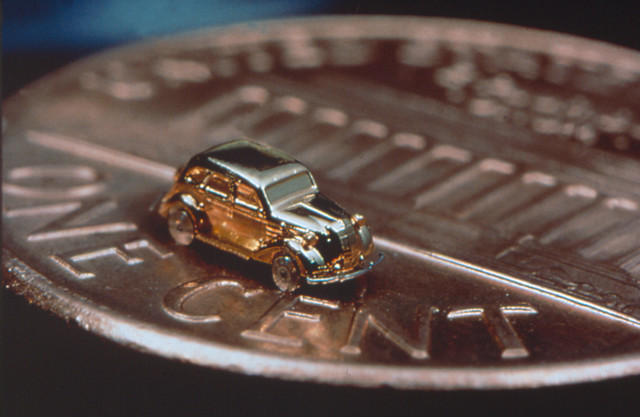
Who's driving the world's smallest car (1/1000th the size of the actual car, the size of a grain of rice)? Our guess: a " copper." --- J writes: I've heard of a "subcompact," but this is ridiculous!
|
|
|
|
|
|
|
 by creaturaWhich Came First? The Chicken Color or the Egg Color?Pearly white, cream, yellow, brown, gray, blue, violet, green, olive. Chicken eggs are colorful even before they're dyed and decorated for Easter celebrations. "The color of eggs comes exclusively from the pigment in the outer layer of the shell and may range from an almost pure white to a deep brown, with many shades in between. The only determinant of egg color is the breed of the chicken. . . . A simple test to determine the color of a hen's eggs is to look at her earlobes. If the earlobes are white, the hen will lay white eggs. If the earlobes are red, she will produce brown eggs" (David Feldman, Why Do Clocks Run Clockwise? and other Imponderables, 1988. Poultry expert Katie Thear notes that "All eggs are initially white, and shell color is the result of the pigments called porphyrins being deposited while the eggs are in the process of formation. In the case of the Rhode Island Red, the brown pigment protoporphyrin, derived from haemoglobin in the blood, is what gives the shell its light brown color. The Araucana produces a pigment called oocyanin, which is a product of bile formation, and results in blue or bluish-green eggs. Interestingly, the color goes right through the shell, making the eggs difficult to candle [i.e., test for freshness by holding up to the light] during incubation." 
by kit
Interestingly, the light of the sun can fade the color of an egg's shell, even before it has been laid. This is a phenomenon that especially affects free-range chickens in hotter climates. "Although shell color is mainly determined by genetics, the effect of strong sun and high temperatures on the hens can produce a fading effect on the shells. Why too much sun affects the surface pigmentation in this way is unknown, but it can be a problem for those who sell such eggs," Thear says. She notes that stress, premature laying, changes in diet, bullying, viral infections, and the presence of predators can also lead to eggs with pale colors. [Read the entire article in my guest blog at ColourLovers.com.]
|
|
|
|
|
|
|
by jovikeThe Little-Known Meanings of Crazy Color Names vol. 2
We continue our strange and wonderful adventure into the uncharted fringes of language, in search of new "shades of meaning." Colors with seemingly incomprehensible names actually tell fascinating and humorous stories, at least to those who are willing to delve beneath the surface. The sandy color called chk gray refers to the sound of a shovel pushing through sand: "I listen until my itching subsides, and the nearby scratch of a shovel digging—chk... chk... chk...—is a gentle drumbeat calling me back to life." (Donald W. George, Japan: True Stories of Life on the Road. 
The green color called chk-chk-chk echoes the soft, rhythmic call of the Olive Thrush, as described in Birds of Kenya and Northern Tanzania by Dale A. Zimmerman. 

by Jeremy Hughes
The mysterious gray color called clk refers to an expression of anger by a Martian whose flying saucer has just been destroyed by a “little beast with a peppermint stick” (Will Eisner, Comics & Sequential Art). 
The pinkish color called dddd echoes “a loud hammering sound,” as described in Tongue Tie—From Confusion to Clarity: A Guide to the Diagnosis and Treatment of Ankyloglossia by Carmen Fernando. 
The smoky purple color called dlrdn refers to an interjection coined by François Rabelais in the novel Gargantua and Pantagruel, spoken by a native of the imaginary “Lanternland.” 
The light brown color dnnn refers to an incoherent response, as from someone intoxicated. “'You all right? You sick or anything, or just drunk?' 'Dnnn,' said Sandra." (William Kennedy, An Albany Trio. 
The light purple color called drrr echoes the sound of "door," as spoken by someone “slurring his words out of pure exhaustion,” as in the novel Doona by Anne McCaffrey. 
The bright green color called fff refers to the sound of a sky rocket fizzing up, as described in “More Than Words” by the New Zealand Ministry of Education. 
The even brighter green color called ffff means fortissississimo, a musician’s directive to perform a passage very, very, very loudly. 
Another green color, called fmp fmp fmmmmp, echoes the sound of a falling body hitting the ground, as in the graphic novel ShadowFall by Kaichi Satake. 
All of these color name insights are derived from my Dictionary of Improbable Words, which is available for online reading. [Read the entire article in my guest blog at ColourLovers.com.]
|
|
|
|
|
|
|
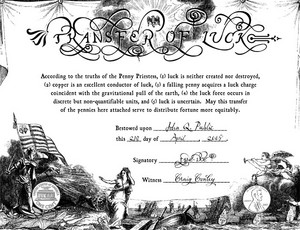
If you've stumbled upon a lucky penny and have a friend who may be down on his or her luck, print out our free, personalized Transfer of Luck Certificate (inspired by the Lucky Penny web site). Rendered in fine calligraphy, the certificate is easy to generate and completely free to print in high resolution. From the certificate:According to the truths of the Penny Priestess, (1) luck is neither created nor destroyed, (2) copper is an excellent conductor of luck, (3) a falling penny acquires a luck charge coincident with the gravitational pull of the earth, (4) the luck force occurs in discrete but non-quantifiable units, and (5) luck is uncertain. May this transfer of the pennies here attached serve to distribute fortune more equitably. Create your own Luck Transfer Certificate » |
|
|
|
|
|
|
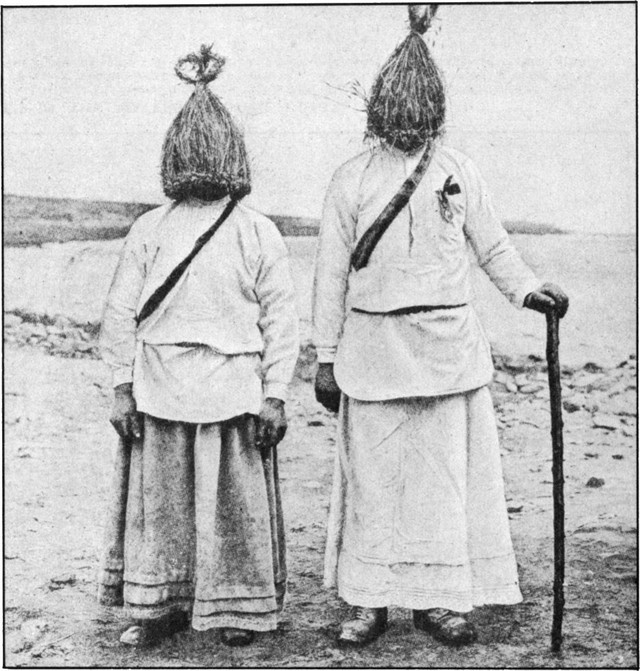
First came the mischievous Irish Straw Boys, the original party crashers. Now comes the rascally German "Zerrissen Jungen" (shredded boys), sporting masks of shredded paper.

This photo is actually by Frankfurt's Pixelgarten. We made up the stuff about "Zerrissen Jungen."
|
|
|
|
|
|
|
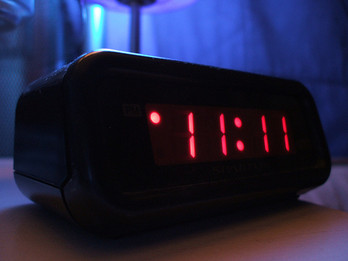
The poet Geof Huth offers this lovely commentary on why we notice and in fact need "11:11": 11:11 At certain points in measured time, the world seems to come into alignment, concepts tend to clarify, ideas gel. But we know in our hearts that this is false, that midnight is as meaningless a concept as the idea that a new year begins at a certain second after a particular midnight. We cannot believe fully in these ideas because we understand that we worship and are guided by arbitrary signs created by humans: sequences of numbers, sounds, or letters. ||:|| But we continue to follow these signs because they direct our lives so well. Their meaningless is the source of their meaning and their power. We imbue them with their significance, so we believe them. Even if they become twisted out of shape, we continue to believe them, we continue to see them, we continue to understand them. |||| We can reduce the information in a sign and still be able to read it, still be able to make sense of it, to add sense to it. We do this to eradicate ambiguity, to make sense. The world is a mass of contradictory signs, so we must choose the ones to read, how to read them, the ones to believe. :::: In the end, we have only ourselves to blame. We look for symmetry. It pleases us. That is what we like about architecture, a metrical poem, crossword puzzles, seemingly deft plotting in a story. And the only thing that makes the asymmetrical interesting is that it runs counter to an existing symmetry. We need symmetry. We need symmetry to give beauty to the surprisingly asymmetrical. .... We need 11:11 to find ourselves an idea to play with. We need 11:11 to feel our lives are temporarily in balance. We need 11:11 to feel human. Without 11:11, the world just runs away from us, untamed, untameable, even unsought. ---------- Sexy Girl responds: 11:11 is my fav time. To me it represents dimensional unity... like playing two octaves at once on the piano. Same but different. Somehow the harmonious moment is magnified when the two are played as one. Kinda like love relationships are meant to be ... yeah.
|
|
|
|
|
|
|
by jovikeThe Little-Known Meanings of Crazy Color NamesColors with seemingly incomprehensible names actually tell fascinating and humorous stories, at least to those who are willing to delve beneath the surface. Join me on a strange and wonderful adventure into the uncharted fringes of language, where we'll discover new "shades of meaning." The chilly blue color called brrrrrrr refers to the "Official State Motto of Alaska," according to humorist Dave Barry (Dave Barry’s Only Travel Guide You’ll Ever Need). 

by Dalephonics
With an additional "r," the watery color called brrrrrrrr conjures up the sound of someone shaking water out of his or her ears after crawling out from under a waterfall, as in Sacred Journey of the Peaceful Warrior by Dan Millman. 
The green color called bbbbbb echoes a vocal imitation of "a sailing boat in a tub of water," as discussed in Baby Talk: The Art of Communicating with Infants and Toddlers by Monica Devine. 
The orange color called "bssss bssss" refers to the German word for the buzzing of a bee. 
The electric green color called bzzt recalls the crackle of a security spotlight turning on, as in Revenge of the Lawn Gnomes by Teddy Marguiles. 
The bright yellow color called bzzz refers to a deliberately mumbled word, due to passive-aggression (Nancy Scheper-Hughes, Saints, Scholars, and Schizophrenics: Mental Illness in Rural Ireland, Twentieth Anniversary Edition). 
The sanguine color called ccc echoes an ambiguous sound made by someone paralyzed with fear, as in the novel Theo Slugg in Low Spirits by Simon Goswell. 
The tawny color called chchch refers to a sound that Guatemalan village children make to get attention (Jason A. Lubam, “Diary of a Jungle Acupuncturist,” Acupuncture Today). 
With an additional "ch," the smoky purple color called chchchch refers to a French word for musical percussion lacking a definite note (fr.AudioFanzine.com). 
Add yet another "ch," and the golden color called chchchchch echoes the “guttural unvoiced growl” of a tiger (Metamorphosism.com). 
All of these color name insights are derived from my Dictionary of Improbable Words, which is available for online reading. [Read the entire article in my guest blog at ColourLovers.com.]
|
Page 170 of 177
> Older Entries...
Original Content Copyright © 2026 by Craig Conley. All rights reserved.
|