I Found a Penny Today, So Here's a Thought
|
|
|
 |
 |
 |
From our outpost at Spacey Panda Music:
Art Requires THIS Sort of Sacrifice?
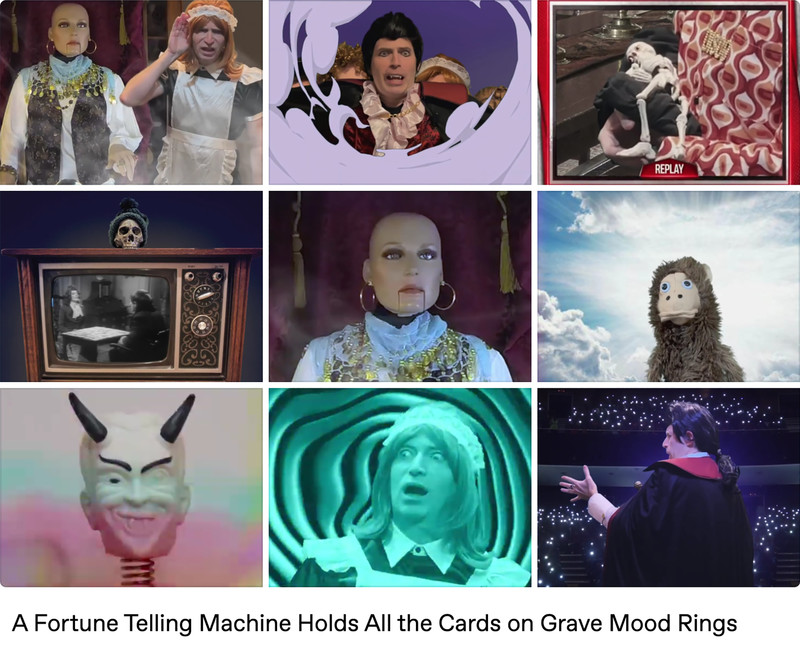
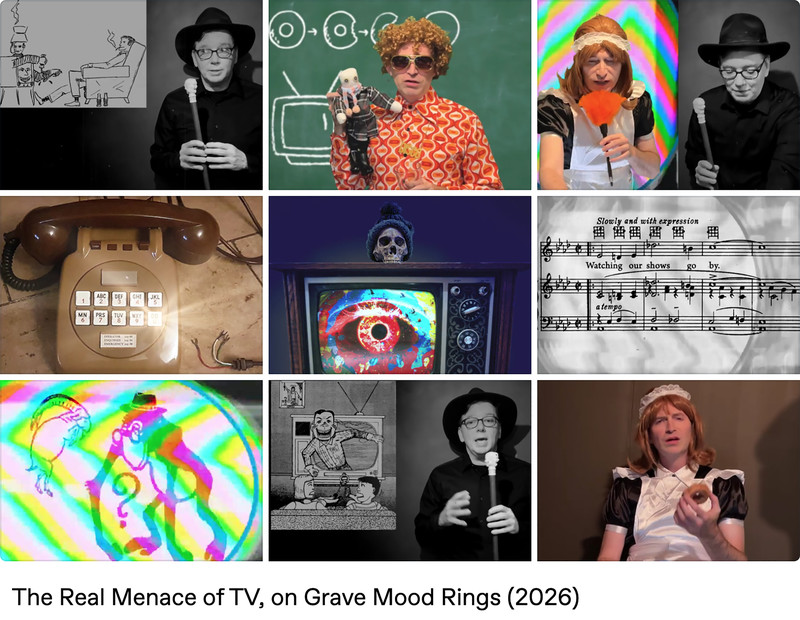
There's a Japanese legend about a cursed flute. It makes its player a gifted musician, but the price of the flute's magic is blood sacrifices. Does all art require burnt offerings of some sort? Close to home, my Grave Mood Rings series essentially took as a sacrifice a close acquaintance of several decades who outright cancelled our connection over communication differences. Could something similar be happening with people who "ghost" fellow artists? We try to make connections in relation to our art, and sometimes those attempts create ghosts as if the art took a sacrifice. Making art fine-tunes one's frequency, so we are bound to encounter more and more ghosts as we focus beyond those at other frequencies. Thing is, people on other frequencies literally can't understand or even see us. It's like the ending of the first Silent Hill film — Rose is trying to call her husband, and his phone even rings, but he can't hear her voice through the static because she's on another plane of existence. When we lose friends or go off someone's radar, we might flip our interpretation and take it as a badge of honor, for it proves that our own frequency has risen beyond them. Consider a mountain metaphor — when you're standing on a mountaintop, you can see down to those who are lower than you, but from their angle they can't see where you're standing. Maybe they can sort of hear you calling down, but there will be a weird echo and they probably won't understand. It's nothing personal, even though it can feel totally personal.
So when someone ghosts us, can't we say to ourselves, "Another sacrifice to the art, and the art feeds and grows"? Just imagine a Japanese-style bulletin board of people's faces, with red streaks of paint crossing them off along the way. Nobody promised it would be pretty, right?
Speaking of ghosts, should we ourselves operate more as if we are spirits in this world, not expecting to be seen or understood but seeking to materialize our miracles to the wonderment and confusion of others? Why try to get caught up in the all-too-human popularity game when one's frequency is literally above all that? Granted, we require at least some amount of money to survive, and we surely wish for sets of eyes and ears to take in our work, but just think of the horror of appealing to the lowest common denominator! Let's focus on finding a refined, rarefied audience. As my magic teacher, the thrice-great Eugene Burger, suggested, "Always speak to the smartest person who might be in the audience."
Artists seem doomed to handle ruining blows. Just yesterday, I felt devastated after receiving a measly 45 cents on a $40 sale of a Tarot deck I created. So I had to employ that esoteric practice of seeing things in a new and truer way by flipping them upside down and backwards. That 45 cents can be viewed not as a defeat but as a personal victory. The 45 cents shows just how terrified the Archons are of artists, which proves how important art actually is. My art is so priceless that the printing company didn't even know how to begin paying me for it. The Archons want to obliterate art, to make artists doubt their worth and to give up trying, so this 45 cents is the perfect reminder never to give up and never to let them win. The number 45 recalls an old 45 record, which is a "single" ... so perhaps I'm symbolically being reminded that I'm a singularity?
Onward and upward, I'm Prof. Oddfellow.
|

 |
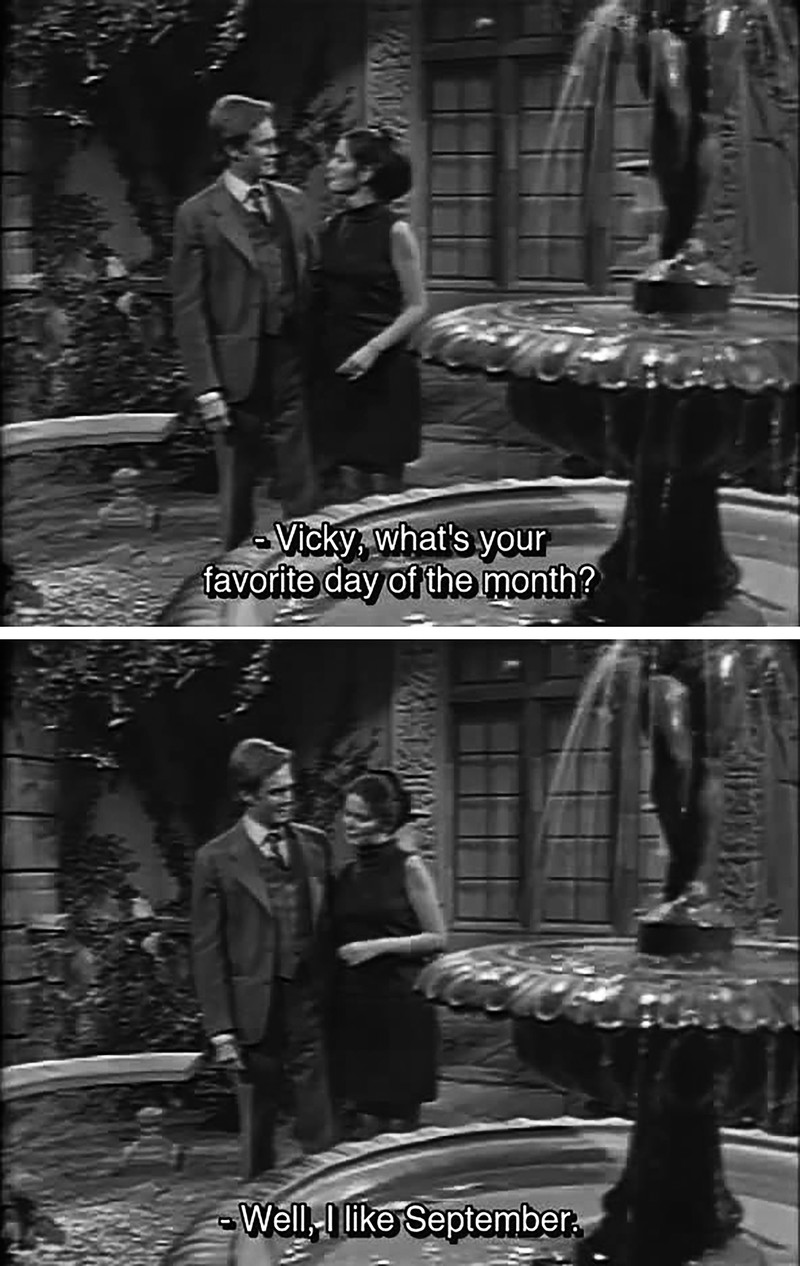
"I mean send her back to the dark hell she came from." From Dark Shadows episode 711.
|


 |
Imagine having a glamour shot of your first pizza of many. From The Romulus Roman, 1976.
|


 |
|
|
 |
 |
 |
From our outpost at Spacey Panda Music:
What in Tarnation is a Psychotronic Squirt Gun?
A musician's unique handle popped up in a Discord group, and I've rarely clicked on a profile so fast. "Psychotronic Squirt Gun." What an intriguing name, implying mentally-controlled technologies in which one's consciousness manipulates electromagnetic fields, but playfully. I knew in an instant that this artist was "aiming" to connect his "tech" with listeners, and that he'd likely be addressing absorbing, fringe topics like parapsychology, mentalism, the bio-plasmic energy devices of radionics, mind disciplines such as meditation... all presumably with a lighthearted science fiction flair. The squirt gun of his title seemed to promise, "Let's play together; you might get 'touched' by what I'm sending out; you might feel something; but it'll be harmless; nobody will get hurt, and it's a sort of game in which we'll share an experience and maybe even hone some skills." Yeah, I got all that (and more) before I even clicked the profile. I was already thinking, "This artist is very smart."
Turns out this artist, whose name is Aaron, has over many years been crafting a giant science fiction epic in which nearly a dozen characters' perspectives interweave. At least one of the ways Aaron has chosen to share his characters and stories is via hundreds of songs in a range of genres (indie rock, psychedelic, punk, darkwave, progressive, and chill, to name but half a dozen styles). As a fellow very prolific artist, I relate to and applaud this approach, but what truly impresses is Aaron's very smart songwriting technique. Following is how I've reverse-engineered what he's doing.
To introduce a new character to his listenership, Aaron presumably opens his heavy sheaf of story notes or completed novel to a pertinent chapter and then looks for just one or two sentences that constitute a crucial turning point, a moment after which nothing will ever be the same in that character's life. He then further distills those thoughts into highly concise, poetic lyrics and sets them to music. It's the disciplined editorial work that shines and gives Aaron's songwriting its signature. He doesn't dump an overly complicated narrative or character backstory into a single song. Aaron is playing the long game and can afford to take his time, to choose his information carefully, and to walk with his listeners at a comfortable pace. He hones in on motivations and tactics. For example, in one song, a character named Daisy experiences a psychic intrusion apparently with the objective of stopping her from helping others, and Aaron elegantly addresses how she calmly grounds herself so as to regain her equilibrium. A simple event is identified and the character's strategic goal, like "resilience" in this case, is explored.
Aaron has discovered and fine-tuned a very smart way to tell a story, and he takes tremendous pains to ensure that what he's expressing is accessible, via live videos addressing each song, formal music video presentations, and detailed summaries everywhere a song appears that identify the character in question and the chapter or part of the story arc being told. Aaron's clear intention is that no single listener will ever feel lost or confused, so he does what must be done to accomplish that with zero tolerance for failure. He has chosen as a sort of slogan, "Music first; meaning underneath," another example of his knack for poetic refinement.
The heart, brains, friendliness and generosity of the Psychotronic Squirt Gun universe spans over a dozen platforms, linked here: https://linktr.ee/aaron_is_psychotronic
|


 |
|
|
 |
 |
 |
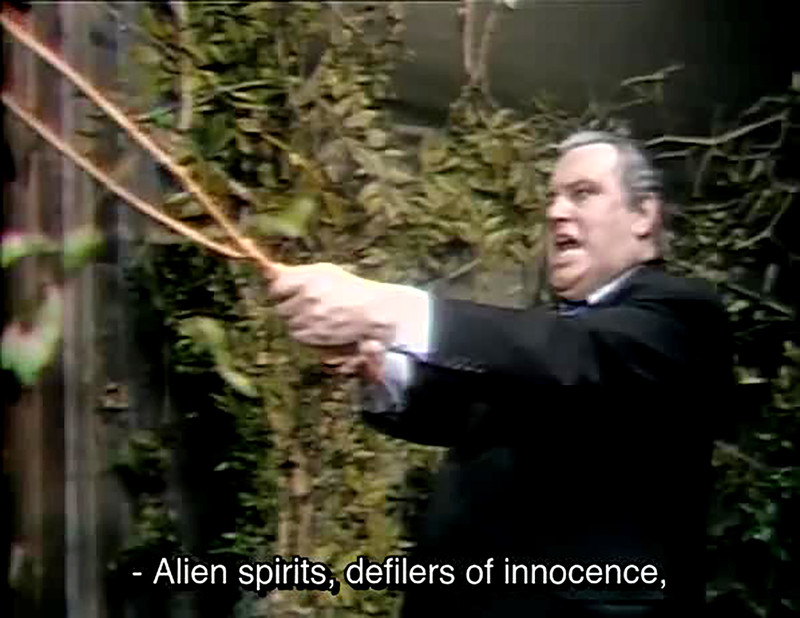
"It's quiet. Except the wind, which is always saying strange things." From Canada's answer to Dark Shadows, Strange Paradise episode 5.
|


 |
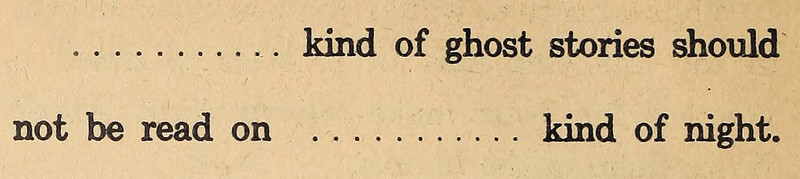
"A cat may have nine lives but it takes a frog to croak every night." From Toike Oike, 1946.
|


Page 22 of 173

> Older Entries...

Original Content Copyright © 2026 by Craig Conley. All rights reserved.
|