|
|
|
|
|
|
Thanks to Tom Sarbeck for saying this of our hard-to-find dictionary of one-letter words:
Compiler Craig Conley says, "In Shakespeare's time, R was called littera canina, 'the dog's letter,' because it sounded like a dog's growl."
There may be word lovers who won't read stuff like that; I'm not one of them.
Conley provided me with more motivation to buy his dictionary's Kindle edition; he said that since he wrote its first edition he hasn't had to buy a single drink.
|
|
|
|
|
|
|
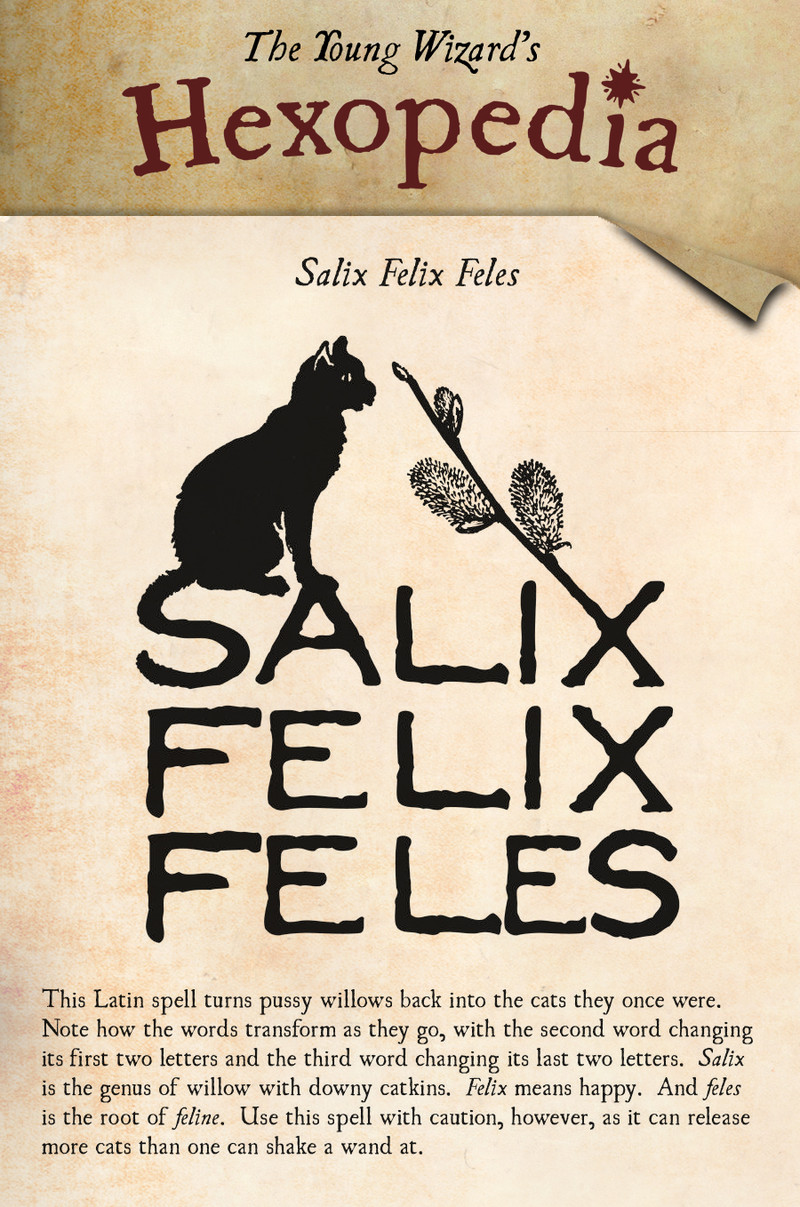
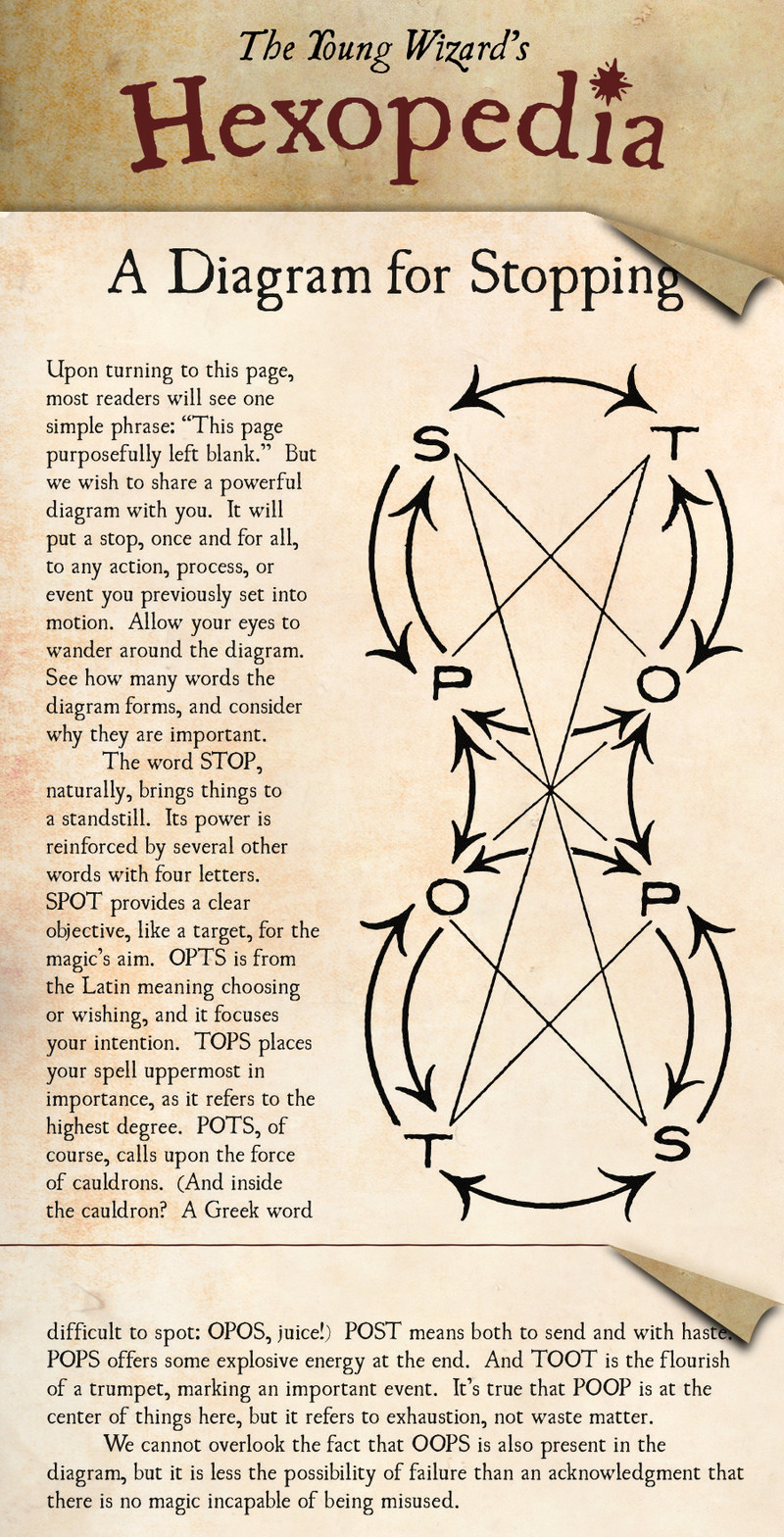
The story of how The Young Wizard's Hexopedia came to be is just about as unlikely as the book itself. One November morning, a stranger wrote from out of the blue, asking for assistance with an extraordinary book of magic. The stranger turned out to be the CEO of a publishing house specializing in the world's quirkiest subject matter, in search of a grimoire that didn't technically exist. His own research had somehow determined that I was the one with the know-how to bring this lost book back from the depths. It seems that he had seen a window display of an esoteric bookshop and had noticed that the lost book in question wasn't there. The problem was that no surviving copies of the book are known to exist. My task was to rediscover and recreate the entire document from quotations and implications in magical literature. The stranger provided me with some crucial scraps, trusting that the whole work might be holographically contained within the parts. Knowing the title and a rough idea of the table of contents, I set to work hunting through cryptic volumes in private libraries of magic (whose locations I'm not at liberty to reveal, though I can say that I visited Hollywood's Magic Castle). Suffice it to say, I left no philosopher's stone unturned. The process was very much like putting together a jigsaw puzzle in a dark room, with only a flickering candle for illumination. To my own surprise, the lost book began taking shape almost immediately. Restoring fragments into sentences and arranging them into paragraphs proved less challenging than one might suppose. For example, you can surely divine what the last word of this sentence will [...]. Whenever a passage seemed to have something almost tangibly missing, like the absence of a vital book in an esoteric shop window, I knew to keep digging. The moment it was clear that the entire Hexopedia was restored, I verified the accuracy of my work with three highly gifted wizards of words: a playwright in New Hampshire, a poet in Pennsylvania, and a teacher of magical arts in Nevada. Then I sent the restoration to the stranger, who flabbergasted me by suggesting that the book should not come back into print at all but rather remain hidden in shadowy slumber until a more enlightened era. (Apparently the trickster merely desired a copy for his personal use!) Having worked so intimately with the text for so long, I felt convinced that the world was ready once again for the Hexopedia ... that it shouldn't rest only in the private library of one megalomaniacal* publisher. And the rest, as the former, is history. Here's a random page from The Young Wizard's Hexopedia.
*Note that "megalomaniacal" is an anagram of "ole magi almanac," so it all seems to be part of some mysterious tapestry, eh?
|
|
|
|
|
|
|
The Surprising Meanings of the All-Vowel Word OOO in the Televisual Treasure Kamen Rider OOO
Arguably the greatest television show ever fashioned (but unfairly obscure outside its native Japan), Kamen Rider OOO (2010-11) charms from moment one with the intriguing word "OOO" in its title. This all-vowel word has a surprisingly diverse array of meanings within the context of the series. In no particular order:
- infinity with an additional circle or infinity times the letter O (as written in cake icing in episode one of the series; referred to in the theme song as "Skip the addition—multiply your way up").
- the unstoppable progression of the idiom "anything goes" (referred to in the theme song as "Anything goes, goes on: ooo's, ooo's, ooo's, ooo's").
- one thousand (the letter O's symbolizing zeros, as the series sports the one-thousandth episode of the Kamen Rider franchise).
- three medallions (referring to an ancient coin-shaped technology for artificial life that acquired consciousness; the three coins are inserted into the hero's belt to trigger a transformation).
- the name of a masked hero (sometimes also spelled Os, pronounced like the oes in goes).
- multiple kings (from the Japanese pronounciation Ozu).
- a joyous bouquet (an allusion to the idiom that "everything is coming up roses," referred to in the theme song as "Coming up OOO").
- the "three of pentacles" in the Tarot (symbolizing coordinating with others, finding all the needed elements, functioning as a unit, cooperating, meeting goals, knowing what to do and how to do it, and proving one's ability, as per Learn Tarot).
- rarity (as in the old Celtic "Chant of Arcady" sung at harvest gatherings: "I'll sing the three O's. What means the three O's? Three, three's the rare O!" —A. S. Harvey, Ballads, Songs and Rhymes of East Anglia, 1936, page 107).
- a winning move ("A single line of three 'O's is worth more than anything because a move that produces this result is a winning move!" —Mike James, Artificial Intelligence in Basic, page 30).
- omnipotence, omniscience, and optimization ("The three O's, omnipotence, omniscience, and optimization ... continue to appear in modern times in the way we conceive of ourselves through the social sciences. Mortal beings figuring out how to act in the world are routinely modeled as if they have unlimited computational power, possess complete information about their situation, and compute the optimal plan of action to take." —Peter M. Todd & Gerd Gigerenzer, Ecological Rationality: Intelligence in the World, pp. 496-7).
- outflanked, outfoxed, overwhelmed ("The 'Three O's': a defence must be either Outflanked, Outfoxed, or Overwhelmed." —Current Research on Peace and Violence, 1987, page 129).
- continual practice ("Whenever anyone asks why our name is spelled with three O's, we remind them that to be good at picking there is no other path than to practice Over and Over and Over again." —Deviant Ollam, Practical Lock Picking, 2012, page xi).
- the possibility of different combinations ("The three O's tempt the reader to explore the possibilities of different combinations." —Guillaume Apollinaire & Anne Hyde Greet, Calligrammes, 1908, page 407).
- decimalization ("For every three O's added to the given number, we shall have one place of decimals. And, in general, since the nth power of ten has no O's we shall always have, in extracting the nth root, one place of decimals for every n O's added to the given number." —Silas Totten, A New Introduction to the Science of Algebra, 1836, page 225).
- a belt, as in the three stars of the constellation Orion. ("The three o's [are part of a] densely woven mesh of triplets [that] constellates this moving poetic object." —Michael Golston, Poetic Machinations, 2015).
- rising to a challenge ("As soon as the ball is served, the three O's come out to challenge." —Jacob Daniel, The Complete Guide to Coaching Soccer Systems and Tactics, 2004).
- seizing the day; embracing the world ("The three o's are a circular microcosm of the day, or, of the world." —Robert Greer Cohn, The Poetry of Rimbaud, page 60).
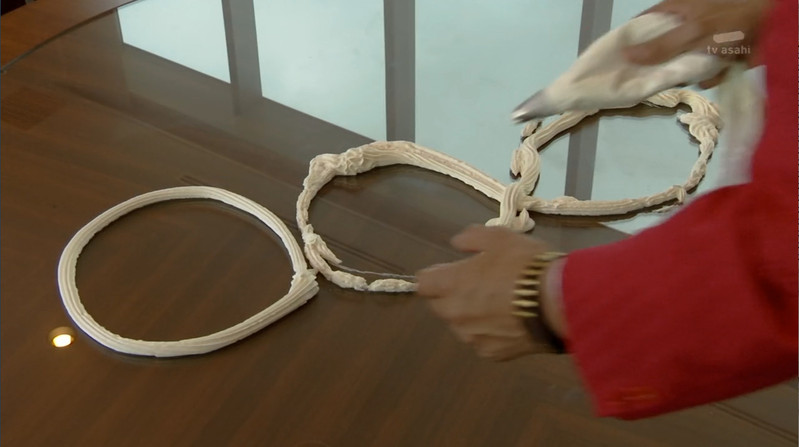
The letter O and the lemniscate form the all-vowel word OOO in Kamen Rider OOO.
|
|
|
|
|
|
|
This David Lynchian Ricky Board is in honor of Gary Barwin, author of Yiddish for Pirates (Random House Canada, 2016), though it is technically a self-portrait by proxy. We'll include Lynch's instructions for making a Ricky Board below (and yes, we realize we violated Lynch's size constraint).
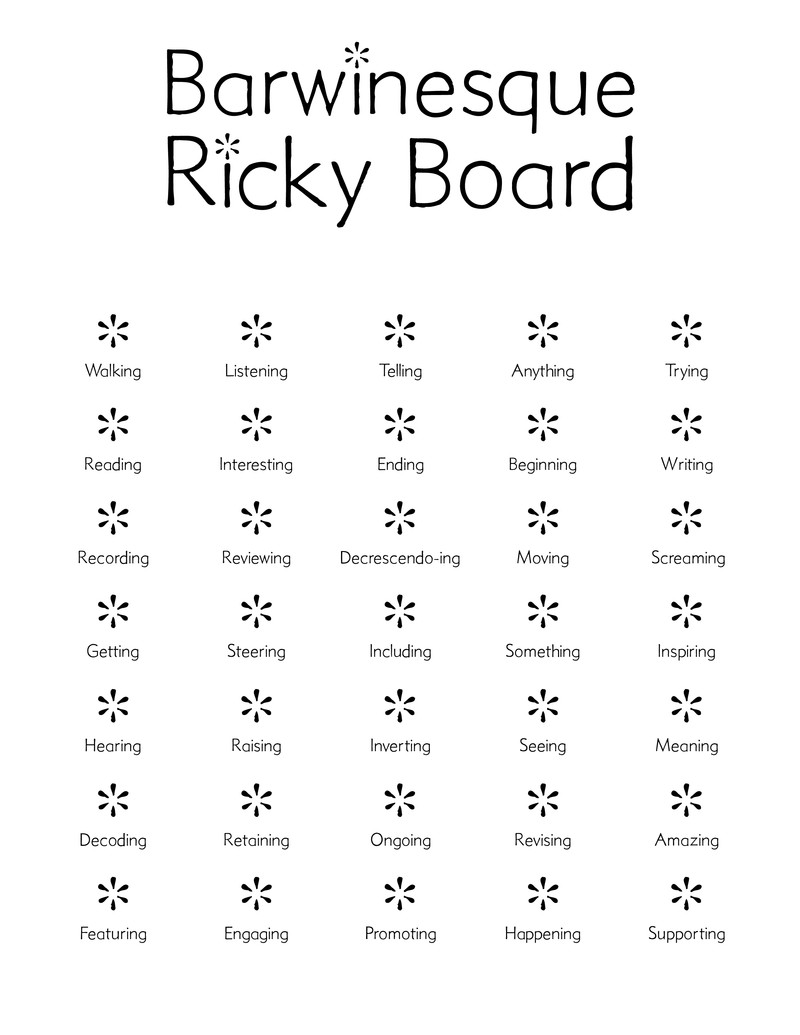
—How To Make A Ricky Board—
by David Lynch
This board can be any size you want.
The proportions are dictated by four rows of five rickies.
Each ricky is, as nearly as possible, exactly the same as every other ricky.
The ricky can be an object or a flat image.
The thing about the rickies is you will see them change before your eyes because you will give each ricky a different name.
The names will be printed or written under each ricky. Twenty different names in all.
You will be amazed at the different personalities that emerge depending on the names you give.
Here is a poem:
Four rows of five
Your rickies come alive
Twenty is plenty
It isn’t tricky
Just name each ricky
Even though they’re all the same
The change comes from the name
|
|
|
|
|
|
|
Thanks to Mike Kloran (author of Zombies: The Stinking Dead) for his review of our dictionary of One-Letter Words: "It’s a fun little piece that looks at all the many ways a single letter may be used as a unit of thought, or as we usually call them, words. And we’re not just talking about the article 'a' or the pronoun 'I.' No no. We’re talking about how all the letters of the alphabet have been used as words throughout literature. ... A really fun way to look at the language in a fresh light, even for tired teachers like you and me." |
|
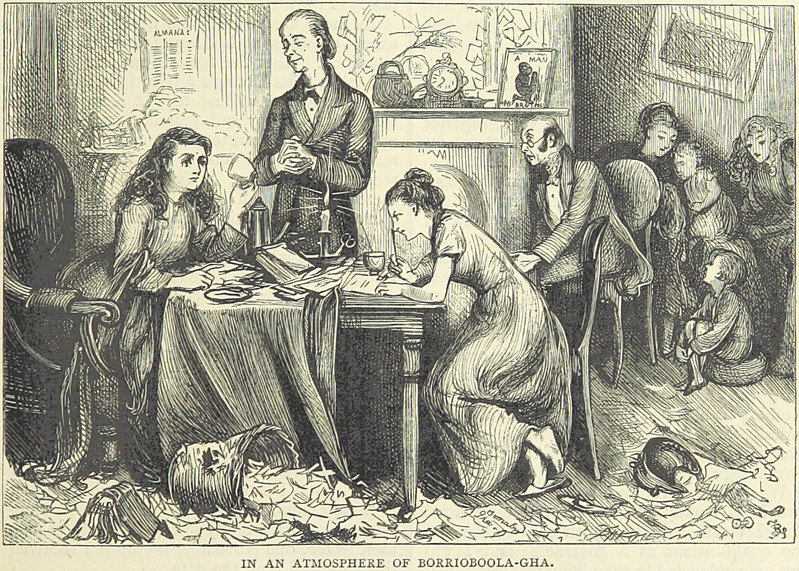
"In an atmosphere of Borrioboola-gha." From Bleak House by Charles Dickens. |
Page 53 of 75
> Older Entries...
Original Content Copyright © 2026 by Craig Conley. All rights reserved.
|