|
|
 |
|
|
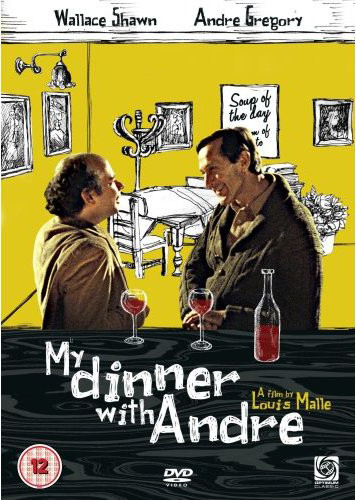
Looks like the artist for a new British release of My Dinner with Andre misread "dinner" as "diner." There's certainly no "Soup of the Day" sign at the swanky restaurant in the film! And that coat check lady looks as thin as a rail! |
|
|
|
|
|
|
"I rather enjoy that sense of bewilderment a novel gives you when you start reading it, but if the first effect is fog, I'm afraid the moment the fog lifts my pleasure in reading will be lost, too." — Italo Calvino, If On a Winter's Night a Traveler (Why not mention again how marvelous this book is?!)
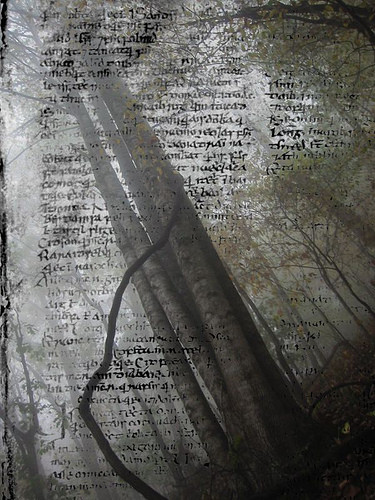
"The Ancient Irish Epic Tale," created by stephanie.
|
|
|
|
|
|
|
We stumbled upon a spooky yet poetic mention of one-letter words in an article about brainstorming for graphic designers: [J]ot down some one letter words that best describe your idea.
For example: sunset, skeleton, dark and death.
Sunset, skeleton, dark, and death. Are these truly one-letter words? (Delightful of you to ask, by the way!) They are, indeed!
Sunsets recall more than a single one-letter word: While the French poet Victor Hugo famously said that "O is the sun," astronomers use a different one-letter word to designate the class of yellow stars to which our sun belongs: G. Additionally, in the ionosphere, the E layer develops around sunset, at an altitude of 90-130km.
Skeletons recall the letter R. In organic chemistry, "The letter R represents the carbon skeleton of the molecule" (Gerard Tortora, Principles of Anatomy and Physiology, 2005). And novelist William Gibson has noted "the color of glow-in-the-dark toy skeletons, each with its own iconic M" (Pattern Recognition, 2003).
Darkness recalls M, a state of deep, dreamless sleep in which consciousness is "lost in darkness" (Joseph Campbell, The Mythic Image, 1974). Poet Tom Sleigh describes an injured driver's face, "each eye / an x of darkness" ("The Wreck," The Dreamhouse, 1999).
Death recalls Z, as in Arnold Yarrow's Death is a Z (1978). It also recalls O, as in cultural theorist Earl Jackson, Jr.'s "big O of death" (Strategies of Deviance, 1995).
Sunset, skeleton, dark, and death: all highly evocative definitions of our ABCs!
|
|
|
|
|
|
|
"Literature's worth lies in its power of mystification, in mystification it has its truth; therefore a fake [i.e., a counterfeit of an author's work], as the mystification of a mystification, is tantamount to a truth squared." — Italo Calvino, If On a Winter's Night a Traveler (Such an extraordinary book!) |
|
|
|
|
|
|
From our Magic Words outpost at Blogger: "'Creation,' like 'creative,' is one of those hypnotic words which are
prone to cast a spell upon the understanding and dissolve our thinking
into a haze. And out of this nebulous state of the intellect springs a
strange but widely prevalent idea. The shaping spirit of imagination
sits aloof, like God as he is commonly conceived, creating in some
thaumaturgic fashion out of nothing its visionary world. That and that
only is deemed to be 'originality'—that, and not the imperial moulding
of old matter into imperishably new forms. The ways of creation are
wrapt in mystery; we may only marvel, and bow the head." — John Livingston Lowes, The Road to Xanadu, 1927 |
|
|
|
|
|
|
Our dictionary of Magic Words has garnered five new reviews: Magic Words is more than a dictionary - it is an impassioned call to writers, magicians and laypeople to bring magic back into their vocabulary. It is, in fact, an incantation calling forth the demons hidden within our speech, and no reader will finish this book without succumbing to its spell. Let there be no doubt about it: Conley is on a mission to promote literacy, and his love of words possesses the cabbalistic reverence of an alchemist in pursuit of gold. For it is in the meaning of each word, of each letter of each word, that we discover the mysterious powers of language - or, as the author puts it, it is the inherent enchantment of the word that gives literature its magical influence. And this book will influence you in a most magical way. —Anthony Marais, author of The Cure--- Words are inherently magical for the writer—also frustrating, obtuse, enchanting and expressive in various moments and times. We struggle with them, delight in them, and weave them together to form significant combinations. Dictionaries are our friends, lists of synonyms our best buddies, and there are many of us who take simple delight in the well-turned phrase. Craig Conley has given us a gift beyond regard: a dictionary of 720 of the words used by (stage) magicians throughout the ages. Who can forget the shiver of delight we felt when hearing "open sesame" in the tale of Ali Baba and the 40 Thieves? Or the eternal Abracadabra! and Hocus Pocus? Now we know where they originated, with their meanings, in combinations, and source material. But this is no common dictionary! Conley clearly loves words. "Hocus Pocus: These primal, rhyming syllables echo the transcendental incantations of Latin rites, reverberating through hallowed cloisters. They invoke an ancient, unworldly power, especially when enunciated slowly and authoritatively." (p. 327) Highly recommended for anyone with a taste for words. —Lisa Mc Sherry, Facing North--- This 352 page dictionary of magic words was a real hoot to review, I had a blast just thumbing through the pages and learning about myths, origins, trivia and other cool stuff. I even learned how to summon zombies and bring big changes into my life. I also found the illustrations and icons to be very helpful with the process. I must tell you I knew of some magic words from books and movies, but I never imagined there were so many and even how they came to be in the first place. I think this voluminous teacher will go a long way in helping anyone broaden their horizons. I would recommend it to those who enjoy learning. Thanks Craig, for the interesting and informative experience. —Riki Frahmann, Mystic Living Today--- I just got "Magic Words: A Dictionary." What fun! Magic words taken from literature, plays, movies; all the way from Ovid to Shakespeare to Ronald Hutton to J.K. Rowling! Each word is presented as a word (with variations, if any) and then in a quote, and then meanings are given from many historical sources. It would be interesting to sprinkle them in my conversation or journal writing or even for magic! Alakazam and abracadabra and hocus pocus, but also Hola Noa Massa, and Lit Flitt Latt Flight, and Shubismack. They are even just fun to say. There is also an Appendix of "magic words" used by people in various professions - "action" for movies, "troubleshoot" for computer technicians. — Chela's Amazon.com review --- Any interested in the words and philosophy of Wicca and magic will find Magic Words
a fascinating dictionary packed with magic words and phrases from
around the world. Over seven hundred essay-style entries probe the
origins of magical words, their history, and their variations. Sources
range from ancient Medieval alchemists to modern necromancers and
magical legends, making for a fine trivia and study reference.
—Diane C. Donovan, California Bookwatch |
|
|
|
|
|
|
Did you know that International Swear Like Shakespeare Day is Nov. 27, 2009? We're honored to announce that SwearLikeShakespeare.com is featuring our illustration of curses of Shakespearean proportions. If an infinite number of monkeys type for an infinite amount of time, will they will eventually produce every possible Shakespearean insult? This is our question, not Wilfried Hou Je Bek's, but he did inspire it. Here's a link to a PDF of a maledicta book produced by a group of Sulawesi Macaque monkeys: Notes Towards the Complete Words of Shakespeare. |
|
|
|
|
|
|
Writing an "abbreviated history" isn't as easy it would seem. For example: Lt. Gen. Wm. B. of LV, NV (b. '43): mia (awol?) c. '63. [42 characters] Translation: Lieutenant General William Baxter of Las Vegas, Nevada (born 1943) went missing in action (absent without leave?) circa 1963. [106 characters] The best abbreviated history we've seen has the squirm-inducing title of Castration: An Abbreviated History of Western Manhood. |
|
|
|
|
|
|
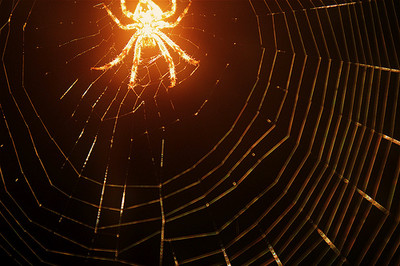
From A Surrealist Dictionary by J. Karl Bogartte: GOWN: A joyful humming sound given off by spider webs during electrical storms.
|
|
|
|
|
|
|
"You have with you the book you were reading ... which you are eager to continue, so that you can then hand it on to her, to communicate again with her through the channel dug by others' words, which, as they are uttered by an alien voice, by the voice of that silent nobody made of ink and typographical spacing, can become yours and hers, a language, a code between the two of you, a means to exchange signals and recognize each other." — Italo Calvino, If On a Winter's Night a Traveler (We've mentioned that this book is a masterpiece, right?) |
|
|
|
|
|
|
"How to establish the exact moment in which a story begins? Everything has already begun before, the first line of the first page of every novel refers to something that has already happened outside the book. Or else the real story is the one that begins ten or a hundred pages further on, and everything that precedes it is only a prologue." — Italo Calvino, If On a Winter's Night a Traveler (We need not mention how wonderful this book is.) |
Page 64 of 75
> Older Entries...
Original Content Copyright © 2026 by Craig Conley. All rights reserved.
|