Found 379 posts tagged ‘fortune teller’ |

 |
|
Restoring the Lost Sense –
October 18, 2014 |
(permalink) |
|
 |
 |
 |
 |
| [Inexplicable images from generations ago invite us to restore the lost
sense of immediacy. We follow the founder of the Theater of
Spontaneity, Jacob Moreno, who proposed stringing together "now and then
flashes" to unfetter illusion and let imagination run free. The images
we have collected for this series came at a tremendous price, which we explained previously.] |
|

 |
|
Restoring the Lost Sense –
October 2, 2014 |
(permalink) |
|
 |
 |
 |
 |
| [Inexplicable images from generations ago invite us to restore the lost
sense of immediacy. We follow the founder of the Theater of
Spontaneity, Jacob Moreno, who proposed stringing together "now and then
flashes" to unfetter illusion and let imagination run free. The images
we have collected for this series came at a tremendous price, which we explained previously.] |
|


 |
|
Restoring the Lost Sense –
June 12, 2014 |
(permalink) |
|
 |
 |
 |
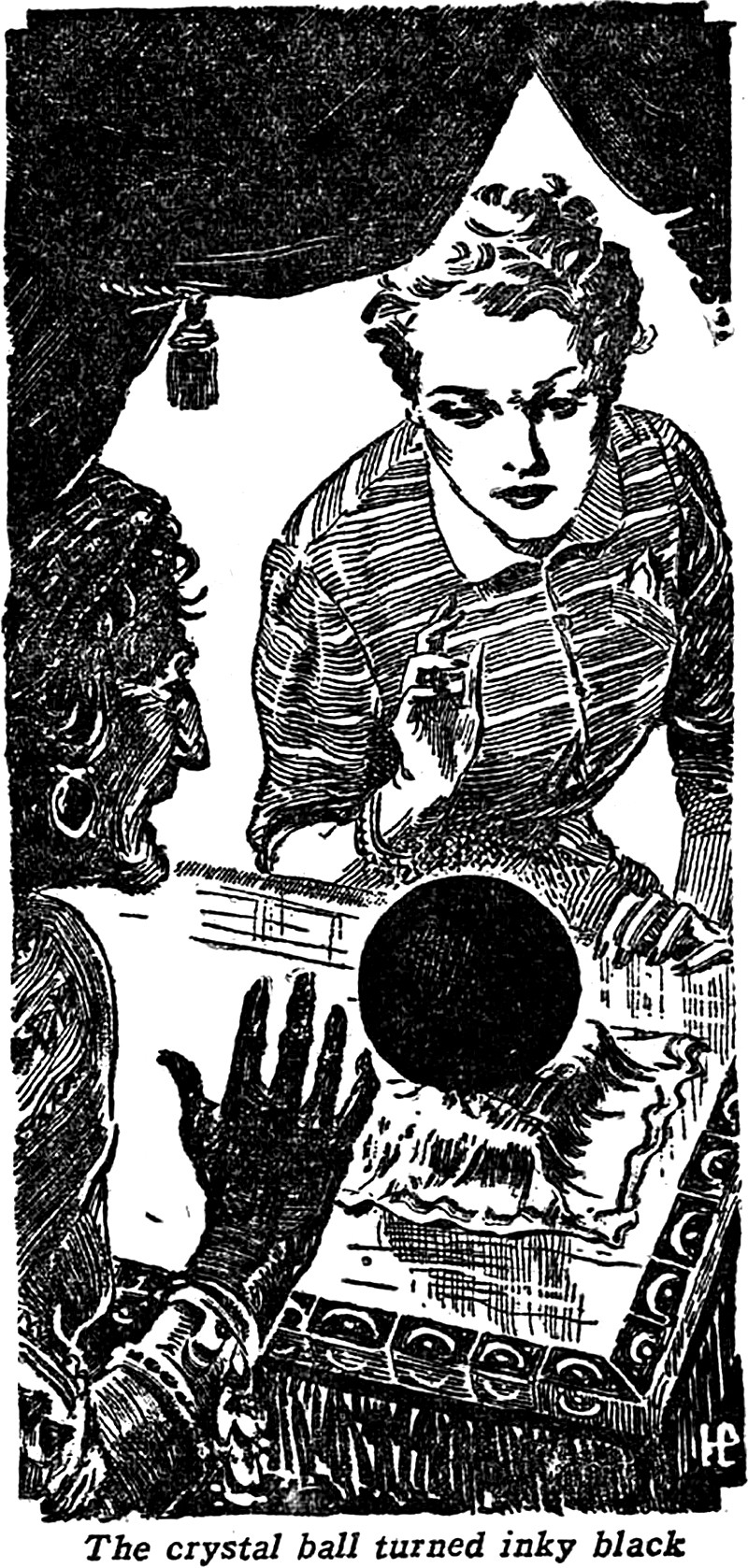
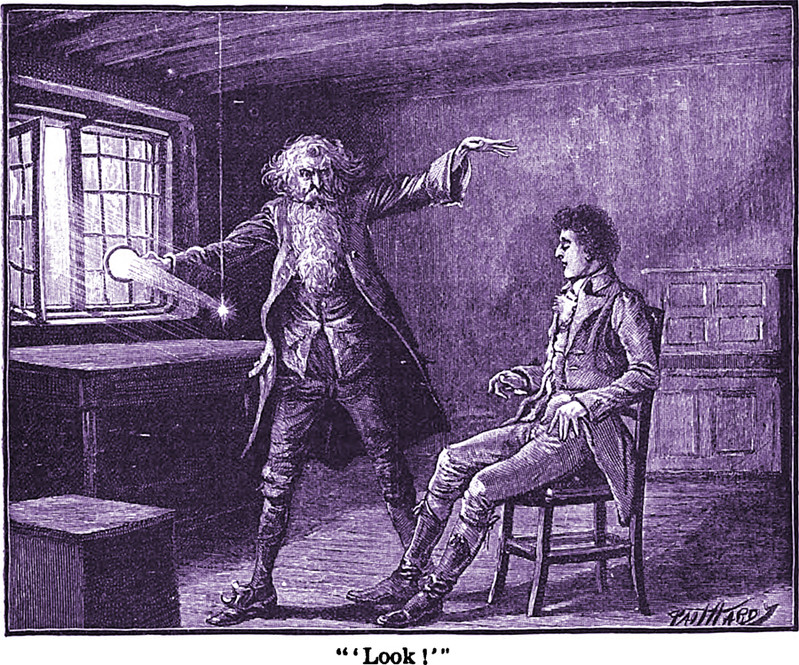
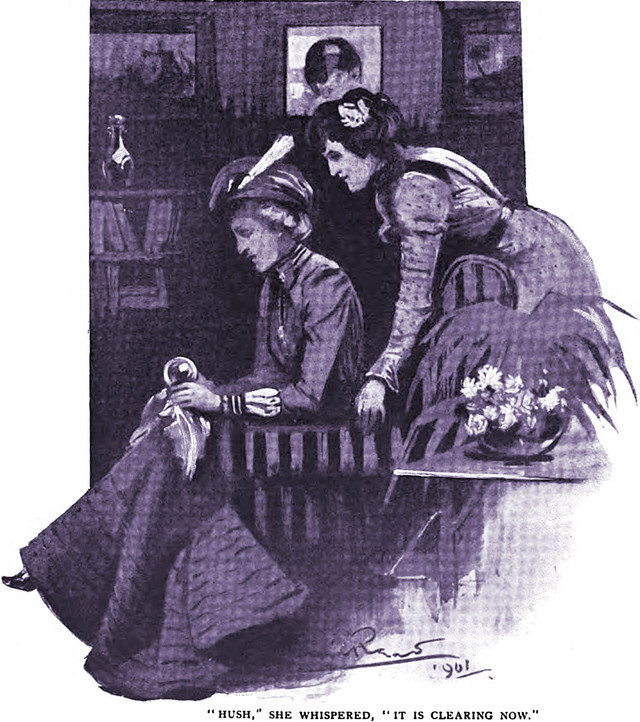
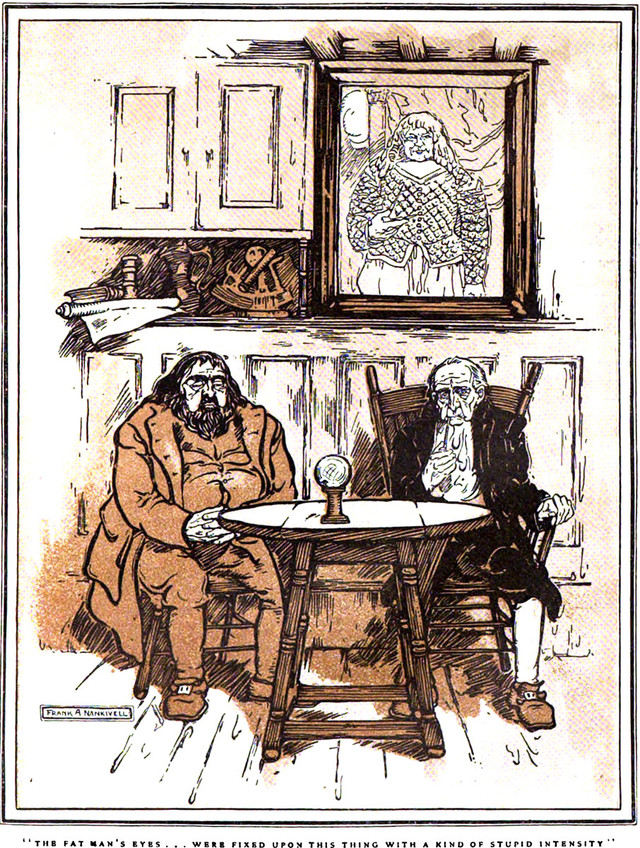
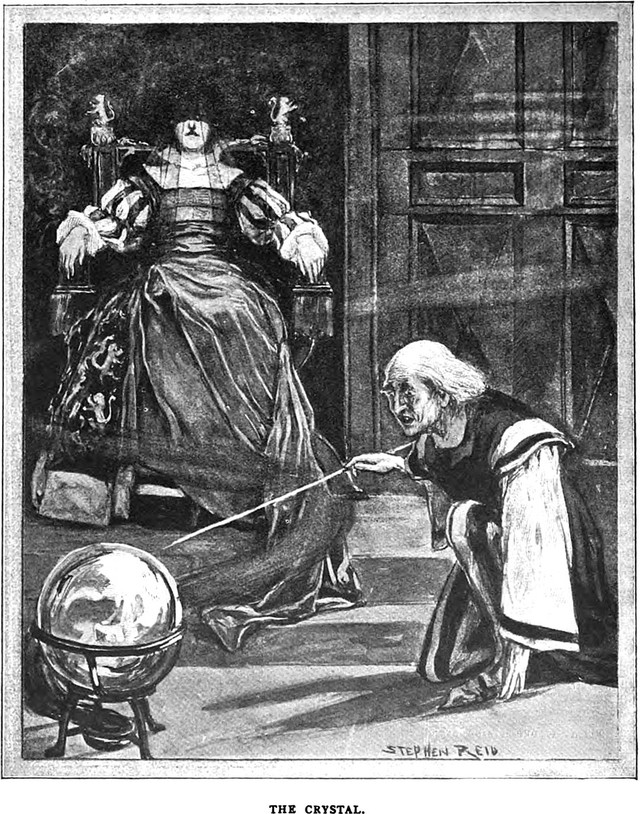
The context for this illustration is rather lovely. A Jewish mystic fixes a precious opal in a frame "not unlike that of a looking glass," hangs it on a silk thread attached to the ceiling, and then opens a window to allow in a stream of sunlight. "It was never known what the old Jew said, but he whispered to the stone just as if it could hear, and then said to his son, 'Thou seest that that crystal focuses the light from heaven, and thou seest that the focus is at the end of this silken thread. Now, this precious opal will go forth in search of truth, and it will tell thee whether this marriage, if it be undertaken, will be for thy good or not. Thou must sit with closed eyes at the other side from the crystal; the rays from the sun will fall direct upon the gem when it is at rest; then when I tell thee to open thine eyes, mark well the colour thou first seest, and, according to that, we will settle how this matter is to be.'" The mystic then swings the gem to and fro, like a pendulum, then leaves it to itself. "Gradually its oscillations became less and less, until at last, just as he was getting somewhat impatient, the young man heard a quick, sharp word, 'Look!' and he opened his eyes and fixed them upon the stone. A blue blaze of fire met his eye, blue as the heavens, bright as the sun in those heavens." Yellow would have indicated gold. Red would have been danger. Blue meant: "Prize above all its heavenly hue; It guides to what is just and true." (The Quiver, 1889, p. 871.)
 |
| [Inexplicable images from generations ago invite us to restore the lost
sense of immediacy. We follow the founder of the Theater of
Spontaneity, Jacob Moreno, who proposed stringing together "now and then
flashes" to unfetter illusion and let imagination run free. The images
we have collected for this series came at a tremendous price, which we explained previously.] |
|


 |
|
|
 |
 |
 |
Given our substantial research into esoteric tomes, we're sometimes consulted for strange and unusual magical spells. An award-winning quarterly magazine of art and culture based in New York [name withheld for reasons of discretion] once asked us for a spell to cast over their printing press. Most recently, a winner of two Gertrude Stein Awards in Innovative American Poetry [name withheld in a nod to our lost age of privacy] asked us for no fewer than thirteen different spells:
- A spell which finds and locates the source of (malicious) gossip and renders the "first tongue" of this gossip chain either serpent-like (i.e. forks the tongue) or like that of some other loathsome beast.
- A spell which will allow a refrigerator to enchant the food in it, so that when you eat the food you see the food's history (such as the worker picking the grapes. This would be quite grisly when it came to lunch meat and we realized it had a "family life.")
- A spell which will render water capable of transmitting its memories. When an enemy steps into a tub of "blissful" water, suddenly he or she is overcome with a thousand television stations of water memory, all the way back to the time of the dinosaurs.
- A spell that turns pussy willows back into the cats they once were.
- A spell which allows you to enter into a painting or use a painting, drawing, etc. as an avenue of escape.
- A spell to send snow back upwards into the sky—a reverse snowstorm spell.
- A spell whereby you can have birds carry a message to other birds to so on to other birds in order to reach someone far away.
- A spell which makes someone the reverse of a money magnet, so money is always figuratively (and literally) flying away from him or her.
- A spell to make someone fall in love with his or her own reflection. For example, a teenager cannot concentrate in class but must constantly seek a reflective surface to the point of madness. Good for a stuck up kid in school, beauty queen hex, etc.
- A spell whereby planes flying overhead will drop valuable things into your yard or on your roof, like a form of tribute from airplane.
- A spell to turn pancake batter into quicksand, so when the person eats the finished product, the pancake inside the person slowly causes the person to implode into himself/herself, vanishing throughout the day in a very geometrically weird way.
- A spell on cookies to make them like online cookies; they drop without the eater's consent and glow, leading you to the person you are trailing and to whom you have given the bewitched cookie.
- A spell to make tornados play music. Needles appears within and the tornado is turned into an old school record player even as it grinds away at a landscape.
|


 |
|
Restoring the Lost Sense –
March 2, 2013 |
(permalink) |
|
 |
 |
 |
 |
| [Inexplicable images from generations ago invite us to restore the lost
sense of immediacy. We follow the founder of the Theater of
Spontaneity, Jacob Moreno, who proposed stringing together "now and then
flashes" to unfetter illusion and let imagination run free. The images
we have collected for this series came at a tremendous price, which we explained previously.] |
|


 |
|
Images Moving Through Time –
November 30, 2010 |
(permalink) |
|
 |
 |
 |
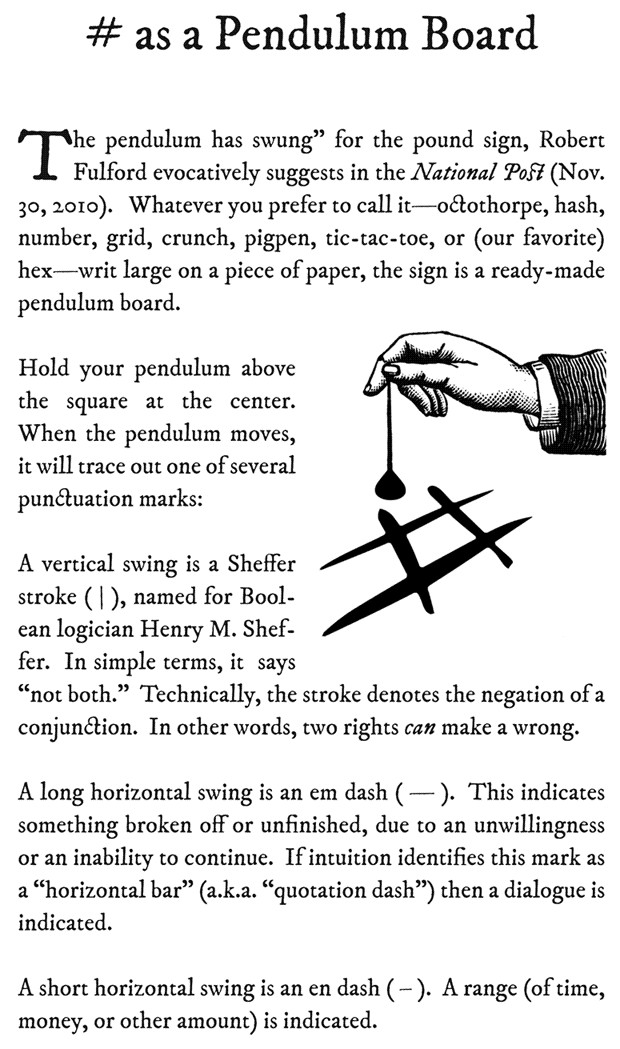
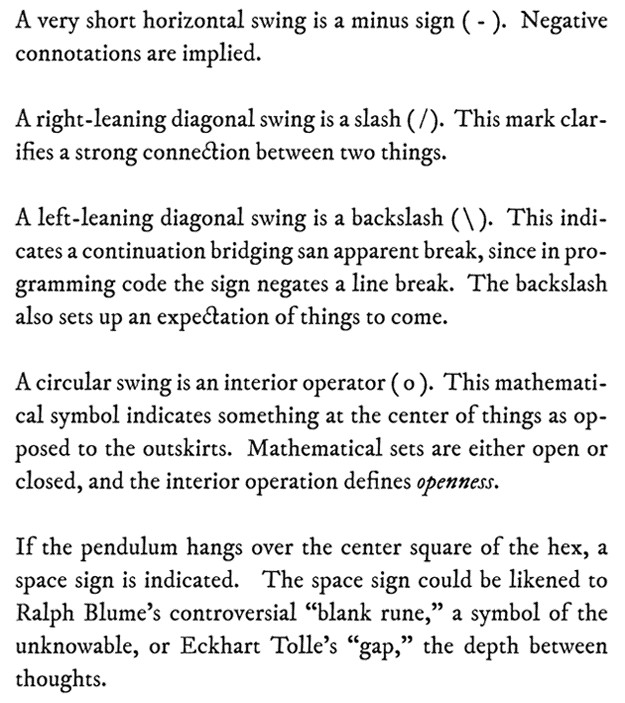
Punctuated Cloud Divination(an excerpt from our whimsical new manual on Divination by Punctuation) An ancient druidic art, divination by cloud formations offers punctuation insights on many different atmospheric levels. The little fluffy altocumulus clouds may coalesce into periods, colons, semicolons, ellipses, and quotation marks. The thin altostratus clouds may form long dashes. Airplane vapor trails and cirrocumulus clouds may form forward or back slashes. The tall cumulonimbus clouds may combine with their altocumulous cousins to form question marks or exclamation marks. The lower stratus clouds may form short dashes, while the highest cirrus wisps may form commas and parentheses. Students of art history will know that billowing punctuation figures into fifth-century Roman mosaics: "the cloud is simply a punctuation mark (a kind of parenthesis) that derives its meaning from the position that it occupies in a linear sequence” (Hubert Damisch, A Theory of Cloud, 2002). So, too, with modern cloud divination: the position of the punctuation within the hieroglyphic clouds is of vital importance. Punctuated cloud divination can be likened to Klexographie—the European parlour game that inspired Swiss psychologist Hermann Rorschach to develop his famous inkblot test. One views a cloudscape through one’s inner eye so as to unlock the wisdom of the inner voice—that primal vestige that knows the answers but doesn’t always speak loudly enough for one to hear. To begin, cast your eyes down to the ground and meditate upon your question. When the moment feels right, look up to the sky. The cloudy symbols and patterns you see will shed light upon your question. You may see multiple pictures within one cloudscape, joined or separated by punctuation icons. Do they tell a story? There’s no need to over-analyze what you see in the clouds; trust your initial responses to the images. Punctuated cloud divination speaks to your intuition, so allow your inner wisdom to pour forth. If you are uncertain of how the clouds illustrate your answer, or if you require additional insight, perform a second reading by casting your eyes downward again, allowing time for the animated cloud shapes to evolve, and then look up again. A scattering of punctuated cloud details: Apostrophe ( ’ ) If an apostrophe cloud dissipates quickly, the loss of a possession is indicated. "O little cloud of faery hue, / Wither so fast away?” (Anonymous, "An Apostrophe”). Bracket ( { ) Shaped to resemble the rounded contours of a cumulus cloud, "cloud brackets” are common architectural features in Buddhist pagodas. Comma ( , ) Cloud commas (also known as mesocyclones and hook clouds) sometimes develop eye-like features at their centers. "The cloud eye-lids that shadow / Stay not to see what will be done” (Edgar Lee Masters, "The Battle of Gettysburg”). Dash ( — ) A cloudy dash may foretell hurriedness. "The moon slowly arose, amid a fitful dash of clouds, and was no sooner from under one than she would dart beneath another” (Samuel M. Kennedy, First Loves). Ellipsis ( . . . ) Ellipsis clouds point out superfluousness: more than enough of a thing. "A few cumulus like ellipses at the horizon’s end . . .” (Christopher Buckley, How Much Earth). Exclamation Point ( ! ) The Hawaiians revere clouds as "the only animated features of the landscape, . . . ever with us.” The storm cloud is feared less than "the whirlwind with that exclamation point, the whirling chimney of red dust” (Charles Warren Stoddard, Hawaiian Life). Question Mark ( ? ) The mystic Osho considered the "immensely significant” question mark to be emblazoned "on each cloud, on each star, on each atom,” since the question mark addresses the eternal mystery of existence ( The Book of Wisdom). Semicolon ( ; ) Postmodernist author Mia Couto likens the semicolon to a raindrop "born prematurely from a cloud.” Raindrops are ephemeral links between heaven and earth; as semicolons, they highlight the fluidity of the boundary as they simultaneously connect and separate (Phillip Rothwell, A Postmodern Nationalist: Truth, Orality, and Gender in the Work of Mia Couto).
|

 |
|
Forgotten Wisdom –
December 18, 2008 |
(permalink) |
|
 |
 |
 |
"Divination explained." From Prof. Oddfellow's sketchbook:
 |
Printed collections of Forgotten Wisdom diagrams are available: Volume I from Mindful Greetings and Volumes II, III and IV from Amazon. Selected posters are also available via Zazzle. |
|


Original Content Copyright © 2025 by Craig Conley. All rights reserved.
|