Go Out in a Blaze of Glory
|

|
|
|
|
|
|
William Burroughs on fear: "Never fight fear head-on. ... Let it in and look at it. What shape is it? What color? Let it wash through you. Move back and hang on. Pretend it isn't there. Get trivial. ... There are many ways to distance yourself from fear. Keep silence and let fear talk. You will see it by what it does. Death doesn't like to be seen that close. Death must always elicit surprised recognition: 'You!' The last person you expected to see, and at the same time, who else? When de Gaulle, after an unsuccessful machine-gun attack on his car, brushed splintered glass off his shoulder and said, 'Encore!,' Death couldn't touch him." — The Western Lands
|
|
|
|
|
|
|
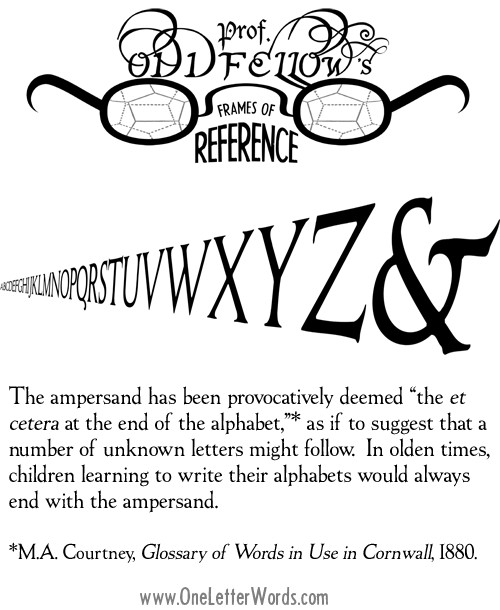
Et Ceterating the Rainbowa guest blog by the incomparable Jeff (inspired by our ampersand piece below) Aunt Blim was confused about many things, and shouldn't have been allowed near the children. Her habit of mixing metaphors—especially in combination with her disregard for syntax—was bad enough, but when I told my classmates that Goldilocks had murdered the leprechauns because they threw cold porridge in her face, I was chased around the schoolyard until I fell down. Worse, aunt Blim had been schooled during a particularly difficult period—circa 1880, according to her parrot—and so had learned to place an ampersand at the very end of the alphabet, after the letters ran out. It was a peculiar way of suggesting that more letters might follow, if only one were willing to wait a while. In effect, it was an et cetera at the end of the alphabet. While her classmates had moved forward and simply ignored such eccentric teachings, aunt Blim internalized them, passing the madness on to succeeding generations. Unfortunately, this included mine, which is how I came to believe her twisted version of the Goldilocks tale in the first place. Passing on warped fables to classmates is one thing, and arguing for archaic principles with your grammar-school teacher is another, but combining the two is likely to get you a fat lip, followed by expulsion. At least that's the way I remember it. As I was being conducted to the principal's office by one ear, my teacher was bellowing in the other. "There is no ampersand at the end of the rainbow!" "There is no ampersand at the end of the rainbow!" I think she was wrong.
|
|
|
|
|
|
|
A guest blog by the inimitable Jeff of Omegaword: Why I Don't Understand What You're Saying
When I was a child, the pediatrician I was forced to visit enjoyed tormenting me with his voice, which he used for making loud, sarcastic remarks concerning the reasons for those visits. When I had athlete's foot, Dr. Blut called it "jungle rot," and reflected, loudly, on the likelihood of it spreading to other areas of my body. Everything he said was delivered at an abnormally high volume because the nurse had ruptured his eardrums.
Nurse Krill always came in immediately after the doctor had finished distressing me with his words, and went straight to the task of measuring my body temperature with one of the infernal appliances she kept in the cabinet of the examination room. After she had selected the appropriate one, she would approach with an air of nonchalance, hiding the mystery behind her back. Then, with a shriek, she would plunge the thing into one of my ear canals while she counted, loudly, to sixty.
At this point, you're probably asking yourself what she might have done to improve her technique. After all, taking a child's temperature with a modern digital thermometer is hardly rocket science, and besides, it isn't so easy to jam one of those little plastic tips so far into an ear canal that the eardrum is ruptured. Right?
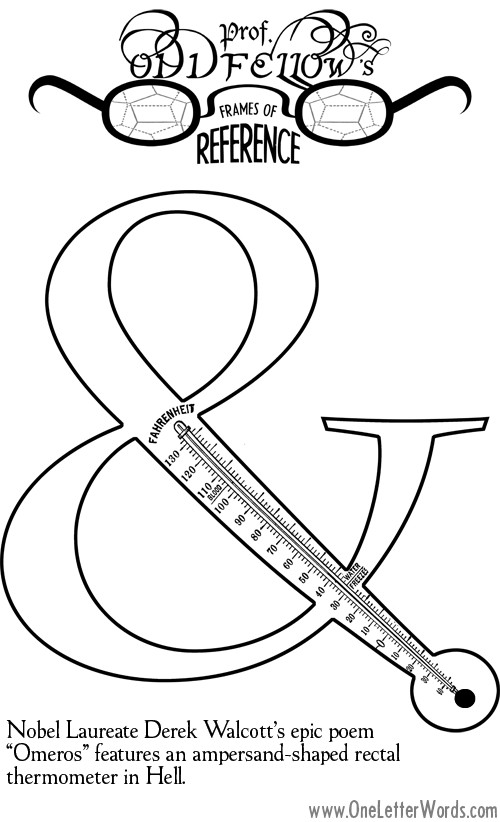
No. You're wrong, as usual. You've conveniently forgotten what year it is in my narrative, and that there's no digital anything, and the rectal thermometer I'm referring to is half a foot long, made of glass, and is filled with tapioca or similarly lethal substance. It obviously wasn't shaped like an ampersand, because that would be silly.*
Continuing on, the main points of my story are simply that (2) you can't assume doctors and nurses aren't demonic entities from Hell, (1) just because Derek Walcott managed to scrawl out a few lines about an ampersand-shaped rectal thermometer doesn't mean he could hear what the doctor was saying about my feet, and (3) it's unwise to trust the accuracy of any temperature measurement when you're surrounded by a bunch of flames.
* |
|
|
|
|
|
|
"He was a many-faceted man who combined the unlikely qualities of both daring adventurer and scholar." —Mary Lovell, A Rage to Live
----- Jonathan responds: I followed a trail to find the context for this image. I thought it was going to be a 1960s Batman episode, in which "Diamond Head" and his gang knock over Tiffanelbow & Co.
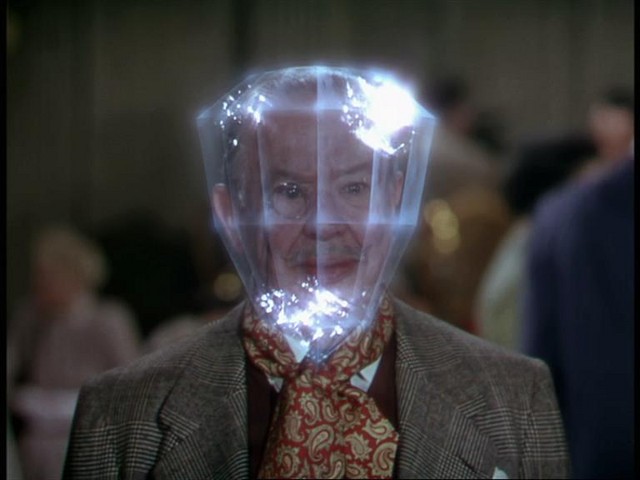
See full size photo here.
|
|
|
|
|
|
|
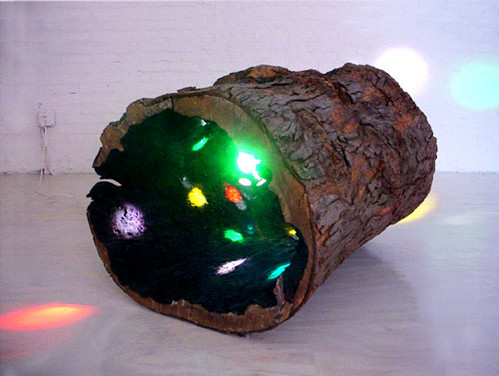
The night the lights went out at Madame Tussaud's wax museum.
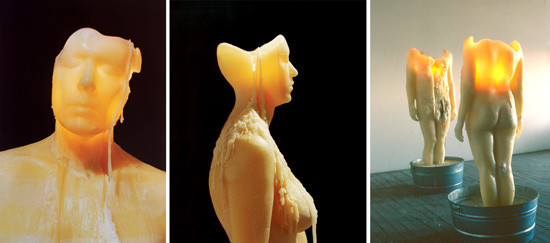
Walter Martin and Paloma Muñoz Human Candles, 1996 Wax, wicks, metal Via
|
|
|
|
|
|
|
Back in 18th century London, an ad in the Old Bailey periodical promised a spectacular show for "lovers of curiosities" by the "Moving Skeleton." "According to the elaborate illustrated notice, the skeleton turned an hourglass, jabbed a dart and groaned '3 times most surprisingly' to alarm the viewers, concluding its performance by smoking a pipe. An advisory notice was included: the show was too frightening to be seen by 'Persons with Child, Children, or others, whose Courage cannot be depended on.'" —Matthew Seccombe, Harvard Law De Jure newsletter. |
Page 21 of 22
> Older Entries...
Original Content Copyright © 2026 by Craig Conley. All rights reserved.
|