I Found a Penny Today, So Here's a Thought
|

|
|
|
|
|
|
We wrote an article for Medium, but we've now removed it due to that site's distasteful policies.
An Unlikely Magician and His Unholy, Unspeakable, Very Public Heresyby Craig ConleyFor those of us who enjoy an inside track on emerging cultural trends, there's a very unusual sort of stage magic that is just beginning to materialize, eschewing the Vegas-style white tigers and strobe lights and dancing strippers (not that there's necessarily anything wrong with those). It's a live theatre evening show, and though the action is rooted in the traditions of the greats like Houdini, the glitz and glamor get transferred — in ways that are honestly best described as "real magic" — into the spectator's own head. It's a new form of what might be called "cerebral" magic, though it's so entertaining that it never strains the brain. And its goals, as we discover with some gentle probing and subtle questioning, are surprisingly lofty.During the Italian Renaissance, philosopher-magicians (think Giordano Bruno) tended to get burned at the stake. Our own age's most celebrated philosophical magician, Chicago's Eugene Burger, delicately sidestepped such a fate, though he could tell some stories about the Inquisition. Burger's devisee, Memphis-based Prof. Larry Hass, plays with fire by performing wonderments as an actual tenured philosopher. His marvels include the very one that got Bruno snuffed out.As dean of the McBride Magic & Mystery School (a private school in Las Vegas that teaches stagecraft, theory, history, and esoterica to amateur and even professional magicians), Hass the stage performer carries some shackles even outside his escape act. A fair preconception is that his sold-out solo show at Memphis' 360-seat Halloran Centre would be educational, that Hass might, perforce, lecture and philosophize. Frankly, are eggheads [from the Greek ouateis, "soothsayers"] especially known for being nimble fingered? Ironically, Hass proves that the question is largely academic. His greatest feat is to transform, via an engaging presentation of profound mysteries, his general public into deeper, more empowered, more optimistic thinkers.Essential to the persuasiveness of philosophical magic is that both magician and audience share a degree of understanding as to what makes magic philosophical. And that is Hass' forte, strengthened by his decades' experience in elucidating abstruse concepts to students. He has now traded his former pupils for spectators' eyes. Hass may not wear a mortarboard or a wizard's hat (or even a topper), but we might say those who participate in his mysteries are bequeathed thinking caps.* A live setting seems essential to Hass' goals. He explains that his work is about being in a genuine relationship and real place with a group of people, creating and riding the waves of collective energy to give them a strongly affirmational experience. "This simply cannot happen with a computer or television screen between us. As I often say, magic on TV or computer screens is by definition 'mediated' magic, but what I seek to create is 'immediate' magic."Hass' take on magic is that extraordinary experiences are ever-present in daily life but are too often overlooked or forgotten. His stage work focuses on showing and reminding audiences of magical aspects of life that tend to be passed over. In brief, Hass says his goal is "to help people move beyond hopelessness, depression, or cynicism; to remind them to play, love, connect, take care of each other, be surprised, see the world in its delicious complexity, and be more free than we sometimes act. And indeed, to remind everyone that they themselves are magicians, too." Hass twists Aristotle's adage: "humans are at least as much the Magical Animal as the rational one."One of the secrets to Hass' success might be termed "visible thinking." He uses his stagecraft to make his own introspection visible to the audience, and via avenues of entertainment and intrigue he makes the audience's own thinking visible to themselves. A question Hass apparently asks himself throughout his show: "Is thinking visible here?" Are audience members finding meaning — their own personal imports, to be sure — in the presentations? Are they co-creating the magic? Is their interest unfolding in the auditorium as they make connections to their everyday life? Do they express open-mindedness, curiosity, not gullibility but appropriate skepticism, a willingness to collaborate toward a common goal, to conjecture with the conjurer?The process of "awakening" that Hass seeks to foster is in fact enacted during the show. "I can see and feel people being moved and transformed as the show unfolds, as I tell my story and other stories and as we play together. It is not about loading intellectual ideas into their heads; it is about creating an emotional awakening experience that can heal and empower." Audience participation figures prominently into at least half of Hass' repertoire, and such involvement is key to his mission to directly animate feelings of wonder. Another strategy Hass employs is to offer a quarter-dozen presentations early on that might come across as "tricks" (with a light bulb, rope, and cards), and then he doesn't do anything else that seems like a trick or would prompt a "how'd he do that?" The vast majority of his 90-minute show involves seemingly impossible demonstrations in which something deeply mysterious and surprising is accomplished by either the volunteers on stage (for example in a book prediction focused on a connection between the participants), the audience as a whole or in selections (as in a grand study of intuition in which the two halves of the entire house seek to reorganize a card deck by color), or Hass himself (as in a Houdini-tribute rope escape). The effects have dramatic punches but never once appear to be a magician showing off. Even when Hass accomplishes the memory feat that cost Giordano Bruno his life, the feat comes across more as an homage to Bruno's genius than Hass' own cleverness.Though a seasoned storyteller, Hass practices something imparted from his mentor Eugene Burger: the fewest words speak volumes. Hass avoids tangents and explanations of ideas. Rather, he takes pains to ensure that his audience sees the ideas, thus igniting others in their heads. To break through the wall of passive spectatorship, Hass sets the scene by calling for alert, conscious engagement. Then he turns the audience's imaginations loose to find their own connections along the way. One of Hass' most moving demonstrations of his own thinking actually occurs between the acts, during the intermission. As the audience gradually returns to their seats, they find Hass already on stage, subtly lit, sitting in a comfy chair, perusing a beloved book of classic magic posters. Wordlessly, casually, he reveals himself doing what he really does do in his daily life: studying, celebrating, meditating upon his mentors and his inspirations, luxuriating in the history, the glamor, and the human stories that have carried him to this day. After the standing ovation, I overheard an audience member exclaiming that it was the intermission, ironically, that offered him the most profound moments of the entire show.By Hass' definition, magic is not the art of deception but rather the artful performance of impossible things that generate energy, delight, and wonder. Rather than feeling "fooled" and taken advantage of, Hass wishes his audiences to experience an empowering, ecstatic experience that can be transformational. His approach to creating new performance pieces is dictated by "the magical effect" and whether or not his magician-philosopher character can say something powerful or fun about it. He is also sensitive to what the psychological effect of a piece does for the dynamics of the show as a whole. In terms of show building, he seeks an overture that is engaging, a turning point that deepens the relationship between the performer and the audience, and a finale that is as dramatic as a kick in the pants or a punch in the heart.---Craig Conley is actually related to a playing card, as his second cousin is Elizabeth of York, immortalized as the Queen of Hearts. Conley is author of Magic Words: A Dictionary (Weiser Books) and dozens of other works on magical, mysterious topics. His website is MysteryArts.com.*"A 'thinking cap' was previously known by the appealing name a 'considering cap.' That term has gone entirely out of use now but was known since at least the early 17th century" (Gary Martin, "The Phrase Finder," 2019).
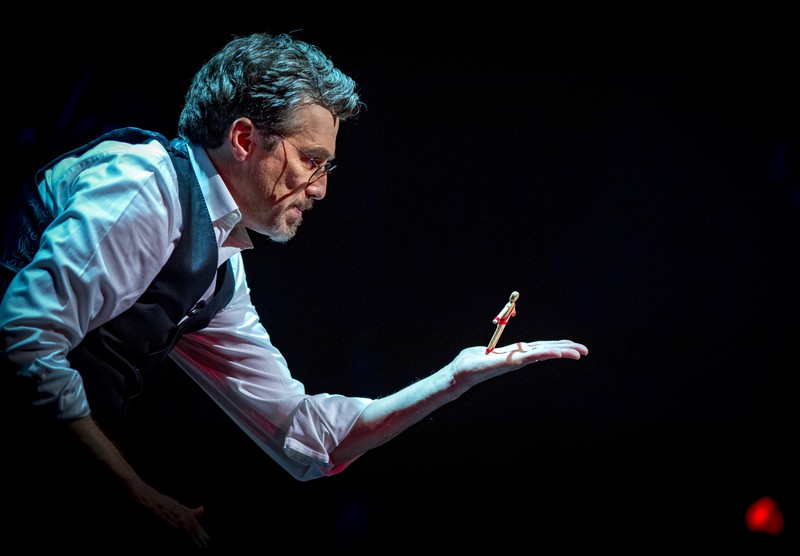
Photo of Larry Hass by Justin Fox Burks, with permission.
|
|
|
|
|
|
|
"And what of the dead? I own that I thought of myself, at times, almost as dead. Are they not locked below ground in chambers smaller than mine was, in their millions of millions? There is no category of human activity in which the dead do not outnumber the living many times over. Most beautiful children are dead. Most soldiers, most cowards. The fairest women and the most learned men – all are dead. Their bodies repose in caskets, in sarcophagi, beneath arches of rude stone, everywhere under the earth. Their spirits haunt our minds, ears pressed to the bones of our foreheads. Who can say how intently they listen as we speak, or for what word?" ―Gene Wolfe, The Citadel of the Autarch
|
|
If you could use a hand, here's one. From Here's a Hand by Wallace Bruce, 1892.
|
Page 130 of 178
> Older Entries...
Original Content Copyright © 2026 by Craig Conley. All rights reserved.
|