I Found a Penny Today, So Here's a Thought
|

|
|
|
|
|
|
Can some types of knowledge be considered "luxuries"? Here's Robertson Davies' take on "ornamental knowledge": Well, allow me to introduce myself to you as an advocate of Ornamental Knowledge. You like the mind to be a neat machine, equipped to work efficiently, if narrowly, and with no extra bits or useless parts. I like the mind to be a dustbin of scraps of brilliant fabric, odd gems, worthless but fascinating curiosities, tinsel, quaint bits of carving, and a reasonable amount of healthy dirt. Shake the machine and it goes out of order; shake the dustbin and it adjusts itself beautifully to its new position.
via Omegaword. |
|
|
|
|
|
|
  by Gerald DavisonThe Spectral Colors of Brocken Bows and GloriesImagine hiking on a sunny mountain and witnessing an unforgettable phenomenon worthy of a Hollywood special effects team: as a bank of chilly fog rises from a couloir, your shadow grows to gigantic proportion (hundreds of feet high), surrounded by a prismatic halo. 

|
In olden times, the spectre was considered to be of supernatural origin and fearfully ominous in nature. Today, the phenomenon is known as a "Brocken Bow," named after a mountain in Germany. Like a small, circular rainbow, a foggy Brocken Bow tends to last from several seconds to fifteen minutes. Bands of color surround the gigantic shadow at a distance of several feet. The outermost band is red, and the others follow the order of the typical rainbow. In some cases, a Brocken Bow is surrounded by a second bow, whose color order is reversed. A similar phenomenon, known as a Glory, is distinguished by the fact that the bands of color touch the head of the shadow. Glories typically sport seven bands of color and can last for hours at a time. Sometimes Glories are surrounded by glowing white fog bows. 
by bob the lomond
In ideal conditions, the sun shines behind the observer and a cloud of fog rises from a lower elevation in front. The ideal temperature for Brocken Bows and Glories varies between 19 and 56 degrees Fahrenheit. Though the bands of colors are no illusion, the size of the shadow is actually a trick of the eye. Apparently, the shadow appears gigantic due to a distortion of depth caused by moving fog particles at varying distances. For a detailed description of Brocken Bows and Glories from a scientific point of view, see Henry Sharpe's piece for Scottish mountaineers. Also don't miss The Nonist's study on the phenomenon, illustrated with vintage woodcuts and color photographs. 
by bob the lomond
[Read the entire article in my guest blog at ColourLovers.com.]
|
|
|
|
|
|
|
 by DerpunkAll the Colors of the WindThe air. A thing too intangible for color you think? ... The truth is all air is colored.
—John C. Van Dyke, The Desert
Anyone who thinks that air is invisible is impaired by a sort of color blindness. Indeed, the air is so alive with color that it could be likened to a rainbow that encircles the entire earth with pink, red, violet, gray, blue, and yellow. Ask a naturalist or a painter, and you'll hear descriptions of an airy spectrum that escapes the unobservant viewer. Carried by swirling dust particles and refracted by the prisms of water vapor, the colors of the air are best observed in a mass. Mountaintop vantages, canyons, desert expanses, or deep valley views are recommended. The warmer the temperature and the stronger the wind, the more color will be detectable. Rising heat carries finer dust particles deepening the air's hues, while high winds carry larger particles, brightening the coloration.1 Here's how naturalist Richard Jefferies poetically recorded seeing the colors of the wind at sunrise one morning: Color comes up in the wind; the thin mist disappears, drunk up in the grass and trees, and the air is full of blue behind the vapor. Blue sky at the far horizon — rich deep blue overhead — a dark-brown blue deep yonder in the gorge among the trees. I feel a sense of blue color as I face the strong breeze; the vibration and blow of its force answer to that hue, the sound of the swinging branches and the rush — rush in the grass is azure in its note ; it is wind-blue, not the night-blue, or heaven-blue, a color of air. To see the color of the air, it needs great space like this — a vastness of concavity and hollow — an equal cauldron of valley and plain under, to the dome of the sky over, for no vessel of earth and sky is too large for the air-color to fill. Thirty, forty, and more miles of eye-sweep, and beyond that the limitless expanse over the sea — the thought of the eye knows no butt, shooting on with stellar penetration into the unknown. In a small space there seems a vacuum, and nothing between you and the hedge opposite, or even across the valley; in a great space the void is filled, and the wind touches the sight like a thing tangible. The air becomes itself a cloud, and is colored — recognized as a thing suspended; something real exists between you and the horizon. Now, full of sun and now of shade, the air-cloud rests in the expanse.2
The COLOURlovers library is full of airy inspiration. There are colors of "thin" to "heavy" atmospheres as well as airless colors of suffocation. NOTES:
[1] John C. Van Dyke, The Desert: Further Studies in Natural Appearances, 1903.
[2] Richard Jefferies, "Winds of Heaven," The Eclectic Magazine, 1886. [Read the entire article in my guest blog at ColourLovers.com.]
|
|
|
|
|
|
|

See big version of this photo here. --- Jeff writes: On a cold and snowy morning, nothing says Warm & Gooey like a nap amid floor to ceiling stacks of electronic equipment, especially when they're all about music. Indeed, home is (somebody stop me) where the hertz is. Ahahahahahahaha!
|
|
|
|
|
|
|
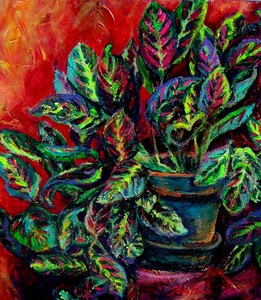
Dr. Albertus Boli informs us that "the so-called 'prayer plant' ( Maranta sp.) is, technically speaking, chanting rather than praying."
|
|
|
|
|
|
|
As Marcel Bénabou writes in Why I Have Not Written Any of My Books, "Above all, dear reader, do not believe that the books I have not written are pure nothingness. On the contrary (let it be clear once and for all), they are held in suspension in universal literature." — Enrique Vila-Matas, Bartleby & Co. |
|
|
|
|
|
|
Loïe Fuller, Illusionist of Light and Color
One of the most spellbinding color illusionists of the last century left her spectators dazzled to near-mystical proportions. Loïe Fuller (1862-1928) was pioneer of choreography and an innovator of theatrical lighting, holding patents for creating color gels and using chemical salts for luminescence. When she took to the stage dressed in flowing silk costumes specially lit according to her own schemes, she transformed into a full-fledged magician. When modern dance founder Isadora Duncan first witnessed Fuller's shape-shifting wizardry, she was bewitched by an alchemy of color and movement that left the impression of a once-in-a-lifetime miracle. Employing only voluminous colored silks illuminated by beams of light, Fuller performed what amounted to a shamanic ritual, convincing her spectators that a sacred metamorphosis was unfolding. Fuller evoked the primal power of the bonfire, depicted the wonder of new life, and enacted the elevation of the soul into boundless essence. Though the experience left Duncan in a state of wordless awe, she couldn't help attempting to account for the sheer magnitude of what she beheld:
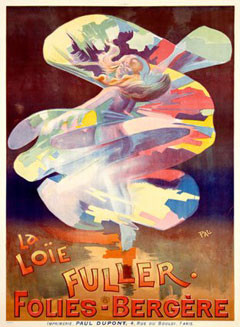 "Before our very eyes she turned to many-coloured, shiny orchids, to a wavering, flowering sea-flower, and at length to a spiral-like lily, all the magic of Merlin, the sorcery of light, colour, flowing form. What an extraordinary genius! No imitator of Loïe Fuller has ever been able even to hint at her genius! I was entranced, but I realized that this was a sudden ebullition of nature which could never be repeated. She transformed herself into a thousand colourful images before the eyes of her audience. Unbelievable. Not to be repeated or described. Loïe Fuller originated all the changing colours and floating Liberty scarves. She was one of the first original inspirations of light and changing colour. I returned to the hotel dazzled and carried away by this marvelous artist. . . . I was more and more enthusiastic about her marvellous ephemeral art. That wonderful creature—she became fluid; she became light; she became every colour and flame, and finally she resolved into miraculous spirals of flames wafted toward the Infinite." (My Life, pp. 71-72)
The significance of Loïe Fuller's performance can hardly be exaggerated. She embodied the Goddess of Light and the Rainbow, whether under the guise of the Greek Artemis or Iris, the Hindu Uma, the Mayan Ix Chel, the Celtic Brigid, or the Roman Diana. Biographers Richard and Marcia Current called Fuller a "magician of light." Befitting a goddess, Fuller had a paradoxical nature, and she created her own mythology. Her biographers explain:
 "A tall and lovely sylph in posters and sculptures, she was in reality a rather chubby woman with a fairly plain face. A dance innovator, she possessed no formal training in choreography. Eventually a cofounder of art museums, she had never even seen an art exhibit before going to Paris at the age of thirty. A close and respected associate of some of the most learned men and women in the world, she could claim no institutional education beyond that offered by the common schools of Illinois in the 1860s and 1870s. What she did have, in addition to her winning ways, was a dauntless will to get ahead, together with enough intelligence, resourcefulness, and ingenuity to give effect to that will. . . . She rose to extraordinary heights from a quite modest background. Her accomplishments were such that she might well have been satisfied with an unadorned account of her beginnings. She was not. Once she had achieved celebrity, she knocked several years off her age and made up fantastic tales about what was left of her early years. She created her own myth." (Loïe Fuller: Goddess of Light, 1997.)
What can we learn from Fuller's color magic?
- Physicality is a limitation only if we allow it to be. Fuller used her earth-mother physique to communicate a sylph-like spirit of the air. Her secrets? Natural, freeform movement and the power of intention.
- Personal history is a limitation only if we allow it to be. One is only as interesting as one makes oneself, so Fuller invented her own legend. Her secret? Reframing the truth to reveal the fascination.
- Formal training is less important than resourcefulness and ingenuity. Fuller's secrets? Banishing doubts and asking "What if?"
- A single silk and a beam of light can unfold a miracle. Fuller created something from nothing. Her secrets? Focusing on simplicity and following her inner guidance.
Before succumbing to breast cancer in 1928, Fuller found herself immortalized on canvas by Toulouse-Lautrec, in verse by Yeats, and on film by Lumiére. Not bad for a girl from a Chicago suburb who marched to her own drummer and followed her own spotlight.
|
|
|
|
|
|
|
 by permanently scatterbrainedThe Girl with the Multicolored HairText by Jeff at Omegaword, palettes by COLOURlovers The last time I saw the girl with the multicolored hair, she was following sunbeams through the kitchen door and ran, laughing, out into the world to find another bright friend. The last time I saw the girl with the multicolored hair, she flew above the treetops where the wind blows warm, and clouds were not allowed to interfere with such a perfect sky. The last time I saw the girl with the multicolored hair, she sang to the sparrows and the green, green grass, and rain was always welcome, but only after noon. | 

|
[Read the entire article in my guest blog at ColourLovers.com.]
|
|
"For pygmies, if you don't fall down laughing, your laughter is incomplete." —Enrique Vila-Matas, Montano's Malady |
|
|
|
|
|
|
We're gobsmacked by all sorts of praise this week: The Serif of Nottingblog
covers our eccentric illustration of the "punctuational theory of
evolution," whimsically saying, "[T]he Abecedaring lexiconleyjurer and
abcderial visualist, Craig Conley ... is an astonishingly
inabecedefatiguable creator and investigator of the world of language:
written, visual, and conceptual."
Anima Tarot covers our short talk on magician Jeff McBride's secret of mastering time: "[A] presentation given by magic scholar and linguist extraordinaire, Craig Conley ... greatly increased my admiration for the artistry of this gifted magician [McBride]." Speaking of that short talk, Martha delightfully tells us we remind her of her favorite professor from college, who could find Greek gods in butter ads! And Ferdinando suggests that our soft-spoken yet confident style recalls someone "channeling a 'higher entity.'" The ever-intriguing Social Fiction kindly covers our diagram of all history contained in a single note of music. And belated thanks to Steve Vander Ark's Harry Potter Lexicon for calling our Magic Words: A Dictionary "a very impressive collection of magic words from all over the world." |
Page 167 of 178
> Older Entries...
Original Content Copyright © 2026 by Craig Conley. All rights reserved.
|