I Found a Penny Today, So Here's a Thought
|
|
|
 |
|
|
A gift pairing idea:
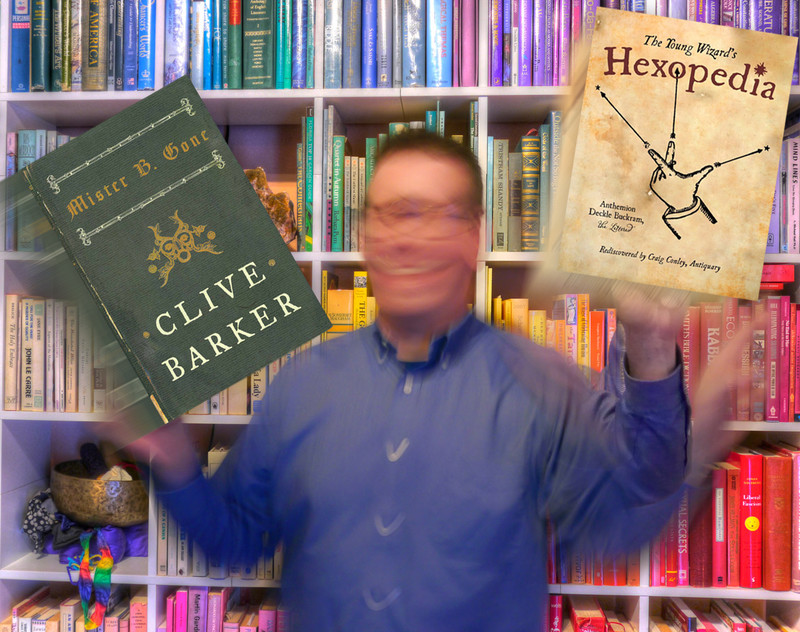
Two Books that Read their Reader’s Mind
Two books on the market purport to provably read the minds of their readers: Clive Barker’s horror novel Mister B. Gone and Anthemion Buckram’s grimoire The Young Wizard’s Hexopedia. You could tell the person who has everything that this book pairing gift suggested itself.
|
|
|
|
|
|
|
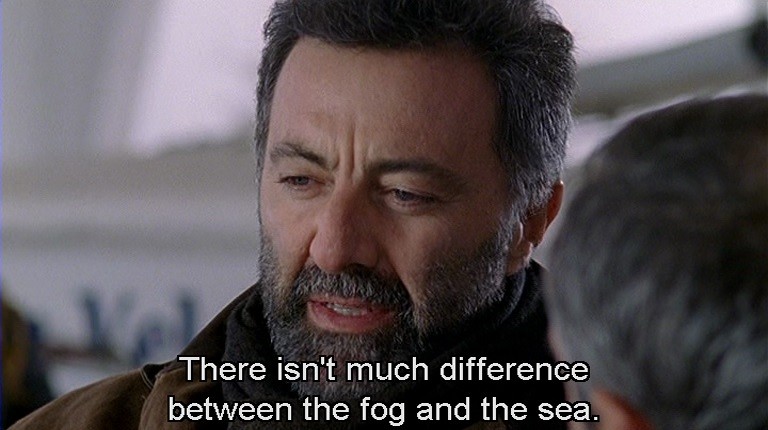
"Water is almost nothing, after all. It is conspicuously different from air only in its tendency to flood and founder and drown, and even that difference may be relative rather than absolute." —Marilynne Robinson, HousekeepingSimilarly:
|
|
|
|
|
|
|

One is reminded of the old game, "Which number comes next in this sequence?":
1, 2, 3, 4, 5, 6, 7, 8, 9, 10, 100, 1000, 10000 ...
This sequence is actually a Shinto breath-counting meditation, using the traditional Japanese numbers of "hi, fu, mi, yo, i, mu, na, ya, koto, tari, momo, chi, yorozu" (as explained in The Essence of Shinto: Japan's Spirtual Heart). But here's what no one else will tell you:
- This sequence is a precursor to permanently erasing files from a computer by overwriting portions of the drive with numbers. This is a meditational technique for overwriting "thought trash."
- This sequence could be likened to the opposite of Zeno's Paradox. Instead of making less and less progress (like Zeno's arrow that never reaches its mark), one makes more and more progress, exponentially.
- This sequence illustrates how radically different Shinto is from Buddhism and other philosophies that seek nothingness. With each zero added, Shinto sees not less but more — greatly more. In its progressive optimism, Shinto uses the concept of zero to expand rather than obliterate.
- Each of the ten zeroes stands for the fact that Shinto has no founder, no orthodox canon of sacred literature, no doctrines or precepts or commandments, no explicit code of ethics, no idols, no need for a building, no ritual of membership or conversion, no holiest place for worshippers, no defined set of prayers, and no organization or central authority.
So yes, basically.
|
|
|
|
|
|
|
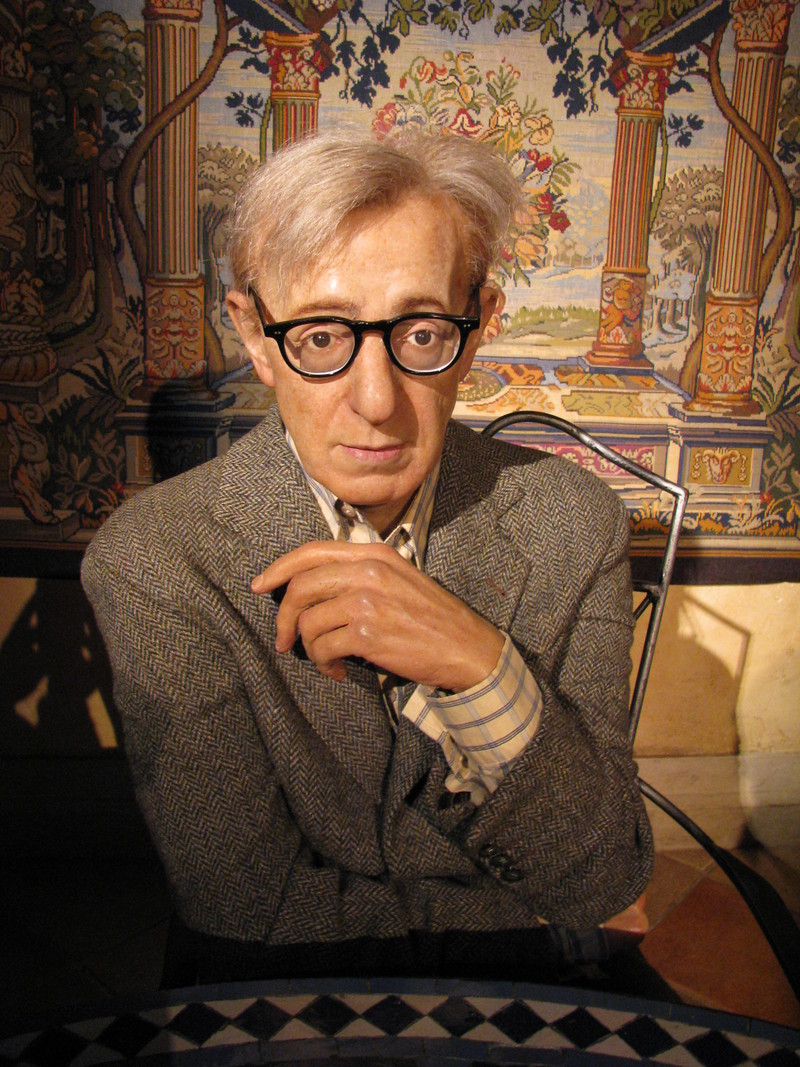
We once tried to buy a photograph of Woody Allen. We called the photographer to ask about availability, and he laughed at us. "That's not Woody Allen," he explained condescendingly. "That's a wax figure of Woody Allen." Then he began hemming and hawing, talking about how much trouble it would be to find the negative and make a print. (Artists, bless 'em, can be real pieces of work themselves.) Flustered by the entire conversation, we politely told him not to put himself out and decided not to pursue the acquisition. But here's the lingering question: had the photo been of Woody Allen himself and not an uncannily lifelike wax figure, might we have worked past the photographer's primadonna attitude and secured a print? I mean, we loved the photo, but did it feel somehow less authentic in its waxy afterglow? Here's what we do know about wax figures:
- "Every day a wax figure is taken for a live man, and live people are mistaken for wax." —Richard Panchyk, New York City History for Kids, 2012
- "The complexion of a wax figure is indeed a work of art." —American Cloak and Suit Review, 1918
- "A wax figure is not cheap, especially a good one." —Dry Goods Reporter, 1906
- "A wax figure is a material thing." —L. W. Forguson, "Has Ayer Vindicated the Sense-Datum Theory?"
- "A wax figure is understood by us as something constructed by an intelligent mind." —Jehangir Nasserwanji Chubb, Faith Possesses Understanding, 1983
And yet:
|
|
|
|
|
|
|
We're delighted to have contributed a bit of our research to Long Forgotten's post about an overlap of the Rich Fool traditions, the Faust legend, and Spontaneous Human Combustion. We're also delighted to have consulted with Gary Barwin on his participation as a " Non-Psychic" in an art installation/performance in Hamilton, Ontario.
|
|
|
|
|
|
|
Here is explained why we should behave as unreally as possible:
"We must accept the so-called reality around us, the woodlouse in the cellar no less than the evening star. It's only we ourselves who are unreal—partly just because we are aware of the fact. And as a result we contradict ourselves. Would you try to build a house of sand? You wouldn't move a finger to do so. Because you know that the house would collapse at once. And all that we do here is equally pointless. It drifts away like writing in the sky. We come from the unknown, linger a lifetime, and drift away again. Better not to act as if we were real. We should behave as unreally as it is possible to behave in reality. ... [I]t is we on earth who are really on the Other Side. Because we are still on the wrong side of reality, even though it surrounds us. That means that fundamentally we are capable of everything except being real." — Ernst Kreuder, The Attic Pretenders
|
Page 147 of 177
> Older Entries...
Original Content Copyright © 2026 by Craig Conley. All rights reserved.
|