|
|
|
|
|
|
unearths some literary gems.
From The Literary Shop and Other Tales, by James L. Ford:
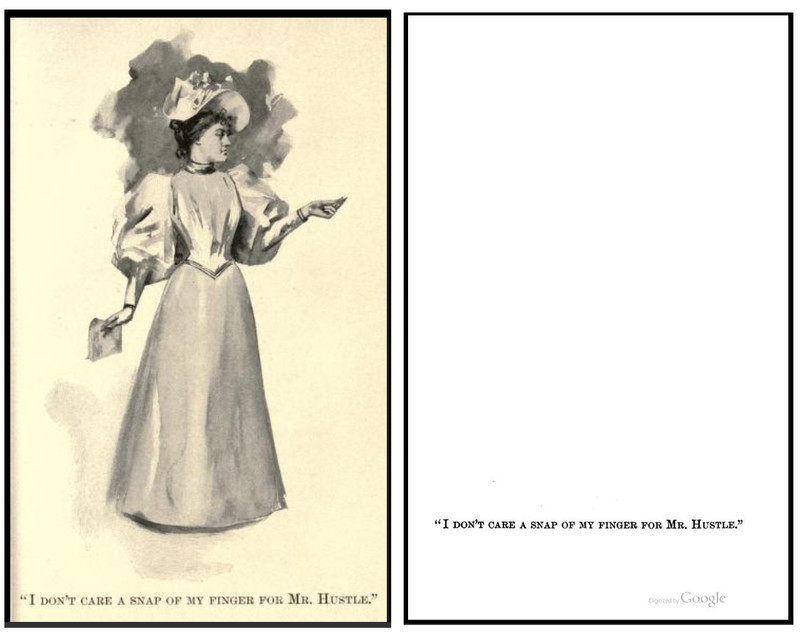
***One Friday morning, many years ago, I went with this poet to the Ledger building, and there found half a dozen writers gathered together in an outer office, anxiously watching the dark shadow of a man that was thrown upon a partition of ground glass that extended from floor to ceiling across the room and separated it from the private office of the great editor.The dark moving shadow on which every eye was fixed was that of Robert Bonner himself, and as it was seen to cross the room to a remote corner—growing smaller and fainter as it receded—every face brightened with hope, and forms that had seemed bent and dejected but a moment before were suddenly straightened. An instant later the door opened and the editor of the Ledger crossed the threshold, handed a ten-dollar bill to one of the waiting poets, and then hastily retired to his own den again.Then my friend showed me how the watchers could tell by the movements of the dark shade whether a poem had been accepted or refused. If the editor walked from his desk to the remote corner of his private office they knew that he did it in order to place a poem in the drawer of an old bureau in which he kept the accepted manuscript; but if, on the other hand, he came directly to the door a horrible feeling of anxiety came into every mind, and each poet uttered a silent prayer—while his heart literally stood still within him—that the blow might fall on some head other than his own.***[Ford is unable to stick to just one animal when critiquing Mr. Rhodes!]He prints the program of the soirée given by Rodolphe and Marcel, and then observes, with the solemnity of a Central Park pelican: “There is nothing very humorous in this, as will be observed, and yet it may be regarded as one of the best specimens of Murger’s genre.”[...]But let us turn from the awful spectacle of Mr. Rhodes standing like a lone penguin in the very midst of the Latin Quarter of Paris....[...]But to return to our sheep—and in the case of Mr. Rhodes the word is an apt one....***“What! you here to-night?” exclaimed old man Sweeny as a frail figure muffled up in a huge ulster staggered through the doorway and stood leaning against the wall, trying to catch his breath.“Yes; I felt that I couldn’t stay away from the footlights to-night. They tell me I’m old and worn out and had better take a rest, but I’ll go on till I drop;” and with a hollow cough the Old Gag plodded slowly down the dim and drafty corridor, and sank wearily on a sofa in the big dressing-room, where the other Gags and Conundrums were awaiting their cues.“Poor old fellow!” said one of them, sadly, “he can’t hold out much longer.”“He ought not to go on except at matinées,” replied another veteran, who was standing in front of the mirror trimming his long, silvery beard; and just then an attendant came in with several basins of gruel, and the old Jests tucked napkins under their chins and sat down to partake of a little nourishment before going on.The bell tinkled and the entertainment began. One after another the Jokes and Conundrums heard their cues, went on, and returned to the dressing-room; for they all had to go on again in the after-piece. The house was crowded to the dome, and there was scarcely a dry eye in the vast audience as one after another of the old Quips and Jests that had been treasured household words in many a family came on and then disappeared to make room for others of their kind.As the evening wore on the whisper ran through the theatre that the Old Gag was going on that night—perhaps for the last time; and many an eye grew dim, many a pulse beat quicker at the thought of listening once more to that hoary Jest, about whose head were clustered so many sacred memories.[...]“You’re hardly strong enough to go on to-night,” said a Merry Jest, touching him kindly on the arm; but the gray-bearded one shook him off, saying hoarsely:“Let be! let be! I must read those old lines once more—it may be for the last time.***[From a section on "The Jokal Calendar"]So even must the humorist recognize the different periods allotted respectively to goats, stovepipes, ice-cream, and other foundations of merriment.[...]If it be a late fall the public may slide along on banana and orange peel jokes until the first cold snap warns housekeepers of the necessity of putting up stovepipes. [The inclusion of orange peels alongside banana peels is interesting.][...]What the reindeer is to the Laplander the goat is to the writer of modern humor. His whole life is devoted to the service of the paragraphist.***Seizing an ancient jest, he tears it from the soil, carefully cleanses the esculent root from its clinging mould, and then proceeds to revamp it for modern use.[...]It has awakened laughter among...Athenians as they lay stretched in languid and perfumed ease immediately after the luxurious bath, and about two hundred years before Christ. It has been said that cleanliness is next to godliness, and yet we find that in this instance there was room to slip this joke in between the two, and have two hundred years of space left.***Mr. McClure showed me a building which he erected last spring and which is now used as a canning factory and warehouse for the storage of perishable goods.“You see,” said Mr. McClure, “we are doing a very large business here, and supplying not only my own magazine and newspaper syndicate with matter, but also various other publications, which I cannot name for obvious reasons, so it frequently happens that we find ourselves at the close of some holiday season with a number of poems, stories, or essays relating to that particular holiday left on our hands. These ‘perishable goods,’ as we call them in the trade, were formerly a total loss, but now we can and preserve them until the holiday comes round again.”[...]We were still standing there, when one of the hands, who seemed to be working overtime, appeared with a step-ladder, climbed up to one of the highest shelves, and brought down three dusty Washington’s Birthday jars, which he opened on the spot. Two were in good condition, but the third containing a poem on “Our Uncrowned King,” was found to be in a bad state of preservation and emitted such a frightful odor that the workman hastily carried it outside the building, Mr. McClure and I following to see what was the matter with it. The poem was lifted out with a pair of pincers, and we saw in an instant that decay had started in the third verse, in which “Mount Vernon” was made to rhyme with “burning,” and had spread until the whole thing was ruined.“I am very lucky to get off as easily as this,” said Mr. McClure, as he noted the name of the author of the defective rhyme, “because it sometimes happens that these jars containing rotten poetry explode and do a great deal of damage.***“You were tralalooing with the De Sneides of Steenth Street, and you dare not deny it!”***
|
|
|
|
|
|
|
unearths some literary gems.
|
|
|
|
|
|
|
unearths some literary gems.
|
|
|
|
|
|
|
unearths some literary gems.
From Cherub Devine, by Sewell Ford:
***Bulkins snorted a fresh appreciation of his own humour, winking roguishly at an astonished broker's clerk who happened to be passing.***The place was all so empty and still! He looked up and down. the long bare veranda, then out across the vividly green lawn. No one was in sight. Behind him were those many darkened rooms from which issued no sounds. The shades of all the front windows were drawn, and the yellow and white awnings masked them still more. It was as if the place had been put to sleep by a mesmerist. He wished he knew how to wake it up.***"It's like playing hide and seek and being it all the time," was his comment.***The Hewingtons, it seemed, were addicted to postscripts.***In fact, the Walloway butler, who weighed twice as much as Eppings and was haughtier in proportion, was coldly doubtful as to whether or not Mr. Nicholas Walloway could be seen.***"I feel like--well, like 5/8 off and nothing bid."***When perplexed and agitated, he polished his glasses; quite a dignified and refined manner of giving relief to his feelings. When merely lost in calm thought, he twirled them about his forefinger by the little gold chain to which they were attached.***Now, one doesn't expect to find a man in frock coat and silk hat dodging behind bushes on a place like Hewington Acres. Yet "Cherub" Devine had come to associate that particular part of Long Island with all sorts of surprises. He was inclined to accept this new manifestation as part of the general programme.***the tails of his frock coat fluttering a taunting salute as he spurted towards freedom***[Bonus: the Miller-Tremways, later referred to as "those hyphen Tremways"][Bonus: Baden-Baden referred to as "Baden Two Times"]
|
|
|
|
|
|
|
unearths some literary gems.
From Spoofs, ed. Richard Butler Glaenzer:
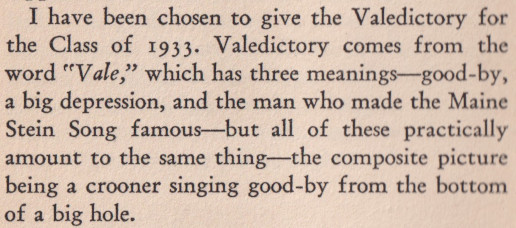
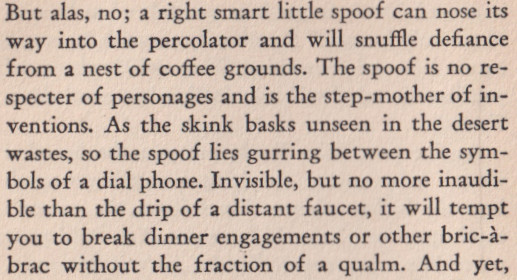
***Merely coax the spoof to trade places with the ibis, and you'll appreciate the preponderant value of a classical education. [from the "Four Words," i.e., foreword, by John Vincent]***Readers are requested to refrain from expecting as pleasing a response if they venture to beard [i.e., corner] [George Bernard Shaw] on a similar occasion. He is already bearded to the nostrils. It would be checkmate for them. [Editor's Note]***Oliver Herford is a leonentity of the first magnitute. [Editor's Note]***The ruddy color of his face was enhanced by cockatoo-like gray hair. [William Rose Benét]***After all, you are probably worrying about something that will never happen. That was an isolated case in Nashville. It may have been in Tallahassee, which makes it all the more nebulous. [James Montgomery Flagg]***Muriel Pollock and Vee Lawnhurst had been sent to the laundry with their pianos. [H. W. Hanemann]***Years ago, Simeon Simon baked such inedible pies in his little bake shop in Hollywood that people came from miles around NOT to buy them. [Don Herold]***Dear President and Faculty, Classmates, Fellow Students, Parents, Kibitzers.... [J. P. McEvoy; I note that this is one of (at least) two pieces in the collection wherein "kibitzers" are included in a running list of vocations.]***[Bonus: a "Morley-Throckmorton-Milliken-Dribble" production]
|
|
|
|
|
|
|
unearths some literary gems.
From The Footlights, Fore and Aft, by Channing Pollock:
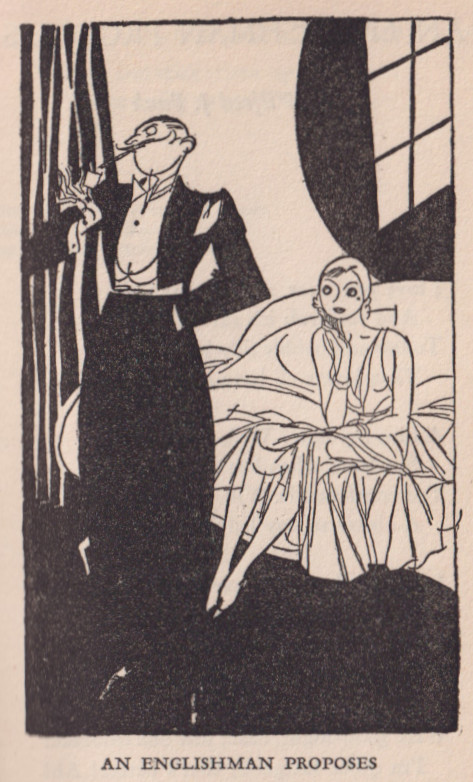
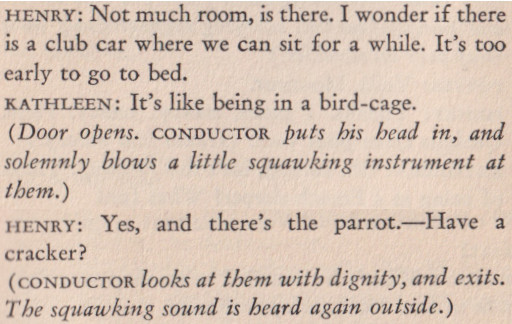
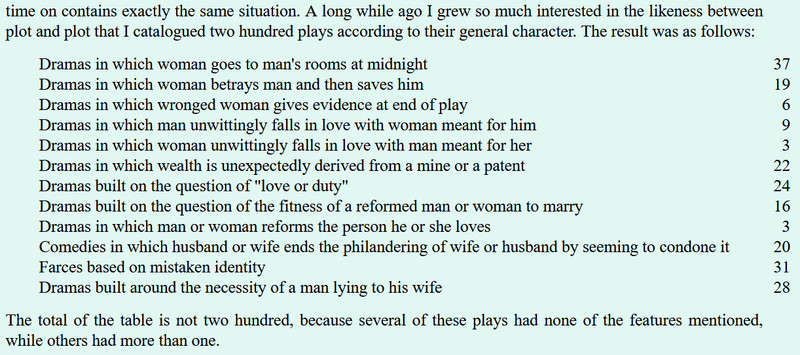
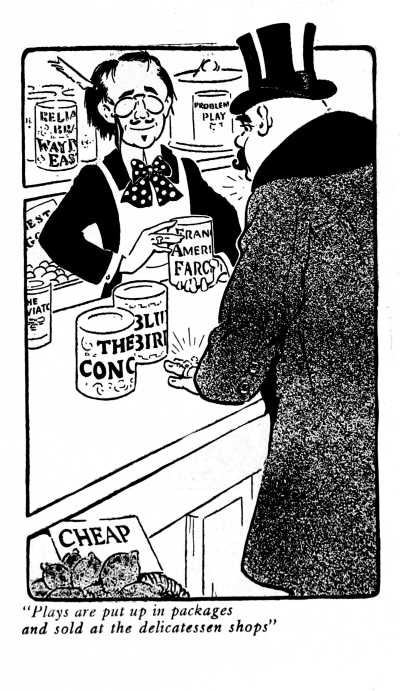
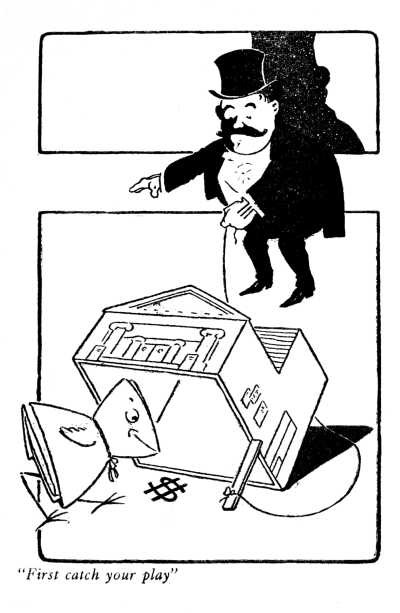
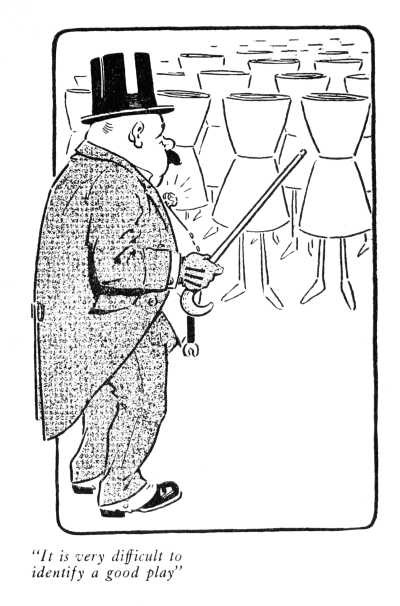
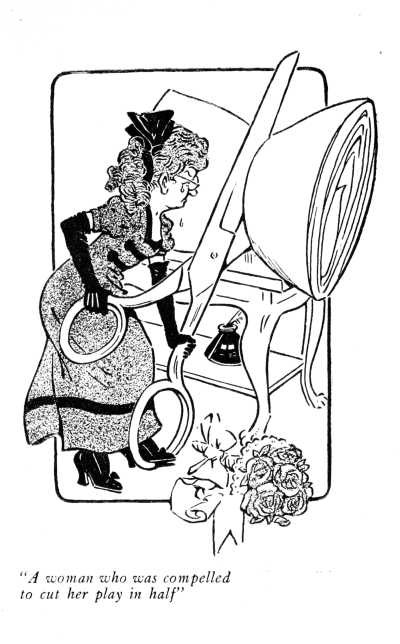
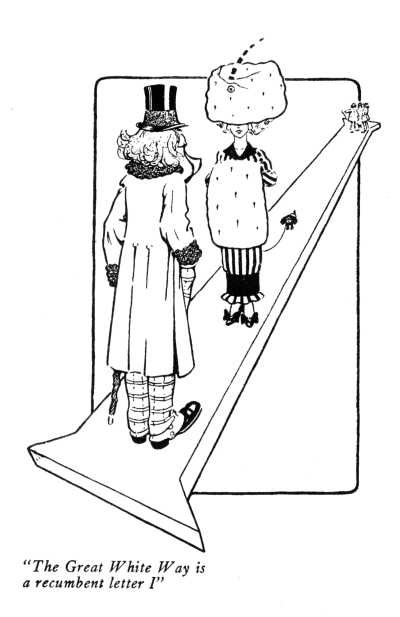
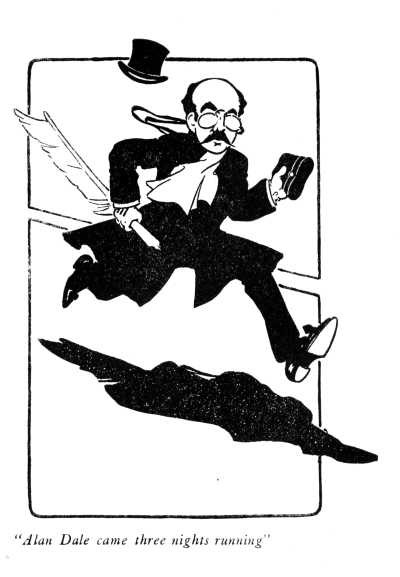
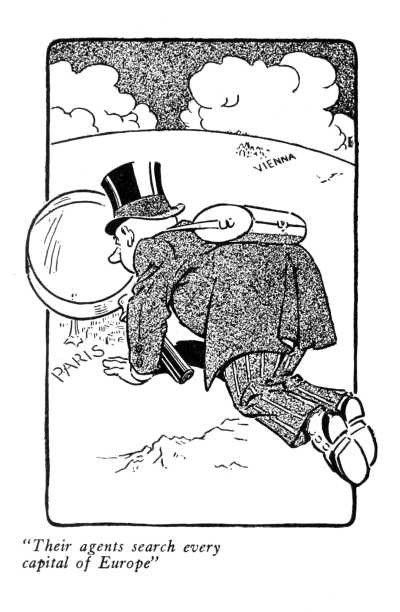
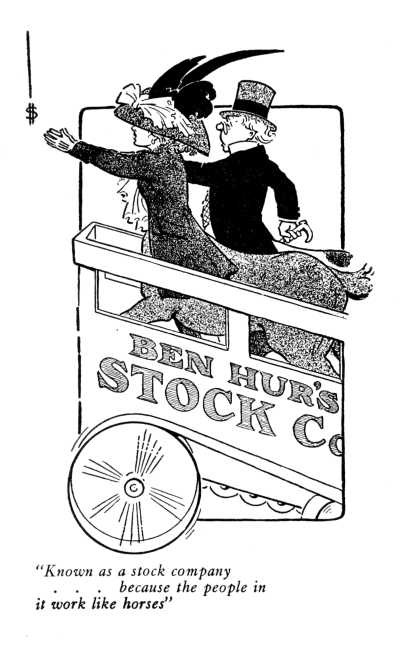
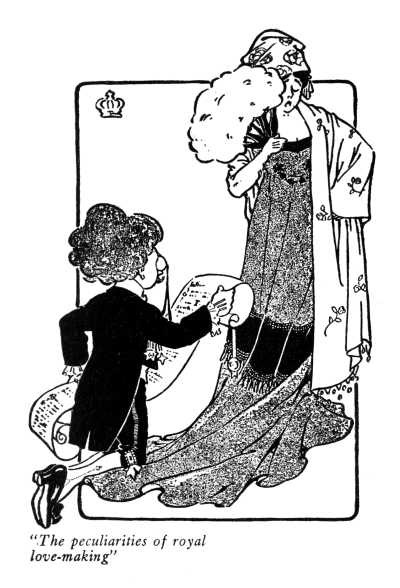
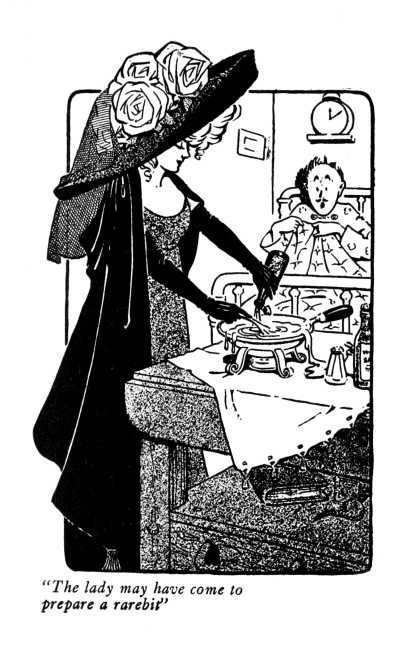
***"Good wine", according to the poet, "needs no bush." With the same logic, one may argue that a good book needs no introduction.... But then—how be sure that it is a good book?Hallowed custom provides that every volume of essays—especially of essays on the theater—shall begin with a preface in which some celebrated critic dilates upon the cleverness of the author. However, celebrated critics are expensive, and, moreover, no one else seems to know as much about the cleverness of this author as does the author himself. In consequence of which two facts, I mean to write my own introduction.One obstacle appears to be well-nigh insurmountable. It will be easy to inform you as to my merits and my qualifications, but I don't quite see how a man can speak patronizingly of himself. And, of course, the patronizing tone is absolutely essential to an introduction. Nobody ever wrote an introduction without it. I shall do my best, but I hope you will be lenient with me in the event of failure.***There are not more than a dozen prominent managers and a score of well known playwrights in America; whoever elects to write a hundred thousand words about the theater must choose between mentioning these names repeatedly and inventing new ones.***"The capital I's", as someone has said of another series of articles, "flash past like telegraph poles seen from a car window."***Bronson Howard, asked to compile a book of rules for playwriting, declined on the ground that he feared being tempted to follow them.***The manner in which one author follows the lead of another, as demonstrated above, extends beyond the selection of such important things as stories, and reaches even to titles. Ten years ago we couldn't have a name without the word "of" in it. On the bill-boards were advertised "The Whitewashing of Julia", "The Manoeuvres of Jane", "The Superstitions of Sue", "The Stubbornness of Geraldine" and a score of others. Then somebody christened a charming sketch "Hop-o'-My-Thumb", and for a while it seemed that we could get nothing but hyphenated titles, such as "Alice-Sit-by-the-Fire" and "All-of-a-Sudden-Peggy."***Parisians call their actors "M'as-tu-vu", which means "Have you seen me?" That is because the first question a French actor asks is "Have you seen me in such-and-such a role?" Your true American actor doesn't waste time with a question of that sort. He feels a peaceful certainty that not to know him argues yourself unknown, and he wouldn't like to hint at such obscurity for an acquaintance. Take all the talk of all the year on The Great White Way, run it through a wringer, and you will have that same letter I, with vanity dripping from every inch of the texture.***One of the mechanical effects in this piece was a bicycle race, during which the contestants pedaled wildly on stationary machines. The effect of passing landscape was given by a panorama and a fence that moved rapidly in the opposite direction. At least, they were supposed to move in the opposite direction, but on the occasion of which I speak they didn't. The race became one between the bicyclists and the surrounding country, and the surrounding country was far in the lead when an irate stage manager rang down the curtain.***Occasionally, the lady, or the gentleman, or both, are quite innocent of wrong-doing. The lady may have come to save the reputation of another lady, or to prepare a rarebit, but when the husband has tracked her by the fan that years of Wilde have not taught such callers to hide with them.... [Another passage that I think we may have seen in before (in Smart Set)--but now with a terrific illustration!]***[Many attachments attached, most of them illustrations--which were the best thing about this book, imho. I've selected liberally, but you can find the complete set at https://www.gutenberg.org/cache/epub/40148/pg40148-images.html . Note that in the text, "three nights running" had the conventional meaning of "three nights in a row," but of course I love how it was (mis)interpreted in the drawing.][Bonus: two actual Broadway play titles, "It's All Your Fault" and "We Can't Be as Bad as All that!"]
|
|
|
|
|
|
|
unearths some literary gems.
|
|
|
|
|
|
|
unearths some literary gems.
From Septimus, by William J. Locke:
***She would plunge into the great swelling sea of Life. She would drink sunshine and fill her soul with laughter. She would do a million hyperbolic things, the mention of which mightily confused her mother.***"Why should you be happier if I took care of your money?""I shouldn't spend it. I might meet a man who wanted to sell me a gas-engine.""But you needn't buy it.""These fellows are so persuasive, you see. At Rotterdam last year, a man made me buy a second-hand dentist's chair.""Are you a dentist?" asked Zora."Lord, no! If I were I could have used the horrible chair.""What did you do with it?""I had it packed up and despatched, carriage paid, to an imaginary person at Singapore."He made this announcement in his tired, gentle manner, without the flicker of a smile. He added, reflectively—"That sort of thing becomes expensive. Don't you find it so?""I would defy anybody to sell me a thing I didn't want," she replied."Ah, that," said he with a glance of wistful admiration, "that is because you have red hair."[...]"What has my red hair to do with it?" she asked pleasantly."It was a red-haired man who sold me the dentist's chair."***"Why are you called Septimus?""I'm the seventh son. All the others died young. I never could make out why I didn't.""Perhaps," said Zora with a laugh, "you were thinking of something else at the time and lost the opportunity."***"Some fellows have a gift for collecting Toby jugs. Everywhere they go they discover a Toby jug. I couldn't find one if I tried for a year."***"I feel as if I had been talking to a typhoon," said Septimus.[N.B. He really means a (metaphorical) typhoon--it's not the clichéd malapropism for "tycoon."]***When she came to examine the poor dragon in the cool light of her own reason it appeared at the worst to be but a pushful patent medicine of an inferior order which, on account of its cheapness and the superior American skill in distributing it, was threatening to drive Sypher's Cure off the market."I'll strangle it as Hercules strangled the dog-headed thing," cried Sypher.He meant the Hydra, which wasn't dog-headed and which Hercules didn't strangle. But a man can be at once unmythological and sincere.***Thus it fell out that Septimus heard of Mordaunt Prince, whose constant appearance in Emmy's London circle of friends Zora had viewed with plentiful lack of interest.***Mrs. Middlemist, looking like a rose in June, had already irradiated the wan November garden. Miss Oldrieve he likened to a spring crocus, and Septimus (with a slap on the back) could choose the vegetable he would like to resemble.***"You always think of Zora.""To think of her," replied Septimus, vaguely allusive, "is a liberal education."***[The cab] was haunted by the ghosts of a fourpenny cigar and a sixpenny bottle of scent which continued a lugubrious flirtation.***"The Vicar will be so shocked and hurt—and what Cousin Jane will say when she hears of it—"She raised her mittened hands and let them fall into her lap. The awfulness of Cousin Jane's indignation transcended the poor lady's powers of description.***"'You know me.'—And I does, ma'am. The outlandish things he does, ma'am, would shock an alligator.—'I should forget the day,' says he. 'I should lose the ring. I should marry the wrong party.'"***Septimus, with his mild blue eyes and upstanding hair, looking like the conventional picture of one who sees a ghost....***They spoke in French, for only one word of English had Hégisippe and his aunt between them, and that being "Howdodogoddam" was the exclusive possession of the former.***"I also don't see how I can get out of the Hôtel Godet. I've been there some time, and I don't know how much to give the servants in tips. The only thing is to stay on."***"Humph!" said Cousin Jane.If the late Rev. Laurence Sterne had known Cousin Jane, "Tristram Shandy" would have been the richer by a chapter on "Humphs." He would have analyzed this particular one with a minute delicacy beyond the powers of Clem Sypher through whose head rang the echo of the irritating vocable for some time afterwards.***"The atmosphere," said Rattenden, "is so rarified that the kettle refuses to boil properly. That is why we always have cold tea at literary gatherings."***She began to wonder whether she was not chasing the phantom of a wild goose.[A *ghost* of a wild goose surely one-ups a plain old wild goose, eh?]***"[The baby is] in Paris just now.""Paris?" she echoed."Oh, he's not by himself, you know," Septimus hastened to reassure her, lest she might think that the babe was alone among the temptations and dissipations of the gay city.***
|
Page 13 of 65
> Older Entries...
Original Content Copyright © 2026 by Craig Conley. All rights reserved.
|