|
|
 |
|
|
unearths some literary gems.
|
|
|
|
|
|
|
unearths some literary gems.
From Stage-Land, by Jerome K. Jerome:
[The theatrical tropes explored here were probably pretty obvious targets for ridicule even in 1906; but some of JKJ's observations amused me despite that.]***We should not care to be the client of a farcical comedy stage lawyer. Legal transactions are trying to the nerves under the most favorable circumstances; conducted by a farcical stage lawyer, the business would be too exciting for us.***The adventuress is like the proverbial cat as regards the number of lives she is possessed of. You never know when she is really dead. Most people like to die once and have done with it, but the adventuress, after once or twice trying it, seems to get quite to like it, and goes on giving way to it, and then it grows upon her until she can't help herself, and it becomes a sort of craving with her.This habit of hers is, however, a very trying one for her friends and husbands—it makes things so uncertain. Something ought to be done to break her of it. Her husbands, on hearing that she is dead, go into raptures and rush off and marry other people, and then just as they are starting off on their new honeymoon up she crops again, as fresh as paint. It is really most annoying.***Everybody is more or less rude and insulting to every body else on the stage; they call it repartee there! We tried the effect of a little stage "repartee" once upon some people in real life, and we wished we hadn't afterward.***It is very curious, by the bye, how deserted all public places become whenever a stage character is about. It would seem as though ordinary citizens sought to avoid them[....]As for Trafalgar Square, the hero always chooses that spot when he wants to get away from the busy crowd and commune in solitude with his own bitter thoughts; and the good old lawyer leaves his office and goes there to discuss any very delicate business over which he particularly does not wish to be disturbed.And they all make speeches there....But it is all right, because there is nobody near to hear them. As far as the eye can reach, not a living thing is to be seen. Northumberland Avenue, the Strand, and St. Martin's Lane are simply a wilderness. The only sign of life about is a 'bus at the top of Whitehall, and it appears to be blocked.How it has managed to get blocked we cannot say. It has the whole road to itself, and is, in fact, itself the only traffic for miles round. Yet there it sticks for hours. The police make no attempt to move it on and the passengers seem quite contented.***The people on the stage think very highly of the good old man, but they don't encourage him much after the first act. He generally dies in the first act.[...]He is a most unfortunate old gentleman. Anything he is mixed up in seems bound to go wrong. If he is manager or director of a bank, smash it goes before even one act is over. His particular firm is always on the verge of bankruptcy. We have only to be told that he has put all his savings into a company—no matter how sound and promising an affair it may always have been and may still seem—to know that that company is a "goner."No power on earth can save it after once the good old man has become a shareholder.If we lived in stage-land and were asked to join any financial scheme, our first question would be:"Is the good old man in it?" If so, that would decide us.***There is something very wonderful about the disguising power of cloaks and hats upon the stage. This comes from the habit people on the stage have of recognizing their friends, not by their faces and voices, but by their cloaks and hats.A married man on the stage knows his wife, because he knows she wears a blue ulster and a red bonnet. The moment she leaves off that blue ulster and red bonnet he is lost and does not know where she is.She puts on a yellow cloak and a green hat, and coming in at another door says she is a lady from the country, and does he want a housekeeper?[...]There is something about her that strangely reminds him of his darling Nell—maybe her boots and dress, which she has not had time to change.***The thing that the stage sailor most craves in this life is that somebody should shiver his timbers."Shiver my timbers!" is the request he makes to every one he meets. But nobody ever does it.***
|
|
|
|
|
|
|
unearths some literary gems.
Wodehouse snippets:
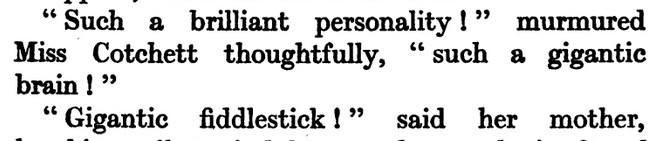
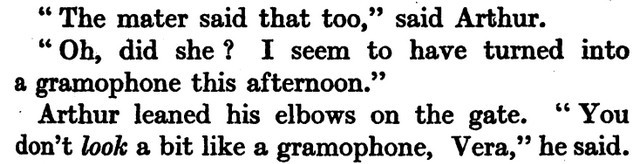
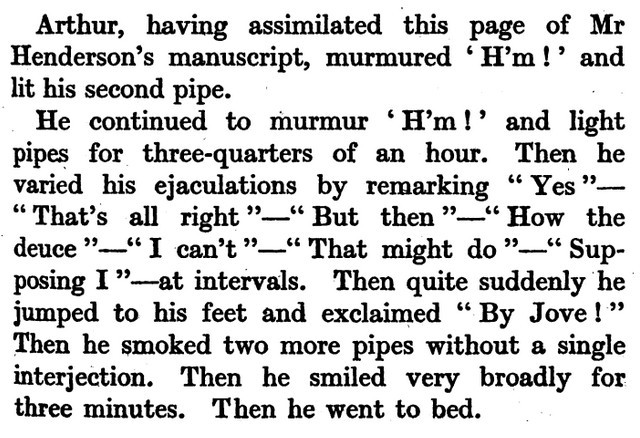
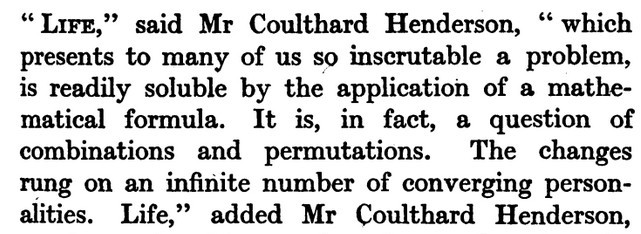
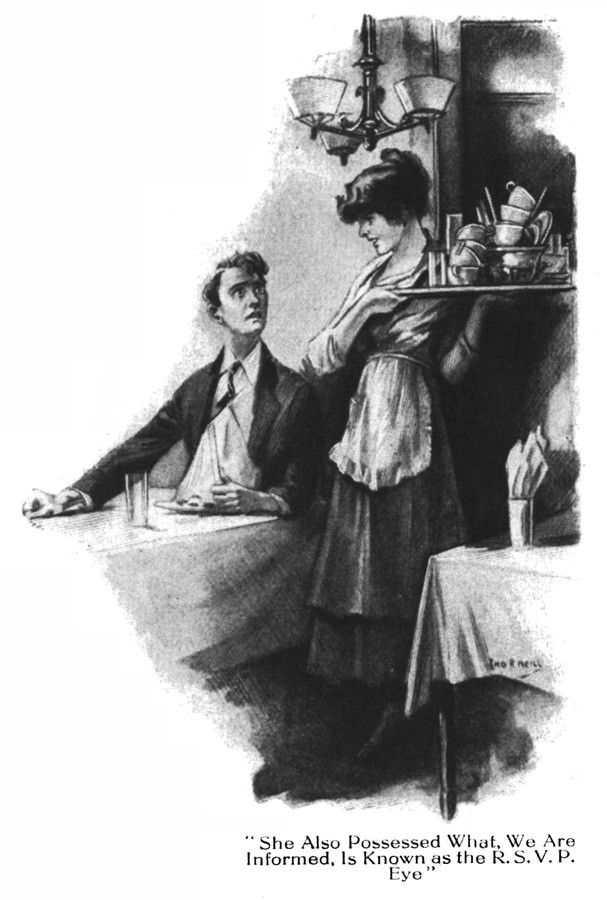
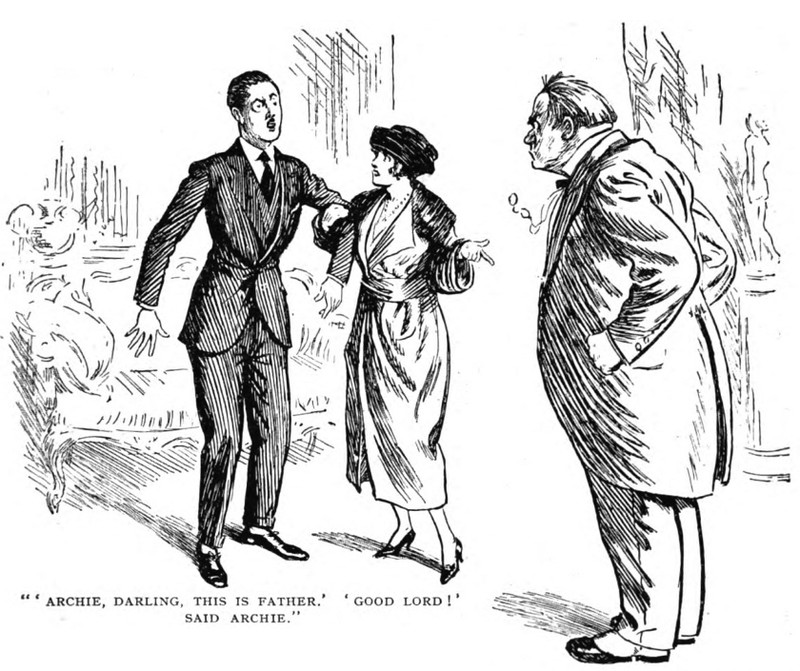
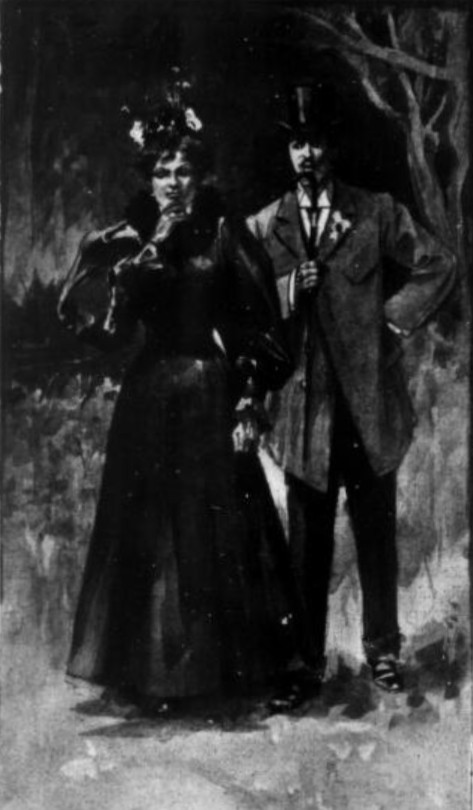
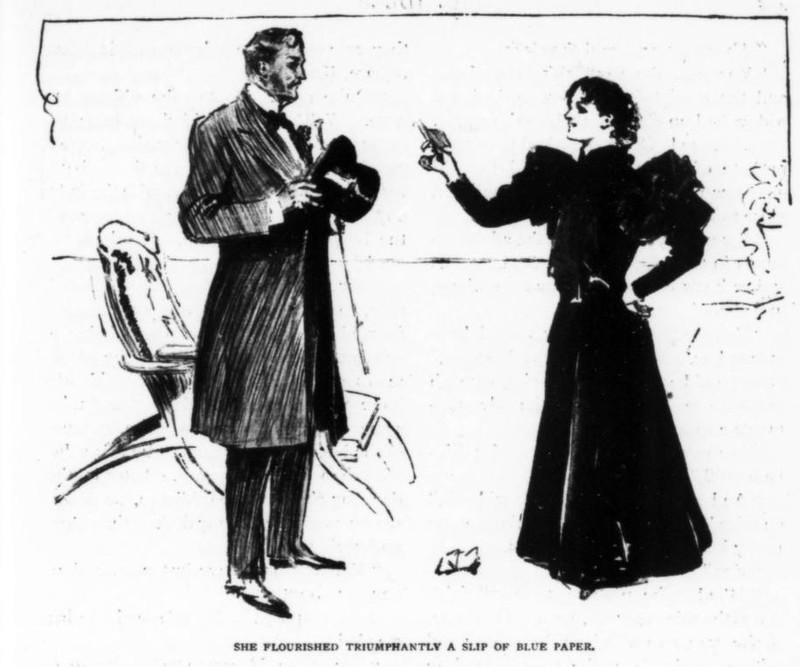
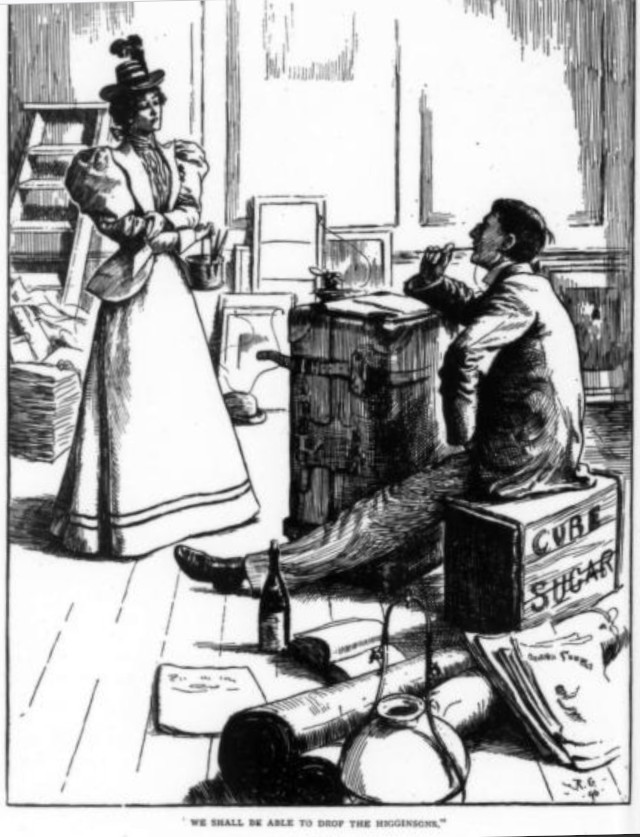
***The Joyous Eyebrow [fictitious Broadway play]***Blue sea, gleaming Casino, cloudless sky, and all the rest of the hippodrome.***Lord Wildersham (pronounced Wing, to rime with Chiddingfold)***“Oh, don’t try and be funny, for goodness’ sake!” snapped Miss Verepoint. “It doesn’t suit you. You haven’t the right shape of head.”***“Moom?”“It’s spelt M-o-f-f-a-m, but pronounced Moom.”“To rhyme,” said Archie, helpfully, “with Bluffinghame.”***“I would do anything in my power to oblige the friend of a man whose cousin has met my brother at a garden-party, but there are no vacancies, I fear.”***In theatrical circles especially it holds a position which might turn the white lights of many a supper palace green with envy.***“I seen turnips with more spirit in ’em that what you’ve got. And Brussels sprouts. Yes, and parsnips.”***“Some day I knew I should meet the only girl I could possibly love, and then I would pour out upon her the stored-up devotion of a lifetime, lay an unblemished heart at her feet, fold her in my arms and say, ‘At last!’ ”“How jolly for her. Like having a circus all to one’s self.”***The collected jaws of the family fell as one jaw. Muriel herself seemed to be bearing the blow with fortitude, but the rest were stunned. Frank and Percy might have been posing for a picture of men who had lost their fountain pens.***[Cinquevalli again (and last time it wasn't Wodehouse)!]Although Dermot Windleband described himself as a Napoleon of Finance, a Cinquevalli of Finance would, perhaps, have been the more accurate description.***“No, no—I quite see that,” assented Roland. Dermot glanced up at him quickly, wondering whether, after all, he knew a little more than he had appeared to do. Luckily, Roland was trying, at the moment, to look intelligent, so Dermot was reassured.***“Why, if they know you want to buy you’ve as much chance of getting away from them without the paper as—as—well, I can’t think of anything that has such a poor chance of anything.”***[plus two illustrations/captions attached, from PGW stories in periodicals]
|
|
|
|
|
|
|
unearths some literary gems.
|
|
|
|
|
|
|
unearths some literary gems.
***
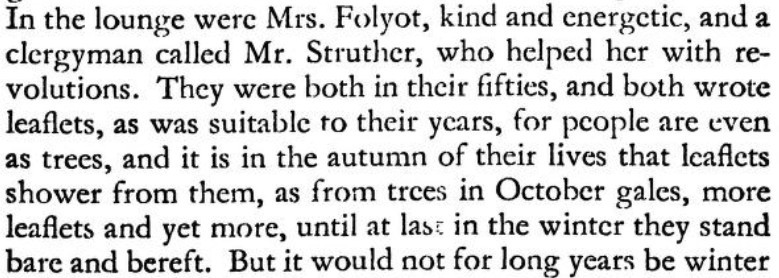
I was taken aback, and may be said to have stayed aback ever since.
***
Tomorrow, ten times the size of last Tuesday, is suddenly rich with promise.
***
[New York City is] a comic strip painted on vellum and bound in gold.
***
[The routine of preliminary play rehearsals] for the author is rather like conducting a party of tourists across fields of glue.
***
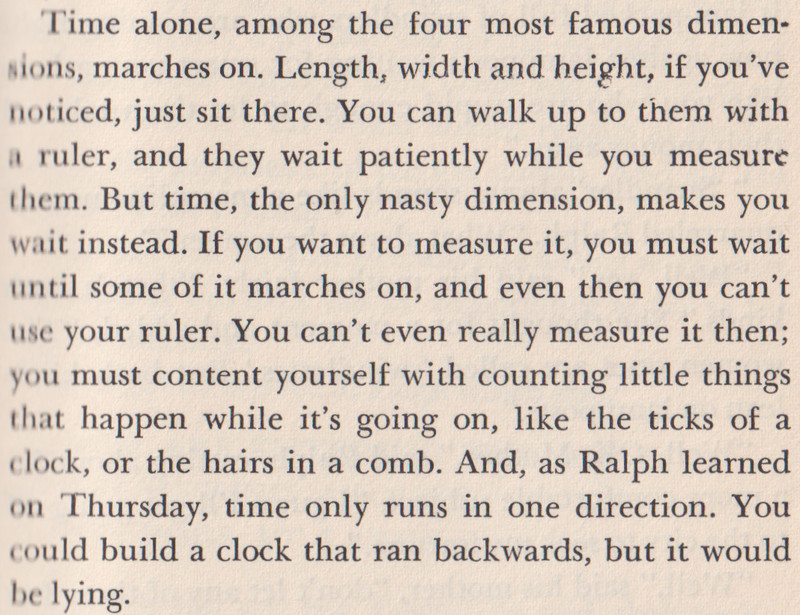
[The secret of the stereoscope] is that having attained at last the third dimension, it begins to remind us of the fourth dimension, that of Time.
***
[A dream is] a bonus after dark, another slice of life cut differently....Only a dream! Why only?
***
There is to me a curious pleasure...in coming upon a real street scene that looks like a good stage set. [I am totally with him on this!]
***
[The sound of an orchestra tuning up is] a chaos...but it is a chaos caught at the supreme moment, immediately before Creation. Everything of order and beauty shortly to be revealed is already there in it. Moreover, it never fails us, unlike some of the compositions that will follow it.
***
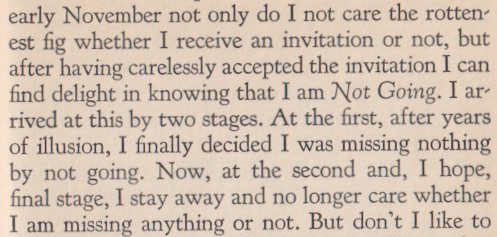
I must admit that with me the delight comes from receiving the free pass and not from actually making use of it....Ironically enough, once I have been given a free pass I rarely find any opportunity to use it.
***
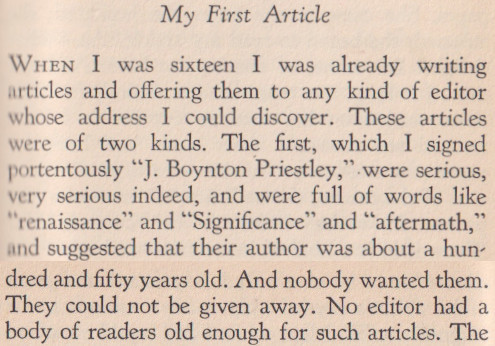
[His younger self's journal notes] are portentous, each note weighing at least fifty-six pounds.
***
This kind of morning…. has a unique trick of lifting me out of time; I seem to be moving along a fifth dimension and to have a four-dimensional outlook. Or put it more sensibly like this. These mornings link up directly and vividly with similar mornings in my past, so that I am aware of myself as I was then.
***
[More snippets attached.]
[Bonus: A (presumably) nonexistent dull book called Life and Times of Lord Dreary. N.B. When transcribing that title just now, I initially left out "and Times." I'm glad I caught the error, because I genuinely feel the complete title is so much better than my inadvertently abridged version. The boring lord's life and times! (my emphasis).]
[Also: One of Priestley's little essays is a tribute to the everything-intentionally-goes-wrong act of Frank Van Hoven. I wasn't aware of this precursor to Tommy Cooper et al., but I assume you know all about him. The Internet tells me, correctly or otherwise, that FVH's slogan was "The Man Who Made Ice Famous." Priestley refers to a genre of FVH trick "as labyrinthine and regressive as a Kafka novel, a trick never to be completed in this world," and describes Van Hoven's unsuccessful struggle with all those uncooperative "things."]
|
|
|
|
|
|
|
unearths some literary gems.
From Iole, by Robert W. Chambers:
***“He calls it the house beautiful, you know.”“Why not the beautiful house?” asked Wayne, still more coldly.“Oh, he gets everything upside down.”***A thrill passed completely through Wayne, and probably came out on the other side.***“And, as it is the little things that are the most precious, so nothing, which is less than the very least, is precious beyond price.”***“Art is an art.” With which epigram he slowly closed his eyes....“Art,” continued the poet, opening his heavy lids with a large, sweet smile, “Art is above Art, but Art is never below Art. Art, to be Art, must be artless. That is a very precious thought—very, very precious. Thank you for understanding me—thank you.”***“You ask me what is Art. I will tell you; it is this!” And the poet, inverting his thumb, pressed it into the air. Then, carefully inspecting the dent he had made in the atmosphere, he erased it with a gesture and folded his arms.***A mechanical smile struggled to break out, but it was not the smile, any more than glucose is sugar.***A wan young man whose face figured only as a by-product of his hair whispered “Hush!”***“Verse is a necklace of tinted sounds strung idly, yet lovingly, upon stray tinseled threads of thought.”***“Let me cite, as an example, those beautiful verses of Henry Haynes,” he replied gravely.TO BE OR NOT TO BEI’d rather be a Could Be,If I can not be an Are;For a Could Be is a May Be,With a chance of touching par.I had rather be a Has BeenThan a Might Have Been, by far;For a Might Be is a Hasn’t BeenBut a Has was once an Are!Also an Are is Is and Am;A Was was all of these;So I’d rather be a Has BeenThan a Hasn’t, if you please.[I suspect Chambers made that poem--and its purported author--up; the only famous Henry Haynes I find is an entertainer who came later. Bernard Shaw in this book is represented by an offstage playwright* called Barnard Haw, so maybe "Henry Haynes" is a spoof on Heinrich Heine or someone? I also learned that this verse is widely misattributed to Milton Berle (who was born several years after this book was published). Though that may have happened in the usual way, I suppose in this case Berle himself might be to blame, as he was notorious for appropriating material.][*Well, of course the playwright usually remains offstage, but this one is doubly offstage.]***[Bonus: This is another book that includes Wodehousian bickering-telegram business. Iole was published in 1905, when I believe PGW was literarily still in short pants, that is to say mostly writing school stories--so I bet Chambers anticipated him.]
|
|
|
|
|
|
|
unearths some literary gems.
From On the Stage--and Off, by Jerome K. Jerome:
***When I communicated my heroic resolution to my friends, they reasoned with me. That is, they called me a fool; and then said that they had always thought me a sensible fellow, though that was the first I had ever heard of it.***I read through every word of Shakespeare,—with notes, which made it still more unintelligible.***Among the sham agents must be classed the “Professors,” or “X. Y. Z.‘s,” who are always “able to place two or three” (never more than two or three: it would be no use four applying) “lady and gentlemen amateurs, of tall or medium stature, either dark or fair, but must be of good appearance, at a leading West-end theater, in good parts: Salaried engagement.”***In these reminiscences I intend to talk only about what I understand—an eccentric resolution for an author, I admit; but no matter, I like to be original now and then.***Of course, I had assumed a stage name. They all do it. Heaven only knows why; I am sure they don’t. While in the profession, I met a young fellow whose real name happened to be the very one that I had assumed, while he had taken my real name for his assumed one. We were both happy and contented enough, until we met; but afterward we took a sadder view of life, with all its shams and vanities.***The music stools and stands in the orchestra, together with the big drum, and the violoncello in a green baize case, were all in a heap in the corner, as if they had had a performance on their own account during the night, and had ended up by getting drunk.***But no, they would all of them live in cottages. It would not pay to alter three or four different scenes, and turn them all into cottages, especially as they might, likely enough, be wanted for something else in a week’s time; so our one cottage interior had to accommodate about four distinct families. To keep up appearances, however, it was called by a different name on each occasion. With a round table and a candle, it was a widow’s cottage. With two candles and a gun, it was a blacksmith’s house. A square table instead of a round one—“Daddy Soloman’s home on the road to London. ‘Home, sweet home.’” Put a spade in the corner, and hang a coat behind the door, and you had the old mill on the Yorkshire moors.It was all no use though. The audience, on the opening night, greeted its second appearance with cries of kindly recognition, and at once entered into the Humor of the thing....After one or two more appearances, the cottage became an established favorite with the gallery. So much so, indeed, that when two scenes passed without it being let down, there were many and anxious inquiries after it, and an earnest hope expressed that nothing serious had happened to it. Its reappearance in the next act (as something entirely new) was greeted with a round of applause, and a triumphant demand to know, “Who said it was lost?”***We had no dress rehearsal. In the whole course of my professional life, I remember but one dress rehearsal. That was for a pantomime in the provinces. Only half the costumes arrived in time for it. I myself appeared in a steel breast-plate and helmet, and a pair of check trousers; and I have a recollection of seeing somebody else...going about in spangled tights and a frock coat. There was a want of finish, as one might say, about the affair.***I am told that in my frock and pinafore days, I used to stand upon the table, and recite poetry, to the intense gratification of my elderly relatives (ah, the old folks knew how to enjoy themselves, when I was a boy!); and an old nurse of mine always insisted that on one occasion I collected half a crown in an omnibus by my spirited rendering of “Baa, baa, black sheep.” I have no recollection of this performance myself though, and, if it really did take place, where’s the money? This part of the question has never, to my mind, been satisfactorily cleared up.***"Our leading man has never turned up, so his part has been cut out, and this has not improved the plot."***“Sometimes there’s a row over the cast. Second Low Comedy isn’t going to play old men. That’s not his line; he was not engaged to play old men. He’ll see everybody somethinged first."***They bore you to death every day, too, with a complete record of the sayings and doings of some immaculate young man lodger they once had. This young man appears to have been quite overweighted with a crushing sense of the goodness of the landlady in question. Many and many a time has he said to her, with tears in his eyes: “Ah, Mrs. So-and-so, you have been more than a mother to me”; and then he has pressed her hand, and felt he could never repay her kindness. Which seems to have been the fact, for he has generally gone off, in the end, owing a pretty considerable sum.***I left here to join a small touring company as Juvenile Lead. I looked upon the offer as a grand opportunity at the time, and following Horace’s * advice, grasped it by the forelock.* Not quite sure whose advice this is. Have put it down to Horace to avoid contradiction.***I, with two or three others, thereupon started off for a theater at the East End, which was about to be opened for a limited number of nights by some great world-renowned actor. This was about the fortieth world-renowned party. I had heard of for the first time within the last twelvemonth. My education in the matter of world-renowned people had evidently been shamefully neglected.***
|
|
|
|
|
|
|
unearths some literary gems.
From the Idler, vol. 9 (1896):
***
"I respected the wishes of the donkey, therefore, and drew the line, henceforward, at six songs." [The donkey is pulling a cart or something, and is therefore a captive audience for the amateur singer.]
***
"I think it's so clever for children to be--to be--what is the word?--clever.
***
[Notes on some of the attachments...]
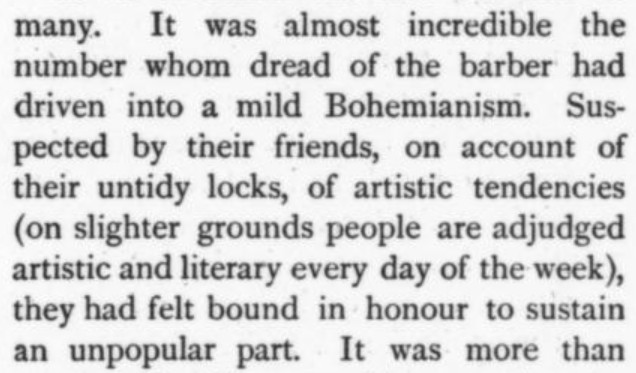
[The passage about accidental bohemians is from a piece wherein a staff of bald barbers is rounded up to cater to balding men who are intimidated by barbers with full heads of hair.]
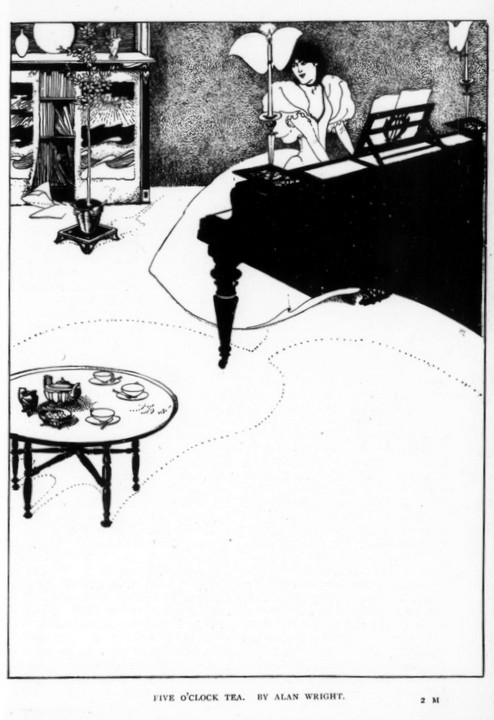
["Five O'clock Tea": In which Art Nouveau precurses Billy's dotted-line excursions in The Family Circus?]
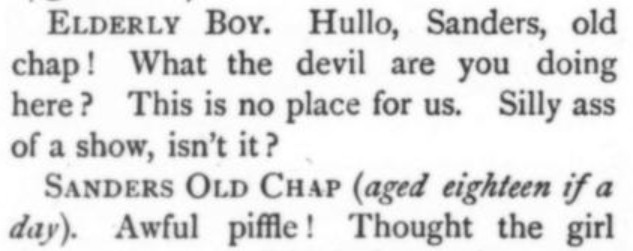
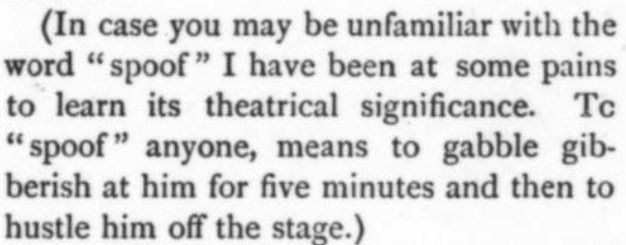
["Sanders Old Chap": Ha! Having been addressed thus by his colleague, the phrase slips into place as his "official" character name.]
["She must have much more time to think about it": That was what the caption told us. (I couldn't get the caption to fit legibly into my screen capture.)]
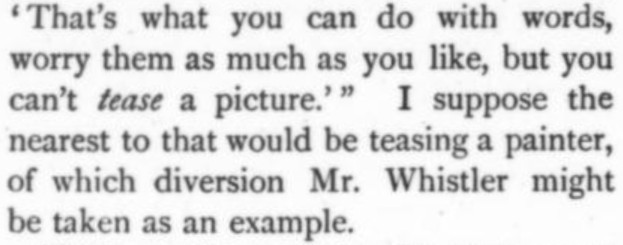
["Teasing a picture": The context, in case it's not self-evident, is the challenge of painting versus writing.]
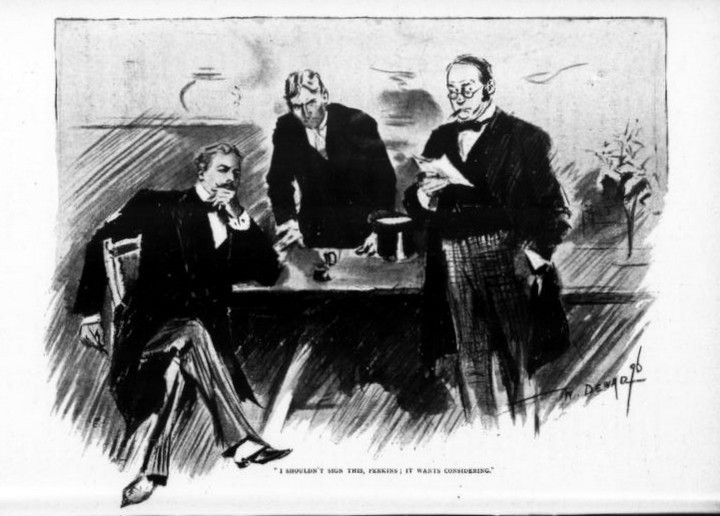
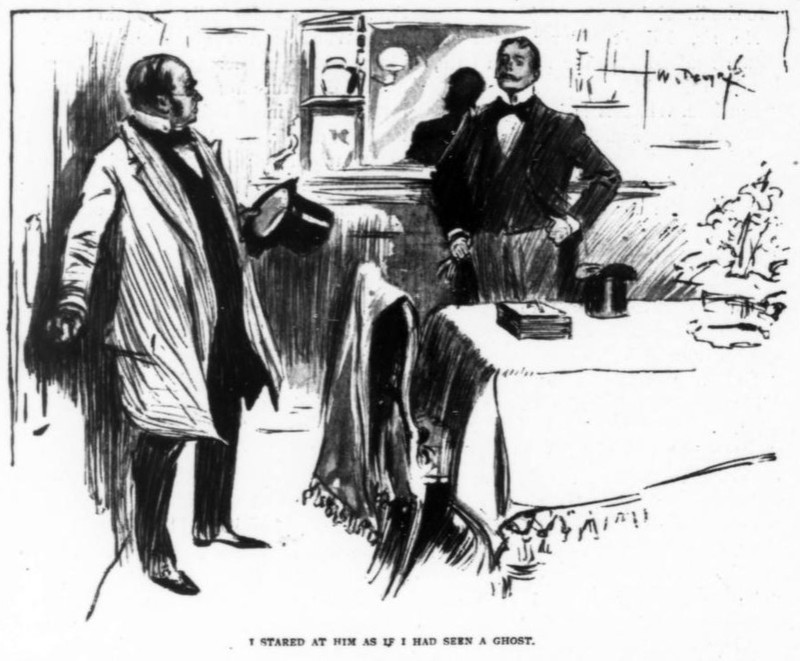
["The wrong ghost": The illustrator seems to have goofed here: in the story, it's the gentleman at left whose presence has startled the narrator-protagonist, whose appearance in the various illustrations consistently matches that of the gentleman at right (Perkins, as seen in "I shouldn't sign this," seated at left as if he's having his portrait painted by a Royal Academician, and has no intention of signing anything anytime soon.). P.S. The landlady in these stories is called Mrs. Nix. Meanwhile, in some other piece, we have a Mrs. Trivett.]
|
|
|
|
|
|
|
unearths some literary gems.
|
Page 19 of 65
> Older Entries...
Original Content Copyright © 2026 by Craig Conley. All rights reserved.
|