|
|
|
|
|
|
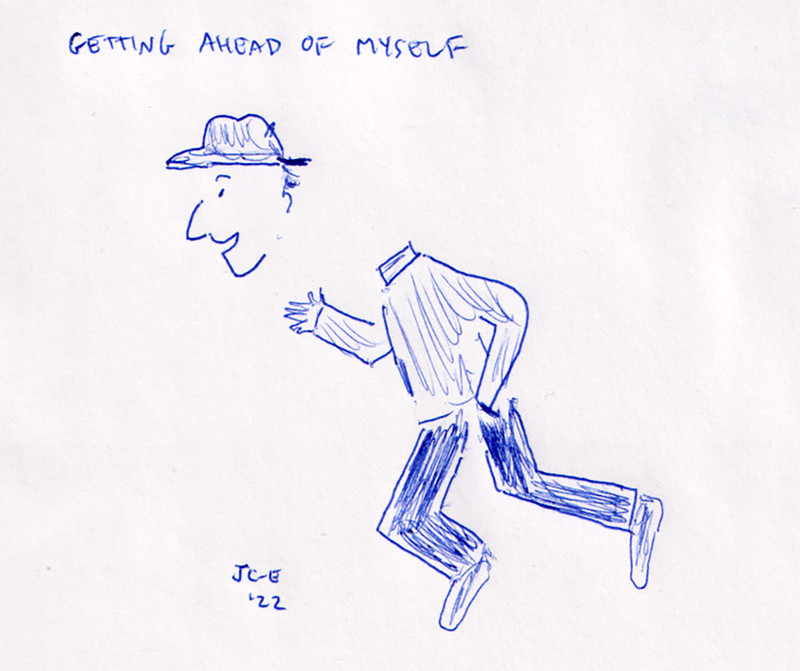
unearths some literary gems.
From Flaubert's Parrot, by Julian Barnes:
***
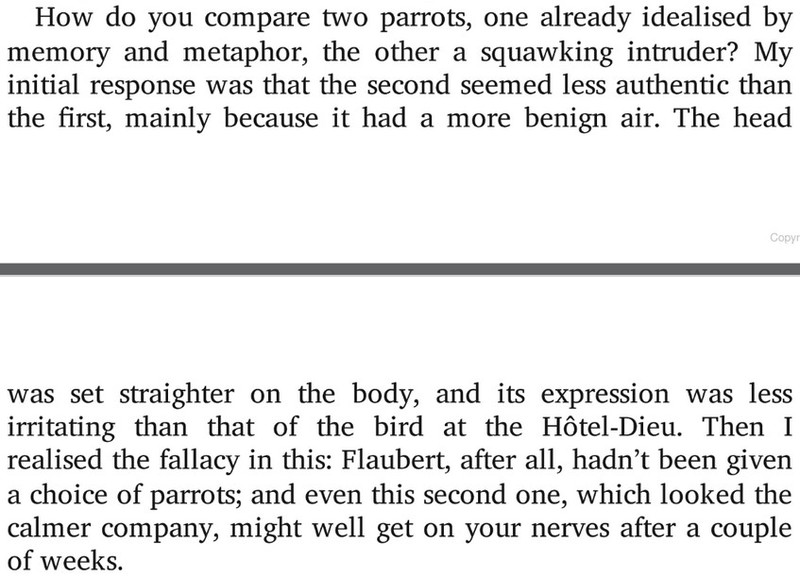
The parrot, he wrote, had been on his desk for three weeks, and the sight of it was beginning to irritate him.
***
You could say that the parrot, representing clever vocalisation without much brain power, was Pure Word....Is the writer much more than a sophisticated parrot?
***
From a neighbouring room a telephone imitated the cry of other telephones.
***
What had Flaubert done with [the stuffed parrot] after finishing Un coeur simple? Did he put it away in a cupboard and forget about its irritating existence until he was searching for an extra blanket?
***
[writes Flaubert] "Me and my books, in the same apartment: like a gherkin in its vinegar."
***
[SPOILER ALERT] There are no parrots in Madame Bovary.
***
And if you don't like these ironies, I have others.
***
The correct word, the true phrase, the perfect sentence are always ‘out there’ somewhere; the writer’s task is to locate them by whatever means he can. For some this means no more than a trip to the supermarket and a loading-up of the metal basket; for others it means being lost on a plain in Greece, in the dark, in snow, in the rain, and finding what you seek only by some rare trick such as barking like a dog.
***
It was a curious ménage: the girl, the uncle, the grandmother--a solitary representative of each generation, like one of those squeezed houses you sometimes see with a single room on each storey. (The French call such a house un baton de perroquet, a parrot's perch.)
***
[The arrival of the railways] produced a new figure at the dinner table: the railway bore....In June 1843 [Flaubert] pronounced the railways to be the third most boring subject imaginable.
***
[From Flaubert's Dictionnaire de idées reçues, which we learn was a sort of ironic etiquette guide cum devil's dictionary]
'Always go into ecstasies about [the railways'] invention, and say: "I, Monsieur, I who am even now speaking to you, was only this morning at X. . .; I left by the X-o'clock train; I did the business I had to do there; and by X-o'clock I was back."'
***
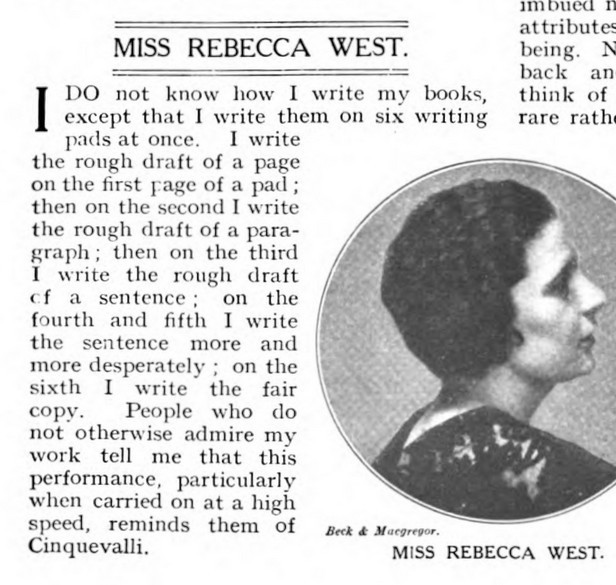
Do the books that writers don't write matter?
***
The books he fails to write once he has announced his profession...are the not-books for which he must take responsibility.
***
[Re. the protagonist's own version of a "dictionary of received ideas," specifically about Flaubert clichés, and including one entry for each letter of the alphabet]
The letter X is going to be a problem, I can see.
[But what about "X-o'clock"! Alas, a missed opportunity, for when this mini-work appears later in the novel, the protag has cheated by writing, under X, "XYLOPHONE: There is no record of Flaubert ever having heard the xylophone." Granted, it made me laugh.]
***
A pier is a disappointed bridge; yet stare at it for long enough and you can dream it to the other side of the Channel. The same is true with these stubs of books.
***
He spread his hands slowly on the table, in a conjuror's calming gesture.
***
|
|
|
|
|
|
|
unearths some literary gems.
From "A Slice of Life," by P. G. Wodehouse:
***“Sir Jasper Finch-Farrowmere?” said Wilfred.“ffinch-ffarrowmere,” corrected the visitor, his sensitive ear detecting the capital letters.“Ah, yes. You spell it with two small f’s.”“Four small f’s.”***“Pooh to you!” said Wilfred. “And, if you want to know what I think, you poor ffish, I believe your name is spelled with a capital F, like anybody else’s.”Stung to the quick, the baronet turned on his heel and left the room without uttering another word.***This cousin, as you will have guessed, was Wilfred himself—but a very different Wilfred from the dark-haired, cleancut young scientist who had revolutionized the world of chemistry a few months before by proving that H2O + b3g4z7 – m9z8 = g6f5p3x.***Give me that key, you fiend.”“ffiend,” corrected Sir Jasper automatically.***[Bonus: The Madame Eulalie site notes, among the corrections to printer's errors, "Magazine had “And with her my bblessing”; corrected to “b-blessing” as in book editions"--which I think is especially funny given all the "ff" business.]
|
|
|
|
|
|
|
unearths some literary gems.
From "Doing Clarence a Bit of Good," by P. G. Wodehouse:
[Sometimes it's not what you say, it's how well you what-not it.]***To make you understand the full what-d’you-call-it of the situation, I shall have to explain just how matters stood between Mrs. Yeardsley and myself.***“If I had the artistic what’s-its-name,” he went on, “if the mere mention of pictures didn’t give me the pip, I daresay it wouldn’t be so bad.”***And the moment she said it I knew something was going to happen. You know that pre-what-d’you-call-it you get sometimes? Well, I got it then.***Well, after all, if you see what I mean—— The days that are no more, don’t you know. Auld Lang Syne, and all that sort of thing. You follow me?***
|
|
|
|
|
|
|
unearths some literary gems.
From "Dear Old Squiffy," by P. G. Wodehouse:
***“You might almost say my genius is stifled. Or strangled, if you prefer it.”“Anything you say,” agreed Archie, courteously. “But how? Why is your what-d’you-call-it what’s-its-named?”***“He doesn’t bite, I suppose, or sting or what-not?”“He may what-not occasionally. It depends on the weather.”***Something seemed to tell him that he was asking for trouble with a loud voice***[Peter is a snake.]The bag was one of those simple bags with a thingummy which you press. Archie pressed it. And, as it opened, out popped the head of Peter. His eyes met Archie’s. Over his head there seemed to be an invisible mark of interrogation.***“My snake! My Peter!” Mme. Brudowska’s voice shook with emotion. “He is here, here in this room.”Archie shook his head.“No snakes here! Absolutely not! I remember noticing when I came in.”***“Mr. Moffam wouldn’t go round stealing snakes.”“Rather not,” said Archie. “Never stole a snake in my life. None of the Moffams have ever gone about stealing snakes. Regular family tradition!”***
|
|
|
|
|
|
|
unearths some literary gems.
From "Disentangling Old Percy," by P. G. Wodehouse:
***I knew just what would happen. Parbury, Parbury, Parbury, and Stevens, the solicitors, simply looked at me as if I had been caught stealing milk-cans. At least, Stevens did. And the three Parburys would have done it, too, only they had been dead a good time.***When I got back I found a pile of telegrams waiting for me. They were all from Florence, and they all wanted me to go to Eaton Square. The last of the batch, which had arrived that morning, was so jolly peremptory that I felt as if something had bitten me when I read it.***
|
|
|
|
|
|
|
unearths some literary gems.
From "Ahead of Schedule," by P. G. Wodehouse:
***Everyone liked Rollo—the great majority on sight, the rest as soon as they heard that he would be a millionaire on the death of his Uncle Andrew. There is a subtle something, a sort of nebulous charm, as it were, about young men who will be millionaires on the death of their Uncle Andrew which softens the ruggedest misanthrope.***Mr. Galloway, having abjured woman utterly, had flung himself with moody energy into the manufacture and propagation of his “Tried and Proven” Braces, and had found consolation in it ever since. He would be strong, he told himself, like his braces. Hearts might snap beneath a sudden strain. Not so the “Tried and Proven.” Love might tug and tug again, but never more should the trousers of passion break away from the tough, masterful braces of self-control.***“Mrs. Wilson and I are old friends, sir. We come from the same town. In fact——”Rollo’s face cleared.“By George! Market what’s-its-name! Why, of course!”***“More the Market Thingummy method, eh? The one you described to me?”“Market Bumpstead, sir!” said Wilson.***
|
|
|
|
|
|
|
unearths some literary gems.
From the Idler, vol. 8 (1895-6):
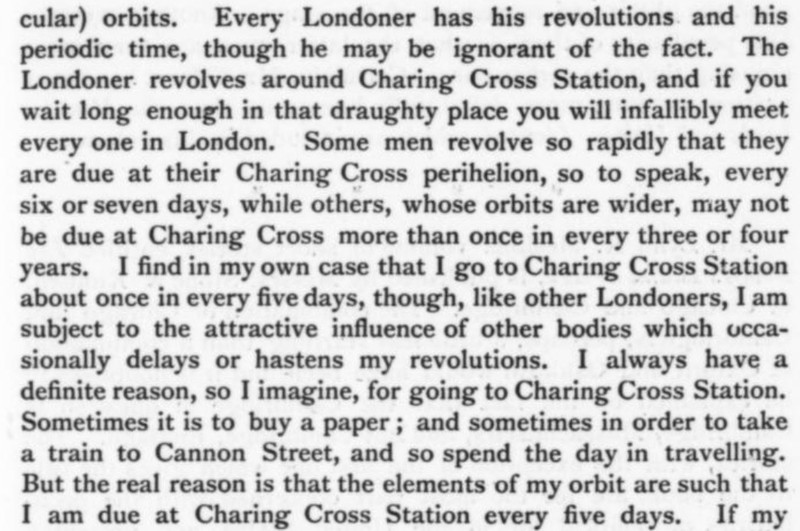
First, some notes on the attachments:
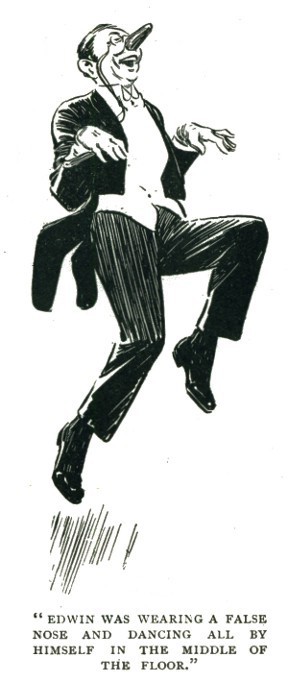
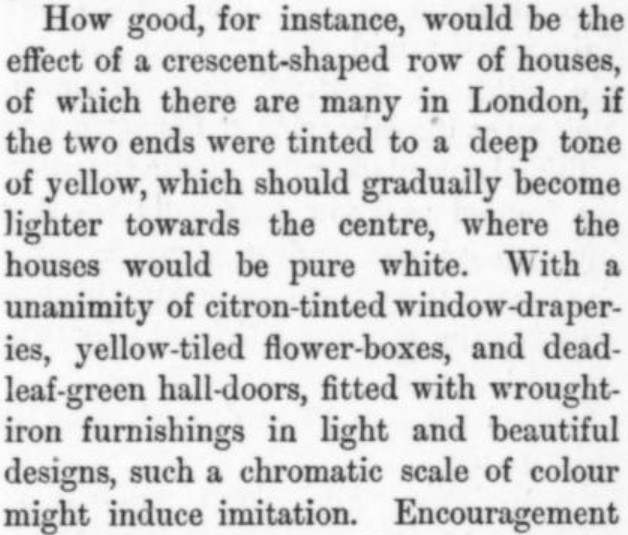
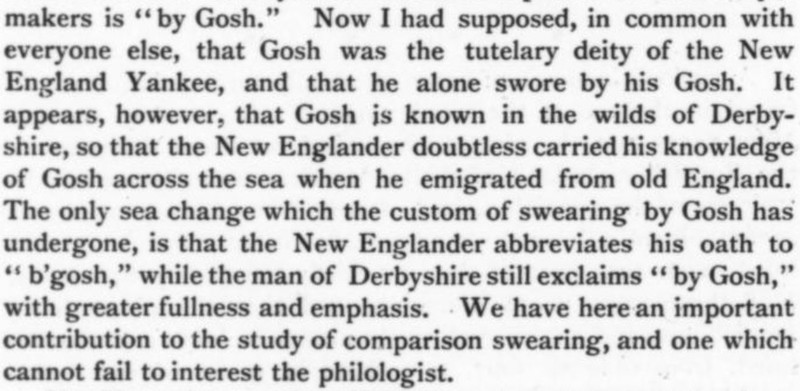
Perhaps you've previously encountered the idea of the gradated-spine-colors bookshelf scheme applied to a row of houses, but I don't think I have. (This is from one of those past futures artifacts, namely, a piece about what London will be like in 1930--with an emphasis on beautification. The third snippet is also from that article.)
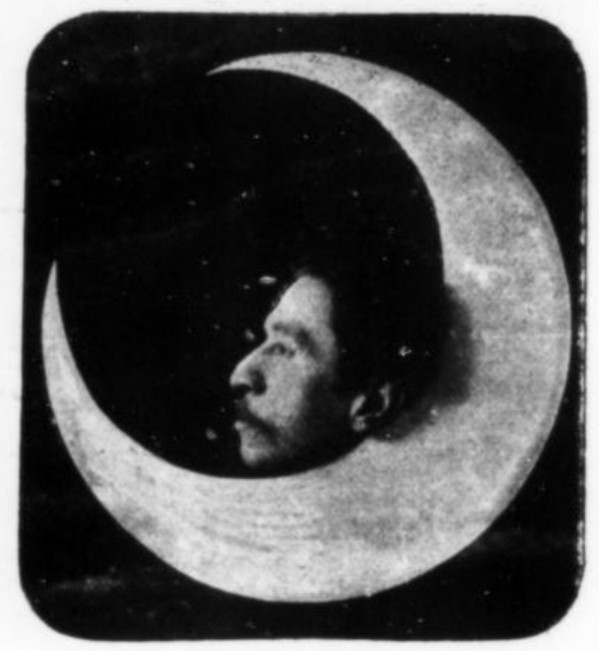
As I see it, this man in the moon is not only in but on the moon.
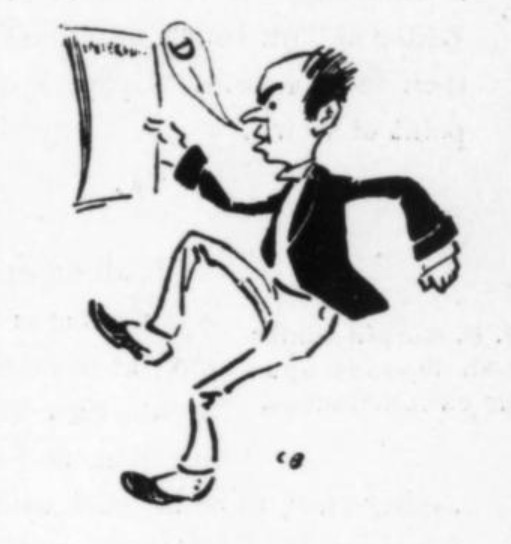
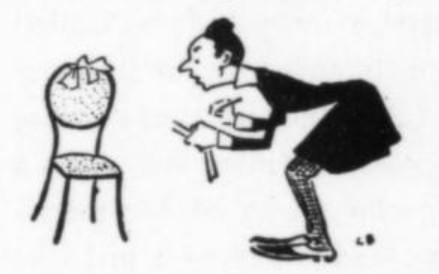
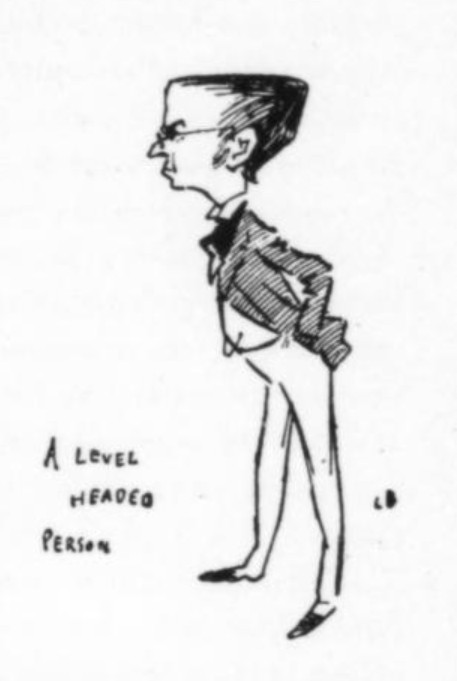
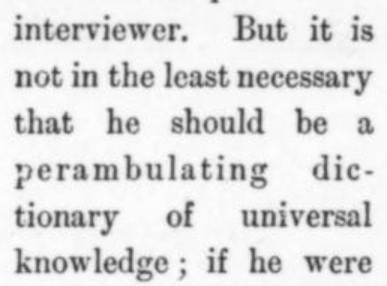
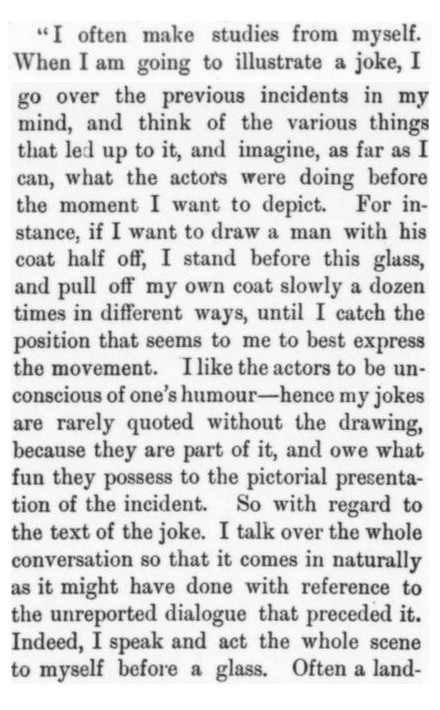
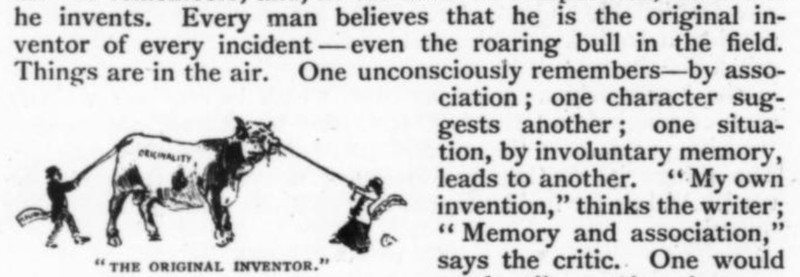
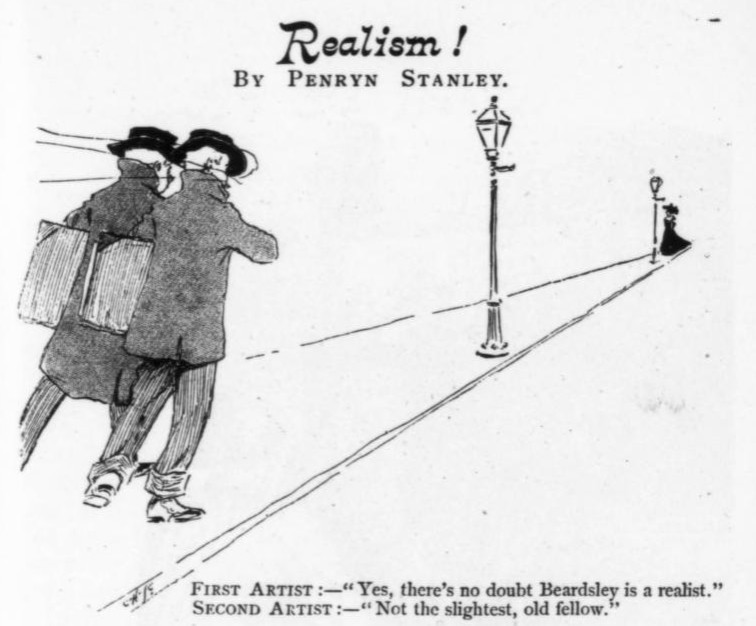
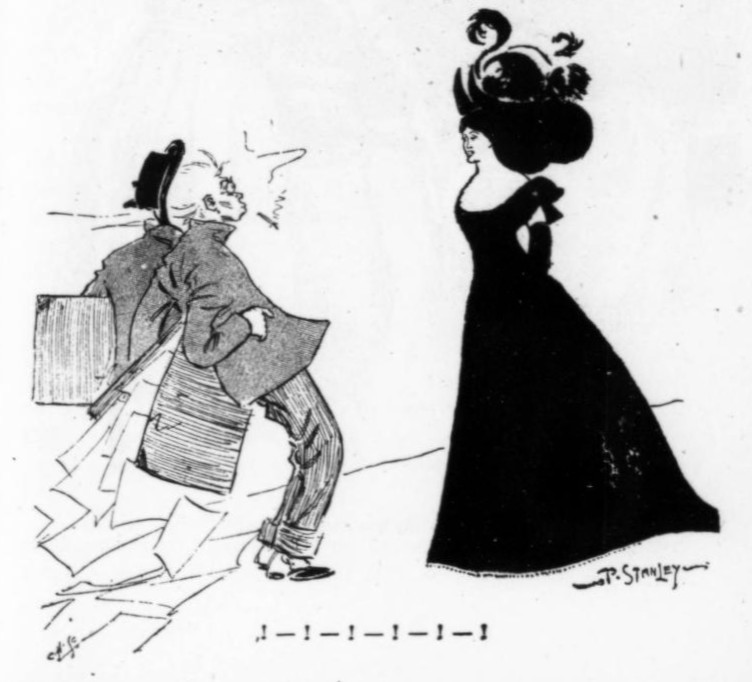
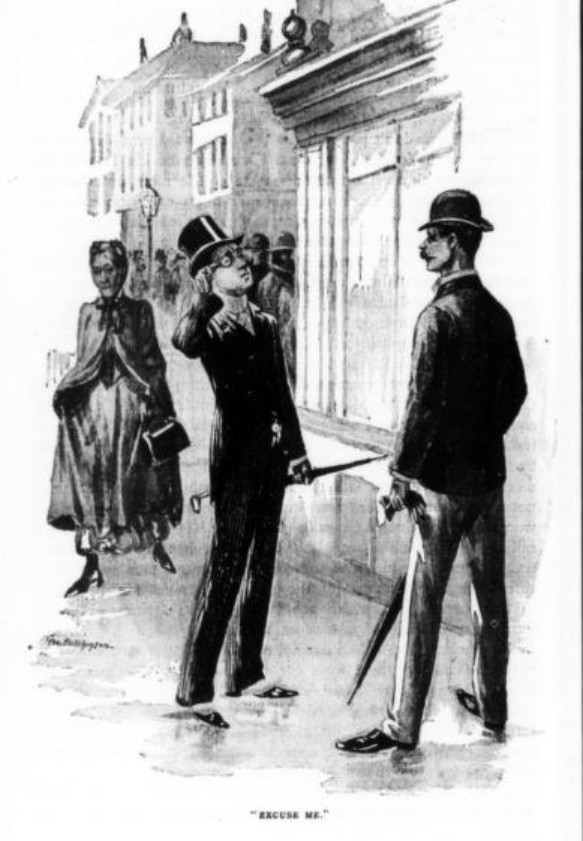
Several of these snippets, and the cartoons, are from an Idlers Club round-robin about interviewing. The illustration of someone interviewing a chair reminds me that someone I know once told me he prepared to interview a band called the Chairs by pretending to interview the empty, actual chairs that awaited their arrival (to test the audio setup).
Here's a bonus bit from the Conan Doyle installment, referring to itinerant oculists: "We work our way round with a trail of spectacles behind us."
Next, I wish to report that there was a reference to someone slipping on a piece of orange peel. All I could say to that was, Yes, we have no bananas?
There was a feature in which Sara Jeannette Duncan interviewed herself. (The gag was that she was treating two of her different, publicly transparent writing names as distinct individuals.)
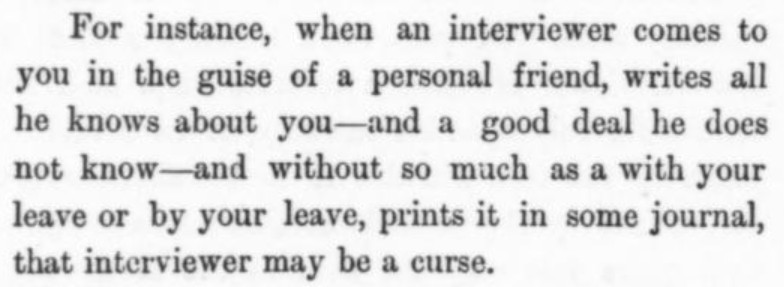
Finally, "Without so much as a with your leave OR by your leave"! [my emphasis]
|
Page 20 of 65
> Older Entries...
Original Content Copyright © 2026 by Craig Conley. All rights reserved.
|