|
|
|
|
|
|
unearths some literary gems.
From Death in the Night Watches, by George Bellairs:
***[Once again I observe how even rather pedestrian writers turn impressively poetic when it comes to flights of mustache metaphor.]He had a large red moustache. His nose, a formidable promontory jutting over this copious covering of his upper lip, combined with it to remind one of the sea breaking against the foot of a granite rock.***[The ancient gardener] began to gossip. He had a confidential and persistent manner, constantly seizing Littlejohn by the arm as he progressed, as though fearing his audience would flee. He behaved for all the world like a salesman, varying his style according to the nature of his story, from that of a tout for indecent post cards to that of an importunate pedlar of insurance.***He had one eyebrow like a Norman arch; the other was Gothic, for he wore a monocle screwed in.[And a little later, one of those empathetic eyepiece incidents occurs--with architectural consequences!]His monocle fell from his eye in dismay and converted the Gothic arch to Norman again.***Long, lean, with sunken cheeks and a torn-looking moustache he gave the impression of being held together by his overalls.***His eyes protruded in intense curiosity and his moustache thrust itself forth incredulously. [Same moustache as above, btw.]***He walked with a peculiar gait like one climbing a ladder.***
|
|
|
|
|
|
|
unearths some literary gems.
From "My Precious Betsy," by John Maddison Morton:
***
Mr. Bobtail: "Yours, et cetera." What's the meaning of et cetera?
Mr. Wagtail: Et cetera? Why, et cetera means et cetera.
Mr. Bobtail: Well, do you know I thought so. Only, as you are a French scholar, I thought I'd ask you.
***
["Without the obtail" dept.]
Mr. Bobtail: (reads) "My dear Elizabeth" — Well, upon my life, that's rather familiar.
Mr. Wagtail: Never mind. I dare say it's only his style.
Mr. Bobtail: But I don't like his style! I object to his style! If it had been "My dear Mrs. Bobtail" — or Mrs. B., without the obtail — it would have been sufficiently free and easy; but, "My dear Elizabeth"— Damn it, Wagtail — I say, Wagtail, damn it!
***
|
|
|
|
|
|
|
unearths some literary gems.
***"You dashed off to feed your cat or something. Minsky? Minky?""Mr. Minks."[Which is only of interest--if at all--because of its coincidental similarity to the following passage in The Pleasure Dial, when Sid Heffy can't remember Artie Plask's name.]"And where’s that new guy, anyway? What’s his name...Placky? Platsky? Pla—"***"It met at his say so, usually once a month when there was absolutely no moon. It was his little joke: the La Luna club didn't really exist, legally or publicly; so it could only run on nights when the real moon didn't exist, either."***
|
|
|
|
|
|
|
unearths some literary gems.
From "Betsy Baker, or, Too Attentive By Half," by John Maddison Morton:
***
Mrs. Mouser. (throws down her work) This is really intolerable! I wish you wouldn’t attempt to sing that song, Mr. Mouser. You’ll never accomplish it.
Mouser. I will accomplish it, Mrs. Mouser. Indeed, I may say, I have accomplished it—all, except the “Ya—oo—oo,” and I’m not going to be beat by a “Ya—oo—oo,” I can tell you.
***
Crummy. Come, come. Now that you see I’ve found you out—tell me how you contrived to wheedle poor Betsy out of her affections?
Mouser. Crummy, I’m not apt to make use of strong language—but—by the living jingo, I never wheedled a Betsy out of anything in all my life!
***
Crummy. Ah ! Any one with her?
Mouser. Yes, my wig. This is your doing—this is your precious work, (seizing Crummy and shaking him). It was you — you who exposed me to the fascinations of this juvenile washerwoman. It’s through you that I have lost my peace of mind, and my wig. Where are they? Where’s my peace of mind? Where’s my wig?
***
|
|
|
|
|
|
|
unearths some literary gems.
From "Taken from the French," by John Maddison Morton:
***
ARTHUR. If you had the slightest particle of regard for me, you’d let me hand you up the hammer and tin-tacks! [....] Stop, Myrtle! Do let me come and hand you up the hammer and tin-tacks! So! I’m to do something energetic, am I? Drown myself in the duck-pond? Yes!—no. I have it! I’ll say good-by to Fritterly, and cut this place at once! And then, Miss Vane, perhaps you’ll be sorry—perhaps you’ll regret that you didn’t let me hand you up the hammer and tin-tacks!
***
LADY FRITTERLY. Spare me your absurd similes.
***
COLONEL COSEY. He’s a pleasant fellow enough in his way, but I prefer being out of his way! To be within the sound of his voice is like living over a printing-office—one continual clatter!
***
[A Parrot Always Makes It Funnier dept.]
LADY FRITTERLY. Give me but time to pack up my jewels, a dozen or two dresses, and a sprinkling of hats, and I’ll be with you, my Arthur! (Going—stops.) You won’t mind my bringing my favorite little pug-dog, of course you won’t—(going—stops again)—and a couple of kittens—a thousand thanks—and you won’t object to putting the parrot cage under your arm? I thought not.
***
|
|
|
|
|
|
|
unearths some literary gems.
***
The Potter sisters--Muriel and Sissy--were well known in Ashdown Dean, largely because hardly anyone knew them at all.
***
[She imagined a Henry James-influenced mystery story] in which several people have achingly endless, convoluted conversations over tea and biscuits, all of them knowing there was that body in the solarium but, with their Jamesian sensibilities, making such oblique references that no one knew if anyone knew if he or she knew. Including the reader.
***
Getting her to talk about anything at all was like being stuck at a party of clams.
[I didn't know that clams had parties! But then, why would I? After all, I don't know any clams well enough to score an invitation.]
***
[Drunk-lord inflation!]
Carrie had once found her outstretched beside the privet hedge, drunk as three lords.
[I'd never done the math to realize that three equally drunk lords would be drunker than just one.]
***
[Her face] reminded Carrie of a poached egg.
***
When she allowed them an audience, it was in her withdrawing room, where she promptly withdrew her attention.
***
It wouldn't surprise Carrie at all if they'd married because of their names--Regina and Reginald--so they could call each other Reggie.
[Cf. Robyn Hitchcock, "All aboard / Brenda's iron sledge / Please don't call me Reg / It's not my name."]
***
[Flirtatious Rhetorical Questions Silently Answered dept.]
Again, she giggled. "Ain't you a caution?"
Jury didn't think so and wanted to get on with it.
***
Bonus: A minor character called Mrs. Thring (i.e., "thing" with an R added).
|
|
|
|
|
|
|
unearths some literary gems.
***
[From Limelight, by Organ]
a well-received performance as Mrs. See-deep [sic] in Observation and Flirtation
[Well! That allusion piqued my interest. It turned out that Observation and Flirtation was a real stage comedy from 1860; I found the text online and took a glance at--and I quote--"Observation and Flirtation: A Comedy in One Act, by Horace Wigan, Comedian, author of Conjugal Lesson--Fascinating Individual--Base Impostor--Pyramus and Thisbe--The Absent One, &c., &c." In the cast of allegorically named characters, Mrs. Seedeep bears her husband's surname; Mister Seedeep goes around making annoying, confident surmises about people's feelings and activities because he "sees" it all.]
[From Observation and Flirtation. "Fiddle-de-dee" as a Verb dept.]
MR. SANGUINE: You in love? fiddle-de-dee!
DR. SLOMAN: Fiddle-de-dee! I shan't fiddle-de-dee!
[A note on the spelling: Both Merriam-Webster's and OED's official versions of the word show no hyphens—but they differ in that M-W's version is "-deedee" (like Dee Dee Ramone) rather than "-dedee" (and a visit to Google Books suggests that "-de-" vs. "-dee-" is in-dee-d a UK vs. U.S. spelling difference). However, three out of OED's five citations for the word are, in fact, hyphenated as in Wigan's version.]
[From the Oxford English Dictionary. Nonsensical Appendage dept.]
Etymology: < fiddle n. or fiddle v., used in a contemptuous sense with a nonsensical appendage.
[Bonus: I think Organ & Wigan would make a good name for a duo, à la Olsen & Johnson.]
|
|
|
|
|
|
|
unearths some literary gems.
From The Lark:
***
There came a time when the world began to grow older, and able to go around alone.
***
Jules Verne raised to the xth power
***
Interchangeable Philosophical Paragraphs
[That piece is exactly as advertised!]
***
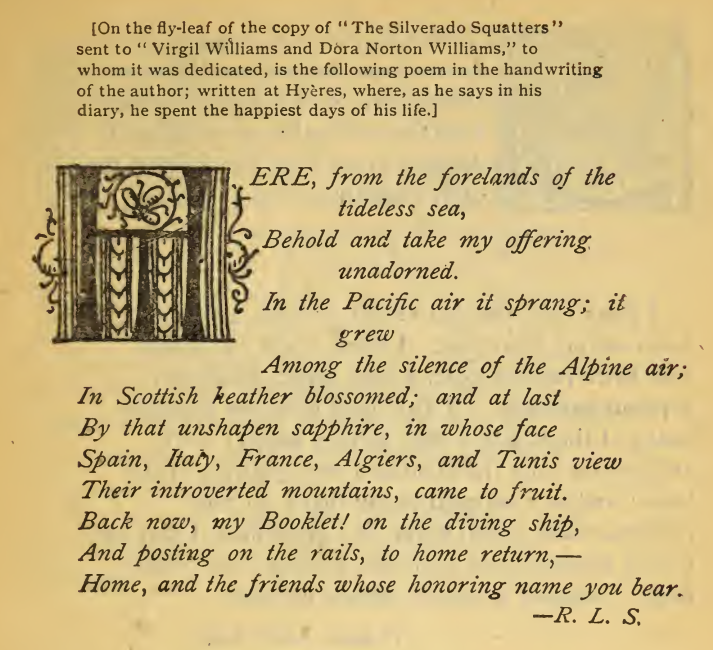
Robert Louis Stevenson says, "Back now, my Booklet"!
***
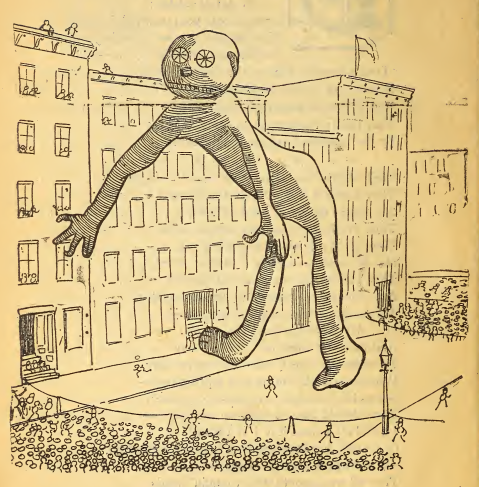
A precursor to the Stay-Puft Marshmallow Man?
***
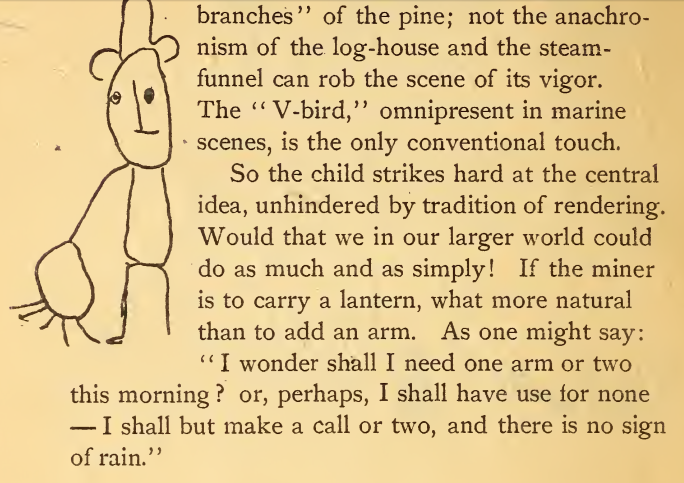
In praise of how children approach the art of drawing.
***
[Fourth attachment.] Furniture nonsense! (I think the page on which this appears is a spoof advertisement.)
***
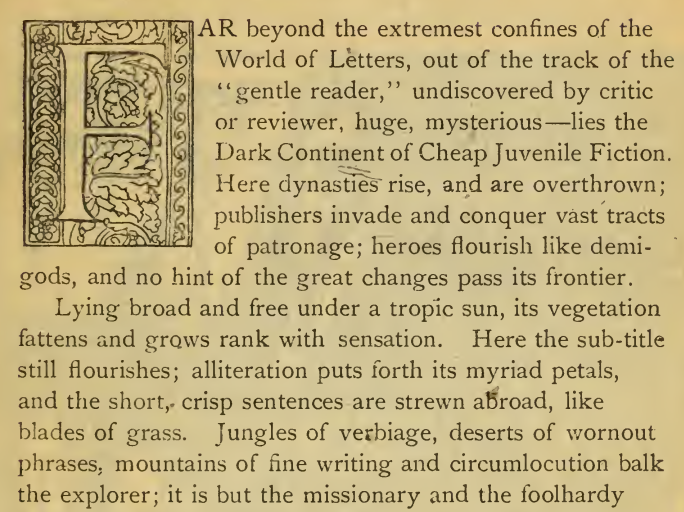
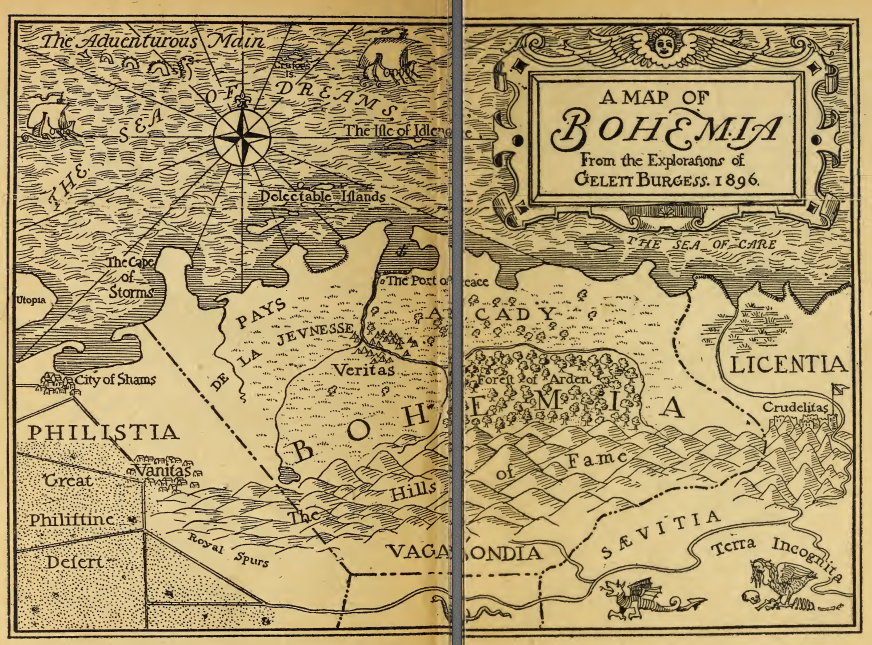
Metaphorical literary geography.
***
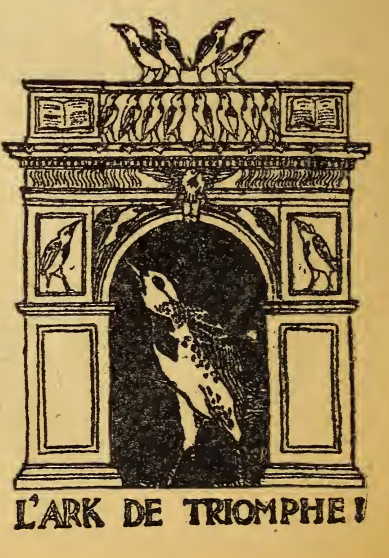
"L'ark de Triomphe."
***
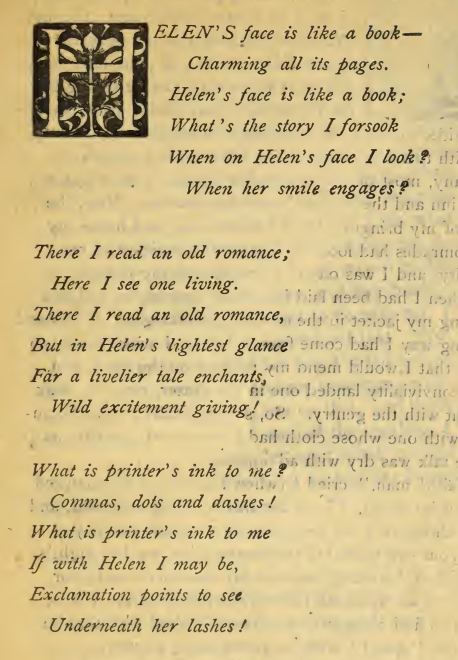
Biblio-punctuational love poetry.
***
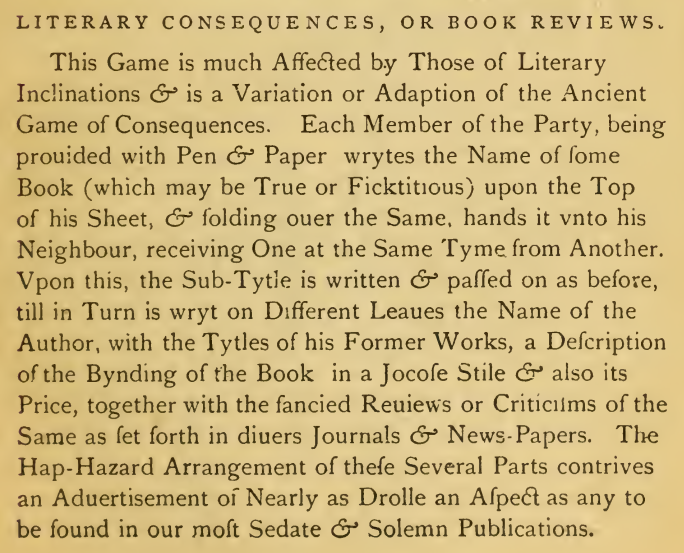
A silly game that seems to loosely precurse and blend Exquisite Corpse, Mad-Libs, and some sort of Ictionary.
***
A Conleyesque map.
***
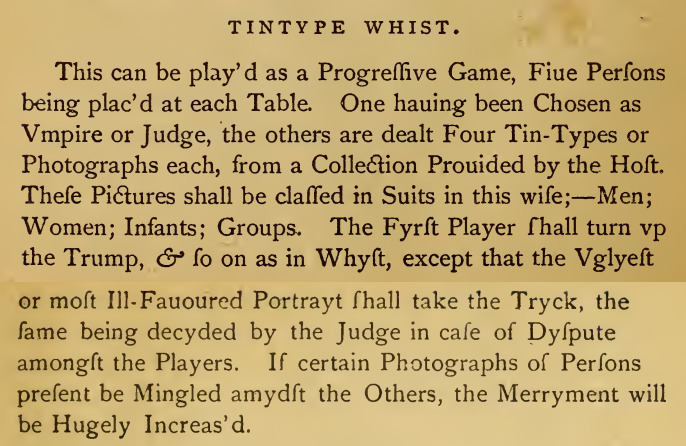
Another silly game: Tintype Whist!
***
|
|
|
|
|
|
|
unearths some literary gems.
A mass of gleaming white statuary confronted him; the room, large and high as a gymnasium, was disposed about it like a frame. Faraday, the statuary might be; or Samuel Rogers; or just conceivably Palmerstone. Seated, it stared apprehensively at the door, as though anticipating the arrival of duns or bailiffs. It base pinned a large though inferior Turkey carpet to the parquet floor. Portraits in ponderous gilt frames conversed wordlessly, and with the effect of administering a decisive snub, across the top of its head. A number of well-polished but clearly functionless tables--of the sort described as "occasional," but whose occasion somehow never arises--were ranged about the room's periphery like sitters-out at a ball. And the only other furniture consisted of two immense Victorian hat and umbrella stands which, flanking the door, flourished a multiplicity of knob-crowned arms, Vishnu-like, at the ceiling.
|
|
|
|
|
|
|
unearths some literary gems.
From A Quiet Life in the Country, by T. E. Kinsey:
***
"I was four years old and recited Newton's Laws of Motion to her and then played "Frère Jacques"--quite badly, she says--on the piano before announcing that when I grew up I was going to be a polar bear."
"You were ambitious, even then."
***
[Though I still like the tmesis-enhanced "la-di-da" best, this is pretty good: "[Blimmin] Lah-di-Dah" as an aristocratic seat! (Note that the variant of the intensive "blooming" is evidently part of the place name, as it's capitalized. Meanwhile, the "di" in Lah-di-Dah is lowercased, because presumably it derives from the Italian "di" or the French "de.")]
"And now she swans around here like the Duchess of Blimmin Lah-di-Dah..."
***
"You know the sort of thing: Lady Evangeline Dullard of the Hampshire Dullards was seen dining out with the Honourable Tarquin Jackanapes."
***
"She's forever poking her nose in at the office, too, y'know. In and out like a fiddler's elbow."
[I see that "in and out like a fiddler's elbow" is a known phrase, but it was new to me.]
***
"'She's all there and halfway back,' as Mrs. Sunderland says."
[Now, this one only brings up two Google hits, both from Google Books, and both 21st-century. (The present book is also 21st-century, but supposedly set in the early 1900s.)
***
|
|
|
|
|
|
|
unearths some literary gems.
***
Ward felt that each morning Joseph Francis arranged his features and kept them that way, unruffled, unmoved, imperturbable.
***
Uncles, cousins, grandfathers, mothers, they had all come out in a welter of storied incident, mingled with births, deaths and street names. [I like the anticlimax of the ending!]
***
"Tommy had skedaddled and was heading for Liverpool or God's to know where"
[I don't recall hearing before this variation on "God knows where," implying that God doesn't know *yet* but will get the memo eventually.]
***
Bonus: A trio of towns called Ovingham, Hartburn, and Ogle
|
Page 42 of 65
> Older Entries...
Original Content Copyright © 2026 by Craig Conley. All rights reserved.
|