|
|
|
|
|
|
unearths some literary gems.
|
|
|
|
|
|
|
unearths some literary gems.
From The Footsteps at the Lock, by Ronald Knox:
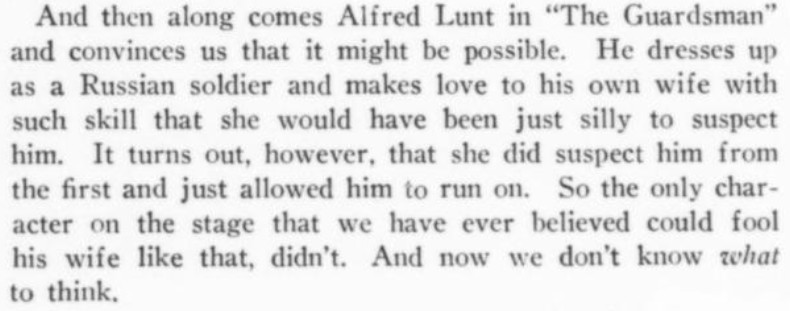
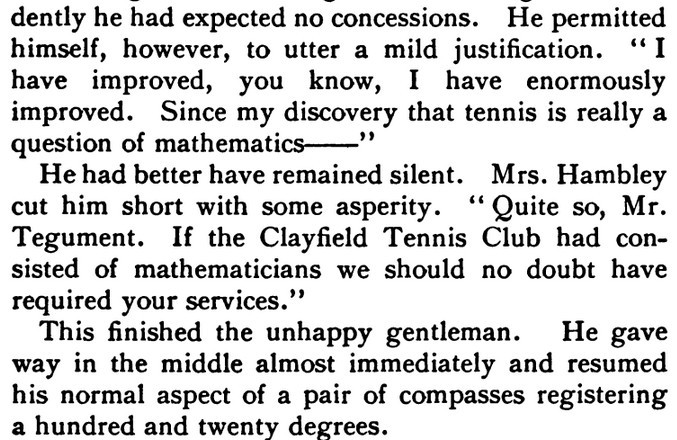
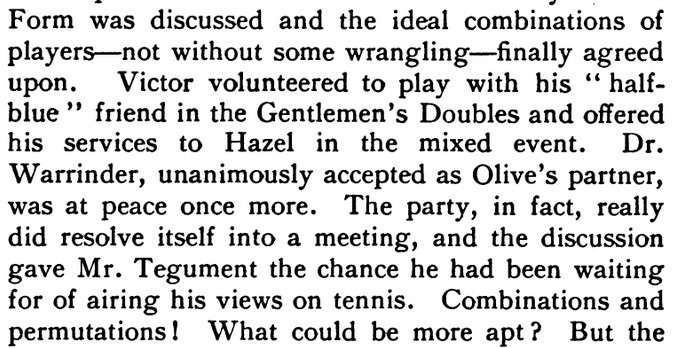
***White wreaths of cloud sailed lazily across the distance, as if assured that they had no speaking part today.***Nigel was introduced to the odd man [i.e., a floating employee or odd-jobs man, I assume], who turned out to be a very ordinary man.***Mr. Burgess [the lock-keeper]...unskilled to close the flood-gates of his own eloquence***"[If I drowned] I might get carried down into the paper mill, and come out at the other end in folio lengths. It would be very annoying to have the account of one's own death printed on one, wouldn't it?"***"I don't know if I ever told you that at school they thought me rather a dab at mathematics.""You whispered it in my ear, darling, when we sat making love on the promenade at Southend."***"I don't know if you often go upstairs backwards, but if you have the habit, you will realize that it's apt to make your stance a little uncertain."***The other still hesitated for a moment; but it was difficult to know whether he was wondering how much the other knew, or merely collecting himself for fresh epigrams.***He was positive of the fact because he remembered discussing the matter with old Mr. So-and-so, and I could ask old Mr. So-and-so if I didn't believe him.***"It's the simplest way he could find of convincing the police that Derek isn't dead--or at any rate that he wasn't dead when Aunt Alma died, and her will took effect. After that, Derek can die as much as he wants to."***"It's quite easy to suspect a person of being in disguise; not nearly so easy to suspect him of being in undisguise."***[Re. the archetypical American] "We are terrified of hearing all about his business. He is so ready to impart information that we never ask him questions."***[Bonus: A character takes on the false name Erasmus Quirk, which, it is later revealed, has been borrowed from a real Victorian novel called Ten Thousand a Year, in which a firm of solicitors are called Quirk, Gammon, and Snap.]
|
|
|
|
|
|
|
unearths some literary gems.
|
|
|
|
|
|
|
unearths some literary gems.
From The Three Taps, by Ronald Knox:
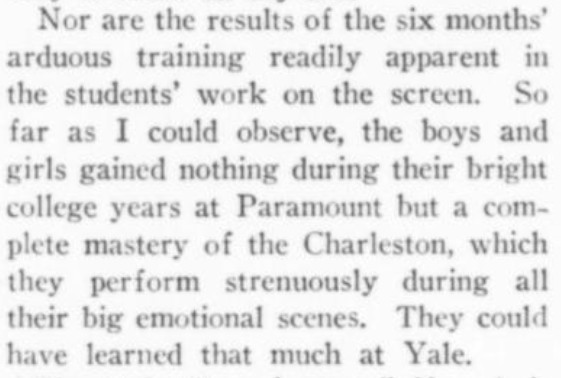
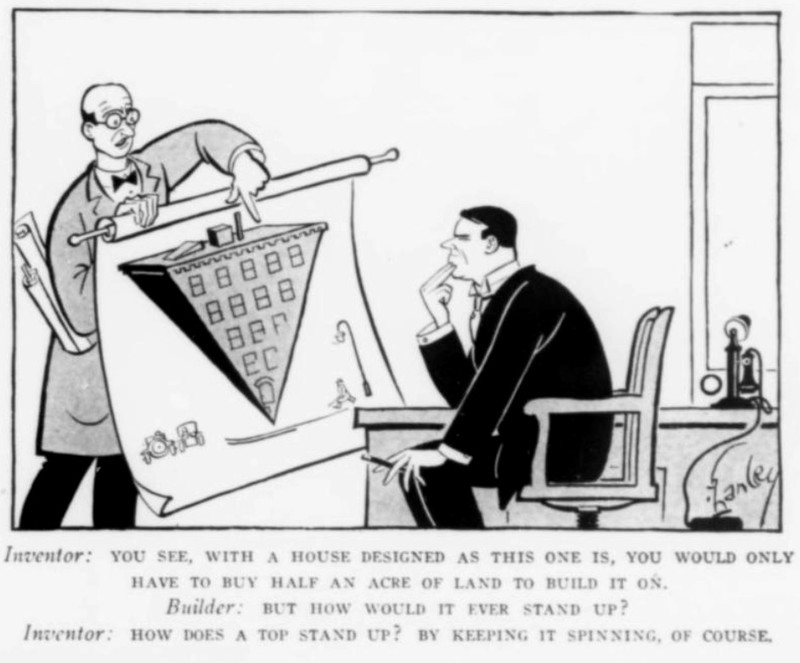
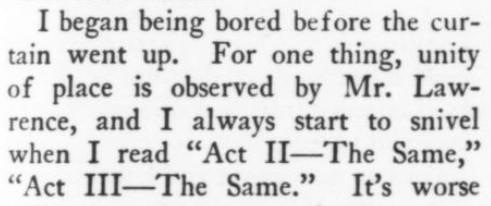
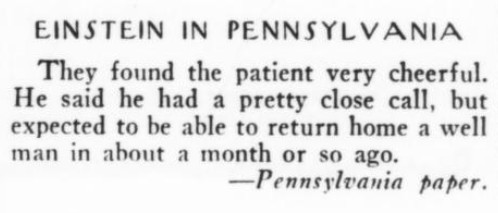
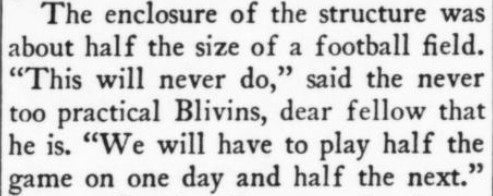
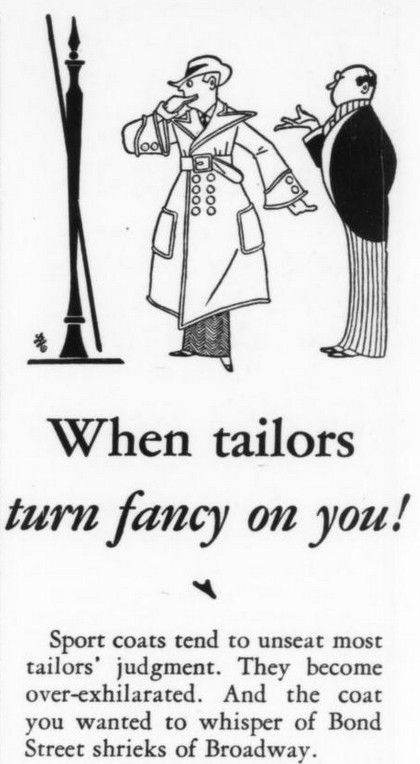
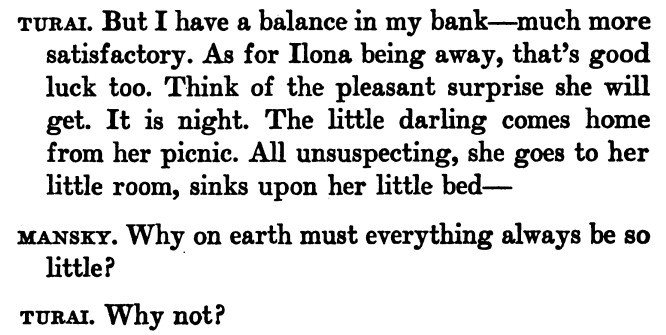
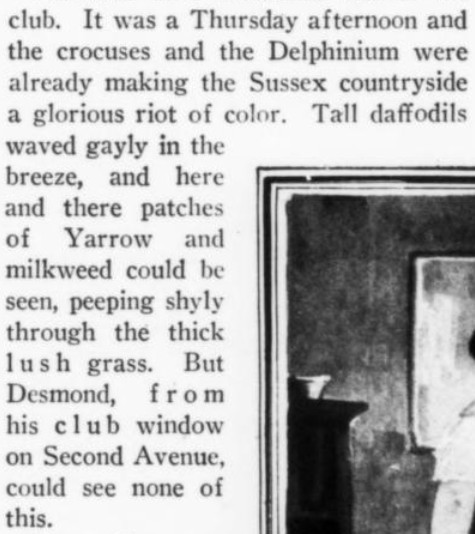
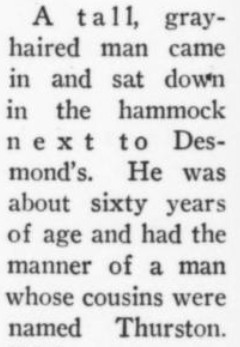
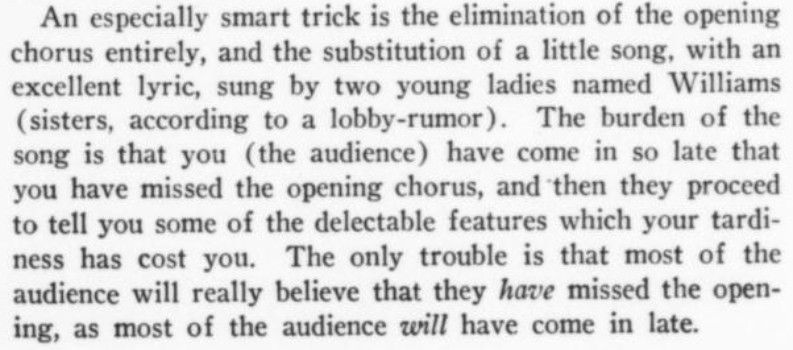
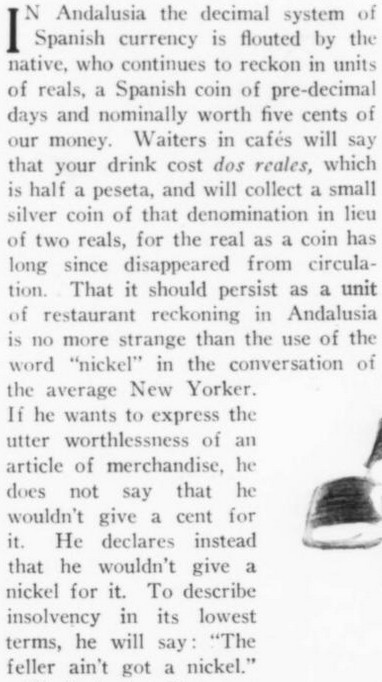
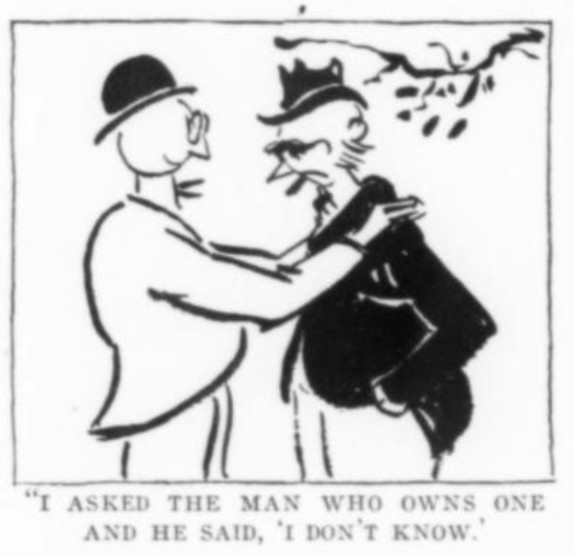
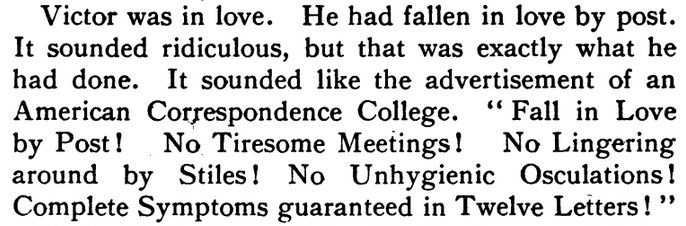
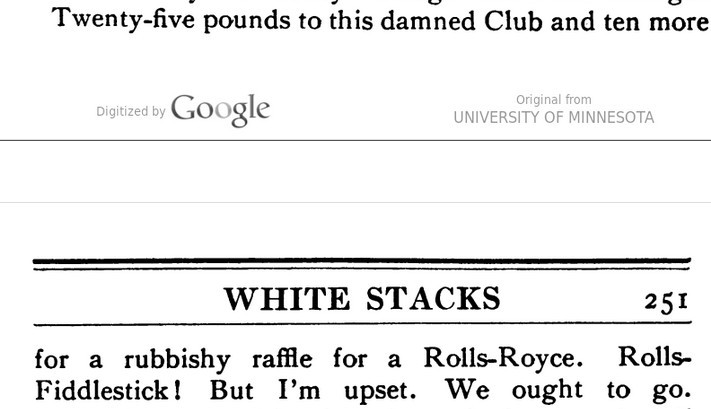
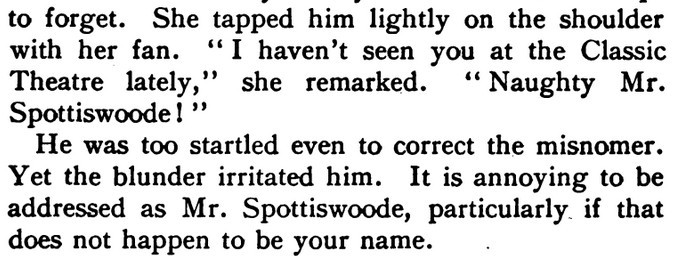
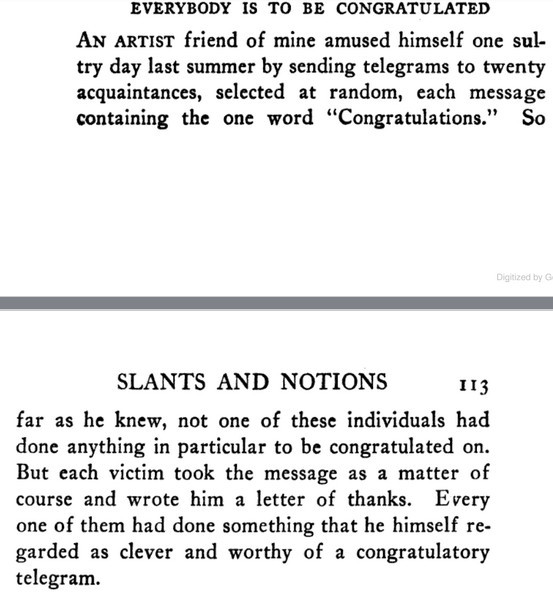
[Another fun one! Again, I'm surprised I hadn't found my way to Knox sooner. I suppose opportunity Knox* on its own schedule.*"Opportunity Knox" would make a good burlesque name, eh?]***[Re. an insurance company, the Indescribable, whose offices are in a building called Indescribable House.]The chicken-farmer whose hen-houses are fitted with the company’s patent automatic egg-register can never make a failure of his business. The egg is no sooner laid than it falls gently through a slot which marks its passage on a kind of taximeter; and if the total of eggs at the end of the month is below the average the company pays—I had almost said, the company lays—an exact monetary equivalent for the shortage.***He had a short black coat with very broad and long lapels, a starched collar that hesitated between the Shakespeare and the all-the-way-and-back-again patterns.[I think "all-the-way-and-back-again," as a fashion term, may be a one-off coinage.]***She always underestimated quantity, referring to a large tureen as “a drop of soup,” and overestimated quality, daily suggesting for her guests’ supper “a nice chop.” The chop always appeared; the nice chop (as the old gentleman pointed out) would have been a pleasant change. As surely as you had eggs and bacon for breakfast, so surely you had a chop for supper; “and some nice fruit to follow” heralded the entrance of a depressed blanc-mange (which Mrs. Davis called “shape,” after its principal attribute).***“Miles, I will not have you talking of poor old Edward like that.”“Who told you his name was Edward?”“It must be; you’ve only to look at him. Anyhow, he will always be Edward to me.***The chair into which the visitor was shepherded was voluminous and comfortable; you could not sit nervously on the edge of it if you tried.***“You have not been to America? The anecdote there is in its first youth; the anecdotes mostly in their extreme old age.”***"I shall console myself by talking to the barmaid, and finding out if she’s capable of saying anything except ‘Raight-ho.’"***"But to-night, at supper, she was jumpy—even you must have noticed it. She almost dropped the soup-plates, and the ‘shape’ was quivering like a guilty thing surprised.”***The sun rose bright the next morning, as if it had heard there was a funeral in contemplation and was determined to be there.***Mr. Simmonds approached the handkerchief question with the air of being just the right man to come to. Other things, you felt, were to be bought in this shop: teethers, for example, and walking-sticks, and liquorice, and so on. But when you came to *handkerchiefs*, there you had found a specialist, a man who had handled handkerchiefs these fifteen years past. Something stylish, perhaps, was required? This with a glance at the customer, as if to size him up and recognise the man of taste. “The *plain* ones? Just plain white, you mean, sir? Well, it’s a curious thing, but I’m not certain I can lay my hand on one of them. You see, there’s more demand for the coloured ones, a bit of edging, anyhow. And, you see, we haven’t got in our new stock yet.” (They never have got in their new stock yet at Simmonds’s.) “Three weeks ago I could have done you a very good line in the plain ones, but I’m rather afraid we’re right out. I’ll just see.”This was followed by an avalanche of drawers, containing handkerchiefs of every conceivable variety that was not plain. A violent horseshoe pattern that ran through all the gamut of the colours; a kind of willow pattern; a humorous series featuring film stars; striped edges, spotted edges, check edges—but no plain. From time to time Mr. Simmonds would draw attention to the merits of the exhibits, as if it were just his luck that his customer should be a man so unadventurous in taste. “Now, that’s a very good number; you couldn’t get a better line than that, not if it was a coloured handkerchief you were wanting. . . . No, no, sir, no trouble at all; I daresay perhaps I may be able to lay my hand on the article you require. . . . You don’t fancy those, now? Those come very cheap because they’re bankrupt stock. Just you feel that, sir, and see what a lot of wear there is in it! . . . Yes, that’s right, they’re a little on the gay side, sir, but we don’t get any real demand, not for the plain ones; people don’t seem to fancy them nowadays. Mind you, if you’ll be staying on here for a day or two, I could get you some; we shall be sending into Pullford the day after to-morrow. But at the moment we seem to be right out of them. . . . Oh, you’ll take the check ones . . . half a dozen? Thank you, sir; you’ll find they’re a very good line; you could go a long way and not find another handkerchief just like that one. It’s a handkerchief we’ve stocked many years now, and never had any difficulty in getting rid of it. And the next article, please?”But Bredon did not meditate any more purchases. He had begun to realize that in Chilthorpe you bought not the thing you wanted but the thing Mr. Simmonds had in stock.[N.B. The New Yorker issue that I was reading concurrently played along here--see attached.]***In front of the Load of Mischief stands an ale-house bench—that is the description which leaps to the mind. Ideally, it should be occupied by an old gaffer in a white smock, drinking cider and smoking a churchwarden. A really progressive hotel would hire a gaffer by the day to do it. A less appropriate advertisement, yet creditable enough to the establishment in the bright air of the June morning, Angela was occupying this seat as her husband came back from his shopping; she was knitting in a nice, old-fashioned way, but spoilt the effect of it rather by whistling as she did so.***"Don’t you feel sometimes as if the whole of human life on this planet were a mere episode, and all our boasted human achievement were a speck on the ocean of infinity?”“Sometimes. But one can always take a pill, can’t one?”***"Let us eat and drink, Mrs. Davis’s ‘shape’ seems to say to us, for to-morrow we die.”***The old gentleman was rubbing his hands briskly in the enjoyment of retrospect; he had scarce any need of breakfast, you would have said, so richly was he chewing the cud of his experiences overnight.***
|
|
|
|
|
|
|
unearths some literary gems.
Fom The Viaduct Murder, by Ronald Knox:
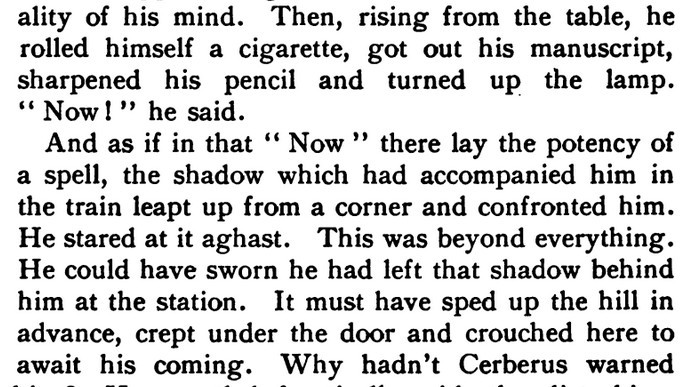
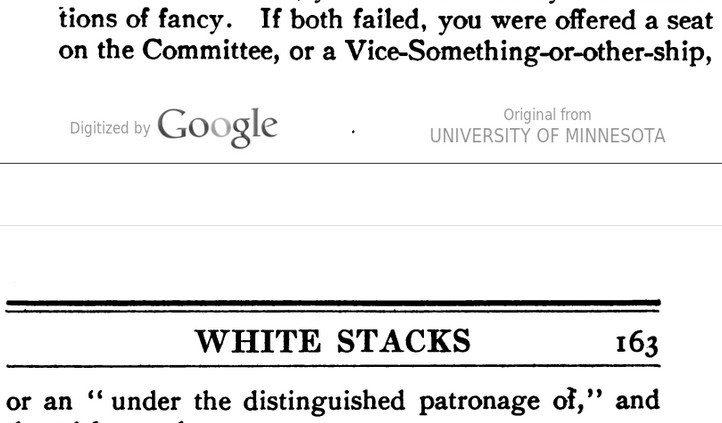
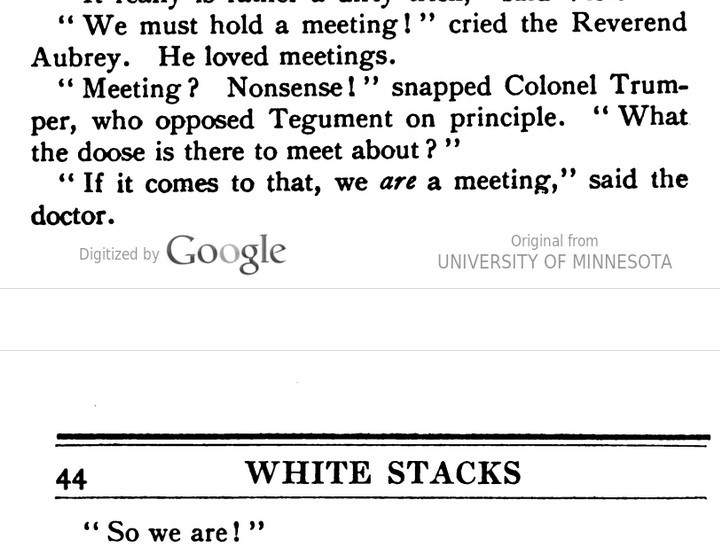
***The house itself may be condemned to the scrap-heap, but you can always make a golf-course out of the Park. Acres, that for centuries have scorned the weight of the plough, have their stubborn glebe broken with the niblick, and over-populated greens recall the softness and the trimness of earlier lawns. Ghosts of an earlier day will walk there, perhaps, but you can always play through them.***(distrust the author whose second paragraph does not come to ground in the particular)***That Mr. Carmichael, the fourth member of the party, had been a don you knew as soon as he opened his mouth. There was that precision in his utterances, that benignity in his eye, that spontaneity in his willingness to impart information, that no other profession breeds. A perpetual fountain of interesting small-talk, he unnerved his audience with a sense of intellectual repletion which was worse than boredom.***“I agree with you about inference,” said Marryatt, disregarding Carmichael’s last remark—one always did disregard Carmichael’s last remark.***Gordon proceeded to look up the trains with an irritating thoroughness, while Reeves danced with impatience—there is no impatience like that engendered by watching another man look up Bradshaw.***“You see, he was always a very reserved gentleman, Mr. Brotherood was; very silent, if you understand what I mean, in conversation.” (Reeves felt that this was probably a characteristic common to most of Mrs. Bramston’s interlocutors.) “Time and again he’s said to me would I mind leaving him now because he’d got a great deal to do.”***October sun glowed temperately over the links, with the air of a kind old gentleman producing sweetmeats unexpectedly.***The 4.50 from Paston Oatvile had to connect with it for the sake of passengers going on to Paston Whitchurch or Binver, and was still wandering up and down in a siding, flirting with a couple of milk-vans and apparently enjoying itself.***If you say, Has the rain stopped, he won’t say Yes, or No; he’ll say, It has, or It hasn’t. The explanation of that is a perfectly simple one: there is no native word for either in Irish, any more than there is in Latin. And that in its turn throws a very important light on the Irish character——”“Oh, go and throw an important light on your grandmother’s ducks,” said Reeves.***“That’s it,” said Carmichael, opening the door, “I remember once in Eastern Roumelia——” but, as he managed to fall down the step into the passage, the reminiscence was fortunately lost.***“There’s a chewing-gum motif running through life at present which is worrying me more than I can say.”***“An hour,” said Gordon, “cannot be properly measured by the movements of a clock, an inanimate thing which registers time but doesn’t feel it.”***“Do you realize that, quite possibly, Davenant may have stood behind that hole in the wall and heard us coming solemnly to the conclusion that he didn’t exist? That he never had existed, except as a sort of spiritual projection of old Brotherhood, and now, consequently, he had ceased to exist?”***“Carmichael will have it that Davenant is a mode of Brotherhood. Like the materialist or the idealist he is stultifying experience for the sake of a formula....Brotherhood, representing Matter, leaves off where Davenant, representing Spirit, begins. Carmichael, representing the modern mind, finds this an excellent reason for supposing that they are really, somehow, the same thing. The materialist sees Brotherhood everywhere, the Idealist sees Davenant everywhere.”***“There’s one other question I want to ask you, a rather odd one. Have you any reason to think that Davenant was carrying a golf-ball in his pocket when he came up on Tuesday afternoon?”“He might be, of course. But he would hardly have mentioned it, would he?”***"I should be careful how you accuse people of theft merely because their pipes are newly cleaned."***Bonuses:two characters named Masterman referred to collectively as "Mastermen"exclamation points referred to as "shriek-marks."
|
|
|
|
|
|
|
unearths some literary gems.
***
Mr. Ricardo, indeed, embroidered and developed and expounded his image of an opal to a degree of tediousness which even in him was remarkable.
***
"She romped without romping."
***
Mr. Ricardo had perused every word of this letter before he realized that it had provoked in him no uncanny sensations whatsoever.... It is true that the ink was purple instead of black; and for a moment or two Mr. Ricardo sought an unworthy consolation in that difference.
***
Mr. Ricardo had undoubtedly earned some good marks, not so much for putting two and two together as for discerning that there might be two and two which would possibly want putting together afterwards.
***
Even those flattering words did not reach beyond the porches of Mr. Ricardo's ears.
***
He rubbed his hands together with a what-do-you-say-to-that? air about him.
***
[Inspector Hanaud (who is a bit of a recognized Poirot precursor), in this third or fourth work, takes his enthusiasm for English slang, and his consequent malapropisms, to eleven. It's now the author's main vein of comic relief (with Mr. Ricardo's amour propre in second place); and while I'd say it's overdone, it definitely has some great moments:
"warm material" for "hot stuff"
"lock the door after the horse has stolen the oats"
"upset the carriage of the pears"]
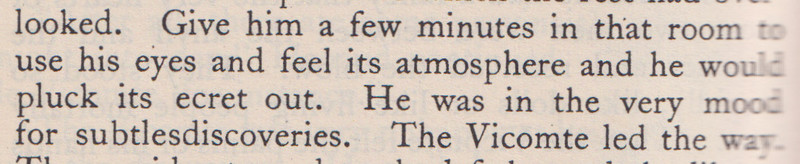
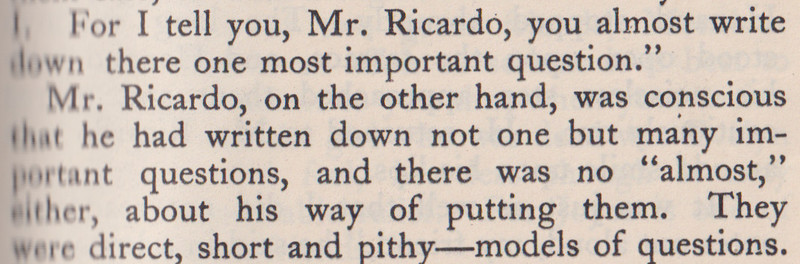
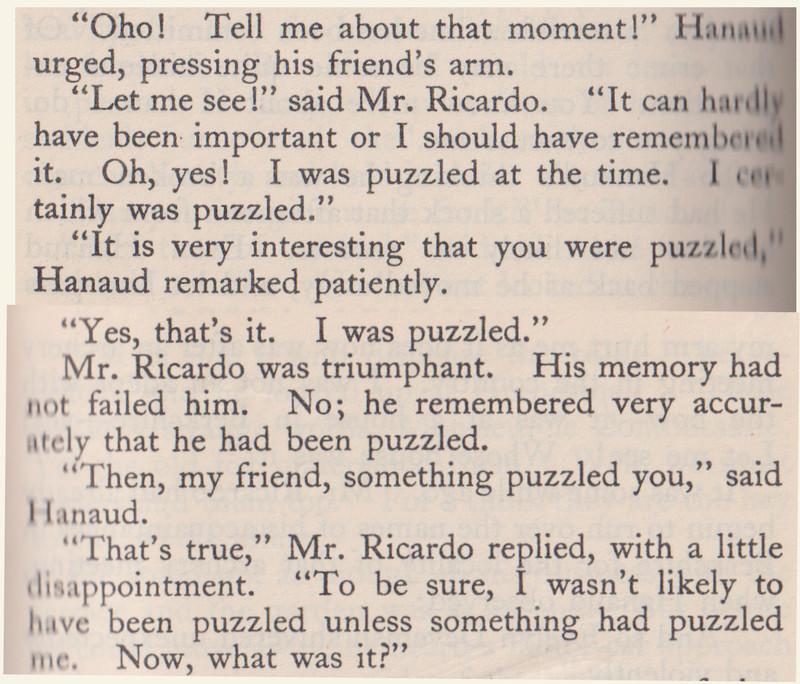
[A few more snippets attached, including a bonus giggle courtesy of the typesetters: The ecret is out! Or rather, the S is out of "secret." Don't worry--it's just dropped downstairs for a moment, awaiting "discovery."]
|
Page 6 of 65
> Older Entries...
Original Content Copyright © 2026 by Craig Conley. All rights reserved.
|