|
|
|
|
|
|
unearths some literary gems.
From Our Mr. Wrenn, by Sinclair Lewis:
***The April skies glowed with benevolence this Saturday morning. The Metropolitan Tower was singing, bright ivory tipped with gold, uplifted and intensely glad of the morning. The buildings walling in Madison Square were jubilant; the honest red-brick fronts, radiant; the new marble, witty. The sparrows in the middle of Fifth Avenue were all talking at once, scandalously but cleverly.***“You’re the brother-in-law to a wise one,” commented the Brass-button Man.[This seems to be a compliment, meaning "you're smart to do that." But the only Google Books results for the phrase come from this very line in this very novel.]***A day of furtive darts out from his room to do London, which glumly declined to be done.***[Punctuation Marks Bearing the Full Burden dept.]“And how do you place Nietzsche?” she gravely desired to know.“?”“Nietzsche. You know—the German humorist.”***"I think I’ll go back to Paris. There even the Interesting People are—why, they’re interesting."***"There’s tea at five dollars a cup that they advertise is grown on ‘cloud-covered mountain-tops.’ I suppose when the tops aren’t cloud-covered they only charge three dollars a cup."***[Culteranismo dept.]"That’s playing. With words. My aged parent calls it ‘talking too much and not saying anything.’ Note that last—not saying anything! It’s one of the rules in playing that mustn’t be broken.”He understood that better than most of the things she said. “Why,” he exclaimed, “it’s kind of talking sideways.”***“And eat them without buttering your nose. For if you butter your nose they’ll think you’re a Greek professor. And you wouldn’t like that, would you, honey?”***He ate his dinner with a grave courtesy toward the food and the waiter. He was positively courtly to his fork.***Yet when dear Carson had jauntily departed, leaving the room still loud with the smack of his grin, Istra seemed to have forgotten that Mr. Wrenn was alive.***The Aengusmere Caravanserai is so unyieldingly cheerful and artistic that it makes the ordinary person long for a dingy old-fashioned room in which he can play solitaire and chew gum without being rebuked with exasperating patience by the wall stencils and clever etchings and polished brasses. It is adjectiferous. The common room (which is uncommon for [a] hotel parlor) is all in superlatives and chintzes.***"Now do tell us all about it, Mr. Wrenn. First, I want you to meet Miss Saxonby and Mr. Gutch and dear Yilyena Dourschetsky and Mr. Howard Bancock Binch—of course you know his poetry.”And then she drew a breath and flopped back into the wing-chair’s muffling depths.***“Gee! I talked to that omelet Berg’ rac like I’d known it all my life!”***Mrs. Arty—Mrs. R. T. Ferrard is her name, but we always call her Mrs. Arty.***The profusion of furniture was like a tumult; the redness and oakness and polishedness of furniture was a dizzying activity.***A general grunt that might be spelled “Hmmmmhm” assented.***"I’m getting sick of Paris and some day I’m going to stop an absinthe on the boulevard and slap its face to show I’m a sturdy moving-picture Western Amurrican."***Setting up his box stage, he glued a pill-box and a match-box on the floor—the side of the box it had always been till now—and there he had the mahogany desks. He thrust three matches into the corks, and behold three graceful actors—graceful for corks, at least.***"Where’s N? Oh, how clever of it, it’s right by M."***Besides, it wasn’t as if he were engaged to Nelly, or anything like that. Besides, of course Istra would never care for him. There were several other besideses with which he harrowed himself while trying to appear picnically agreeable.***
|
|
|
|
|
|
|
unearths some literary gems.
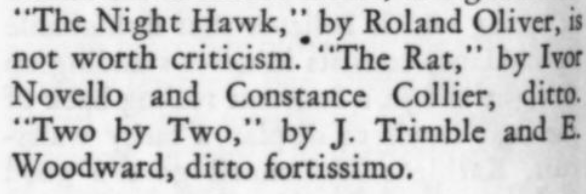
A few bits from George Jean Nathan:
[Most of these are from a theater column called "The Pantaloon Parnassus"! I would say "Puppy-Cow" raises more questions than it answers. (Can we connect the dots to little do[g]ies? Or to the Mac Classic dogcow?)]
It may be described as a Fokine ballet without dancing.
|
|
|
|
|
|
|
unearths some literary gems.
A few snippets from Wodehouse essays:
[from "To the Editor: Sir..."]A novel, after all, is rather a commercial sort of affair. A letter to the papers is Art for Art's sake.[from "An Outline of Shakespeare"]The fact that the anniversary of Shakespeare's birth appears this year....[That's the beginning of the piece; and, as I did the math, I found myself puzzled, because neither the date of its original publication, nor that of its being reissued in the collection in which I found it, seemed to match up with the 400th anniversary of the Bard's birth. But then I reread PGW's sentence--and noticed that he never said it was the 400th anniversary, or any particular anniversary at all! Technically, all he said was that Shakespeare's birthday was on the calendar that year. Ha![ditto]"Is there anything else!" cried Shakespeare. "Why, there's nothing else but something else."[from "Prospects for Wambledon"]It simply shows--well, I cannot at the moment think just what it does show, but it obviously has a significance of some sort.[I'm including that just because it's some sort of JC-E precursor.][from "Fashionable Weddings and Smart Divorces"][a couple of bride's family-groom's family pairings]Bootle - BartholomewMumbleby - Packsmith
|
|
|
|
|
|
|
unearths some literary gems.
From Much Ado about Me, by Fred Allen:
***With his dark beady eyes and the big cigar jutting out of his mouth, Sam looked like an animated but partly melted snowman.***The Professor's mouth was an adjective hutch.***For their finish the brothers donned one large harlequin costume and, dancing close together, executed intricate steps with such precision it appeared that only one person, with two heads, was dancing.***[Can you spot what's wrong with the name of this circuit? (:v> Allen does not seem to notice anything amiss.]The Interstate was a big-time circuit that operated theaters in Fort Worth, Dallas, Houston, and San Antonio.***Harold, with his various writing assignments, was busier than an octopus going through a revolving door.[Once again (cf. decopus w/ umbrella tucked under arm), I must protest that an octopus would, in fact, be *overqualified* to get through a revolving door without maxing out its resources.]***He looked like a toy that some child had wound up and forgotten to play with.***Leonard Sillman...was the loudest dancer I have ever heard. He trod the heavy fantastic.***[Bonus 1: I learned that "Christmas in July" was a real "thing" for entertainers, back in the day, because they typically had to work through the holidays, but often had summers off, and congregated in vacation communities where they would indulge in an off-season Yule on July 4th.][Bonus 2: a comedy trio called Darn, Good, and Funny][Bonus 3: A "female impersonator" called Raymonde who had two entire layers of gender-bending: he did his act as a woman, then took off a wig to reveal himself as a man, then took *that* wig off to reveal more "feminine" hair, then finally revealed himself as a man again. Doing the math, it seems that Raymonde (pre-)one-upped Victor/Victoria, who had only three quarters of this equation.][Bonus 4: an entertainer named George Hassell whose favorite oath was "God's trousers!"][Bonus 5: Allen uses the phrase "avocado tears" where one would normally say "crocodile tears." I was guessing he arrived there via "alligator pear"--and Google Books brings up no other instance of this phrase--but general results show that "avocado tears" has a presence in contemporary times, though what comes up on a quick search are things like user names and music-artist names, rather than contextualized usage of the term.][Bonus 6: an act called "Disappointments of 1927" in which every act Allen tries to introduce phones in to say they're not coming]
|
|
|
|
|
|
|
unearths some literary gems.
From Places Where I've Done Time, by William Saroyan:
"[Joaquin Miller] said, 'And you, what's your name,' and I said, 'Henry Saroyan.'""If he asked me, I would have said, 'Puddin tame, ask me again, I'll tell you the same.'""Ah, you don't say that when Wahkeen Miller asks you. He's an old man."
|
|
|
|
|
|
|
unearths some literary gems.
Snippets from stories by Noel Coward:
***[from "Traveler's Joy"]
He was no fool, he often told himself, none of that painful mutton-dressed-as-lamb business for him! Why, he had voluntarily given up playing Juveniles years ago when he was a bare forty-five.
***
[from "What Mad Pursuit?"]
"What's bred in the bone comes out in the what have you."
"I'd rather listen to Irene than Jeritza, Ponselle and Flagstad all together in a lump." Evan, repressing a shudder at the thought of Jeritza, Ponselle and Flagstad all together in a lump, agreed wholeheartedly.
[Bonus 1: There's a character in this story whose conversational tic is to say "who shall be nameless," sometimes immediately *after* having already named the person he's speaking about (e.g., "Bonwit, who shall be nameless, got so fried...;" "that's Dwight Macadoo who shall be nameless"). Eventually, we see that this habit extends beyond actual persons: "a cowboy in Arizona...rounding up all those Goddamned steers--who shall be nameless."]
[Bonus 2: Enter a pair of Alsatian dogs named Chico and Zeppo. So just when you expect Harpo, Coward zags (or zeps) on us!]
***
[from "Stop Me If You've Heard It]
"Please, God," she whispered to herself. "Don't let it be the one about the Englishman and the Scotsman and the American in the railway carriage, nor the one about the old lady and the parrot...."
***
[from "Star Quality"]
The clock on the mantelpiece struck five very quickly, as though it were in a hurry.
"She's as merry as a cartload of grigs, whatever they may be."
***
[from "Bon Voyage"]
"More than one rhetorical question in one sentence always bewilders me," said Eldrich.
"Dio mio! As my old grandmother used to say."
"Mine always said 'Madonna mia.'"
[...]
"Ciao for now, as my other old grandmother used to say."
[Bonus: a character called Mrs. Bagel]
***
Bonus fictitious(?) theatrical show titles from across the story collection:
And So What
Some Take It Straight
Dear Yesterday
Wise Man's Folly
|
|
|
|
|
|
|
unearths some literary gems.
From Freshwater, by Virginia Woolf:
NELL: A porpoise? A real porpoise?JOHN: What else should a porpoise be?[Note: I wrote the following "bonus" section before learning that "Trekkie" was, per Wikipedia, artist "Trekkie Ritchie Parsons (née Marjorie Tulip Ritchie)." I'm preserving the obsolete paragraph below for the record; and, meanwhile, we've gained a person bearing the middle name Tulip.][Bonus: The person who edited this very posthumous publication thanks, among others, someone whose given name apparently is Trekkie. The complete phrase, part of the usual roster of acknowledgees, is "Trekkie and Ian Parsons." So I figure either Trekkie and Ian are human family members sharing a surname; or Trekkie is Ian's dog or cat or parrot (getting precedence!); or Trekkie is a mononymic but forgotten celebrity who cohabits with Ian. I further reason that since the book wasn't published until 1976, the term "Trekkie," as in Star Trek fan, was probably already around, so someone might conceivably have used it as a parrot name or, if they were an ST superfan, adopted it as their own nickname.]
|
|
|
|
|
|
|
unearths some literary gems.
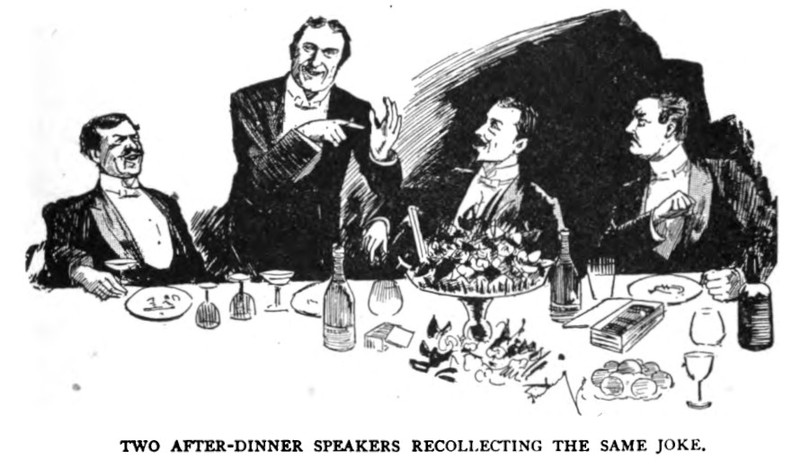
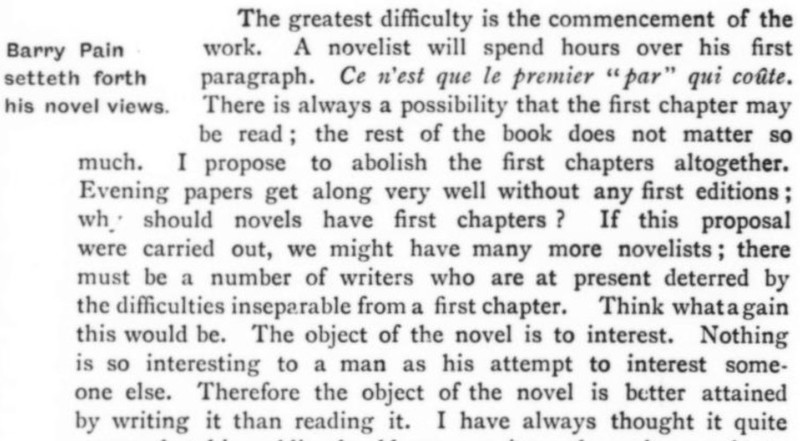
Some snippets from The Idler, Feb. and March 1892:
***
My proposal is that amateur performances shall take place in dumb show and also in the dark.
***
I confess I felt hurt. People should be careful what they say in a haunted house.
[...]
The game is not worth the phosphorescence.
[That piece in full: https://archive.org/details/sim_idler-an-illustrated-monthly-magazine_1892-03_1/page/194/mode/2up?view=theater]
***
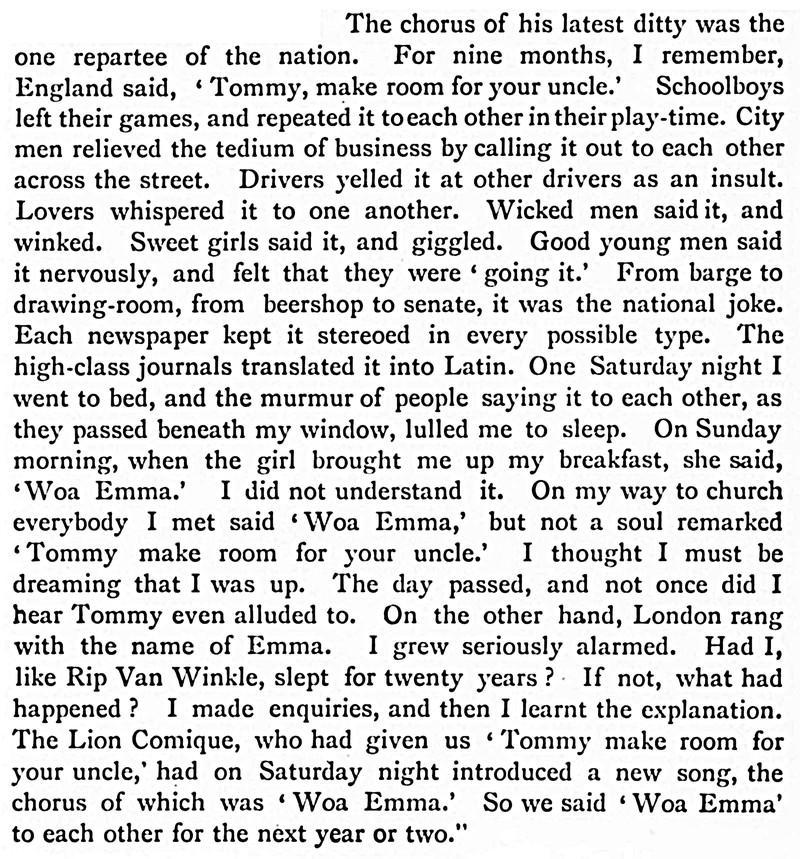
[re. the bygone "lion comique" type of performer]
"that opera hat that closed at every joke, and opened at every noble sentiment"
***
|
Page 23 of 64
> Older Entries...
Original Content Copyright © 2025 by Craig Conley. All rights reserved.
|