|
|
 |
|
|
unearths some literary gems.
Dear Reader, small the boon I ask,—
Your gentle smile, to egg my wit on;
Lest people deem my earnest task
Not worth the paper it is writ on.
***
The iceman...had the hard, set jaw of a prize fighter was successfully eating steak, and he welcomed the incoming fried potatoes, as one greets a new instalment of a serial.
***
“Hello,” languidly responded a girl like a long pale lily—a Burne-Jones type, who sometimes carried around a small stained-glass window to rest her head against.
***
She saw gardens like the Tuileries and Tuilerums.
***
"Good work, I'll megaphone."
***
Warble sat down in an easy-going chair—so easy, it slid across the room with her.
***
Goldwin Leathersham was a great Captain of Industry. In fact, he put the dust in industry, or, at least, he took it out of it. He got it, anyway.
***
The French chef looked puzzled. He was an expensive chef and part of his duty was to look puzzled at any plain-named dish.
***
“Why, you see, I am a solist—like a palmist you know—but as to feet. I studied solistry in Asia Minor and I know it from the ground up. Oh, please, Mrs. Petticoat, let me read your sole!”
[...]
“The Solar system,” he began, “is interesting in the extreme. It was invented by Solon, though Platoe also theorized on the immortality of the sole. His ideas, however have been discarded by modern footmen.
“Locke, is [sic] his treatise On the Human Understanding, discusses the subject fully and with many footnotes, and old Samuel Foote himself cast footlights on the subject.”
[...]
“The palmist may claim to read the true character from the lines of the hand, but it is only by solistry that the real sole is laid bare and the character of a subject in any walk of life is exposed. The lines of the sole are greatly indicative of character, for all traits must draw the line somewhere. Now, Mrs. Petticoat, this line extending from the Mount of Trilby to the outer side of the sole is the life line. If that appears to be broken it indicates future death. If more pronounced on one sole than the other, it implies that the subject has one foot in the grave. You haven't, don't be alarmed. Here is the headline, straight and continuous, showing a long and level head.”
[...]
“This line running from the Mount of Cinderella to the heel is the clothes line and denotes love of dress. This line crossing it is the fish line and shows you are incapable of telling the truth.”
[...]
“A thorough, broad understanding and a friendly footing toward all,” declared the solist, “and no danger of misunderstanding.”
[...]
“Mount of Atalanta highly prominent,” said Goodsport, “that means you are a runner, either for office or for pleasure. Here is a line meeting—that indicates a railroad man. H'm. A well-developed football shows you have been to college. You seem to be inclined to solemates—”
But Leathersham had taken to his heels.
[...]
“Ah, the poetic foot!” the soloist exclaimed. “There are two kinds of poetic feet—the Iambic and the Trochaic. You have one of each.
***
They were a stuck-up lot. The fly-paper had intrigued them all.
***
The irrepressible impulse of reform egged her on and it was a perfectly good egg.
***
“I know all about art but I don't know what I like,” she returned, blushing prettily.
[This precurses Thurber's "He knows all about art, but he doesn't know what he likes" cartoon by almost two decades, btw.]
***
“Why, a Color Organ is that marvelous new invention that plays color instead of sound.”
***
"I bet her soul has got its rubbers on!"
***
“Having a walk?” he inquired, casually.
“Yop,” she casualed back.
***
[Un-round numbers dept.]
“How long'll you be gone?”
“It may be four yearth and it may be eleven—”
***
Her position was that of a pickle taster.
At first, only of the little gherkins, then promoted through medium cucumbers, to the glory of full-fledged Dills.
***
|
|
|
|
|
|
|
unearths some literary gems.
From "Harlequin and Columbine," by Booth Tarkington:
***
His face was toward the Library, with its two annoyed pet lions.
***
“Tea!” gasped Canby. “People are sick of tea! I didn't write any tea!”
“There isn't any,” said Tinker. “The way he's got it, there's an interruption before the tea comes, and it isn't brought in.”
“But she's ordered it! If it doesn't come the audience will wonder—”
“No,” said Tinker. “They won't think of that. They won't hear her order it.”
“Then for heaven's sake, why has he put it in? I wrote this play to begin right in the story—”
“That's the trouble. They never hear the beginning. They're slamming seats, taking off wraps, looking round to see who's there. That's why we used to begin plays with servants dusting and 'Well-I-never-half-past-nine-and-the-young-master-not-yet-risen!”
***
Tinker came noiselessly down the aisle and resumed his seat beside Canby, who was uttering short, broken sighs, and appeared to have been trying with fair success to give himself a shampoo.
“It's ruined, Mr. Tinker!” he moaned, and his accompanying gesture was misleading, seeming to indicate that he alluded to his hair.
***
Potter stamped the floor; there was wrenched from him an incoherent shriek containing fragments of profane words and ending distinguishably with: “It's that Missmiss again!”
***
She was reputed to walk much among gentles, and to have a high taste in letters and the drama; for she was chief of an essay club, had a hushing manner, and often quoted with precision from reviews, or from such publishers' advertisements as contained no slang; and she was a member of one of the leagues for patronizing the theatre in moderation.
“Mr. Canby,” said the hostess pleasantly, “Miss Cornish wishes to—”
This obtained the attention of the assembly, while Canby, at the other end of the room, sat back in his chair with the unenthusiastic air of a man being served with papers.
“Yes, Miss Cornish.”
Miss Cornish cleared her throat, not practically, but with culture, as preliminary to an address. “I was saying, Mr. Canby,” she began, “that I had a suggestion to make which may not only interest you, but certain others of us who do not enjoy equal opportunities in some matters—as—as others of us who do. Indeed, I believe it will interest all of us without regard to—to—to this. What I was about to suggest was that since today you have had a very interesting experience, not only interesting because you have entered into a professional as well as personal friendship with one of our foremost artists—an artist whose work is cultivated always—but also interesting because there are some of us here whose more practical occupations and walk in life must necessarily withhold them from—from this. What I meant to suggest was that, as this prevents them from—from this—would it not be a favourable opportunity for them to—to glean some commentary upon the actual methods of a field of art? Personally, it happens that whenever opportunities and invitations have been—have been urged, other duties intervened, but though, on that account never having been actually present, I am familiar, of course, through conversation with great artists and memoirs and—and other sources of literature—with the procedure and etiquette of rehearsal. But others among us, no doubt through lack of leisure, are perhaps less so than—than this.”
***
“He writes about theatrical matters,” said Carson Tinker. “Talky-talk writing: 'the drama'—'temperament'—'people of cultivation'—quotes Latin or Italian or something. 'Technique' is his star word; he plays 'technique' for a hand every other line. Doesn't do any harm; in fact, I think he does us a good deal of good. Lots of people read that talky-talk writing nowadays. Not in New York, but in road-towns, where they have plenty of time. This fellow's never against any show much, unless he takes a notion. You slip 'dolsy far nienty' or something about Danty or logarithms somewhere into your play, where it won't delay the action much, and he'll be for you.”
***
“A play isn't something you read; it's something actors do on a stage; and they can't afford to do it unless the public pays to watch 'em. If it won't buy tickets, you haven't got a play; you've only got some typewriting.”
Canby glanced involuntarily at the blue-covered manuscript he had placed upon a table beside him. It had a guilty look.
***
He never interrupted when Potter was speaking; and Canby noticed that whenever Potter talked at any length Tinker looked thoughtful and distant, like a mechanic so accustomed to the whirr and thunder of the machine-shop that he may indulge in reveries there.
***
“You'll see as you get to know him. You won't know him any better than you do now, Mr. Canby; you'll only know him more.”
***
The whole vast cavern of the theatre was as still as the very self of silence.
***
|
|
|
|
|
|
|
unearths some literary gems.
These snippets are from a catalog of rare editions of 1920s-1930s fiction. Text outside of quotation marks (complete with typos and other mistakes) comes from the dealer (or possibleysome third-party they source from); text inside quotation marks comes from the actual blurbs found on the books.***1. Anonymously written expose of New York night-life and Broadway habitués including Lenny Parr whose "six major adventures constitute a sexagon not to be discovered in the most advanced geometry."2. Jazz Age romance novel of high society and an antique dealer thrown into the mix.3. "She loved her elderly husband the gentle, musty antique dealer whose thoughts she could never read; but she loved Ambrose too, the mad, blonde, young man who wanted the china shepherdess...."4. Jazz-Age novel of a "very modern girl" who is dissatisfied with her marriage. [Author Freeman] Tilden is best known for his writings about the National Park system.5. Two bank clerks and their wives are "left a small fortune, but on conditions not only stringent but embarrassing. Among other tasks assigned them were the theft of an Anglo-Indian colonel's false teeth, the production of half of the uncrowned King of Limehouse's mustache, and inducing a bishop to use bad language."6. An English prep school teacher moves to London, "meets the kind of Bohemians he has visualized, moves into a Chelsea flat, gaudily and theatrically decorated in ultramodern style. He grows a picturesque mustache and beard, buys a cape, a broad brimmed hat, a velvet jacket, green shirts and flowing ties. He becomes a member of the Y to the Nths, a weird, arty, frantically advanced group whose ideas he doesn't in the least understand". [Bonus: Author name is Guy Pocock.]7. Humorous novel about a young chemist from Pittsburgh with hopes of making his city the cleanest in the world.8. Humorous novel of Jazz Age Paris, "the fairly complex love affairs of Edgar Bowman among the higher brows to be found on the Left Bank. It culminates in the amazing and uproarious dialogue between James Joyce and Gertrude Stein, and in the absolute abandonment of Aunt Minnie to the gigolos and the modernists."9. "Johnny, Assistant Manager of Cosmic Films, job included applying banana oil to the over heated cylinders of temperamental stars."10. "A pedantic writer hopes that his latest novel will bring him fame and fortune."11. "Hilarious romance of a mathematical wizard actuary who jumped straight from a Hartford insurance office into the middle of a carnival troupe."***And few smaller snippets.***"a comedy of commotion"Mr. Snooks-Badajos who got into Parliament by mistakeHumpty-Dumpty's eyebrows***Next, an excerpt from a contemporary (1935) New York Times review of a book called Quick, Mr. Bunnifeel!.***'A goodly number of the words in his yarn are profane. Literally, he substitutes the word (profane) neatly enclosed in parentheses for every cuss word. This seems monotonous rather than funny. And the conscientious reader will find it tiresome deciding each time whether this particular (profane) should be a noun or an adjective, and after that, selecting the most appropriate word. "By Mencken" is the only oath that isn't expurgated.'***Some titles.***The Man Who Found Himself[which I learned was written by an author who had an earlier, apparently unrelated work called The Man Who Lost Himself]Hiss! Boom!! Blah!!!Some Nephew!Believe You Me!Murder on Alternate Tuesdays[And neither Hilary nor I knew there was an H. G. Wells book called The Bulpington of Blup!]***And some miscellaneous notes.***There was a 20th-century author who called themselves Inigo Jones; and one called Mrs. Wilson Woodrow.This one got my attention because of the discrepancy between the actual title and the stated title to the side: what a difference an "of" makes!https://www.yesterdaysgallery.com/pages/books/11322/mary-kennedy/question-of-the-nightSimilarly, the stated title here sounds like an imperative, but of course the dust jacket and description make it clear that a "stay-at-home" is a person.https://www.yesterdaysgallery.com/pages/books/15735/lawrence-nelson/stay-at-home And this looks like a precursor to Into the Woods:ERSKINE, John. Cinderella's Daughter and Other Sequels and Consequences. Indianapolis: Bobbs Merrill Company. 1930.Erskine's humorous novel that adds the details and real endings not given in such fairy tales as Cinderella, Lady Godiva, Beanstalk Jack, Patient Griselda, Beauty and the Beast, and Sleeping Beauty.***
|
|
|
|
|
|
|
unearths some literary gems.
From Having Fun, by Denis Mackail:
from the foreword:A preface or an introduction or a foreword....suggests that the author isn't such a clown or nitwit as some of the subsequent matter might suggest. "Ha!" says the reader. "A preface;" yet even as he skips it, he feels an increased respect for the rest of the volume.***[Mackail's "system"]I perceive the faint glimmerings of an idea. I seize it by the scruff, I wheedle and cajole it, and presently it ceases to glimmer, and develops a distinct outline. I then pat it on the back, give it a good meal, and prepare a careful scenario from it. I then sit down and write something which has absolutely no connection with it whatsoever.from "Mr. (and Mrs.) Mystery"Mr. Blankett and Mrs. Flaptonfrom "Ten for Tact"Professor Gumm and Doctor Rumpelbach [remember them, from another DK piece? here again, they're offstage characters only, this time joined in the wings by...]that clever Miss Pothecaryfrom "Bradsmith Was Wrong" [another callback--in this case a bookend; cf. previously snippetized story called "Bradsmith Was Right"]an utterly illegible postscript in which I could only distinguish a word that looked like "cheese"from "Calling a Cab"Mrs. Netherhampton--hitherto (and also hereafter, for the sake of simplicity) known to us as Aunt Maudefrom "The Kiss-Effect"[the setting is a soundstage filming session]In the dark little projection-room...a farrago of blithering rubbish was being poured on to the undersized screen. Not that it would be blithering rubbish--or, to be more accurate, not that the public would consider it blithering rubbish--when it had all been cut and edited and arranged in the right order.***"Query shadow," wrote a hand emerging from the sleeve of a pullover. "Query sleigh-bells," wrote another. "Query old joke," wrote a smaller hand with a couple of rings on it.***"Fred! Sam! Mr. Noseworthy!"from "The Courtship of Beano Blennerhassett"A ceremony without young Beano's attendance might be perfectly legal, but the idea had got about, at any rate during that particular season, that it would be much safer if he were there. There was something about young Beano's waistcoats that no mere clergyman or caterer could hope to replace.***Miss Hyacinth Worple-Dewsbury***Miss Worple-Dewsbury's younger sister Cowslip***He put in a rush order for an absolute whale of a waistcoat and the very dickens of a tie.***He plunged into the throng, seized an ice from an astonished dowager, a glass of champagne from a flabbergasted admiral, a plate of sandwiches from a poor relation, and was back again by the gramophone in almost less time than it takes to tell.***[!]He made it sufficiently clear--in spite of innumerable ambiguities, anti-climaxes, ellisions [sic], hiatuses, inversions, oxymorons, pleonasms and one or two zeugmas...that his love was a definite arbutus.from "Romance at Belloni's"the Honourable Algernon Frothingham and the distinctly talented Miss Sunshine Potts***No Kidding, a transatlantic operatta which was positively packing the Palaceum***Carlo's smile and Carlo's adjectives were only waiting to consolidate and crystallize anything that might come their way.from "The Two-Seater""He's asleep!"The evidence of dead silence might have seemed insufficient to some people, since it is quite possible to be awake in a room by oneself without talking, coughing, groaning or kicking the furniture.***She could have wished that she had managed the first [gear] change...with less resemblance to the sound of a giant clearing his throat.from "The Best Man""There was a sort of light in her eyes, and a sort of absolute I-can't-describe-it on her mouth."from "As a Matter of Fact"But this--for grammarians will already have pounced on my use of the pluperfect tense--was before my experience had been enlarged by the incidents which I am about to describe.***The urgent thing that remained was to find out what in the name of thunder he had been doing, and why in the name of everything else he had made such a mystery of it.from "What Noise Annoys an Author?"Hey, not to say ho, for the kind of work that was going to knock that American syndicate endways.***Mrs. Blizzard***Messrs. Snapper and Snapper [house agents]***[narrator's aside upon the introduction of a "young lady" as a second main character]But if you think, now, that he's going to marry her, you're wrong.[I admit I did--and, based on past experience, with no little justification!]***Ideas were coming from Heaven alone knows where, words were being selected from that strange garbage-heap known as the English language; they were meeting; they were running down Mr. Longridge's right arm; they were flowing over his sheaf of paper.***"My name's Hill-Hill. Freda Hill-Hill."***And yet--and yet...Three more very literary dots...***[In various stories, Mackail's characters exclaim "Blank!" or "Oh, blank!" I explored this on Facebook.]In various early 20th-c. short stories I've been reading by Denis Mackail, vexed characters are represented as using "Oh, blank!" as an expletive. I think I've probably seen other British authors of yore use this euphemistic oath as well.So, obviously, "blank" stands in for stronger language, language that might have been deemed unacceptable in the light fiction of that era. What I'm wondering, though, is whether real-life oath-inhibited people ever actually *said* "Oh, blank!" in so many words, or whether "Oh, blank!" was only ever an author's convention, seen in print but never heard, with real-life folks relying on their various other euphemisms.I've just consulted my New Partridge Dictionary of Slang and Unconventional English, which I should have done sooner. It notes, for the expletive "blank," that it is "written more often than spoken, but not without uses in speech." (I also usually search old literature via Google Books to research this kind of language stuff—but obviously there would be an unavoidable paradox in this instance!)Incidentally, the note I quoted from Partridge above is in an entry that lumps "blank," "blankety," and "blankety-blank" all together. I'm pretty familiar with "blankety-blank (etc.)" in popular culture. More curious about "Oh, blank!" specifically.A question that even slang researchers might not easily be able to answer is whether "Oh, blank!" actually *originated* in print (as a publisher's precursor to the journalese "[expletive deleted]" that I personally recall from the 1970s), to then pass into oral use; or whether it followed the more typical path of slang in general, arising in oral culture first and then being naturalistically incorporated into fictional dialogue. By the way, Partridge traces the "blank" family of expletives back to the mid-19th century.***
|
|
|
|
|
|
|
unearths some literary gems.
I recommend this comic novel from 1901, about a young gentleman with a telescope who gets caught in an increasingly farcical mess involving his long-suffering grandmother, a pompous bully of an astronomer (who speaks of himself in the third person), a pair of self-conscious but insistent astrologers (one of whom frequently speaks in broken Latin), and an enthusiastic mischief maker who has intentionally embarked on a double life as a "silly" person because she was frustrated with being thought of as a "sensible" young woman. You'll meet a secret-mail librarian (at an establishment called Jellybrand's) who quibbles pedantically at every figure of speech; an affable Drones Club-type idiot who thinks Thackeray and his contemporaries are the latest thing; and a lady's companion named Mrs. Fancy Quinglet, who ends many of her speeches with "I can’t speak different nor mean other," and has refused to say the name of a dog called Beau after learning it's not spelled "Bow." I know Wodehouse was already active by this time, by I think Hichens was ahead of him in terms of this sort of ridiculously but cleverly entangled plot, its fashionable-London setting, and some of the characterizations--and here and there are some impressively Wodehousian paragraphs, stylistically speaking. (And just wait until you see what Hichens does with spates of telegrams, in chapter X!) Hichens also has a gift for some positively cartoonish descriptions of physical antics.Here's a link; snippets below, if you want a preview or a shortcut or snippets only.https://www.gutenberg.org/files/2463/2463-h/2463-h.htm#link2HCH0001***A grandmother’s clock pronounced the hour of ten in a frail and elegant voice***He was a neatly-made little man of fashionable, even of modish, cut, spare, smart and whimsical, with a clean-shaved, small-featured face, large, shining brown eyes, abundant and slightly-waving brown hair, that could only be parted, with the sweetest sorrow, in the centre of his well-shaped, almost philosophical head, and movements light and temperate as those of a meditative squirrel.***As he spoke he threw his black overcoat wide open, seated himself on the edge of one of the chairs in a dignified attitude, and crossed his feet—which were not innocent of spats—one over the other.***[One Letter Word dept.]"Sagittarius Lodge on the river—the river—what river did you say—?”“The River Mouse,” rejoined Malkiel in a muffled voice, and shaking his head sadly.“Exactly—on the River Mouse at Crompton—”“Crampton.”“Crampton St. Peter total—”“N.!”“What?”“Crampton St. Peter. N. That is the point.”[...]“I ask you what does en mean? I am, I fear, a very ill-informed person, and I really don’t know.”“Think of an envelope, sir,” said Malkiel, with gentle commiseration. “Well, are you thinking?”The Prophet grew purple.“I am—but it is no use. Besides, why on earth should I think of an envelope? I beg you to explain.”“North, sir, the northern postal district of the metropolis. Fairly simple that—I think, sir.”“N.!” cried the illuminated Prophet. “I see. I was thinking of en all the time. I beg your pardon. Please go on. N.—of course!”***The young librarian helped the fatigued-looking wine into the two glasses, where it lay as if thoroughly exhausted by the effort of getting there.***The torrent of knocks roared louder, slightly failed upon the ear, made a crescendo, emulated Niagara, surpassed that very American effort of nature, wavered, faltered to Lodore, died away to a feeble tittup like water dropping from a tap to flagstones, rose again in a final spurt that would have made Southey open his dictionary for adjectives, and drained away to death.***The venerable astronomer was already very stout in person and very inflamed in appearance. But at this point in the discourse he suddenly became so very much stouter and so very much more inflamed, that his audience of three gazed upon him rather as little children gaze upon dough which has been set by the cook to “rise” and which is fulfilling its mission with an unexpected, and indeed intemperate, vivacity. Their eyes grew round, their features rigid, their hands tense, their attitudes expectant. Leaning forward, they stared upon Sir Tiglath with an unwinking fixity and preternatural determination that was almost entirely infantine. And while they did so he continued slowly to expand in size and to deepen in colour until mortality seemed to drop from him. He ceased to be a man and became a phenomenon, a purple thing that journeyed towards some unutterable end, portentous as marching judgment, tragic as fate, searching as epidemic, and yet heavily painted and generally touched up by the brush of some humorous demon, such as lays about him in preparation for Christmas pantomime, sworn to provide the giants’ faces and the ogres’ heads for Drury Lane.“Don’t!” at last cried a young voice. “Don’t, Sir Tiglath!”A peal of laughter followed the remark, of that laughter which is loud and yet entirely without the saving grace of merriment, a mere sudden demonstration of hysteria.“Oh, Sir Tiglath—don’t!”A second laugh joined the first and rang up with it, older, but also hysterical—Mrs. Merillia’s.“No, no—please don’t, Sir Tig—Tig—”A third laugh burst into the ring, seeming to complete it fatally—the Prophet’s.“Sir Tiglath—for Heaven’s sake—don’t!”The adjuration came from a trio of choked voices, and might have given pause even to a descending lift or other inflexible and blind machine.But still the astronomer grew steadily more gigantic in person and more like the god of wine in hue. The three voices failed, and the terrible, united laughter was just upon the point of breaking forth again when a diversion occurred. The door of the drawing-room was softly opened, and Mrs. Fancy Quinglet appeared upon the threshold, holding in her hands an ice-wool shawl for the comfort of her mistress. It chanced that as the phenomenon of the astronomer was based upon a large elbow chair exactly facing the door she was instantly and fully confronted by it. She did not drop the shawl, as any ordinary maid would most probably have done. Mrs. Fancy was not of that kidney. She did not even turn tail, or give a month’s warning or a scream. She was of those women who, when they meet the inevitable, instinctively seem to recognise that it demands courage as a manner and truth as a greeting. She, therefore, stared straight at Sir Tiglath—much as she stared at Mrs. Merillia when she was about to arrange that lady’s wig for an assembly—and remarked in a decisive, though very respectful, tone of voice,—“The gentleman’s about to burst, ma’am. I can’t speak different nor mean other.”Upon finding their thoughts thus deftly gathered up and woven into a moderately grammatical sentence, Mrs. Merillia, Lady Enid and the Prophet experienced a sense of extraordinary relief, and no longer felt the stern necessity of laughing. But this was not the miracle worked by Mrs. Fancy. Had she, even then, rested satisfied with her acumen, maintained silence and awaited the immediate fulfilment of her prediction, what must have happened can hardly be in doubt. But she was seized by that excess of bravery which is called foolhardiness, and driven by it to that peculiar and thoughtless vehemence of action which sometimes wins V.C.‘s for men who, in later days, conceal amazement under the cherished decoration. She suddenly laid down the ice-wool shawl upon a neighbouring sociable, walked up to the phenomenon of the astronomer, and remarked to it with great distinctness,—“You’re about to burst, sir. I know it, sir, and I can’t know other.”[a little later]He began to expand once more, but Mrs. Merillia perceived the tendency and checked it in time.“Pray, Sir Tiglath,” she said almost severely, “don’t. With my sprained ankle I am really not equal to it.”***There are moments when the mere expression in another person’s eyes seems to shout a request at one. The expression in the Prophet’s eyes performed this feat at this moment, with such abrupt vehemence, that Lady Enid felt almost deafened.***The Prophet glanced towards Lady Enid. She was looking almost narrow and not at all pleased. She, and all her family, had a habit of suddenly appearing thinner than usual when they were put out.***“Sir Tiglath is really, as an old man, what everybody thinks I am, as a young woman. D’you see?”“You mean?”“The opposite of me. And in this way too. While I hide my silliness under my eyebrows, and hair, and smile, and manner, he hides his sensibleness under his. When people meet me they always think—what a common-sense young woman! When they meet him they always think—what a preposterous old man!”“Well, but then,” cried the Prophet, struck by a sudden idea, “if that is so, how can you live a double life as Miss Minerva Partridge? You can’t change your eyebrows with your name!”***“Here’s a go, Gustavus,” remarked Mr. Ferdinand a moment later as he entered the servants’ hall.“Where, Mr. Ferdinand?” replied Gustavus***On the left side of her pelisse reposed a round bouquet of violets about the size of a Rugby football.***So saying the Prophet hurried away, leaving Mr. Ferdinand almost as firmly rooted to the Turkey carpet with surprise as if he had been woven into the pattern at birth, and never unpicked in later years.***An eight-day clock, which was carefully and lovingly wound up by the prudent Mrs. Fancy Quinglet every morning and evening, snored peacefully in a recess by the hearth.***To say that Mr. Ferdinand ceased from looking through the telescope for the Lord Chancellor’s second-cook at this juncture would, perhaps, not convey quite a fair idea of the activity which he could on occasion display even at his somewhat advanced age. It might be more just to state that, without wasting any precious time in useless elongation, he described an exceedingly rapid circular movement, still preserving the shortened form of himself which had so deceived and startled his master, and brought his eye from the orifice of the telescope to a level with the Prophet’s knees exactly at the moment when the Prophet rebounded from the plate chest into the centre of the apartment.***[Being Confused by a Horse dept.]“I beg your pardon. I—the horse confuses me.”***“You’re worse than I am! It’s splendid!”“Worse!”“Why, yes. You’re foolish enough to think your silly acts sensible. I wish I could get to that.”***Lady Enid and the Prophet discovered the astronomer sitting there tete-a-tete with a muffin.***"Madame is possessed of a magnificent library, sir, encyclopaedic in its scope and cosmopolitan in its point of view. In it are represented every age and every race since the dawn of letters; thousands upon thousands of authors, sir, Rabelais and Dean Farrar, Lamb and the Hindoos, Mettlelink and the pith of the great philosophers such as John Oliver Hobbes, Locke, Hume and Earl Spencer; the biting sarcasm of Hiny, the pathos of Peps, the oratorical master-strokes of such men as Gladstone, Demosthenes and Keir Hardie; the romance of Kipling, sir, of Bret Harte and Danty Rossini; the poetry of Kempis a Browning and of Elizabeth Thomas Barrett—all, all are there bound in Persian calf."***“What have I always said! All prophets are what they call outsiders—hors d’oeuvres, neither more nor less.”***He began to steal, like a shadow, across the hall, and, impressed by his surreptitious manner, his old and valued friends instinctively followed his example. All three of them, then, with long steps and theatrical pauses, were stagily upon the move, when suddenly the door that led to the servants’ quarters swung open and Mrs. Fancy Quinglet debouched into their midst, succeeded by Mr. Ferdinand, who carried in his hand a menu card in a silver holder. At the moment of their appearance the Prophet, holding his finger to his lips, was taking a soft and secret stride in the direction of the library door, his body bent forward and his head protruded towards the sanctum he longed to gain, and Madame and Mr. Sagittarius, true to the instinct of imitation that dwells in our monkey race, were in precisely similar attitudes behind him. The hall being rather dark, and the gait of the trio it contained thus tragically surreptitious, it was perhaps not unnatural that Mrs. Fancy should give vent to a piercing cry of terror, and that Mr. Ferdinand should drop the menu and crouch back against the wall in a hunched position expressive of alarm. At any rate, such were their actions, while—for their part—the Prophet and his two old and valued friends uttered a united exclamation and struck three attitudes that were pregnant with defensive amazement.***“I am an outside broker. I swear it. My dress, my manner proclaim the fact. Sophronia, tell the gentleman that I am an outside broker and that all Margate has recognised me as such.”“My husband states the fact,” said Madame, in response to this impassioned appeal. “My husband brokes outside, and has done for the last twenty years."***[Pathetic Fallacy with Ice Cream dept.]Mr. Ferdinand, who was trembling in every limb at having to assist at such a scene in his dining-room, which had hitherto been the very temple of soft conversation and the most exquisite decorum, advanced towards Madame, clattering the flat silver dish, and causing the frozen delicacy that the cook had elegantly posed upon it to run first this way and then that as if in imitative agitation.***“Mrs. Eliza Doubleway!” shouted the footman.“Mrs. Eliza!” cried Mr. Sagittarius, in great excitement. “That’s the soothsayer from the Beck!”“Madame Charlotte Humm!” yelled the footman.“Madame Humm!” vociferated Mr. Sagittarius, “the crystal-gazer from the Hill!”“Professor Elijah Chapman!” bawled the footman.“The nose-reader!” piped Mr. Sagittarius. “The nose-reader from the Butts!”[...]“Dr. Birdie Soames!” interposed the vibrant bass of the footman.“The physiognomy lady from the Common!” said Mr. Sagittarius, on the point of breaking down under the emotion of the moment.***From all sides rose the hum of comment and the murmur of speculation. Pince-nez were adjusted, eyeglasses screwed into eyes, fingers pointed, feet elevated upon uneasy toes.***Mittens, too, were visible covered with cabalistic inscriptions in glittering beadwork.***[Disguised as Oneself dept.]“I know!” she cried, after a moment’s thought. “I’ll masquerade to-night as myself.”“As yourself?”“Yes. All these dear silly people here think that I’ve got an astral body.”“What’s that?”“A sort of floating business—a business that you can set floating.”“What—a company?”“No, no. A replica of yourself. The great Towle—”“He’s here to-night.”“I knew he was coming. Well, the great Towle detached this astral body once at a séance and, for a joke—a silly joke, you know—”“Yes, yes.”“I christened it by my real name, Lady Enid Thistle, and said Lady Enid was an ancestress of mine.”“Why did you?”“Because it was so idiotic.”“I see.”“Well, I’ve only now to spread a report among these dear creatures that I’m astral to-night, and get Towle to back me up, and I can easily be Lady Enid for an hour or two. In this crowd Sir Tiglath need never find out that I’m generally known in these circles as Miss Partridge.”***"I suddenly began to feel astral just as I was going to eat a sandwich."***“The old astronomer does not know the meaning of the word—fear.”Exactly as he uttered these inspiring words the hall clock growled, like a very large dog, and struck two. Sir Tiglath started and caught hold of Gustavus, who started in his turn and shrank away. The Prophet alone stood up to the clock, which finished its remark with a click, and resumed its habitual occupation of ticking.the_silly_life
|
|
|
|
|
|
|
unearths some literary gems.
From "The Lost Cocktail," by Denis Mackail:
[This piece was like something straight out of early Wodehouse. (Mackail was a good friend and, of course, admirer of PGW.)]***[This follows a long-winded rhetorical question on the part of the narrator.]And when we put a question in that particular tone of voice, you should know quite well that we haven't the smallest intention of waiting for any answer.***"A very pleasant young lady, sir, if I may--""Pleasant!...My dear Francis, if you call Miss Melbury pleasant, you'd call Methuselah middle-aged.***"I worship the very air she walks on, and the ground she breathes."***"My uncle and old Melbury are both what's-its-names. You know. Not shop-walkers, but--""Churchwardens, sir?""That's it."***Bonus: a character called Miss Pansy Pocock
|
|
|
|
|
|
|
unearths some literary gems.
From What Next? by Denis Mackail:
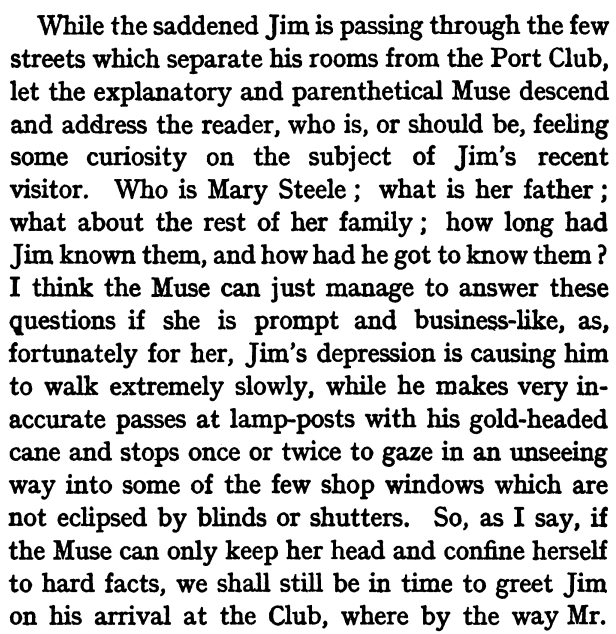
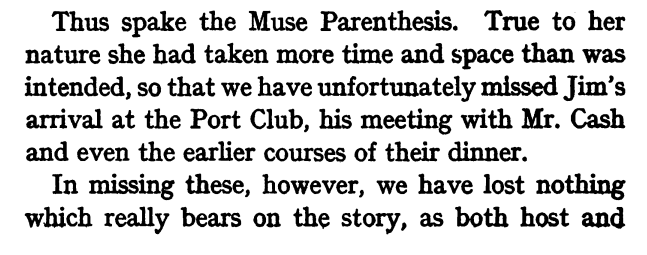
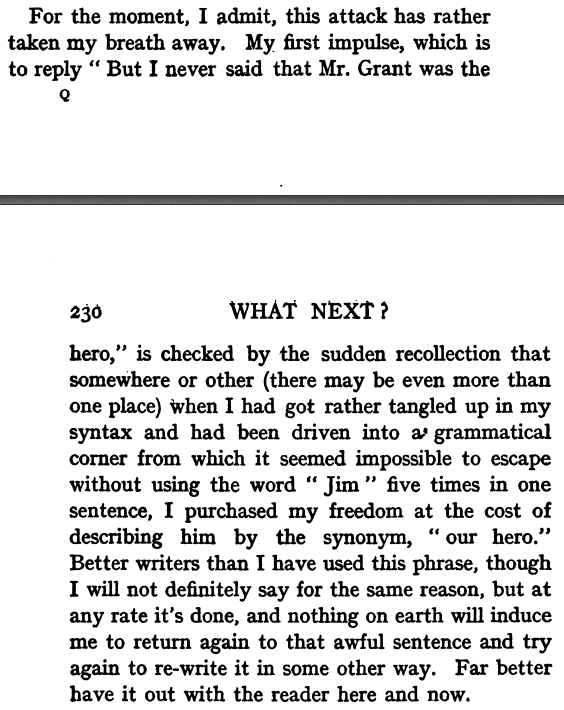
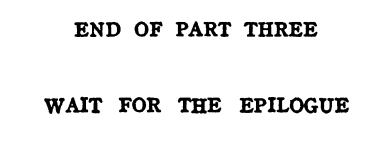
***[Mr. Cash is a solicitor]The thought of this for some reason caused him to smile, which was so unheard-of a thing to occur in Mr. Cash's room that that gentleman stopped abruptly in the middle of the word "backwardisation" and said, "I beg your pardon, perhaps I am not quite clear?"***[Mis-finished Sentences dept.!]"Besides I should miss all your--""Proposals," suggested Jim hopefully...."Nonsense. 'Racing tips' was what I was going to say."***Ergo, what the dickens and everything else am I to say?[I guess "and everything else" is a sort of blank map of maledicta, eh?]***[Parenthetical!]"Let the explanatory and parenthetical Muse descend and address the reader."[See full passage attached. And then the sequel attachment, in which the narrator really sells the idea that his story is happening in real time.]***This "but------" was the curse of Jim's existence. The riddle of the sphinx and the problem of squaring the circle left him cold.***At about ten o'clock Mr. Cash, in illustrating a mannerism of the female mandrill, knocked over a bottle of brandy.***[On the Port Club's "magic" port wine, which can be deeply indulged with nary a hangover.]Oh unsurpassable and unequalled Port Club Port, two bottles of which will be but a pleasant memory to Messrs. Cash and Grant in the morning! Oh rare grape! Oh skilled bottler! Oh peerless vintage!--how I wish I had ever met you in real life!***He bent still further forward, and his eyeglasses fell off his nose and spun wildly on the end of the curly cord. [Wildly!]***"I was a professor of never mind what at a university in the North of England."***It is well known that once a reader starts skipping he never stops, but takes longer and wilder leaps each time.***One leg of his trousers had formed itself into a kind of spiral knickerbocker and barely descended below his knee. [The rare singular "knickerbocker."]***[Laughing in Turkish Baths dept.]He might, for instance, have a Turkish bath; that wouldn't cost much; but then he hated Turkish baths really. It was so difficult not to laugh in them.***...before you, or anyone else for that matter, could say "Robinson and Cleaver."[I had to look up "Robinson and Cleaver," which turns out to be a once-famous Victorian-era Belfast department store. And of course I appreciate the narrator's thoroughness in specifying that you or anyone else couldn't say it fast enough.]***"I've got to meet Father at half-past three at platform something-or-other."[It's none of my business, but I think this may be taking genericization too far for comfort!]***Jim had at all times the gift of the sort of sleep that no outward physical disturbance could arouse. From his earliest youth cold sponges had, so to speak, left him cold.***[See attached. In which the narrator defends his depiction of the protagonist to a hypothetical, indignant reader.]***[When you can't be bothered to do your own cussing.]"Damn!" said Lush."Ditto," said Jim.***"Damn and blast!" roared Jim...."Blast and damn!" he repeated, and was on the point of adding further words of a similar nature....***A torrent of quite unspeakable though silent oaths was radiating from Jim as from some raging high-powered wireless station. [Oh, if only this book were illustrated!]***the first night of the fifth edition of "Muffins and Crumpets"***[Wait for the epilogue! (attached)]***Bonus: A passing reference in this book to the delightful surname Snelgrove was my first encounter with it. Eager to make up for lost time, I visited Wikipedia to become Snelgrove-aware. There I discovered (Missed Opportunity Dept.) that the Canadian coffee chain Timothy's could have been called Snelgrove's! Goodness gracious, I have done business at Timothy's on, I think, multiple occasions, never knowing there was an implicit Snelgrove lurking!https://en.wikipedia.org/wiki/Timothy%27s_World_Coffee#Origin_and_background
|
Page 28 of 64
> Older Entries...
Original Content Copyright © 2025 by Craig Conley. All rights reserved.
|