|
|
 |
 |
 |
Here's a game of "What am I?" Your clues: - I am an arrogant slap in the face from across the room.
- I am an ethereal corset trapping everyone in the same unnatural shape.
- I am a lazy and inelegant concession to fashionable ego.
- I am too often a substitute for true allure and style.
- I am an opaque shell concealing everything—revealing nothing.
- I am a childish masque hiding the timid and unimaginative.
What am I? Answer: Perfume (The answer is in black text on the black background. Highlight it to view.) These clues are courtesy of Christopher Brosius.
|

 |
|
|
 |
 |
 |
Here's one of Nabokov's methods for a secret code. Note the charming detail that " one-letter words remain undisguised": For their correspondence in the first period of separation, Van and Ada had invented a code ... One-letter words remained undisguised. In any longer word each letter was replaced by the one succeeding it in the alphabet at such an ordinal point–second, third, fourth, and so forth–which corresponded to the number of letters in that word. Thus "love", a four-letter word, became "pszi" ("p" being the fourth letter after "l" in the alphabetic series, "s" the fourth after "o" et cetera), whilst, say, "lovely" (in which the longer stretch made it necessary, in two instances, to resume the alphabet after exhausting it) became "ruBkrE", where the letters overflowing into the new alphabetic series were capitalized. —V. Nabokov, Ada or Ardor: A Family ChronicleVia Gretel und Hänsel
|

 |
|
|
 |
 |
 |
Going through some old files, we rediscovered our rough notes for a card game we devised several years ago. Suggestions for improvements are welcome.
---
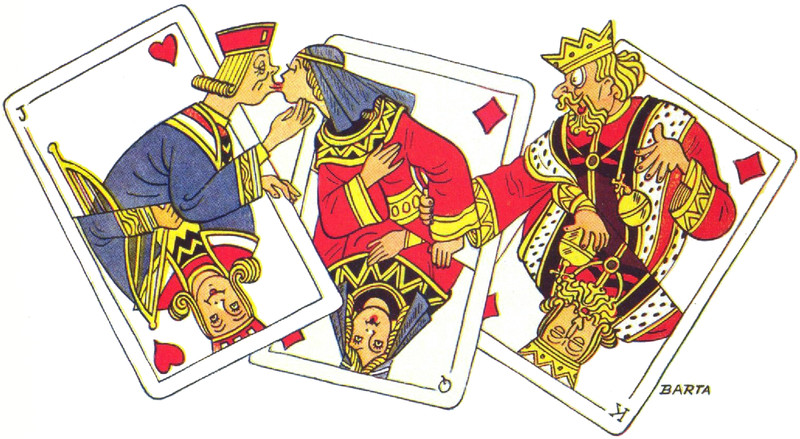
Elements is a card game for 2 players that involves sketching a map throughout. The object of the game is to win all the cards. At the end, both players will have created their own map of a new world they have created out of combined elements.
Required materials: deck of element cards, two pieces of blank paper, pencils (or crayons, markers, and so on).
The cards are divided into 7 suits (earth, air, space, fire, water, metal, wood), according to the sacred elements recognized in ancient belief systems from around the world. Each element card is numbered from 1 to 10. Higher numbers indicate stronger forces (i.e. influences, powers) associated with that element, and lower numbers indicate weaker forces.
Shuffle the deck. Deal out all the cards, so that each player has half of the deck. Players do not look at their cards, but keep them in a stack face down.
Players simultaneously turn their top cards face up and put them on the table. Whoever turns the higher card takes both cards, determines the cards' outcome according to the key below, adds the cards to his own discard pile, and quickly sketches the outcome to his map. Then both players turn up their next card and so on.
If the turned up cards are equal, there is a stalemate and each player adds his own card to his own stalemate pile.
The game continues until one player has the majority of cards in his discard pile and wins. However, both players will end up with a map of a new world.
Regarding the map, it is recommended that each player begin by dividing the blank page into three equal sections with three horizontal lines. The upper section will represent the Upper World or sky, the middle section will represent the Middle World or land, and the lower section will represent the Underworld or underground.
Key:
earth / earth (stalemate) earth / air mountaintop earth / space cavern earth / fire crystal formations earth / water mudslide earth / metal buried treasure earth / wood planted seed
air / earth dust cloud air / air (stalemate) air / space gusting wind air / fire hot air balloon air / water cloud air / metal windmill air / wood fallen tree
space / earth moon space / air tornado space / space (stalemate) space / fire shooting star space / water rainbow space / metal asteroid space / wood hollow tree
fire / earth volcano fire / air fireball fire / space aurora fire / fire (stalemate) fire / water steam plume fire / metal forge fire / wood smoldering ashes
water / earth ocean water / air rainstorm water / space underwater grotto water / fire geyser water / water (stalemate) water / metal wishing well water / wood shipwreck
metal / earth bridge metal / air airplane metal / space meteor metal / fire torch metal / water chalice metal / metal (stalemate) metal / wood axe
wood / earth forest wood / air tall tree wood / space crate wood / fire sacrificial pyre wood / water reeds wood / metal vine-covered statue wood / wood (stalemate)
|


 |
|
|
 |
 |
 |
A Can of Yams or a Can of Sweet Potatoes?How well do you know your tubers? In each sentence, guess whether the can of ___ contains yams or sweet potatoes.1. "Her eyes stopped at the single can of ___. That one insignificant can, Katie knew, was her downfall." — Donna Nelson, Encore, 2004, p. 173 2. "One itsy-bitsy can of ___ won't do it, will it, Sammy boy?" — Jamie L. Turner, By the Light of a Thousand Stars, 1999. p. 179 3. "They can take a chance on a can of ___ and enjoy a surprise." — Thomas Swann Harding, The Popular Practice of Fraud, 1935, p. 313 4. "Cash gain in April is linked to an incident involving a can of ___ and a finger." —Horoscope, The Weekly World News, March 15, 2004 5. "Destiny lies in a can of ___ in syrup." —Horoscope, The Weekly World News, Nov. 15, 2004 6. "People like that, they got to deserve a can of ___ up the ass." — Joe R. Lansdale, A Fist Full of Stories, 1996, p. 133 Answers: 1. sweet potatoes, 2. sweet potatoes, 3. sweet potatoes, 4. yams, 5. yams, 6. yams. (The answers are in black text on the black background. Highlight to view.) (This puzzle is inspired by and dedicated to Jonathan-Caws Elwitt, author of The Can of Yams.)
|

 |
|
|
 |
 |
 |
Turtles or Hurdles?In each sentence, guess whether the blank traverses a "turtle" or a "hurdle."1. "What a sight [those slow, lumbering snails] had been! Something like a slow ___." — Patricia Highsmith, Eleven, 1989, p. 772. 2. "Interestingly, the animals would occasionally leap over the ___." —Christopher Peterson, et al., Learned Helplessness, 1995, p. 193. 3. "He jumped over the ___. Then he turned and ran across the roof as fast as he could." —Paul Andrew Witty, Reading for Interest, 1955, p .114 Answer: 1. hurdle, 2. hurdle, 3. turtle (The answer is in black text on the black background. Highlight it to view.) (This puzzle is inspired by and dedicated to Jonathan-Caws Elwitt.)
|

 |
|
|
 |
 |
 |
Handwriting etiquette calls for a neat dash through misprinted characters. However, several such character obliterations actually form new characters—creation through destruction. Can you dash off the names for each of the would-be transformations below? (Click on the image for answers.) (Dedicated to Gary Barwin and Geof Huth.) --- Geof Huth writes: Craig, thanks for the dedication, of all kinds.
|

 |
|
|
 |
 |
 |
Imagine a retail store's Open/Closed sign. Now imagine that it's printed on only one side. With just two words and a detachable apostrophe, how can the sign indicate that the store is open or closed for business? For our answer, click here.
|

 |
|
|
 |
 |
 |
This puzzle was inspired by the Silly Pillows song "Cross Purposes." For the answer, see the lyrics.
|


 |
|
|
 |
 |
 |
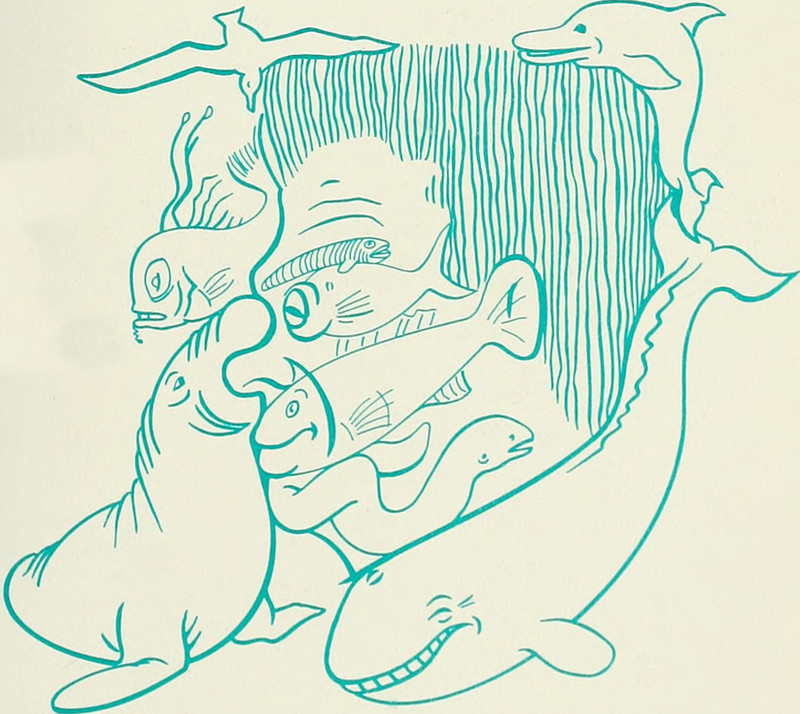
An artist called Highwireart took this photo of an exhibit of Pacific Northewest native masks in Vancouver British Columbia. Can you locate the 9 masks in the photo as well as the woman? Click here for a large sized version of the photo.
|

 |
|
|
 |
 |
 |
  by GiantChess.comTaking Chess Beyond Black and WhiteThere's an age-old debate in the Chess world over whether Black or White is the "superior" color. Because White makes the first move, White wins an overwhelming percentage of the time. But what if both sides were Grandmasters? Would there still be a color advantage, or would every game end in a stalemate? The Surrealist artist Marcel Duchamp found his own way to break free of this philosophical "gray area." In 1920, he invented a color version of his favorite board game in an attempt to turn Chess into an artistic activity. Duchamp's color choices weren't arbitrary. Indeed, as Duchamp expert Francis Naumann points out, the color of each piece served as a "continuous visual reminder of its movement and strategic power." Duchamp's two Rooks were light blue and dark blue. The Bishops were light and dark yellow. As the Queen is a combination of the Rook and Bishop (in terms of power and movement), she blended blue and yellow to form light and dark green. The Knights, sharing no characteristics with other chessmen, were light and dark red. Kings were white and black, and pawns were also white and black. Naumann notes that Duchamp compared the black and white game of chess to a "pen and ink drawing," likening chess players to painters who created black and white artwork out of pre-existing forms. "Extending Duchamp's analogy," Naumann suggests, "we could then say that playing on the chromatic set would be the equivalent of drawing in color." Though eyewitnesses recorded seeing Duchamp's painted chessmen in the early 1920s, the remarkable set seems to have become lost in the mists of time. We are left only with anecdotes and our own imaginations. Today, specialty chess piece manufacturers offer a rainbow of colorful pieces for clients who wish to assemble custom sets. For example, Chaos creates pieces in purple, green, blue, red, white and black, while Giant Chess offers 16 hues including "Edelweis," "white milk," silver, vermillion, chestnut brown, Olympia gold, silver, and soft violet. [Read the entire article in my guest blog at ColourLovers.com.]
|

 |
|
|
 |
 |
 |
Top Ten Tips forRun-of-the-Mill Playersto Enjoy Outstanding Games(an Abecedarian guest blog for DeepFun.com) There's nothing so comfy as mediocrity. Indeed, our culture teaches us both explicitly and implicitly that "okay" is good enough. But when it comes to fun, the middle-of-the-road game players cheat themselves out of something precious. Lackluster players miss out on the special spark that characterizes outstanding game play. We're not talking about the thrill of victory versus the agony of defeat. An outstanding player will have more fun losing a game than an average player will have winning a game. The fact is that mediocre players cannot, by definition, get caught up in the lighthearted spirit of the game. Following are ten techniques for transforming yourself into an outstanding player of your favorite game. 1. Seek your game's hidden source of entertainment, its heart of fascination. In Classical times, Greek and Roman games consisted mainly of running, wrestling, jumping, riding, and racing. On the surface, these games were nothing out of the ordinary, yet their players made them the world's most extraordinary entertainments, exciting the enthusiasm and awakening the spirits of the spectators.[1] To find your game's heart of fascination, observe those moments when players become carried away, when they exclaim joyously, when they leap into the air or rise off their seats as if suddenly weightless. Notice those moments when teams cheer one another, when the thrill of the play dissolves rivalry. When you identify the dynamic at play—the true spirit of the game—you can foster it, prolong it, and take it to Olympic heights. 2. Improve your flexibility and agility (whether muscular or mental). To stretch your gray matter, a Web search for "lateral thinking exercise" will offer puzzles unsolvable by traditional step-by-step logic. To increase your physical flexibility, the "sun salutation" of Yoga is a 12-step series of poses that exercise every muscle and joint of the body. Do a Web search for "sun salutation" to find free pictorial guidance. 3. Use drills to work on weaknesses (whether muscular or mental). If another player is one step ahead of you mentally or one second faster than you physically, that's a winning edge. A single increment of improvement may be all you need for success. Set simple goals and work one step at a time. 4. Better your memory. A good memory is a boon to virtually any game. A Web search for "memory game" will yield hundreds of free online resources for exercising your powers of recollection. 5. Dispel falsehoods that hinder you. Are you convinced that golf isn't a woman's game, or that softball is a young person's game, or that pinball is about making lights blink with a rolling ball? Educate yourself about your game. Read books, explore websites, talk to other players. There's always more to learn. 6. Sharpen your concentration. This is the age of the eleven-second attention span. Being easily distracted is ruinous to game play. Sharpening your concentration takes conscious, prolonged, repeated effort. Keep a journal about your game. Thinking and writing about your game will help to increase your power of concentration. 7. Manage your stress. Stress management techniques will help you improve virtually any game. A Web search for "stress management" will yield hundreds of free online tips and techniques. One marvelous stress reducer is laughter. A Web search for "laughter therapy" will inform you about how laughter reduces stress hormones, boosts immunity, promotes a positive attitude, and engenders a feeling of power. 8. Practice solo. If your game involves two or more people, don't let that fact discourage you from practicing any aspects you can work on by yourself. 9. Embrace change. "Change is necessary to improve your game. You must not be afraid to risk giving up the known for the unknown if you wish to play better."[2] 10. The final tip is too specific to apply to just any game. You already know what it implies, or will soon discover it through your ongoing self-education. Perhaps this tip will require the help of a coach or the advice of a teaching pro. Perhaps it will involve visualization techniques, or the use of a video camera, or familiarization with quantum physics. This final tip may be the ultimate key to your fullest enjoyment of your game. Notes: [1] Lewis Henry Morgan, League of the Ho-dé-no-sau-nee Or Iroquois, 1904, p. 303. [2] Philip B. Capelle, Play Your Best Pool, 1995, p. 383.
|

 |
|
|
 |
 |
 |
The "Spirit of the Game"(an Abecedarian guest blog for DeepFun.com) Without the spirit of the game, what would the game be? —Nevin H. Gibson, The Encyclopedia of Golf
Arabian folklore tells of a wish-granting genie imprisoned in an oil lamp or bottle. Might players innocently conjure such a spirit in a game of spin-the-bottle? Indeed, every game has a motivating force at the heart of it -- its own sort of soul. Whatever we might call it -- essence, atmosphere, intention, or ethos -- it's that special spark that distinguishes the game from all others. Like a genie of folklore, the Spirit of the Game grants good sports a wish -- the ultimate wish. (We'll get to that in a moment.) The Spirit of the Game is not necessarily spelled out in the rules. Indeed, "There are situations in which adherence to the so-called letter of the rules can be taken to violate the spirit of the game."[1] The Spirit of the Game is a distillation of the intent of the rules. It has been called "a self-regulating set of norms without which some games would degenerate into anarchy."[2] It is a frame of mind, not a commandment carved in stone. It's a point of view, a sense of humor, a strength of character. Novelist Richard Le Gallienne summed it up perfectly: "To be whimsical, therefore, in pursuit of a whim, fanciful in the chase of a fancy, is surely but to maintain the spirit of the game."[3] Because it is typically undefined, the Spirit of the Game can be abused. Unsportsmanlike conduct (like taunting and intimidation) is one indication of abuse; bringing the game into disrepute is another.[4] When honored across the board, the Spirit of the Game turns opponents into equals. Most importantly, it engenders fun. While camaraderie is jolly and competition is stimulating, "the real spirit of the game is all about having fun."[5] Though each game has its own unique Spirit, there are some universal characteristics. The Spirit of the Game is: • even-tempered • self-possessed, yet unselfish • levelheaded • well-balanced • untroubled • either easygoing or animated • motivated • spontaneous • committed • earnest • disciplined • wholehearted • courteous • honorable • responsible • idealistic Ultimately, the Spirit of the Game "is the only thing in the game which is lasting."[6] Corporate trainer Julius E. Eitington makes an interesting observation: when players become caught up in the Spirit of the Game, they "become themselves."[7] What is one's true self, but that of a player on the grand game board of life? Edward Clark Marsh once described being enlivened by the Spirit of the Game: "If it was not for a moment real life, it at least made you wish it were."[8] Other signs that the Spirit of the Game is present include: • both sides wish each other good luck • both sides cheer one another (winning or losing is secondary; the game itself is a victory for all [9]) • everyone plays fair (no cheating, no bending of the rules) • players celebrate the game's tradition, safeguard its precedent, and carry on its legacy • players supervise themselves. Game scientist Andrew Thornton notes that "There is no agreed upon definition of the Spirit of the Game, but there is a pervasive sense that one should play by it. The Spirit of the Game is the Police" inside each player's head.[10] But we've neglected the quintessential sign that the Spirit of the Game is present. And that's when the ultimate wish is granted: the firing shot that sets play into motion. When the game is afoot, all else is inconsequential! Fun Facts about the Spirit of the Game: • In Ultimate Frisbee, where there are no referees and no penalties, the Spirit of the Game is the underlying philosophy. "The Ultimate player will always praise and support successful actions on both teams. It is a normal thing to introduce yourself to the opponent at the beginning of every point and to wish him a good game. And after the game both teams stand in a circle talking about the game and singing a song for the opponent team. So it is a lot more than just a short handshake after a game."[11] • The Spirit of the Game comes into play "before the game has even begun."[12] • "Soccer is unique among sports in that the official's job is first and foremost to maintain the spirit of the game as well as the safety of all concerned; this concern outweighs all other laws of the game."[13] • The Spirit of the Game of soccer has been traced back to the early to mid nineteenth century, when the game developed from its folk roots into its modern form.[14] • The Spirit of the Game of curling "demands good sportsmanship, kindly feeling, and honourable conduct."[15] • The Fighting Spirit of the Game of American football is persistently aggressive in nature: "Throughout the history of football, the violent spirit of the game has endured, even as other elements of the game have changed."[16] • The Spirit of the Game of lacrosse "is a feeling of honor and dignity."[17] • The Spirit of the Game reminds players that not everything is a matter of life and death, that consequences are temporary, and that results are not critical.[6] • The Spirit of the Game teaches players to "accept success with grace and failure with restraint."[18] • The Spirit of the Game of golf is characterized by disciplined conduct, courtesy, and sportsmanship at all times.[19] [1] Allan C. Hutchinson, It's All in the Game, 2000, p. 195. [2] Lincoln Allison, Amateurism in Sport, 2001, p. 161. [3] The Quest of the Golden Girl, 1897, p. 35. [4] William John Morgan, Ethics in Sport, 2007, p. 126. [5] Richard Carlson, The Don't Sweat Guide to Golf, 2002, p. 205. [6] Division for Girls' and Women's Sports, Sports Programs for College Women, June 21-27, 1969, p. 23. [7] The Winning Trainer, 2001, p. 142. [8] "Anthony Hope's 'Sophy of Kravonia,'" The Bookman, 1907, p. 381. [9] Modris Eksteins, Rites of Spring, 2000, p. 124. [10] Belinda Wheaton, ed., Understanding Lifestyle Sport, 2004, p. 187. [11] Jorg Bahl, Ultimate Frisbee, 2007, p. 4. [12] John Byl, Co-Ed Recreational Games, 2002, p. 205. [13] Andy Caruso, Soccer Coaching, 1996, p. 29. [14] Sharon Colwell, "The 'Letter' and the 'Spirit': Football Laws and Refereeing in the Twenty-First Century," The Future of Football, 2000, p. 201. [15] Gary Belsky & Neil Fine, 23 Ways to Get to First Base, 2007, p. 209. [16] William D. Dean, The American Spiritual Culture, 2002, p. 148. [17] Steve Bristol, quoted in Our Game: The Character and Culture of Lacrosse by John M. Yeager, 2005, p. 79. [18] Hubert Vogelsinger, The Challenge of Soccer, 1973, p. 274. [19] United States Golf Association, Golf Rules Illustrated, 2004, p. 4.
|

 |
|
|
 |
 |
 |
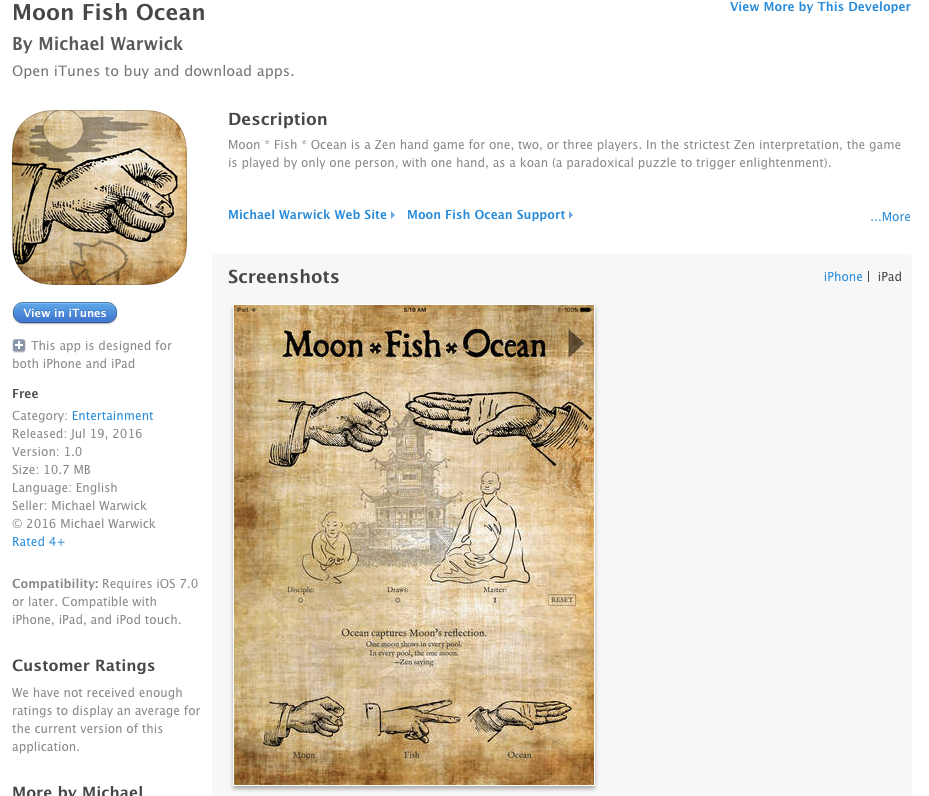
We're delighted to announce that the game of "Rock, Paper, Scissors" has been reincarnated into a Zen version: " Moon, Fish, Ocean." Play online against the Blind Master (a.k.a. your humble server). Every hand combination tells a Zen poem through sign language. Then check out the book version, which whimsically explores the complete rules, scoring, history, and variations of the game. We're honored that our game inspired the visual poet Geof Huth to create a poem-word (or " pwoermd," to be precise): moonfishoceanGeof's poem then inspired a Finnish translation, by Karri Kokko: kuukalameriGeof explains that "'kuu' is 'moon,' 'kala' is 'fish,' and 'meri' (which appears to be a cognate of the French 'mer') means 'ocean.'"
|


Page 28 of 29

> Older Entries...

Original Content Copyright © 2026 by Craig Conley. All rights reserved.
|