Found 217 posts matching ‘Radio’ |

 |
|
This May Surprise You –
July 30, 2016 |
(permalink) |
|
 |
 |
 |
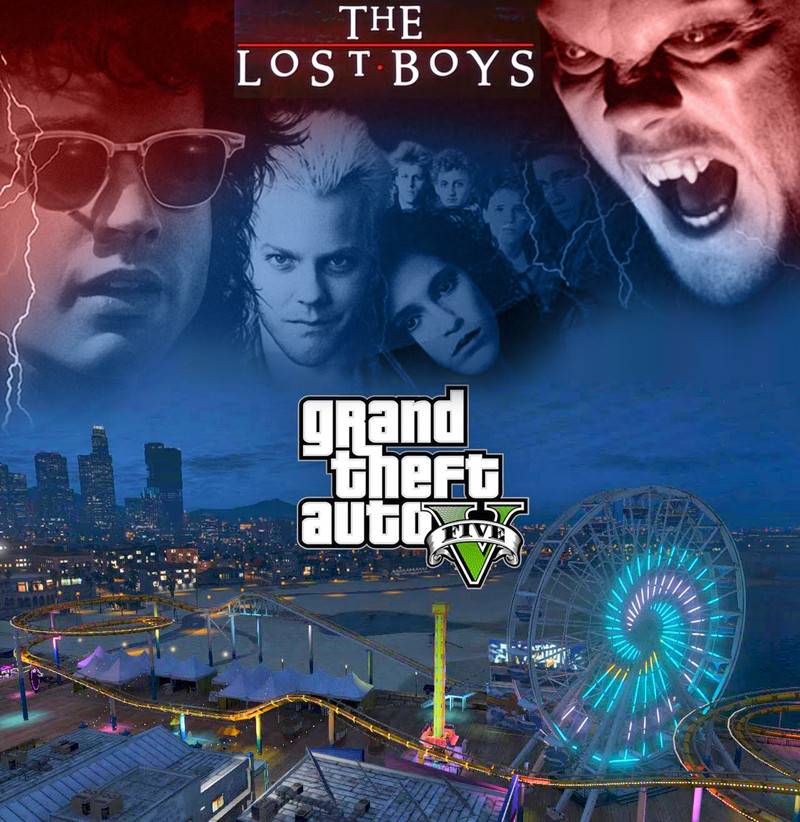
Where's the overlap between the beloved vampire film The Lost Boys and the open world game of Grand Theft Auto V? Besides the vampire tooth of the game's Roman numeral and besides the boardwalk setting? Off the top of our head, there are two music-related overlaps. First, there's the band Age of Consent, who provide GTAV's infectious theme " Colours" (chant it with us: "go out, late night; come home, daylight"). They recorded a cover of Tim Cappello's " I Still Believe" from The Lost Boys soundtrack. Second, the artist Twin Shadow (who serves as the DJ of Radio Mirror Park in the game and who offers the other standout track in the game, " Old Love / New Love"), has a song called " Golden Light," the chorus of which is an homage to the chorus of the film's memorable "Cry Little Sister" theme (chant it with us: "Thou shall not fall; thou shall not lie; thou shall not fear; thou shal not kill"). Twin Shadow's own lyrics are in the spirit of the film, too -- consider how this line, "Some people say there's a golden light -- you're the golden light -- and if I chase after you doesn't mean that it's true," recalls the film's character Michael who has newly arrived in the golden state and, feeling hopeless, chases after a creature of the night.
|

 |
|
Restoring the Lost Sense –
July 30, 2016 |
(permalink) |
|
 |
 |
 |
|


 |
|
|
 |
 |
 |
Our Unicorn Book is Officially Accused of Being Too Esoteric, Like a Book of Spells! Huzzah!
This review of our Field Guide to Identifying Unicorns by Sound is a must-read, even if the critic (who didn't buy the book and who self-identifies as mentally ill) rated the book with a single star. We've identified that single star as the one Sappho called "the fairest of all the stars":
I have rented this book from my local library, and attempted to read it. I was expecting some semblance of argument for the reality of Unicorns as a species, or at the very least salient information on Unicorns. Instead, it should be said that this book is a work of esoterica, and could be classified alongside books of spells or psychic channeling. The entire book consists of instructions of various places and ways to sit down in the quiet of nature, and listen. According to the author, the reader is supposed to be listening for singing unicorns, anyone availed of folkloric or mythological knowledge, will find a distinct absence of singing unicorns from the works of Pliny, the Bible, and other books considered primary sources on unicorns (unless one counts the Shadavar, which undoubtedly sings, but whose nature as a true unicorn is tenuous). I'll give you an example of my own, one night in bed, I was convinced that my tinnitus was actually the result of me hearing radio waves, needless to say I was actually mentally ill at the time. I am not accusing the author of being crazy, but I will willingly accuse him of being very separated from skepticism and reality. If you obey this book, you would be sitting out in nature meditating, which is fine, but I doubt you will hear any singing unicorns unless you mistakenly convince yourself that you are hearing them. What is wrong with communing with nature via meditation, to simply experience nature and commune with it? You need no new age or esoteric beliefs to do THAT, in fact, even Atheists often admit a reverence for nature. In the words of Carl Sagan, the garden is just as wonderful, even if it does not have fairies at the bottom of it.
Yes, we're reframed this negativity into something positive, as part of our personal museum of coping mechanisms. Indeed, the writing life is full of foul challenges. See this video, in which we reveal our secrets for landing a major book deal, even if you don't have a best-selling idea, weren't born into the right families, and don't work very hard: https://youtu.be/GuvJpPTawGs
---
Adam writres:
I found A Field Guide to Identifying Unicorns by Sound to be a delightful excursion into my own mind and spirit. An exercise in thinking for myself and better understanding the world and my place in it. A journey that cannot end because I will never stop finding new questions to ask or roads to travel… I would suggest that this reader is like far too much of our society. Incapable of thinking for themselves. They expect to be told what to think and believe in then blindly follow the masses to do the bidding of the few in power. I believe these people should just stay confined in their Church of Facebook and leave reading books to those of us who still use our brain cells…
|

 |
|
|
 |
 |
 |
How to Use a Magic Word as a Tarot Spread Template
(from our guest post at Thematic Tarot)
The great alchemist John Dee designed a protective magical talisman under the direction of the angel Uriel: crossed lines, a central circle, and the letters A, G, L, and A. These letters constitute an acronym (also known as a kabbalistic "notariqon") of the unspeakable primordial name that was lost through the ages. It's a well-kept secret that this talisman can serve as a revealing template for a four-card Tarot spread.

The Hebraic words of the acronym are understood to be: Atah Gebur Le-olahm Adonai. This sentence is translated many ways, but you'll see the underlying similarities:
- "You reign for eternity, O Lord."
- "Thou art mighty forever, O Lord."
- "Thou art strong to eternity, Lord."
- "Thou art mighty to the ages, amen."
- "Thou art great forever, my Lord."
- "Thine is the power throughout endless ages, O Lord."
(Interestingly, in the Middle Ages, Christians in Germany used AGLA as a talisman against fire, the letters standing as an acronym for a German sentence meaning, "Almighty God, extinguish the conflagration," as noted in The Oxford Dictionary of the Jewish Religion by Adele Berlin.)
We'll explore three approaches to AGLA for purposes of Tarot spreads. The simplest is based upon this interpretation of the Hebraic words:
"You are strong through the ages, so be it."

The card placed upon "You" is, of course, the significator. The card placed upon "Are Strong" refers to the querent's greatest strength. The card placed upon "Through the Ages" refers to an ongoing issue that seems woven into the entire course of one's lifetime. The card placed upon "So Be It" refers to a truth or certainty that one need not waste energy upon resisting.
Here's how such a reading might go. Drawing cards from the Tarot of Portmeirion, we place the King of Wands on A, "You"; the Ace of Swords on G, "Are Strong"; the Empress on L, "Through the Ages"; and the High Priestess on A, "So Be It." As the significator, the King of Wands depicts a golden Burmese statue of a dancer high atop a stone column, communicating artistic flair and confidently setting a glowing example far and wide. As the symbol of strength, the Ace of Swords depicts a sea-beaten shaft of iron that has survived the cliffside structure it once supported, symbolizing a steadfast spirit undaunted by adversity. As a symbol of the ages, the Empress depicts a statue of the Nordic all-mother Goddess Frigga (labeled "Frix" on the plinth). Wielding a broken crossbow in her left hand and the hilt of a sword in the other, the Empress stands assuredly atop a limestone pedestal, head turned toward her right. She is framed by greenery and overlooks a small fountain -- a popular wishing well -- establishing her as a heeder of prayers and granter of desires. Her broken sword (presumably ruined over time) is of interest, as it symbolizes a firm grip on intention, free from lacerations. Within the context of this spread, we can interpret the Ace of Swords as depicting the Empress' lost blade. The "So Be It" High Priestess is a trompe l’oeil mermaid "sculpture" painted on sheet metal. She sports two tails, symbolizing duality. They curl up to suggest, along with her curved arms, a figure-eight/infinity shape. The infinity shape is echoed in the dramatic curls of her hair. Eyes closed, she cradles a large fish from whose mouth flows the water of the deep realm of the unconscious. The High Priestess, framed by an archway, meditatively sits atop a sphere in a stone pavilion near a tollgate. In terms of "So Be It," she indicates the wisdom of the inner voice during contemplative silence, the need for patience, and the importance of a deep understanding.
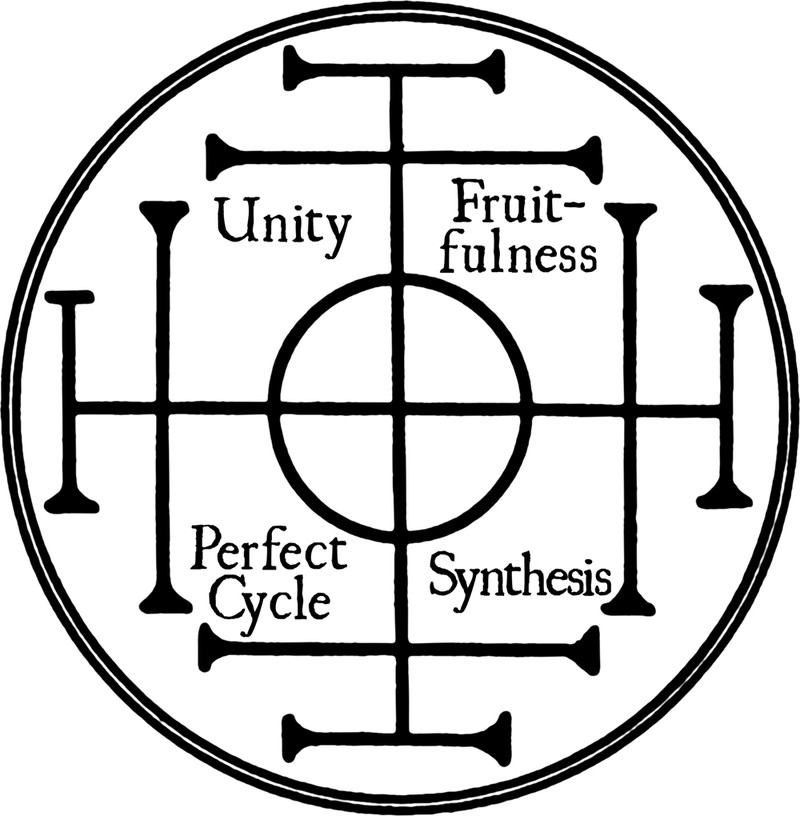
Another way to approach AGLA is explained in Eliphas Levi's The History of Magic. Levi proposes that the first letter of the Hebrew alphabet, Aleph, signifies unity; the letter Gimel, the third in the alphabet, signifies the triad and hence fruitfulness (as in two parents creating a third life); the letter Lamed signifies the perfect cycle; and the duplicated Aleph signifies synthesis.
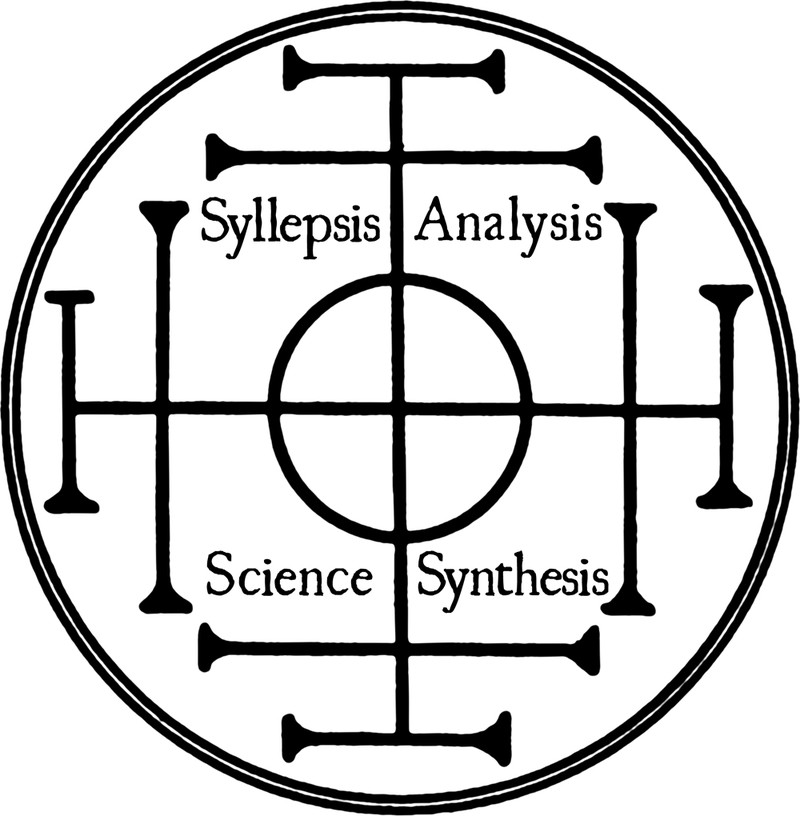
Levi offers a third way to understand AGLA: syllepsis, analysis, science, synthesis.
Syllepsis (from the Greek meaning "taking together") is a term of semantics and refers to a word or expression that is simultaneously figurative and literal. It's a word that we can understand in two different ways at the same time. But those two ways are bound together like two sides of the same coin, as the theorist Riffaterre has put it. Whatever card is placed upon Syllepsis refers to something whose polar opposite we're overlooking, like what's embossed on the back of a coin. In other words, there's an inescapable duality at play. To find the bright side, look for the humor in this, because Syllepsis is a form of punning, a wordplay of double meanings.
The card placed upon Analysis refers to what needs to be examined in detail to determine its constituent elements or structure. Analysis comes from the Greek word meaning to "unloose," so on the bright side this is something about which we can loosen up, quite literally.
The card placed upon Science refers to something that could benefit from discipline, observation, and experimentation.
The card placed upon Synthesis (from the Greek meaning to "place together") is a call to combine ideas into a theory or system.
Levi reminds us that "according to Kabalah, the perfect word is the word realised by acts." Acting upon AGLA with Tarot cards can be a profound way to translate its knowledge into action and thereby understand its mysteries.
For more details about the talisman AGLA, see The Young Wizard's Hexopedia (pictured below) and Magic Words: A Dictionary.
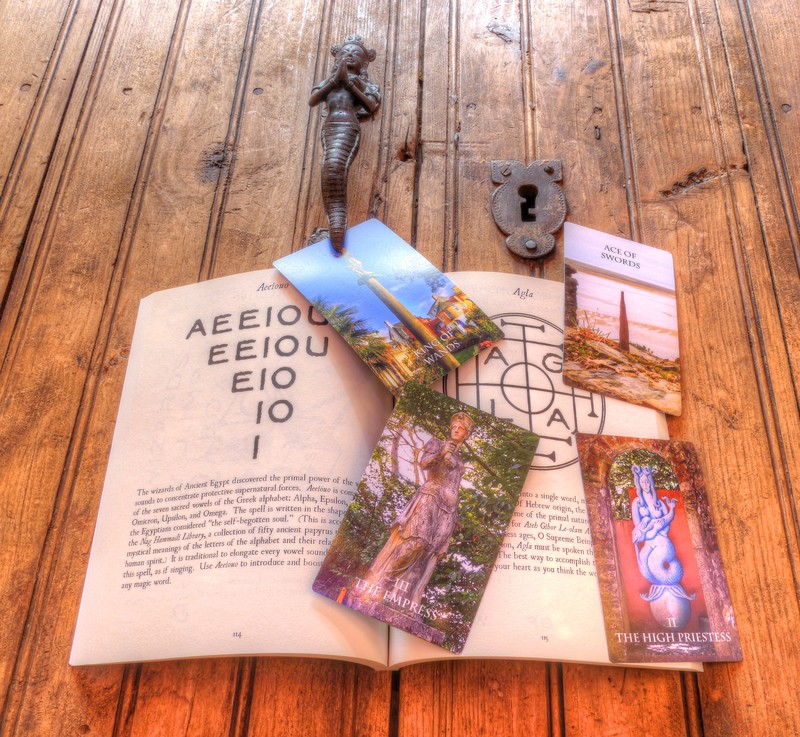
—Craig Conley is author of The Young Wizard's Hexopedia, the Tarot of Portmeirion, HarperCollins' One-Letter Words: A Dictionary, Pomegranate's One Letter Words Knowledge Cards Deck, and Weiser Books' Magic Words: A Dictionary. He is co-author of New Star Books' Franzlations: A Guide to the Imaginary Parables. He has published dozens of articles in such magazines as Verbatim, Pentacle, Mothering, and Magic. His work has been profiled in the New York Times, the New York Post, The Wall Street Journal, The Chicago Tribune, National Public Radio, The Dallas Morning News, Publishers Weekly, The Associated Press, and dozens of others.
|


 |
|
Yesterday's Weather –
June 5, 2014 |
(permalink) |
|
 |
 |
 |
The more climates change, the more things stay the same. This melting glacier dates back to 1873's The Story of the Rocks by Joel Dorman Steele.
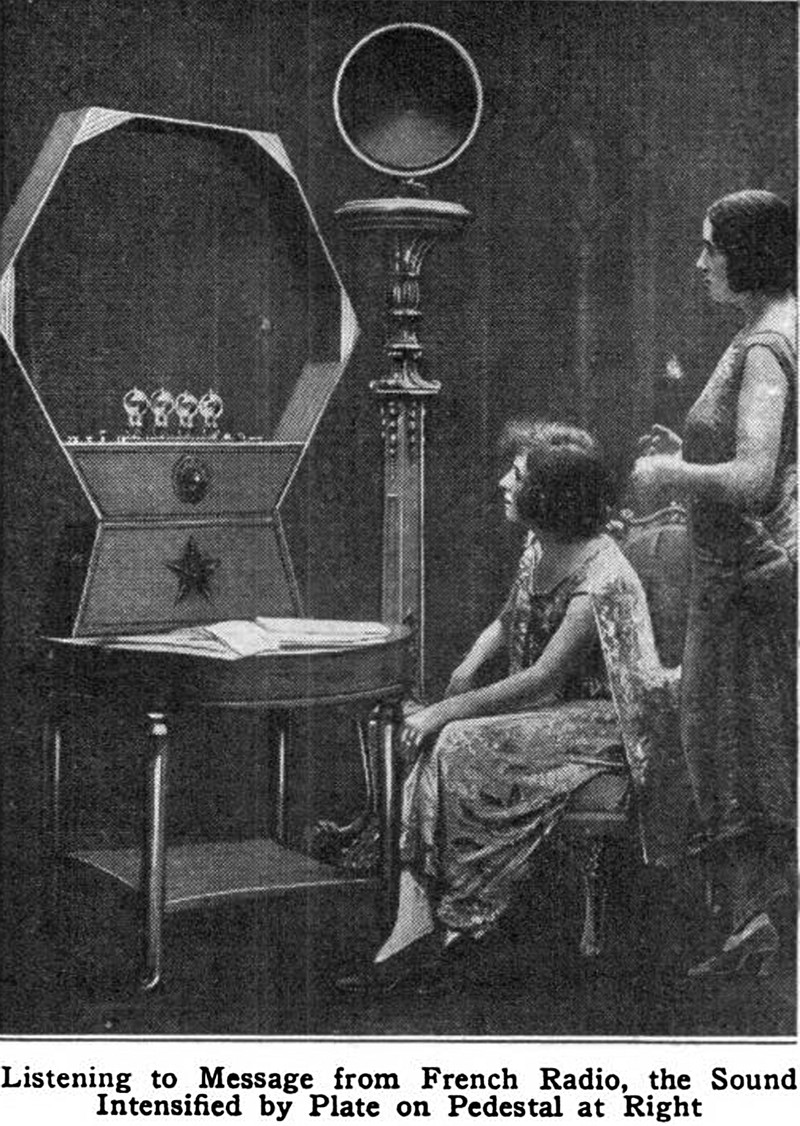
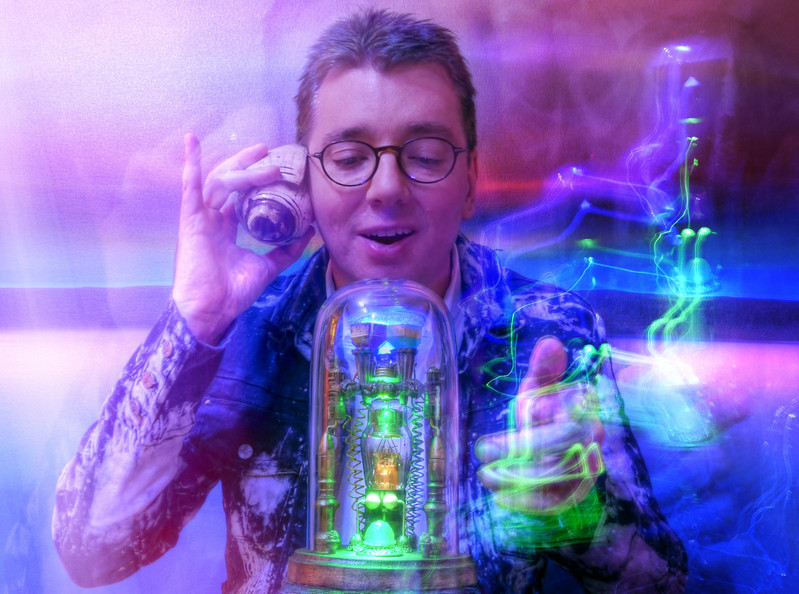
Here's what the voices in my Spirit Radio said about climate change: youtube link.
|


 |
|
I Found a Penny Today, So Here's a Thought –
August 29, 2012 |
(permalink) |
|
 |
 |
 |
We're reading a bawdy farce of old-time radio ( The Pleasure Dial by Jeremy Edwards), and the spectacles are one of the tools we use whenever we delve into material from (or set in) the past (to help filter and focus the mists of time, naturally). What has us so delighted? It's a passage in Chapter 22, involving imaginary water. (Jeremy Edwards is the first author we've encountered who is witty enough to make a glass of water hilarious.) Here are the lines, though we mustn't explain the context lest we ruin a plot twist: The last time she’d been here, she’d been in the company of a Dada composer she was sleeping with, who wanted to see his sister carry a bucket across the stage in a rustic allegory. Not a memorable role for the poor young woman, who had not yet graduated to 'ingenue'; but to her credit she had not spilled a drop of the imaginary water, and Mariel had duly congratulated her.
|

 |
|
Puzzles and Games :: Which is Funnier –
December 6, 2011 |
(permalink) |
|
 |
 |
 |
Which is funnier: an apple or a banana?Clue: This is according to a radio presenter. Answer: banana (The answer is in black text on the black background. Highlight it to view.) Citation: Peter Stewart , Essential Radio Skills: How to Present a Radio Show (2010), p. 216
|

 |
|
Puzzles and Games :: Which is Funnier –
June 18, 2009 |
(permalink) |
|
 |
 |
 |
Complete this quotation: “The stooge is the unhappiest character in radio. He knows that he is funnier than the ______.”
Clue: This is according to radio comedian Fred Allen, 1947.
Answer: Comedian. (The answer is in black text on the black background. Highlight it to view.)
Citation: Alan R. Havig, Fred Allen’s Radio Comedy (1990), p. 70.
|

 |
|
The Right Word –
February 24, 2008 |
(permalink) |
|
 |
 |
 |
All mixtapes go to heaven. Source.
Information Prose :: A Manifesto in 47 Points :: Version 1.0 by Jeremy P. Bushnell, jeremy@invisible-city.com 9. You can learn a lot about a person from a mixtape. 10. When at someone’s house for the first time, you tend to look at their bookshelves. 11. Fiction which builds characters without taking this into account has its head in the sand. 12.
The primary goal of the information prose writer is to document the
contemporary mind and environment in a way that takes the contemporary
importance of media and information seriously. 13. Many
contemporary fiction writers are afraid or otherwise unwilling to do
this. I submit as evidence the large numbers of contemporary novels set
in environments which lack informational richness: rural areas, the
past, " magical realism" worlds. 14. Information prose does not
attempt to depict a simplified version of the world. Information prose
attempts to contain as much of the complexity of the world as possible. 15. "Do you understand how tremendously dense? A minute in a room, together." — Don DeLillo, Valparaiso 16.
A fictional American present in which no one watches TV, listens to the
radio, or checks their e-mail is sentimental and false. 17.
Information prose writers should not aim to write work which is
timeless. The value of documentary work never lies in its timelessness. 18.
When writing about characters who inhabit dense fields of information
(both remembered and newly-experienced), the value of quoting,
sampling, and appropriation rapidly becomes apparent. 19.
Creative work utilizing techniques of appropriation has been produced
with regularity for nearly a hundred years now, in all forms of media.
Information prose writers should no longer need to defend these
techniques against charges of novelty. 20. A partial primer,
organized in a rough chronology: the Comte de Lauteamont’s Maldoror,
Dada collages, Tristan Tzara’s cut-up poems, William S. Burroughs’
cut-up and fold-in novels, Robert Rauschenberg’s media silkscreens,
Bern Porter’s found poems, Situationist detournement projects, the
poetry of John Ashbery, Brian Eno and David Byrne’s My Life In the Bush
of Ghosts, the novels of Kathy Acker, the albums of Public Enemy and
Negativland, and the films of Craig Baldwin. 21. All evidence indicates that much of this work is of lasting merit. 22.
All evidence indicates that these techniques of appropriation are
exactly the ones necessary to create a recognizable picture of the
contemporary present. 23. "As artists, our work involves
displacing and displaying bites of publicly available, publicly
influential material because it peppers our personal environment and
affects our consciousness. In our society, the media which surrounds us
is as available, and as valid a subject for art, as nature itself."
—Negativland’s Tenets of Free Appropriation 24. Information
prose writers should not be afraid to plagiarize. It is not their duty
to write citations. Our memories and experiences do not usually come
attended by complete bibliographies. 25. Information prose
writers should not overlook the technique of the fragment. Our
experience of the textuality of the surrounding world is largely
fragmentary; information prose should strive to reflect that. (to be continued) _____
|

 |
|
|
 |
 |
 |
Earth–Moon–Earth (Moonlight Sonata Reflected from the Surface of the Moon)Earth-Moon-Earth "is a form of radio transmission whereby messages are sent in morse–code from earth, reflected from the surface of the moon, and then received back on earth. The moon reflects only part of the information back – some is absorbed in its shadows, 'lost' in its craters. Beethoven’s Moonlight Sonata has been translated into morse-code and sent to the moon via E.M.E. Returning to earth 'fragmented' by the moon’s surface, it has been re-translated into a new score, the gaps and absences becoming intervals and rests." View the sent score and the crater-filled score received back, and hear excerpts of the score here.
|


 |
|
Semicolon's Dream Journal –
May 20, 2006 |
(permalink) |
|
 |
 |
 |
I dreamed I was a "semicolon butterfly" (polygonia
interrogationis). My wings were mottled with various shades of
red and brown, and their tips were violet. I floated off the page
and lighted on an inkwell. I uncurled my tongue and dipped it
into the blue-black nectar.
Later that night, I dreamed I was listening to a financial report on
the radio: "Prices of semicolons, plot devices, prologues and inciting
incidents continued to fall yesterday, lopping twenty-eight points off
the TomJones Index." It was uncannily like something out of THE
WELL OF LOST PLOTS by Jasper Fforde.
|


Original Content Copyright © 2026 by Craig Conley. All rights reserved.
|