|
|
 |
|
Standing on a Toilet“How’d the guy get in?”
“He stood on a commode in the men’s room and no one saw him at closing.”
Ruth waved her hand in disgust. “That’s one of the oldest tricks on the books.”
—Jo Dereske, Miss Zukas and the Library Murders (1994)
|
|
|
|
|
|
Raphael's " Lady With Unicorn." A unicorn stepping stone. A fancy Irish dress that celebrates unicorns. Destroying the great desert unicorn art installation. According to my research in A Field Guide to Identifying Unicorns by Sound, the captivating, lightsome voice of a unicorn may sound like: - a wondrous cascading
- an exotic lullaby
- something out of a fairy tale
- a strange, melodic chuckling
- a trickling flute
- a comfort
- a mourning dove
- an angelic shower
- a happy cooing
- Ella Fitzgerald
- spiritually-charged vibrations
- burbling water
- something from the future
- peculiarly clear
Unicorn-themed color palettes from ColourLovers.com: 
"Unicorn Night Light" by Hellbuny. The full palette description is here. |
|
| 
"Unicorn" by Farewelltransmission. The full palette description is here. |
|
| 
"Unicorn Tapestry" by MattyD. The full palette description is here. |
|
|
|
|
|
|
|
Luke Metcalfe, creator of a charming online anagram dictionary, suggests that "to some small degree we've been subconsciously shaping our language to make nice anagrams." He is referring to the huge number of anagrams that are surprisingly fitting, such as: eternity and entirety, backward and drawback, discern and rescind, demand and madden, comedian and demoniac, American and cinerama, aspirate and parasite, oldies and soiled, lust and slut. |
|
Squeal of an InfantThe oldest trick in the world
is the squeal of an infant
—Anonymous, “Sweet Relief,” Adventus Christi (1972)
|
|
|
|
|
|
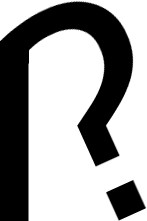
Every time I write a rhetorical question, I wish there were a special question mark to signify my meaning. Here's what I came up with. The Society for the Promotion of Good Grammar writes: Up until now, the only problem with them has been the clumsy punctuation we use. If we use a traditional question mark, some yahoo might answer. If we use a period, we sound like Eeyore, the donkey who needs Prozac. So thank you, Craig Conley, for this, the rhetorical question symbol. Why didn't we think of that? (Wait, don't answer -- it was rhetorical.)
----
Bruce Robb shares:
According to Wikipedia:
In the 1580s, English printer Henry Denham invented a "rhetorical question
mark" for use at the end of a rhetorical question; however, it died out of
use in the 1600s. It was the reverse of an ordinary question mark, so that
instead of the main opening pointing back into the sentence, it opened away
from it.[*]
* Truss, Lynne. Eats, Shoots & Leaves, 2003. p. 142.
|
|
|
|
From Prof. Oddfellow's sketchbook:
|
|
The unicorn is described in this history of animals entitled Ontleding Des Menschelyken Lichaams from 1551. A nifty unicorn puppet. Do cats love unicorns? Unicorn-themed color palettes from ColourLovers.com: 
"Unicorns" by Xtoq. The full palette description is here. |
|
| 
"Unicorn" by Fidgety. The full palette description is here. |
|
| 
"Real Men Heart Unicorns" by Zkarcher. The full palette description is here. |
|
|
|
“Snake!”“Sss . . . snake!” George screamed. God, thought Harry, one of Preacher’s snakes has escaped. Harry jerked his head for a look. And George stepped in and knocked him on his ass and kicked him full in the chest. . . . Goddam, [Harry] thought, I fell for the oldest trick in the book.
—Joe R. Lansdale, “The Pit,” The Mammoth Book of Pulp Action (2001)
|
Page 3 of 4
> Older Entries...
Original Content Copyright © 2026 by Craig Conley. All rights reserved.
|






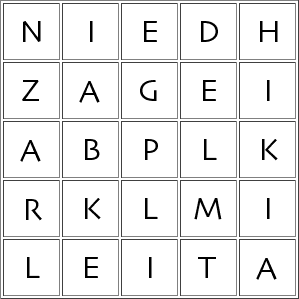 This puzzle grid contains several big words. Can you find them?