Found 542 posts tagged ‘magician’ |
|
Puzzles and Games –
January 23, 2013 |
(permalink) |
|
 |
 |
 |
Jollification expert Bernie DeKoven highlights our oddest work yet — a book that transforms other books in surprising ways. As we confabulated with Bernie: The Dictionary Game (see also Fictionary) turns a serious reference book into a gaming generator; the dictionary is playfully transformed from a tool for decoding puzzling words into a puzzle-making machine, where whimsically fake definitions take the stage. But could any book, spontaneously pulled off the shelf, be transformed into a playfulness machine? Could one’s entire home library be a gaming center? That’s the lofty goal of a new publication that offers, among other oddities, cut-out paper spectacles for seeing more than is readily apparent in any book.
Please note that our Machinarium Verbosus is a book for the few—the very few. If it’s important to one’s psychological well-being that the machinations of the Universe be neat and
tidy and wholly comprehensible by the human mind, then absolutely do not proceed with
this book’s experiments. Let this constitute a very serious warning: do not take these experiments
lightly, as any one of them may induce an existential crisis.
|


 |
|
Restoring the Lost Sense –
September 20, 2012 |
(permalink) |
|
 |
 |
 |
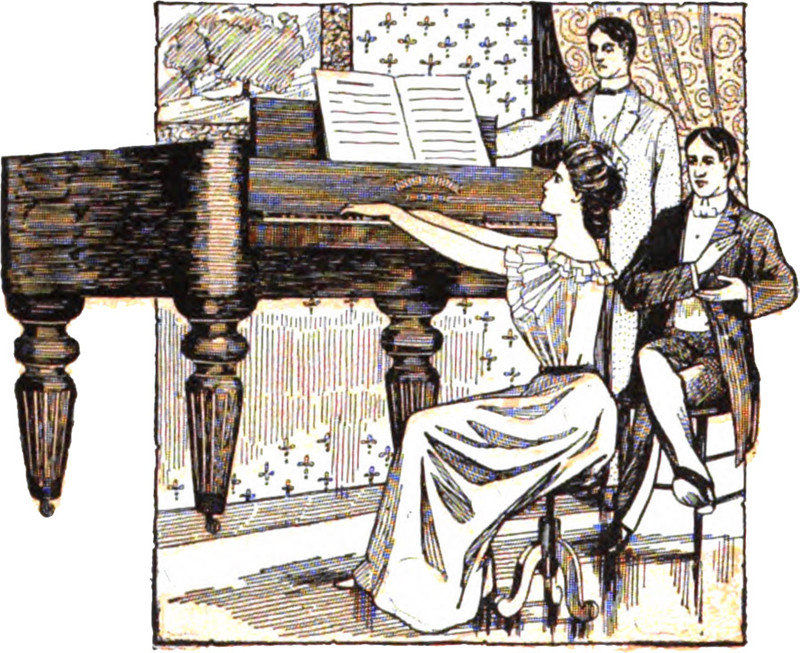
An illustration from a 1904 issue of Saturday Evening Post magazine. The caption reads: "To reassure her he began doing incredible things with the big silver hoops." It was this illustration that inspired our article for Secret Art Journal, " Magic as Reassurance."
 |
| [Inexplicable images from generations ago invite us to restore the lost
sense of immediacy. We follow the founder of the Theater of
Spontaneity, Jacob Moreno, who proposed stringing together "now and then
flashes" to unfetter illusion and let imagination run free. The images
we have collected for this series came at a tremendous price, which we explained previously.] |
|


 |
|
Go Out in a Blaze of Glory –
October 28, 2011 |
(permalink) |
|
 |
 |
 |
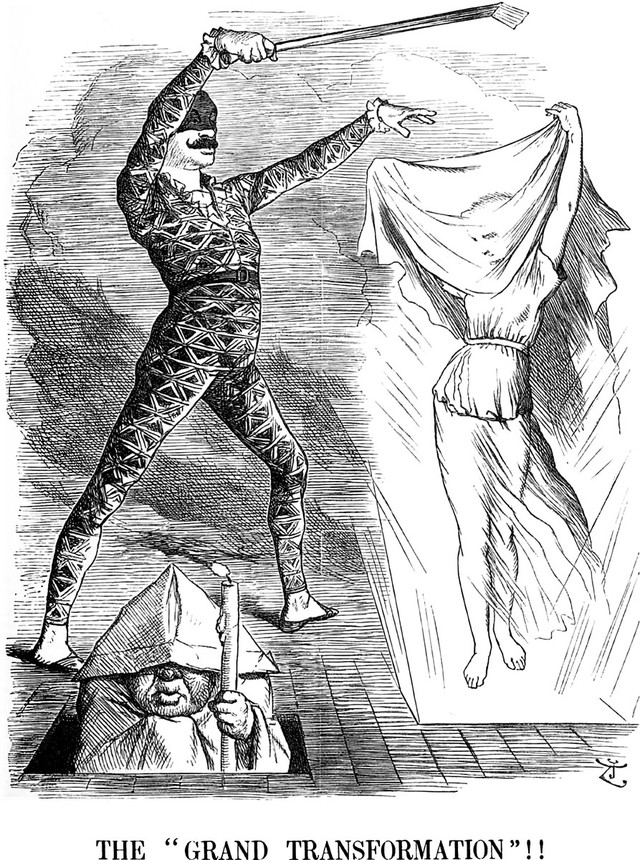
We discovered this curious "ghost in a candle" trick in an issue of The Strand from 1895.
Here's the explanation of the trick candle, "invented by a man as a rather peculiar surprise for a friend. He made that friend a present of some coloured wax candles, one of which contained the affair shown. The receiver was very fond of having a few candles of the coloured kind placed about his drawing-room, in candelabra, and was intensely surprised one night when one of those which he had thankfully accepted from his friend exploded with a loud 'bang,' after having burnt down about half-way, and revealed to view a miniature ghost, with outstretched arms, which had issued from the remaining portion of the candle. To say that the man was puzzled by so extraordinary an apparition is to incompletely describe his feelings. I wonder how the reader would accept such a crisis. I know that I should have been very much astonished. Yet the effect was produced in an exceedingly simple manner, as can be understood by examining the drawings. The lower half of the candle really consisted of a thin cardboard case, containing a spring and a small 'ghost' with spring-arms, which would fly apart immediately upon being released from their bondage. A small portion of gunpowder, separated by a disc of paper from the head of the 'ghost,' completed the apparatus. The outside of the cylinder was waxed to appear as but the continuation of the candle. When the flame burnt to the powder it naturally caused it to explode, and simultaneously with the discharge the spring forced the little image upwards. This device would make an effective toy, I am inclined to think, as the cylinder could be used as often as required, by fixing a half-candle properly to the top of it and concealing the join."
 |
|
|


 |
|
Restoring the Lost Sense –
June 7, 2011 |
(permalink) |
|
 |
 |
 |
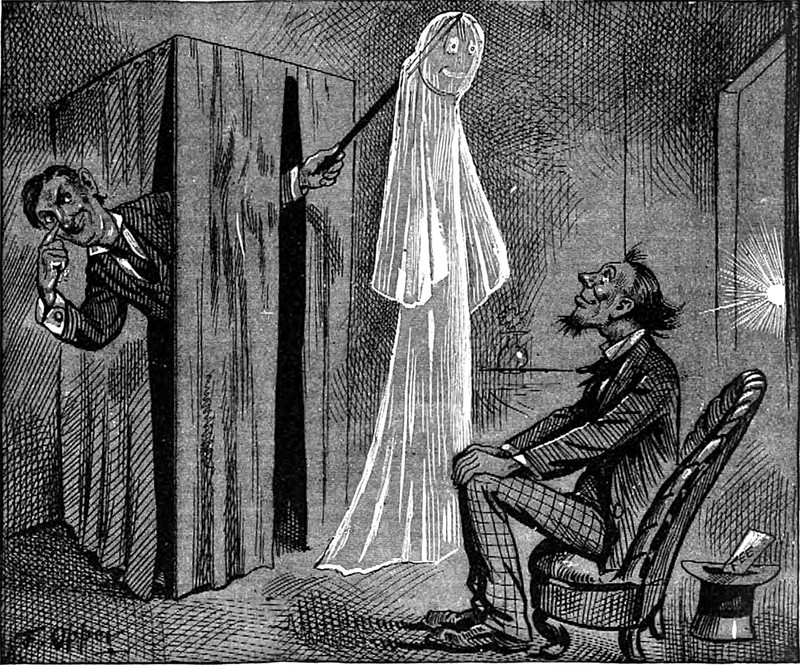
We would swear this illustration of a fire eater is dated "1967," though the issue of Cosmopolitan in question was published in May 1900. Apparently, an artist is only as far ahead of his time as his autograph dates him. (Note that in 1902, Georges Melies will film his classic A Trip to the Moon, which will also be exactly sixty-seven years ahead of its time.)
Bob responds: That performer is a fire eating magician! The mouth of the performer is functioning as a hat. The fire appears to have taken a specific shape of a rabbit: hand holding its rear end, paws reaching back to the performer's mouth, and two ears towering up from the too-small head. Not bad for the shaping of a flame.
And I can believe in anything else I want too.
 |
| [Inexplicable images from generations ago invite us to restore the lost
sense of immediacy. We follow the founder of the Theater of
Spontaneity, Jacob Moreno, who proposed stringing together "now and then
flashes" to unfetter illusion and let imagination run free. The images
we have collected for this series came at a tremendous price, which we explained previously.] |
|


 |
|
I Found a Penny Today, So Here's a Thought –
November 20, 2010 |
(permalink) |
|
 |
 |
 |
From our Magic Words outpost at Blogger: We contributed an article in the December issue of MAGIC magazine about our favorite magical gathering. There are No S's in "Magic & Meaning"
by Craig Conley
What’s the secret for keeping a magic conference from turning into a “vicious circle”? For host Jeff McBride, it’s uncoiling that circle into a spiral, with a fixed starting point but enough momentum to spring. McBride’s unwound magic circle known as “Magic and Meaning” is an innovative, annual workshop held over four days in Las Vegas. McBride gathers a band of prominent thinkers, theorists, and philosophers of the art to spark insights for magicians from around the world. Attendees have only one thing in common: a quest to unravel the secrets of wonderment.
Named after a book by Eugene Burger and Robert E. Neale, Magic and Meaning is perhaps something of a misnomer, for the workshop doesn’t celebrate any one flavor of magic, and the so-called meaning of any particular trick is ultimately for each beholder to determine. But if we add an “s” to each word, we’re offered a clearer window into what actually unfolds here.
Magic(s) and Meaning(s) is an evolving concept, in keeping with McBride’s spirit of innovation (his Wonderground magic and performance art variety show was recently awarded most innovative nightclub experience in Las Vegas). Five years ago, the workshop was perhaps equal parts instruction, performance, and collaboration. Today, at a secret shelter from the city’s hubbub of excitement, breakthroughs are shared through succinct formal presentations (called PEP Talks) as well as more detailed keynote addresses, while the teaching of tricks and honing of skills occurs more intimately.
In October 2010, stalwarts Burger, Neale, Lawrence Hass, and George Parker led the proceedings. Keynotes included McBride’s secrets of meeting impossible deadlines and Neale’s revelations on the importance of being one’s own kindly dictator. PEP talks included Cory Haines’ ingenious methods for applying game show strategies to mentalism routines, Parker’s insights into how ocular blind spots gave birth to our conception of the devil, Jordan Wright’s demonstration that the surrealist artistic movement is magic’s greatest ally, Kenton Knepper’s cutting-edge techniques on character readings in magical performance, Gordon Meyer’s procedures for long-distance creative collaborations, and Abbi Spinner McBride’s explanation of how to birth miracles through magic “midwifing,” just to name a few. Other luminaries, like Luna Shimada, kept a low profile, with the promise of presenting next time.
In between formal talks and small group sessions, subtle teachings abound. For instance, Burger has a sort of running gag—he performs a brilliant card routine with someone, one-on-one, and as the gasps and shrieks die down his parting words are, “It’s the only thing I know.” His subtle teaching? I understood it to encapsulate several points simultaneously, including: “Do a single trick brilliantly and you’re a brilliant magician,” “To create wonderment is the one true ‘trick’ for a magician to master,” and “Speak with humility, tongue planted firmly in cheek—that’s great sleight-of-mouth.” Hass, a seasoned college professor, communicates his own subtle teachings in a different way. Loquacious as he is, Hass demonstrates by example the art of active listening.
The two words most commonly associated with the workshop—“storytelling” and “bizarre”—are not especially accurate. Magicians interested in storytelling are most certainly in attendance, yet while the inherent magic of language is celebrated, there is no formal instruction in crafting narratives. Indeed, Burger himself prefers pithily-condensed verbal accompaniments to his nimble-fingered feats. And while bizarrists may be attracted to the workshop, Magic(s) and Meaning(s) actually evolved out of a previous gathering called “Beyond Bizarre,” which actively sought to transcend the limitations and preconceptions of that label.
The most accurate word to associate with the workshop is likely “texture.” As Burger puts it, a highly textured magic show will take audiences in different ways, much the way a highly textured surface will reflect light across a broad spectrum. No two audience members will be dazzled by exactly the same sparkles. Burger suggests that how a trick is received is not what matters. “Once the trick is deceptive,” he explains, “it’s about me and what I want it to be."
Hass would seem to agree: “I believe seeing and feeling the tension about the meanings of magic is an important thing to do, because it prepares us for the step of figuring out where we want to land, and then walking the walk (and talking the talk) of our landing place.” Burger refers to a teaching in an ancient poem: what matters is the singing of one’s song, not its reception. He counsels magicians to let their magic “sing with greater clarity and love” so as to affect their audiences most deeply.
True to the spirit of self-determination, Burger discourages the brotherhood of magicians from using the word “we,” and in fact he considers that little pronoun to be an illusion of its own. “The deepest questions are personal ones,” he suggests to the workshop participants. “What do I want my magic to be? Because it can be anything!” His attitude is in keeping with the anti-proselytizing, pro-independence spirit of the event. Neale’s favorite definition of magic is “imagination at play,” and his goal for the workshop is “to encourage you to play with your imagination.” McBride’s own stated objective is to create a space in which individuals can shine in their own right.
Witnessing the complementary styles of the facilitators in action, one can’t help but to see them as cultivators of a magical garden. Burger—a bonsai artist, pruning away anything extraneous. Neale—a topiarist, fashioning shapes in some seriously silly ways. (As Neale says in Magic Matters, “It is important to be serious, and it is just as important to be silly with the serious.”) Hass—a hydroponic specialist, exposing the roots only to nourish them. Parker—a builder of matrices for vines to stretch upon in their own directions. McBride—a hedgerow trimmer, demarcating the fringes with safeguards and perhaps raising a labyrinth at the center.
Come to think of it, those two vanished s’s in the workshop’s title are perhaps best left invisible. According to Burger's credo on self-determination, there really is only one magic and one meaning—and that's yours.
|

 |
|
|
 |
 |
 |
From Prof. Oddfellow's sketchbook: From our Magic Words outpost at Blogger:
 |
Printed collections of Forgotten Wisdom diagrams are available: Volume I from Mindful Greetings and Volumes II, III and IV from Amazon. Selected posters are also available via Zazzle. |
|

 |
|
Colorful Allusions –
January 9, 2010 |
(permalink) |
|
 |
 |
 |
From our Magic Words outpost at Blogspot: "Fresh snow reminds me of a magician's hankie covering the magic happening beneath. Soon it will be pulled back, and surprise! It is spring!" — Dr. Bill Gordon
|

Page 27 of 28

> Older Entries...

Original Content Copyright © 2026 by Craig Conley. All rights reserved.
|