I Found a Penny Today, So Here's a Thought
|

|
|
|
|
|
|
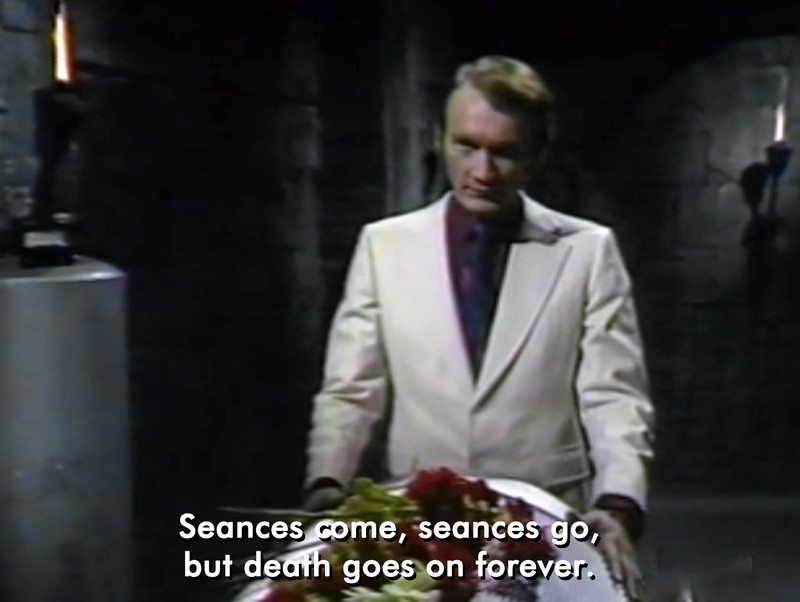
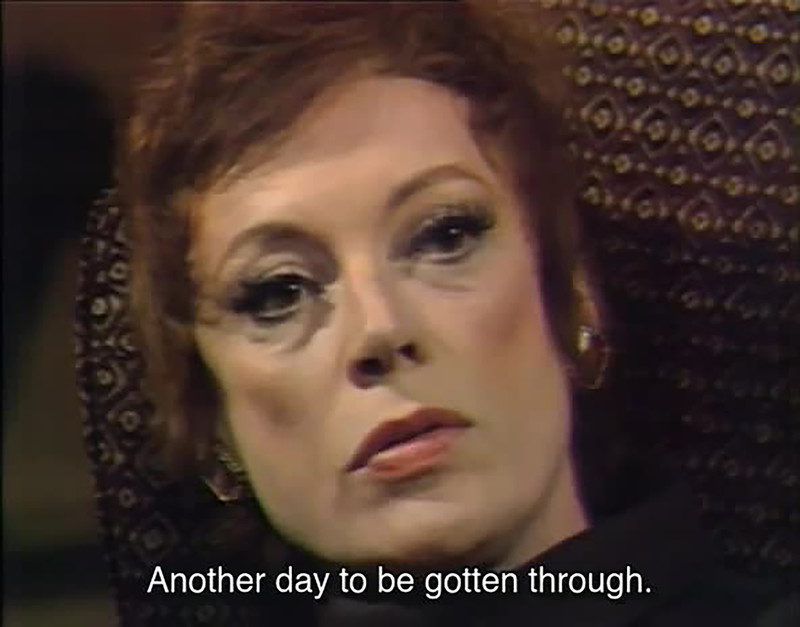
"Seances come, seances go, but death goes on forever." From Canada's answer to Dark Shadows, Strange Paradise episode 32.
|
|
|
|
|
|
|
Here's the text of our second guest hosting of the Insane Signals podcast:
Not all reunions are the same. To meet your long-lost, separated-at-birth identical twin? Aw! To meet your Double-Walker, the doppelgänger of German lore which is your exact replica and your phantom forerunner? Awwwwwww! Your doppelgänger is your psychopomp or death omen. With a shiver down the spine, you'll know your doppelgänger the moment you meet it, just before you collapse, even as cats and dogs are said to have the ability to see and recognize a doppelgänger.
The literature establishes that every living being, man or beast, has a spirit copy of itself. When your path of life leads you to meet your doppelgänger, everything will change. That's because the doppelgänger causes you to question everything you presumed about your family, your friends, your hometown. Couldn't it have replaced your loved ones with their likenesses? Might those likenesses even have been replaced by other copies and others in an ever-blooming cycle of selves, none of whom are those you loved? But we're getting ahead of ourselves, even as our doppelgänger walks ahead of us. What we'll explore now will become progressively mind-blowing, and I'll save the chilling-most idea for the end. One thing seems certain: the doppelgänger beckons you to your doom. It comes to fetch you and is even called a fetch. You are fetched away by your mirror image, your detachable soul, your exact counterpart that wanders abroad. Such entities have been described throughout human history, including the ancient Egyptian concept of a second self and the Christian idea of one's personal guardian angel. Norwegian lore speaks of a similar figure known as the Follower, but it often takes animal form and is more akin to a werewolf.
The famous Austrian psychotherapist Sigmund Freud avoided ever meeting the dramatist Arthur Schnitzler for fear of meeting his double and dying from the encounter. Admitting such was actually Freud's RSVP to Schnitzler, and it's a reasonable excuse to use, that one cannot attend a party for fear of encountering one's doppelgänger.
There are so many other historical accounts of doppelgängers. Russian empress Catherine the Great was often seen entering her throne room while simultaneously lying in bed. English queen Elizabeth the First saw her own doppelgänger as a corpse before dying herself. Poet Percy Shelley encountered his doppelgänger twice, and during one encounter it asked him, "How long do you mean to be content?" President Abraham Lincoln saw his paler doppelgänger in a mirror.
Disturbing questions begin to ask themselves. Are we each two creatures? Are we each ourselves and an enemy doppelgänger? Even more disturbing, which of the two is the "senior," so to speak — are you the real one, like the landlord of your body, or are you the unwelcome guest who would seek to evict you from your own estate? It's said that when one's double selves meet, only one can remain, and that's because the second self must sap the other's energy in order to fully manifest.
Is the idea of multiple dimensions or parallel universes at play? Could a second self transgress the dimensional veil and glimpse itself in another existence? Author and supernaturalist Charles Williams, a colleague of the more famous J. R. R. Tolkien and C. S. Lewis but frankly the best writer of the three, posited another, darker idea. He saw the doppelgänger as one's spirit form after death, wandering the timeless Otherworld and, during a prolonged life review, revisiting key moments from life. So one's doppelgänger could be one's future, deceased self, shifting backward through time and possibly choosing a point from which to begin again. Imagine being possessed not merely by a ghostly walk-in but by your own dead self ... to die prematurely by your future spirit usurping you in its past but your present. To be a host to the parasite that you will become, living an infinite loop like a snake eating its own tail, your dreams and memories progressively breaking down through redundancy. It's something to think about before you fall asleep — has it already happened to you, or are you yet to meet your doppelgänger, perhaps upon the very moment you open your eyes in the morning?
We'd leave it there, for how could we top that visual? But it's fair to wonder what can be done. Here are some tips I've gleaned from the literature. Try never to feel out of place or appear anywhere at the wrong time. Keep your alter ego in check. Avoid double-talk, repeating yourself, reiterating points, double entendres, and double negatives. Never go on double-dates. Avoid too much self-reflection. Never double-cross another. Don't seek to know yourself too clearly. Avoid getting into a double bind. Avoid double-glazing your windows. Never be a double-dealer. Reduce the number of mirrors in your living space. Don't work as a double-agent. Never host unwanted guests. Don't be deceitfully double-faced. Use corrective lenses to avoid double vision. Don't talk to yourself. Never trick others as an impostor. If you are already the product of a broken home, just know that I'll pray for you.
I'm Prof. Oddfellow, a Permanent Official in many impermanent offices, the first authority in the world on certain subjects, and the first authority in the nether regions on one or two more, always conducting several lines of research at once, some perfectly wholesome. See me in glorious monochrome in the long-running series Prof. Oddfellow's Penetralia and Grave Mood Rings, on Roku, Youtube, MysteryArts.com, and in the House of Scream Studios horror specials.
|
|
|
|
|
|
|
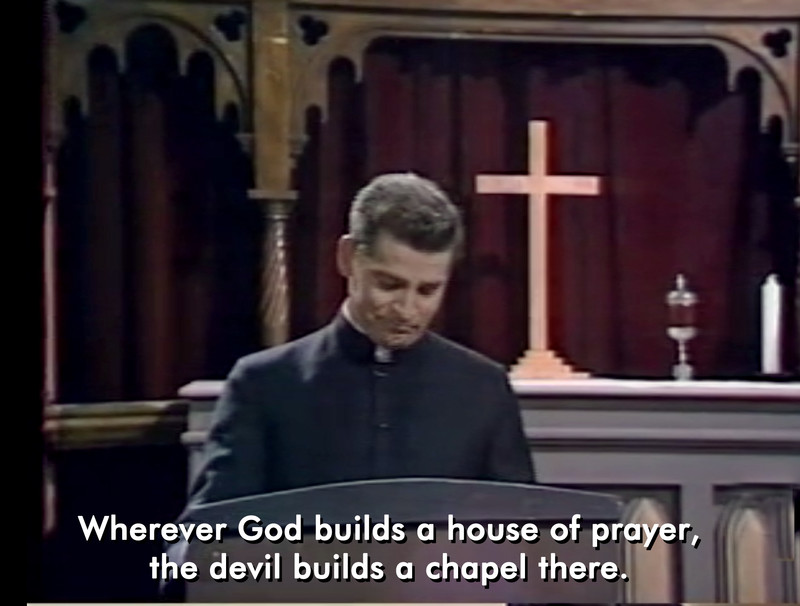
"Wherever God builds a house of prayer, the devil builds a chapel there." From Canada's answer to Dark Shadows, Strange Paradise episode 3.
|
|
|
|
|
|
|
Here's the text of our first guest hosting of the Insane Signals podcast:The two very oldest books of horror are likely far more ancient than you might guess, and they offer a way to appreciate all horror films from a new perspective. These two books are haunted by terrifying slasher entities armed with blades, who cut throats and sever heads, live among snakes, and feast and dance in blood. There are also monsters who devour hearts, corpses, and souls. Let's not forget the executioner whose noose drags people along as their intestines are extracted, their brains are licked, and their bones are gnawed ... all before they are hacked repeatedly.Just how old are these books of terror with sinister casts of demonic monstrosities? Did you guess thousands of years BC? Yes, the books in question are the books of the dead from Egypt and Tibet. They offer hallucinatory reads, but can it be true that they color all horror in their wake? Well, they present the afterlife in all its gory details, but they also invite us to understand life, too, as a similarly fantastical journey. The Tibetan version most clearly states that the forbidding adventure through the hereafter is in fact no different than other illusory states of consciousness such as dreaming and waking. Indeed, all states of existence are seen by Buddhism as in-between or Bardo-states. We close our eyes and dream little movies, we open our eyes and seem to live different movies, we die and experience another movie on the way to either reincarnating or transcending to an unknown realm.So if within the movie of our life we're watching a film on the silver screen, we might try to interpret the characters from the get-go as having recently deceased, their stories inviting us to travel with them through the hellish afterworld as they battle the fears and demons engendered by their past sins or bad decisions. Applying such a perspective, we can re-interpret favorite films to discover additional significances. Let's take three quick examples, starting with The Lost Boys, of 1987. A mom and her two sons make a move after a divorce, presumably dying in a car accident. They find themselves arriving at the otherworldly, otherwise non-existent city of Santa Carla to reunite with an aged grandpa who specializes in grotesque taxidermy. He greets them by playing dead, as if rather broadly hinting that his family has moved to a necropolis. Santa Carla is a realm of illusions. Within the underground lair of the vampires, maggots are sometimes takeout rice, worms shift into noodles, and wine is also blood. The boardwalk's merry-go-round rotates like the Buddhist wheel of attachment, ignorance, anger, and desire. But, filtered through the books of the dead, the message is uplifting, as predeceased loved ones can help us to overcome the shadows that precede us. Now also consider The Cabin in the Woods, from 2011. The two surviving protagonists finally come to terms with the end of the world, deciding that humanity doesn't deserve endless cycles of ritual murder. Seen from the angle of the books of the dead, the protagonists lost their lives before the film even started, so their final realization isn't actually about the imminent end of world since their world had already ended with their own deaths. Instead, we can view their final realization as consciousness of their own demise and having finally let go of the negative beliefs that sought to keep them attached to lost illusions. Only by the very end of the film have the characters integrated their own darkness and found themselves ready to begin afresh with no old baggage. Instead of a brutally dark, apocalyptic nightmare, the film becomes a documentary of sorts about damned souls extricating themselves from the existential circle of suffering.Finally, Dario Argento's Suspiria of 1977 can be newly understood as one freshly dead ballet dancer's escape from a netherworld of maggots, covens of human-sacrificing witches, throat-ripping dogs, electrical storms, and ambuscades of razor-wire and glass shards. Considering her as being dead from moment one, even the film's opening with her uncanny exit from the airport begins to make a new sort of sense. Everyone she encounters is an unsettling resident of the Bardo, either a fellow wandering spirit or a karmic hellion. Only by consuming the entire ballet school in flames can the protagonist transcend that Bardo. It's as if she had recited the Egyptian Book of the Dead's spell for being transformed into a living soul and not entering into the place of execution. I'll recite that spell at the end of this piece, in case you could use it.Argento's films, like those of David Lynch, are commonly described as dreams. Ingmar Bergman, director of the psychological horror film Hour of the Wolf, even proclaimed that "All my films are dreams." If the ancient wisdom of the books of the dead is correct, all of life is in fact a sort of hallucination, just as all of death is. Waking life is no realer than the world of the dreamtime or of dying. The great researcher of all things weird, Charles Fort, believed in a ghost world, only he decided that waking existence is wholly peopled by phantoms. The also-great science fictionalist Philp K. Dick came to a similar conclusion in his Exegesis, that we are the dead but don't know it, cyclically living in a simulated, purgatorial world until we manage to enact enough good decisions to trigger off an intervention from a divinity or our own higher selves. Dick wrote, "We have for a long time been dying brains/souls slipping lower and lower through the realms, but the punishment of reliving this bottom-realm life is also an opportunity to add new good karma and break the vicious cycle of otherwise endless reliving of a portion of our former life. ... We must change the 'groove' for the better or just keep coming back, not remembering, not re-ascending."For those with faith in ancient Egyptian magic, here's the spell for never perishing as translated by Raymond Faulkner:"I am the soul of Ra who issued from the Abyss, that soul of the god who created authority. Wrong-doing is my detestation, and I will not see it; I think about righteousness, and I live by it; I am Authority which will never perish in this my name of 'Soul.' I came into being of myself with the Primordial Water in this my name of Khepri, and I come into being in it daily. I am the Lord of Light; death is my detestation, and I will not enter into the place of execution of the Netherworld. It is I who cause Osiris to be a spirit, and I have made content those who are in his suite... I am Nun, and the doers of wrong cannot harm me. I am the eldest of the primeval gods, the soul of souls of the eternal gods; my body is everlasting, my shape is eternity, Lord of Years, Ruler of Everlasting. I am he who created darkness and who made his seat in the limits of the sky. I desire to reach their limits, and I walk afoot; I go ahead with my staff; I cross the firmament. I drive away the hidden snakes which are upon my march to the Lord of the Two Regions. I am the soul of the souls of the eternal gods; my body is everlasting. I am he who is on high, Lord of Tatjebu; I am young in my city, I am boyish in the field, and such is my name, for my name will not perish. I am the soul who created the Abyss, who made his seat in the realm of the dead. My nest will not be seen, my egg will not be broken; I have got rid of my ills; I have seen my father, the Lord of the Evening, and whose body it is which is in Heliopolis; I govern those who are in the dusk upon the western Mound of the Ibis."What more is there to say? I am Prof. Oddfellow, whose name will not perish. Check out my "Priceless Spectacles" column in the free House of Scream magazine at HouseofScream.com. And see me in glorious monochrome in the long-running series Prof. Oddfellow's Penetralia and Grave Mood Rings, on Roku, Youtube, MysteryArts.com, and in the House of Scream Studios horror specials.
|
|
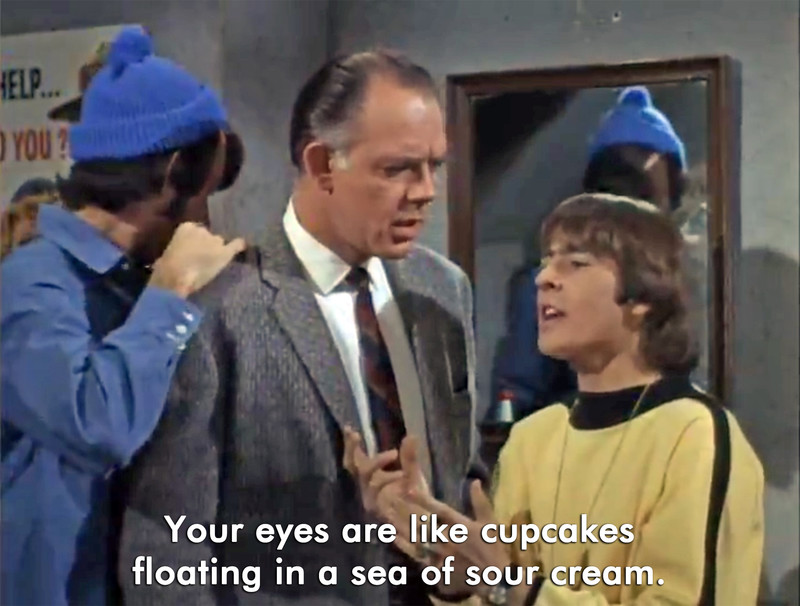
"Your eyes are like cupcakes floating in a sea of sour cream." From the fever dream that is The Monkees, season 1, episode 27.
|
|
|
|
|
|
|
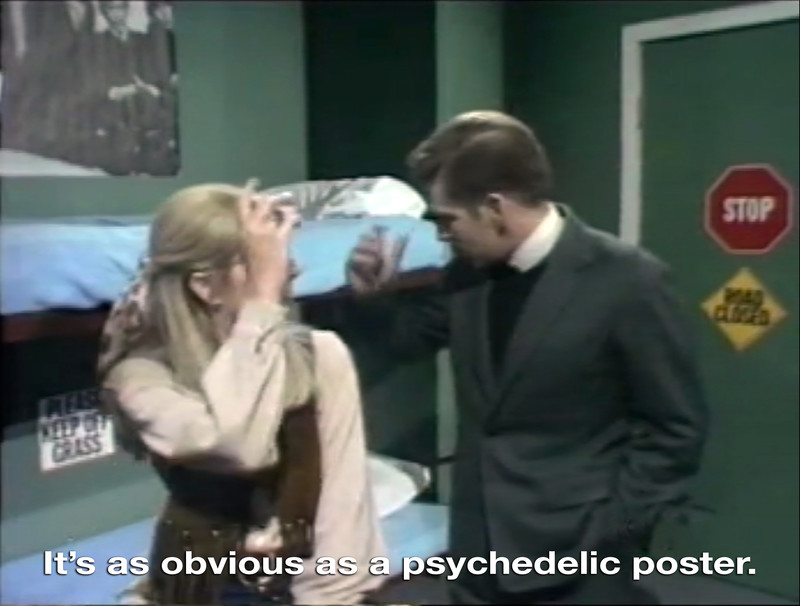
"It's as obvious as a psychedelic poster." From Canada's answer to Dark Shadows, Strange Paradise episode 7.
|
|
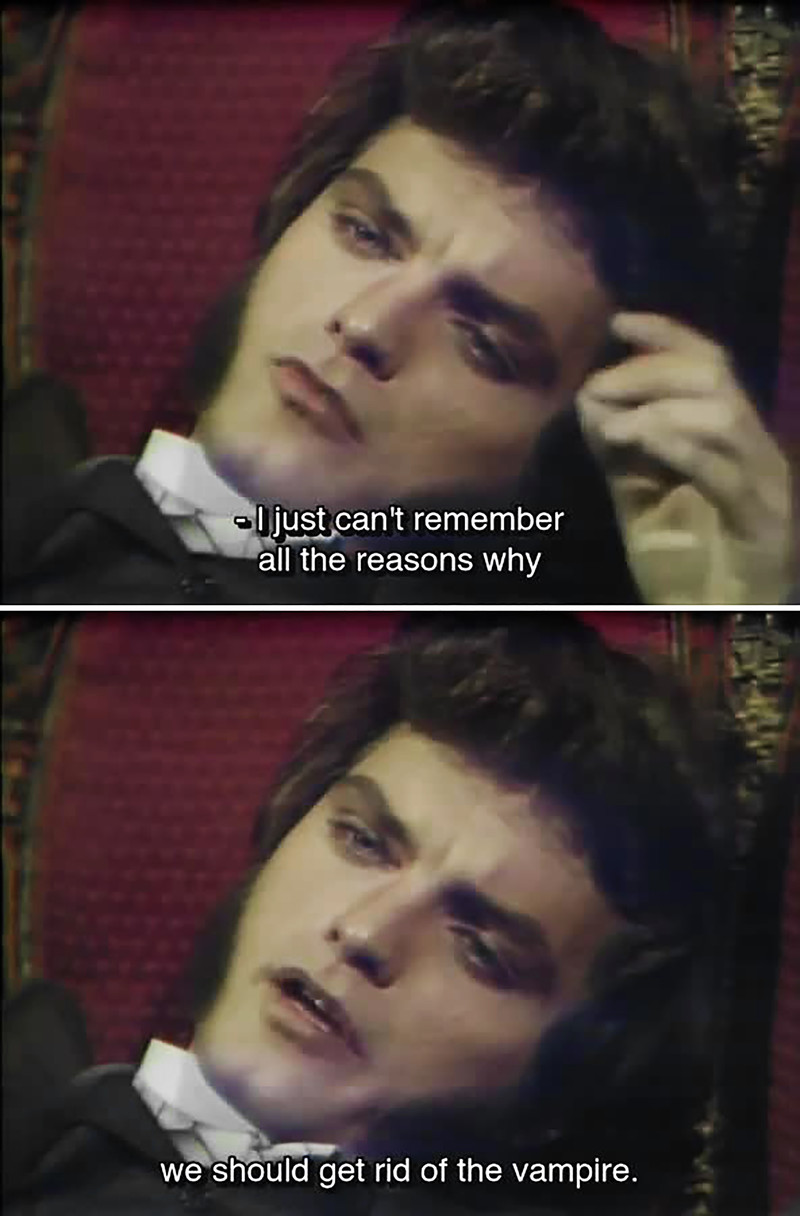
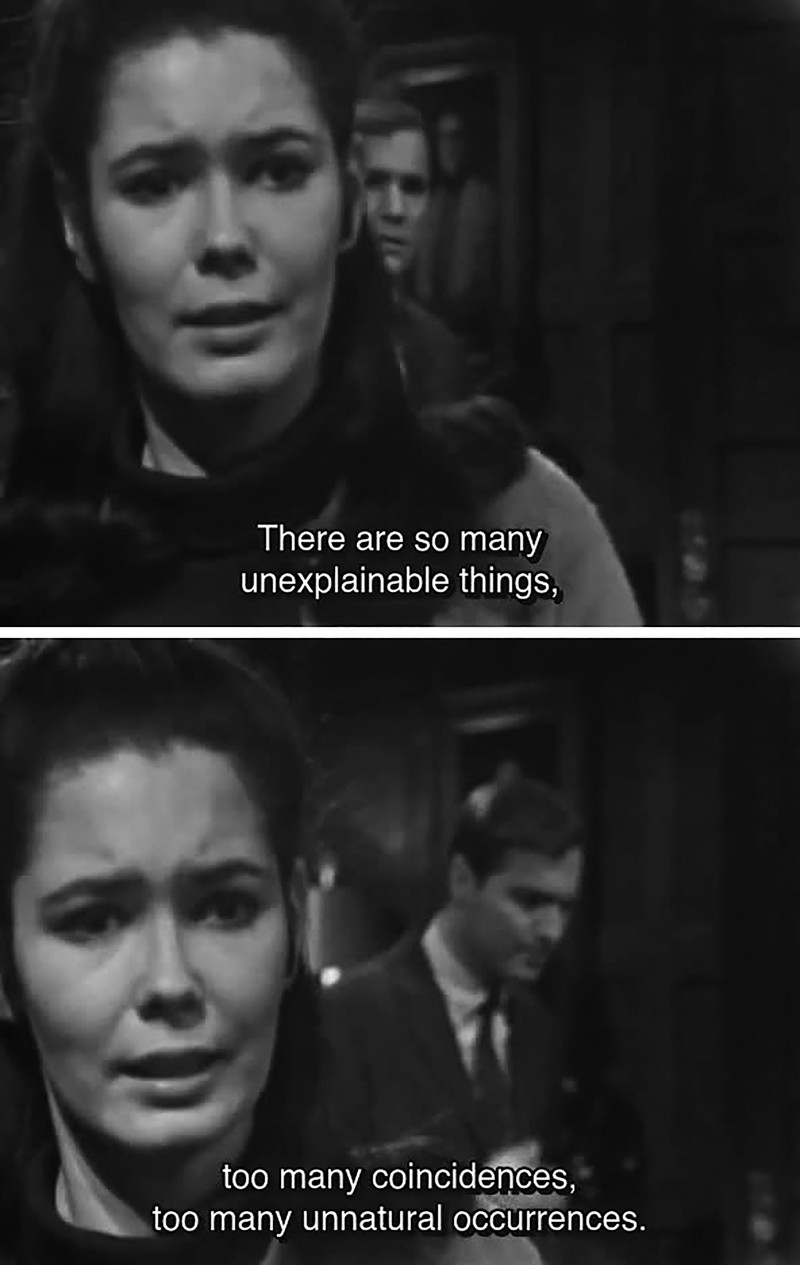
"There are so many unexplainable things, too many coincidences, too many unnatural occurrences." From Dark Shadows episode 159.
|
Page 16 of 178
> Older Entries...
Original Content Copyright © 2026 by Craig Conley. All rights reserved.
|