Go Out in a Blaze of Glory
|

|
|
|
|
|
|
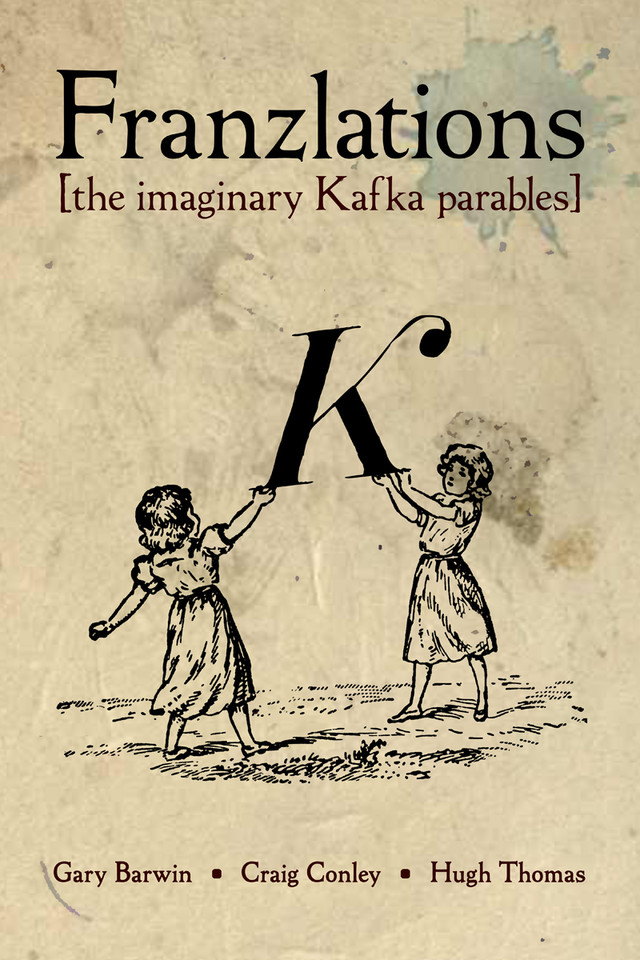
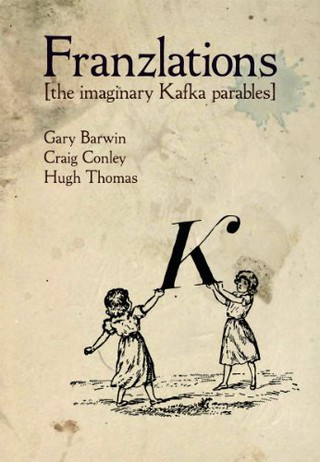
If only all terrible reviews could be of this caliber, fewer authors might be driven to drink. Dr. Thomas Hodd, of the Université de Moncton, reviewed our Franzlations (a guide to the imaginary Kafka parables) for the Journal of Canadian Poetry, Volume 28. Long story short, our book is worse than cancerous poetry (quite literally, he says it compares unfavorably to a specific book of poems about cancer that should have been left on the hospital bed and not published). Franzlations, he says, is "more like an artifact than a book of poetry" — criticism we will take on the chin with a British stiff-upper-lip (as it were). Our "images and phrases begin to resonate, although for what purpose is unclear since the esotericism implied within these pages feels contrived, and ultimately fails to extend beyond the pages of the book" — to which we retort, " That's what they said about The Emerald Tablet of Hermes Trismegistus!" But in all seriousness, esoteric is defined as being intended for a small number of people with a specialized knowledge, so if the esotericism of Franzlations were to be unleashed from the pages of the book, it would transmute into exotericism (intended for the general public), an idea that causes our corrosive juices to reflux. As we meditate upon Dr. Hodd's scathing conclusion, we have to smile (enigmatically, to be sure), because to be "neither poetry nor art," neither words nor images, is very Zen. Dr. Hodd has inadvertently acknowledged that we've attained enlightenment.
|
|
|
|
|
|
|
First the good news: We just noticed a lovely review of One-Letter Words: A Dictionary, courtesy of Virginia Durksen over at Goodreads: "What's not to love? I confess to being a reader of dictionaries. Not a regular reader, but a frequent browser, when the sun is shining and a word has caught my eye. Conley pulls together a list—this inspires more lists in me. I want to add things to this dictionary. The publisher should create a volume with spaces to add things, for word collectors. And, goodreads should add an option for re-reading, never stop reading, use it all the time. That would be this book." But it's not all good news. An unrefined person over at Goodreads ripped our dictionary of one-letter words 26 new anal cavities. (Googling "does a book have an anus?" delivers zero results, so ours may be a world first!) Forget the fact that our dictionary has been remaindered for years and was, in fact, dead in the marketplace before it ever debuted (see our interview with Janet Boyer for the lurid backstory). Why condemn when you can create? This gauche person stated that he's pretty sure he could do a better job. So why doesn't he? The more dictionaries of one-letter words, the better! But actual creators and innovators are few and far between. We don't have time to write paragraphs of derision toward other people's work -- we're too busy marching to rain on someone else's parade.
|
|
|
|
|
|
|
Thanks, poet rob mclennan, for saying that our Franzlations "read like an illustrated translation or even continuation of Kafka’s work. ... The three authors work absurd movement, incredible wisdom and clarity, reading nearly as an extended essay-as-response on the work of Franz Kafka." |
|
|
|
|
|
|
Even though modern eyes might consider the young lady's skirt to be quite long (in the image below), she's wearing the "short skirt now in vogue," making her vulnerable to casting a disreputable shadow. We generally love that one might be scandalized by one's shadow. A true character must cast a fascinating shadow, one way or another. Note that the tricky "witching hour" here is sunset and not midnight. Jeff shares: After careful analysis of the photograph, I note the following:
1) The trollop's ankles cast the shadow of a wading bird, thus creating the overwhelming sensation of familiarity in the average seaside lothario.
2) The upper portion of the trollop's shadow appears to have a bun in the oven, creating, in the average seaside lothario, the overwhelming desire for family.
3) Neither the lustful dandy nor the translucent salt behind him have shadows of their own, therefore they cannot be true characters. I blame Photoshop.
4) Upon closer inspection, the cad sneaking up the stairs is Puss 'n Boots, not Jack Sparrow.
5) The trollop's right hand is not a hand at all. It is a pincer, leading me to suspect that she is either Crab Woman or Lobster Girl. If the former, she may be harboring a crab cake in the oven instead. If the latter, she has simply lost her mittens.
6) She and the approaching cat in the hat are merely going out for seafood and a movie. It's 1868 after all.
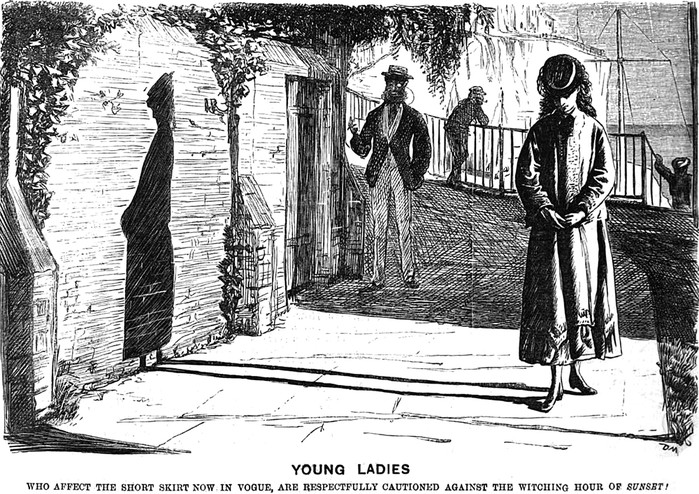
From Punch, 1868. The caption reads, "Young ladies who affect the short skirt now in vogue, are respectfully cautioned against the witching hour of sunset!"
|
|
|
|
|
|
|
Unencumbered by linear time, recording artist Ken Clinger adapted and covered a song we wrote 14 years ago, " Legend of the Map." Interestingly*, all references to Esperanto have been erased! *Given that the song is about Esperanto, and given that Ken Clinger is a student of Esperanto. |
|
|
|
|
|
|
[A] very humorous series of essays, experiments and actual OBJECTS (?!) all addressing metaphysical ideas in literature--but in an EXTREMELY playful way. I LOVE this book.
|
|
|
|
|
|
|
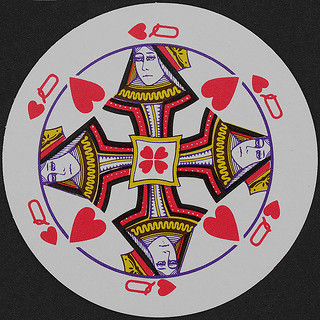
We've been keeping one of our latest publications under the radar, lest it fall into the wrong hands. But we felt safe sharing it with Clint Marsh (of Goblinproofing One's Chicken Coop fame) . From his review in The Pamphleteer: A master of practical esoterica, Prof. Oddfellow (a.k.a. the inimitable Craig Conley) follows in the footsteps of magicians throughout history in tracing his lineage to a potent fabulous ancestor, in this case Elizabeth of York, the mother of Henry VIII and the woman immortalized as the Queen of Hearts in the familiar deck of playing cards we've all seen. Instead of climbing the family tree back toward Elizabeth, though, Conley begins with her and comes down through history toward himself. This approach makes perfect sense to anyone bent on establishing a blood connection to a particular figure from the past, and it seems to involve less risk of falling down the wrong genealogical rabbit hole. ... [Heirs to the Queen of Hearts: Tracing Magical Genealogy is] a wonderful new addition to his teeming brood of bibliomantic offspring.
|
|
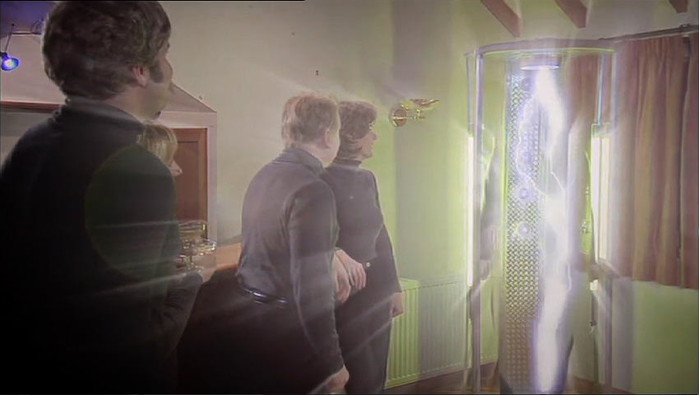
Here's a strange moment in the pitch-perfect Scottish comedy series Burnistoun.
|
|
|
|
|
|
|
I let go a year or ten ago It's all a twilight zone I don't know where I will go The future's not my home —Eric Berglund, "Illuminata," White Magic
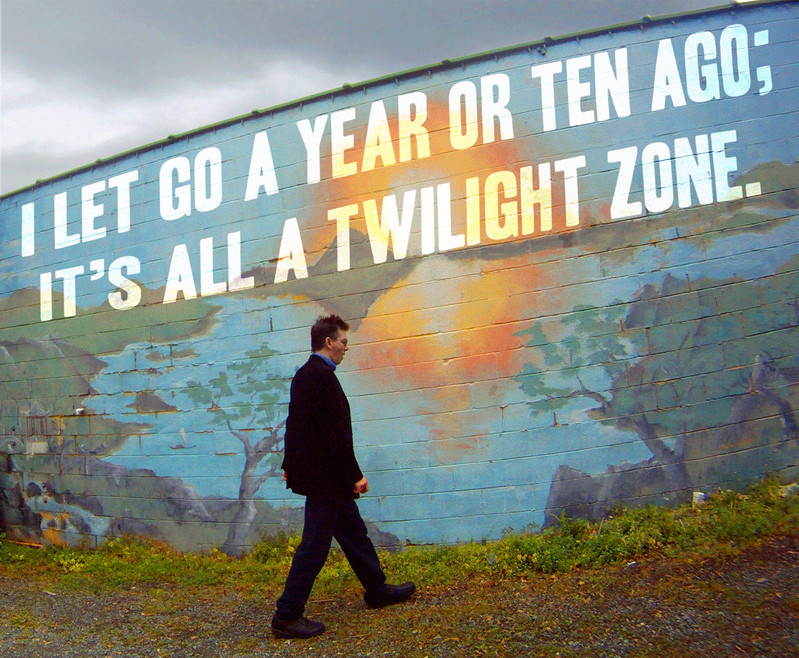
Prof. Oddfellow let go a year or ten ago.
|
|
|
|
|
|
|
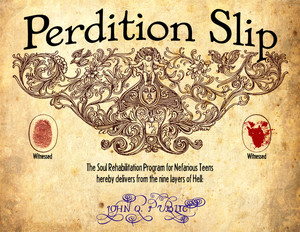
In collaboration with Martha Brockenbrough, Prof. Oddfellow presents the Perdition Slip in honor of DEVINE INTERVENTION, a novel about the world's worst guardian angel, published by Arthur A. Levine Books/Scholastic. For more information, visit marthabrockenbrough.com.
We had the honor of working with the ever-so-clever Martha Brockenbrough on a customizable get-out-of-hell permission slip. Martha explains: Do you pick your nose in your car? Have you ever forgotten to send your aunt a thank you card for the holiday sweater? Did you laugh when someone forwarded your frenemy's sexts to the whole school? Do you use the words "frenemy" and "sexts" without feeling a little bit cheap? Alas, there's is a good chance you are on your way to Hell. But we have good news. For a limited time (in the grand, eternal scheme of things), you are eligible for this Perdition Slip.* It's guaranteed to save your hide from the nine flaming rings of Hell. Simply fill it in, print it out, and pass it on to all your friends. And maybe even your frenemies. *Cash value 1/20th of a shekel. No refunds. Expiration date slightly after yours.
|
|
|
|
|
|
|
As Funny as a Traffic Light(for Bernie DeKoven) Sometimes glee lights up in the unlikeliest, most mundane of places. I was waiting to cross an intersection, behind a couple of pedestrians. We waited and waited, yet the contrarian crosswalk signal kept playing a game of chicken with us. Law-abiding citizens, we remained standing at the curb, even though the traffic on either side was similarly frozen with red lights. The pedestrians in front of me pressed the crosswalk button repeatedly, to no avail. As the seconds marched on, we all began to feel silly just standing there. It was technically safe to cross, and we could feel deference to authority giving over to a craving for self-determination. As simple as their signals may be on the surface, traffic lights are so inscrutable. How intelligent and authoritative are they really? They might be hooked up to high-tech sensors and networks (some are, surely), but then again any one traffic light might be decades behind the times. We know that some traffic lights are so smart and witty that they have their own Twitter accounts. (A light on Michigan Avenue in Chicago tweets such wisecracks as, "I don't believe in false starts," "I hear your prayers, and I answer either 'yes' or 'wait,'" "They say we're all connected," "We have to stop meeting like this," and "From my vantage point, you've already involved the cops." No kidding: https://twitter.com/#!/ChiTrafficLight). We're left wondering if a non-responsive light is broken ("on the blink," as it were), or if we're being challenged by unknown forces to throw caution to the wind. As if of one mind, the pedestrians in front of me and I finally had enough of this Kafkaesque stalemate. We stepped forward and boldly crossed that street in defiance of the laws of man and God. And as our feet came down on that first step, the crosswalk signal glowed "WALK." And the pedestrians in front of me burst out laughing. They laughed, and they laughed, and they laughed as they completed their crossing. And still they laughed. "The light was red!" the man cackled. "Then it turned green!" the woman cackled back. When she'd finally caught her breath, the woman made a phone call to share what apparently had been the funniest experience of their lives. "We were standing there," she explained, "and then we started walking ... and the light changed!" But she couldn't explain further, as once again she was overcome with tearful hilarity. There's a Zen koan in there somewhere: "What's the humor of one light changing?" The pedestrians howled on, and their laughter was contagious. I walked on home, chuckling to myself, with a definite spring in my step. I'd crossed paths with folks who don't want to have fun but who embrace life's subtlest perversities with gusto.
|
|
|
|
|
|
|
We appreciated this review of our latest project in the Winnipeg Free Press: Franzlations: the imaginary Kafka parables (New Star, 104 pages, $19), co-written by Gary Barwin, Craig Conley, and Hugh Thomas, imagines new parables in the style of those crafted by Franz Kafka. Often reworking Kafka's own prose poems, or incorporating biographical information (e.g., how Kafka is credited with inventing the safety helmet), these "Franzlations" attempt to imagine "The set of all possible Kafkas." Some pieces reward mainly those versed in Kafka's work. "What would make a crow into a Castle?" assumes the reader's knowledge of both his unfinished novel The Castle and his parable about how crows might destroy heaven. However, the book should still delight those unfamiliar with Kafka. Anyone can enjoy the comic beauty and bitter irony on offer in this exceptional, imaginative book: "Do not despair. There are red party balloons everywhere, especially in the future." |
|
|
|
|
|
|
From the Enduring Fascination with Last Words Department: Enrique Vila-Matas recalls that his mother had a lifelong habit of saying strange things, to the point that his grandmother often explained to visitors: "The child, you see, has lived in Paris." On her deathbed, his mother spoke a few last words that "due to their premeditated strangeness, sounded to me like an epitaph, though we didn't dare put them on her tombstone. 'I'll laugh at the bitter things I said,' she said. Her two brothers looked dismayed. 'It's because she lived in Paris,' I told them." (From Never Any End to Paris.) (For Greg at Futility Closet.) |
|
|
|
|
|
|
"The sky is an apocalyptic mix of rainclouds, sun, rainbow, snow ghosts and I have no idea what day what month what year it actually is." — Miekal And, author of Bystander: An Irreality
|
Page 18 of 22
> Older Entries...
Original Content Copyright © 2026 by Craig Conley. All rights reserved.
|