Shifting Consciousness to a Magical State
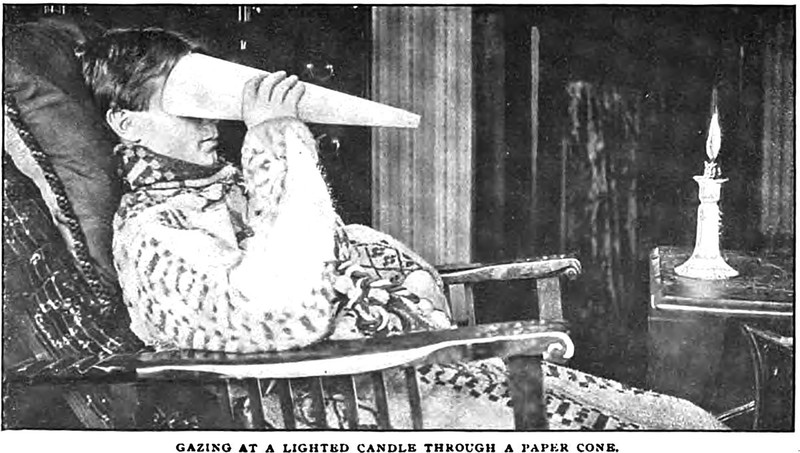
Being a lifelong student of esoteric sciences, I was just asked by a friend how best to shift one's consciousness to a magical state without using psychedelics. Don't let the photo above mislead you — no cone or candle is required (unless you'd like to use them!) If you're ready to see the world in a whole new way, there's a proven approach. As we'll explore below, the first step is to be very specific about what sort of magical world you wish to access. Do you wish to operate less constrained by the flow of time? Are you intrigued to see evidence of fairies at work in your environment, or the overlapping of parallel dimensions, or the existence of energetic portals, or sleeping dragons, or doorways into the Otherworld? As we'll also explore, an adventurous "quest" will be requisite for bringing your magical perspective to life.
To shift one's consciousness to a magical or otherwise parallel state requires, of course, an ability to perceive from a fresh perspective. It sounds lovely to "see the world through the eyes of a child" (that goes back at least to 1914's Ampleforth Journal), yet one's first question might be, "How, exactly?" Forget that advice, as well as rose-colored glasses for the time being at least. What seems crucial is a specific intention to penetrate an alternate reality, coupled with what might constitute a form of highly mindful, active meditation.
A real-world example of a magical consciousness? Toward the creation of the Tarot of Portmeirion, I visited that eccentric architectural garden in Wales tasked with the daunting goal of finding 78 visual representations of the swords, cups, pentacles, wands, and major arcana. This required experiencing the village as a pop-up book of Tarot archetypes. I saw every building, cobblestone, statue, topiary, fencepost and fountain with new eyes as I sought very literal imagery for each card. The decision to see everything in terms of the Tarot led to a self-working process, with all 78 images presenting themselves within a two-week visit. Though I'd previously spent several holidays at Portmeirion, the quest for Tarot cards opened an entirely new way of enjoying the place, leading to the discovery of untold nooks and crannies as well as appreciating the artistry on display from literally new angles.
Another real-world example springs from a more casual project—seeking out "temporal anomalies" during road trips. This involves following highway exits into small towns and sleuthing for clock towers or other town square timepieces that are telling the wrong time, then exploring the environs for weirdness that might account for a timewarp. As with Portmeirion, this has proven to be a self-working process, for the decision to see the fabric of spacetime riddled with quirks opens a window into such a world. One favorite example was at the Ocala National Bank, where all four directional clock faces told a different time. An investigation of the building revealed two nearby portals to nowhere on separate brick walls — doors installed up to two-stories high, like windows, but with no steps or ladders to access them. Such a spacewarp was possibly tied to the temporal anomaly. My shift of consciousness has yielded the documentation of fifty such peculiarities to date.
Experience would suggest that a clear-cut definition of a magical universe in conjunction with a related quest of sorts will yield the best results. A few further examples might illuminate.
The Blissymbolics Communication Institute, which teaches its ideographic system to people with speech impairments, suggests that "the whole world can be seen as a giant Blissymbol Board" (Communicating Together, 1984). Hence, one could begin mapping the system's one-hundred shapes mirrored in natural and artificial structures, perhaps gaining insights into a sort of world language at play in the landscape as individual geometric shapes communicate fundamental concepts. A message and grammar of a discrete area could be documented. Similarly, "the world can be seen as a great alphabetic writing, analogous to what a writer inscribes, letter by letter, on a manuscript page" (Laurene De Looze, The Letter and the Cosmos, 2016). Hence, some seek a consciousness of the world as a literary text that "takes on a life which is independent of its author, so that the interpretive process at the receiver's end makes a real contribution to the whole communicative enterprise" (Gabriel Daly, Creation and Redemption, 1989).
Rabbi Adin Steinsaltz encourages shifting one's consciousness to grasp the world as a "vast orchestra in which each of the creatures has a distinct voice and sound" (Simple Words, 1999). This form of mindfulness might call for the development of a playbill, crediting the individual "players" one hears in concert throughout one's day.
A weirder and darker side of reality can be better processed through consciousness shifts. Buddhism famously describes waking reality as one of six dreamlike Bardo states and specifies techniques for sidestepping what the Tibetan Book of the Dead calls the ambuscades at every turn. Similarly, science fiction's luminary Philip K. Dick developed eyes to see the world's aspect as a Black Iron Prison and wrote about finding ways to break free. Along the lines of quantum physics calling reality a simulation, it can be rather mind-blowing to view daily life as a glorified video game, for one will begin noticing identical-looking "non-player characters" in unlikely places as one seeks to accumulate experience, stamina, and other points along the way.
Any number of other consciousness shifts are possible, the key being an activity component akin to walking meditation or the spiritual sand paintings of Native Americans and Tibetan Buddhists.