Found 421 posts tagged ‘prof. oddfellow’ |
|
I Found a Penny Today, So Here's a Thought –
January 27, 2027 |
(permalink) |
|
 |
|
|
|
|
|
I Found a Penny Today, So Here's a Thought –
January 12, 2027 |
(permalink) |
|
|
|
|
|
|
|
I Found a Penny Today, So Here's a Thought –
December 17, 2026 |
(permalink) |
|
|
|
|
|
|
|
I Found a Penny Today, So Here's a Thought –
December 10, 2026 |
(permalink) |
|
|
|
|
|
|
|
I Found a Penny Today, So Here's a Thought –
November 29, 2026 |
(permalink) |
|
|
|
|
How to Stay Motivated in the Face of False Friends, Absent Funding, Pathetic Stats, and the Gaping Void
As a creator, I hope you aren't in similar dire straits:
- a minus zero budget
- no promise of funding
- inadequate equipment or setup for production
- not enough hours in the day for seriously pursuing the dream
- can't qualify for "monetization" due to a snail's pace of new followers
- supportive commenters suddenly drift away with no polite goodbyes
- so-called friends drop away when you dare to express your frustrations
- leaky viewer/listener retention
- potential collaborators break promises or outright ghost you
In the face of all these challenges (and more), during free moments over the last 2 years I've somehow yet filmed over 200 episodes and recorded over 70 theme tunes for my horror-comedy web series Grave Mood Rings, and the production goes on. There's likely no one formula for staying motivated, since no two creator situations are exactly the same. B
1670954383.0828.2594
Key players dropping out: Past script writers for Grave Mood Rings have retired themselves, but I couldn't let that kill my momentum, so I made the conscious decision to feel freer. I had to choose to flip the negatives into positives, so instead of being left in a lurch, I manifested heightened creativity in their absence. Sure, there was disillusionment and dismay to process, but I could also celebrate saying "good riddance" to those who weren't, at the end of the day, genuine supporters of the project. They may have dallied with the idea, they may have contributed according to their own comfort levels, but they ultimately got left behind because they simply weren't running fast enough. The thing is, art takes on its own impetus. My show may seem like my "baby" that I nurture, but babies develop according to their own natures. I have to keep running, too, to see where the project is going. Sure, I try to steer things, but it would be delusional for any creator to feel in total control of a work of art.
Headaches of collaboration: Collaboration has been the lifeblood of my show. I could work in a vacuum, shooting hoops by myself in my own driveway, as it were, but that feels too lonely. Grave Mood Rings isn't an egotistic pet project, and I'd much rather showcase additional talents by making the show a game with multiple players or (since I don't really know sports metaphors) a soup improved by lots of interesting spices. To date, the show has featured 40 guests. But, oh, the headaches involved! There have been uncountable collaborators who never responded to queries, who made false promises (sometimes repeatedly!), who had enough time to type out complex excuses in the time it would have taken to film the 10-second clip for the show, and those who did in fact follow through but took a year to deliver. Project management could be a full-time job in itself, for without follow-ups and cajoling, disappointment is all but guaranteed. It's fascinating to see just how precious people can be with their time and supportiveness. No judgement (well, maybe some!).
Money issues: Dealing with a zero budget can lead to greater innovations, so I actually embrace not being funded (though, let's face it, I wouldn't turn down money if it were ever offered). Incrementally over 2 years, I have spent $1000 on props, costumes, and a green screen. The phone's camera and the tripod I already had. A family member has gifted me an occasional prop, wig, and even the costume for a haunted tree character. A co-writer who fired himself bought a branded t-shirt we needed for a particular theme, but that apparently drained his entire fund for investing in our production. I haven't factored what my time has been worth over the course of producing 200+ episodes. The editing alone averages to 8 hours per 3 minutes of completed footage, and work on pre-production easily doubles that. My partner, who plays all the characters except for my own Prof. Oddfellow, takes time away from his paying job to complete the post-production, and I haven't tallied the money he'd technically be owed for over 2,000 hours should we ever secure funding. We're both dedicating our time and our own money to make Grave Mood Rings happen, and we're the only ones doing that because we're the only ones who believe in the show enough to do that. All the boo-hoo-hoos aside, it's actually pretty cool because it puts us in a class of our own. We'd prefer to be who we are than to trade places with anybody who has let us down or let us go along the way.
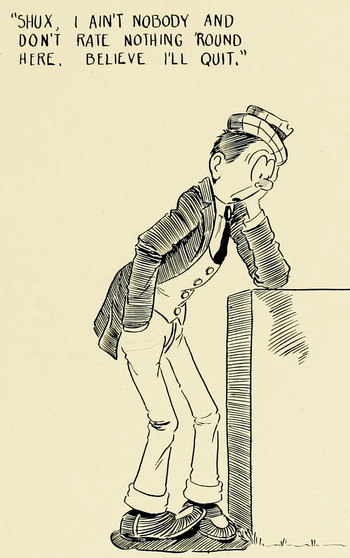 The numbers game of stats and followers: Here's something that ought to adjust one's attitude. The digital marketing company Chaotic Good’s founders said the following in a Billboard interview: “Everything on the internet is fake. ... It’s an open secret in the music industry that all the numbers—play counts, followers, stats—are fake or at least obfuscated. ... Bots and 'streaming farms' have become a marketing expense." So this is a great reminder not to compare our own apparent success to other people's. We can't even trust the numbers on our own stats, since the powers that be not only inflate the "success" of artists being pushed on the public but also deflate the stats of those in obscurity. It's a terrible situation, and it would be great if we could really know just how many people are ever seeing or hearing what we create, but for the time being we must be content with working in something of a gaping void. Like tossing messages in bottles into the sea, we must maintain a bit of blind hopefulness, since the current state of the internet does not allow us to know much if anything about our audience share. By the way, here's a little laugh: my creations aren't even followed by bots! I watch my follower counts very carefully, and I can track almost every single one of them because they are each the result of painstaking direct marketing. I spend hours every day searching for people who might be interested in what I'm doing, for me to reach out to. This is an excruciatingly difficult and too-often unsatisfactory process, especially when hard-won new viewers end up dropping away over time. If and when I discover the secret of retaining a loyal audience, I will share it gladly.
Bottom line: I admit to being an artistic failure at: making money, keeping colleagues, and maintaining followings. But I'm a winner at not letting the setbacks defeat me or slow down my productivity. When I don't dare to buy another prop, I craft my own out of whatever trash is lying about (best or worst example: a stethoscope fashioned out of scrap paper). When a scriptwriter fails me, I write my own. When my partner has no free time to film or edit, I research future possible collaborations and channels to keep the momentum. My goal is to write and film 3 new episodes each week; sometimes it's just 1 episode, which is still okay. It all seems to come down to a decision or an intention: keep going anyway, undistracted by so-called setbacks. Losing two co-writers ended up breathing new life in the series, so we can't ever judge stumbling blocks as they occur since we can't know where they'll end up leading us. A very supportive horror host just said: "[Grave Mood Rings] has always been good, but it seems like since that one writer dropped you, you've just really spread your wings. Like a phoenix! Kudos coming out of a difficult situation and making it better."
 Onward and upward!
|
|
|
I Found a Penny Today, So Here's a Thought –
November 26, 2026 |
(permalink) |
|
|
|
|
|
|
|
I Found a Penny Today, So Here's a Thought –
October 10, 2026 |
(permalink) |
|
|
|
|
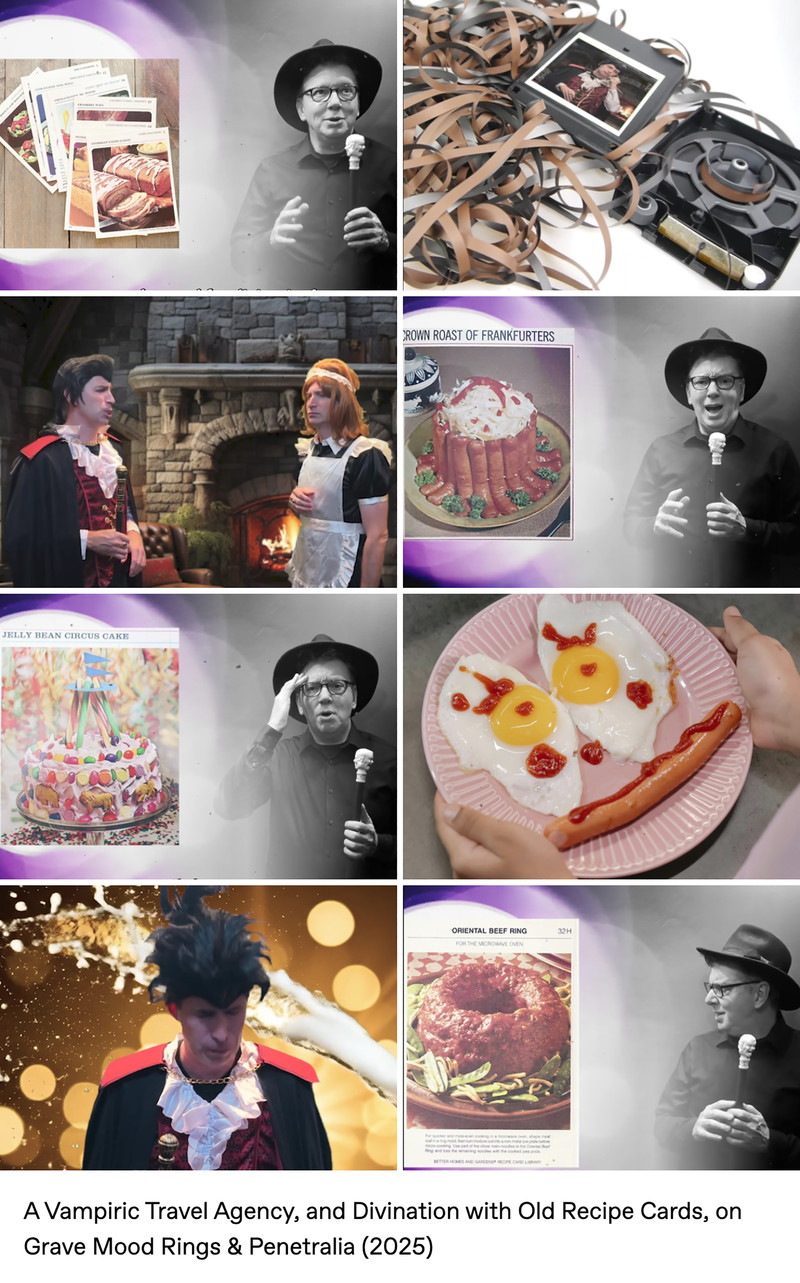
Stills from this episode of Grave Mood Rings, courtesy of Dare-g on Tumblr.
|
|
|
I Found a Penny Today, So Here's a Thought –
October 7, 2026 |
(permalink) |
|
|
|
|
The Real Horrors Are Always Backstage, Plus Notes on Managing Inner Demons
Horror-comedy is a bizarre genre. Most of the laughs are on camera, but most of the horrors occur behind-the-scenes. As writer / producer / director of the cult series Grave Mood Rings, I've endured horrors beyond comprehension, all rooted in terrifying reality. "Real horror is a fragile, glass-boned thing" (Carlos Clarens). Forget so-called friends cancelling you for being honest about your discomforts, or the excruciations of struggling against a system that automatically suppresses original voices. Forget crucial cheerleaders dropping away, or the irony of being unable to either sell or give away your labors of love. Profounder horrors leave a creator as fragile as a glass skeleton.
"The real horror is that unless we stop it, it's just a prologue" (Uncanny X-Men Vol. 1). Whereas a film or miniseries has a conclusion, an open-ended series can stop only if its creators decide to terminate it. In the absence of a finish line, the show takes on its own momentum, turning the crew into minions. It's not so much like riding an endless roller coaster but rather like building the diabolical track into infinity. With no network to threaten cancellation, no viewership numbers of consequence, no budget to run out of, and no reliance on outside talent, an indie production can die only by its own hand, and that is a real horror. Such a show is kept alive by intravenous feedings, by the very machine it has morphed into. With no promotion or backing, the show is essentially incapacitated, impotent, in its own sort of pain and unfit to communicate. Is it the show's life that's being prolonged, or is it the show's death? What a horrible thing to contemplate.
"The real horror is what drove you onto that alien shore in the first place" (Jay Amberg). Fellow creators may be able to relate — we might find ourselves in the midst of a project whose precise origin is hazy. Even if we can pinpoint its genesis, we're all-too-aware that we couldn't foresee exactly where it was all leading, how complicated it would turn out to be, how big it would strive to become, or how it would morph along the way. Though technically at the helm of our own undertakings, we are in fact strangers in a strange land. The feeling is its own form of horror.
"The real horror is not in the shadows, but in that twisted little world inside our own skulls" (Jovanka Vuckovic). "There is no force, no power from without which threatens me. ... The real horror is that which lies in myself" (Henrik Ibsen). When we stop blaming the system, selfish "friends," and fickle audiences, we might confront the very personal tribulations that come with producing a long-running minus-zero-budget tv series. Undistracted by outside voices, one must face and finesse one's inner demons. Here are some tips I've developed along the way, in no special order:
1. As an Inhuman Resources Manager, remember to fill every vacancy within yourself with self-motivated inner demons possessing leadership abilities. Realistically, we are living in a less-than-perfect world with less-than-perfect inner demons, but if we simply take steps toward improvement, we will move in the direction of world domination.
2. This might be a good time to invoke the serenity prayer: "Lord of Storms, give me the grace to accept with serenity the atrocities I must commit, the courage to pass the spawn of my enemies through fire, and the wisdom to distinguish gargoyles from cheap garden ornaments."
3. Being your own life coach, enable your inner demons to move toward their potential, both as individuals and as a legion. It's not enough to preach about teamwork or stand on the murky borderlands acting like a cheerleader. You must work to achieve the grand vision that lies over the scorched horizon. You'll have to join your own team, become a team player, and even place the teeming hoard's goals above your own.
4. Let your team of inner demons choose its own leader to manage infernal affairs. Ideally, each position should be rotated periodically, including whichever demon happens to be skewered on the rotisserie. Be sure to empathize with your inner demons, and let them know that you are all in the same sinking ship.
"The real horror is still to come" (Famous Monsters of Filmland #162). The beat goes on. Grave Mood Rings continues to laugh its way through the horrors. Check it out at MysteryArts.com, Roku, and wherever you watch videos online. —Hailed by the art world as the most unusual scholar working today, Craig Conley a.k.a. Prof. Oddfellow fled academia to author Weiser Books' Magic Words: A Dictionary, HarperCollins' One-Letter Words: A Dictionary, and The Young Wizard's Hexopedia. Esoteric publications include Books of the Dead, Magic Archetypes, The Care and Feeding of a Spirit Board, Seance Parlor Feng Shui, How to Hoodoo Hack a Yearbook, Heirs to the Queen of Hearts, Astrogalomancy, The One-Minute Mystic, and Divination by Punctuation. He produces, directs, and writes both Grave Mood Rings and Prof. Oddfellow's Penetralia. His work has been profiled in the New York Post, the New York Times, The Wall Street Journal, The Chicago Tribune, National Public Radio, The Dallas Morning News, Publishers Weekly, The Associated Press, and dozens of others. His website is MysteryArts.com
|
|
|
I Found a Penny Today, So Here's a Thought –
September 30, 2026 |
(permalink) |
|
|
|
|
From our outpost at Spacey Panda Music:
The Artistic Introvert / Extrovert Clash Too Few Are Talking About
"Light me, and I'll burn for you" is a lyric from the INXS song "Burn For You." It contains an entire philosophy of life, and see if you agree that it gets to the heart of the misunderstandings and resentments that occur between introverted and extroverted types.
I once marveled at how big a band INXS was, thinking, "A rock band with all of nine musicians on stage?!" Later, I discovered that Michael Hutchence had another band, formed during an INXS hiatus, called Max Q, this time with seven members. It finally became obvious: Hutchence's attitude seemed to be, "I like you, so why not be in my band?" One might recall the Kamen Rider Fourze series, in which the lead character seeks to make friends with every single student in his school while battling the powers of evil.
An artist can be as solo, uncluttered, and pure as a Zen garden. Then again, an artist can have an attitude of "the more the merrier" and join forces with as many people as possible, no matter how jumbled the stage gets. These are two diametric approaches to how art can be handled.
Lovers of collaborations may be taken aback when fellow artists shy away from making connections. The difference between the solo (narrow spotlight) and big-band (expansive limelight) approaches is so great it can be nigh impossible to reconcile the two, and hurt feelings seem almost inevitable on both sides (the extrovert feeling snubbed and unsupported, the introvert feeling crowded and pressured).
Some powerful insights are offered by psychologist Barbara Velazquez:
The extrovert lives in the world of what is; the introvert in the world of what can or should be. Neither is truly aware of the existence of the other's point of view. Upon perceiving evidence of the other's existence, both regard it as unnatural, alien, and irregular, little knowing that the other perspective is as common as their own.
The reason introverts and extroverts are so often unaware of the other's existence is that "our immediate environment tends to be consistent with our psychological perspective." Extroverts tend to marry extroverts and raise children who share that orientation, and vice versa. "Our friendships and our occupations also tend to reflect our psychological orientation." Crucially:
It is where introversion and extroversion meet as strangers that misunderstanding and resentment appear. The introverted son of extroverted parents would find himself chided for his shyness and introspection, and his unconventionality and pride in individuality could be considered an oddity. The Extrovert Sensation type, placed in a strongly metaphysical environment, could be regarded as overly materialistic, narrowminded, and lacking in faith.
It's interesting to note that:
The extrovert looks to observable clues in the external environment as a guideline for behavior. Since in the introvert such guidelines are not observable but are the result of unobservable mental processes, much of the behavior is regarded as nothing short of unfathomable. The introvert, on the other hand, expects others to manipulate and evaluate reality from a similar conceptual vantage point. When it slowly becomes apparent that this does not take place, the external demands placed upon the introvert begin to appear inexplicably superficial and limiting. Each, out of ignorance, tends to regard the difference in the other's perspective as a personal affront. (Thinking on the Edge, 1993).
Naturally there are many studies about how opposites can temper one another and work together successfully. Nobody is 100% introverted or extroverted (you may even be an “ambivert” right in the middle, an “omnivert” at one extreme or the other according to mood, or an “otrovert” who is socially capable yet feels like a perpetual outsider). Knowing about where you register on the spectrum and observing where another registers will obviously serve to help smooth misunderstandings and resentments as we all seek to create art.
|
|
|
Restoring the Lost Sense –
August 25, 2026 |
(permalink) |
|
|
|
|
|
|
|
I Found a Penny Today, So Here's a Thought –
August 3, 2026 |
(permalink) |
|
|
|
|
From our outpost at Spacey Panda Music:
Art Requires THIS Sort of Sacrifice?
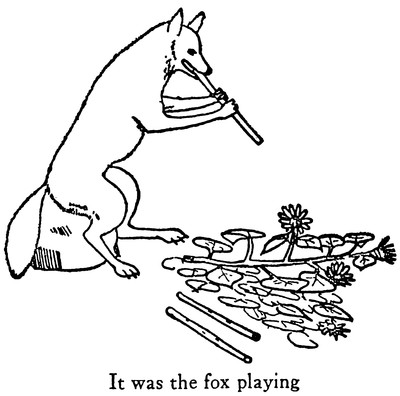
There's a Japanese legend about a cursed flute. It makes its player a gifted musician, but the price of the flute's magic is blood sacrifices. Does all art require burnt offerings of some sort? Close to home, my Grave Mood Rings series essentially took as a sacrifice a close acquaintance of several decades who outright cancelled our connection over communication differences. Could something similar be happening with people who "ghost" fellow artists? We try to make connections in relation to our art, and sometimes those attempts create ghosts as if the art took a sacrifice. Making art fine-tunes one's frequency, so we are bound to encounter more and more ghosts as we focus beyond those at other frequencies. Thing is, people on other frequencies literally can't understand or even see us. It's like the ending of the first Silent Hill film — Rose is trying to call her husband, and his phone even rings, but he can't hear her voice through the static because she's on another plane of existence. When we lose friends or go off someone's radar, we might flip our interpretation and take it as a badge of honor, for it proves that our own frequency has risen beyond them. Consider a mountain metaphor — when you're standing on a mountaintop, you can see down to those who are lower than you, but from their angle they can't see where you're standing. Maybe they can sort of hear you calling down, but there will be a weird echo and they probably won't understand. It's nothing personal, even though it can feel totally personal.
So when someone ghosts us, can't we say to ourselves, "Another sacrifice to the art, and the art feeds and grows"? Just imagine a Japanese-style bulletin board of people's faces, with red streaks of paint crossing them off along the way. Nobody promised it would be pretty, right?
Speaking of ghosts, should we ourselves operate more as if we are spirits in this world, not expecting to be seen or understood but seeking to materialize our miracles to the wonderment and confusion of others? Why try to get caught up in the all-too-human popularity game when one's frequency is literally above all that? Granted, we require at least some amount of money to survive, and we surely wish for sets of eyes and ears to take in our work, but just think of the horror of appealing to the lowest common denominator! Let's focus on finding a refined, rarefied audience. As my magic teacher, the thrice-great Eugene Burger, suggested, "Always speak to the smartest person who might be in the audience."
Artists seem doomed to handle ruining blows. Just yesterday, I felt devastated after receiving a measly 45 cents on a $40 sale of a Tarot deck I created. So I had to employ that esoteric practice of seeing things in a new and truer way by flipping them upside down and backwards. That 45 cents can be viewed not as a defeat but as a personal victory. The 45 cents shows just how terrified the Archons are of artists, which proves how important art actually is. My art is so priceless that the printing company didn't even know how to begin paying me for it. The Archons want to obliterate art, to make artists doubt their worth and to give up trying, so this 45 cents is the perfect reminder never to give up and never to let them win. The number 45 recalls an old 45 record, which is a "single" ... so perhaps I'm symbolically being reminded that I'm a singularity?
Onward and upward, I'm Prof. Oddfellow.
|
|
|
I Found a Penny Today, So Here's a Thought –
July 29, 2026 |
(permalink) |
|
|
|
|
|
|
|
I Found a Penny Today, So Here's a Thought –
July 18, 2026 |
(permalink) |
|
|
|
|
From our outpost at Spacey Panda Music:
What in Tarnation is a Psychotronic Squirt Gun?
A musician's unique handle popped up in a Discord group, and I've rarely clicked on a profile so fast. "Psychotronic Squirt Gun." What an intriguing name, implying mentally-controlled technologies in which one's consciousness manipulates electromagnetic fields, but playfully. I knew in an instant that this artist was "aiming" to connect his "tech" with listeners, and that he'd likely be addressing absorbing, fringe topics like parapsychology, mentalism, the bio-plasmic energy devices of radionics, mind disciplines such as meditation... all presumably with a lighthearted science fiction flair. The squirt gun of his title seemed to promise, "Let's play together; you might get 'touched' by what I'm sending out; you might feel something; but it'll be harmless; nobody will get hurt, and it's a sort of game in which we'll share an experience and maybe even hone some skills." Yeah, I got all that (and more) before I even clicked the profile. I was already thinking, "This artist is very smart."
Turns out this artist, whose name is Aaron, has over many years been crafting a giant science fiction epic in which nearly a dozen characters' perspectives interweave. At least one of the ways Aaron has chosen to share his characters and stories is via hundreds of songs in a range of genres (indie rock, psychedelic, punk, darkwave, progressive, and chill, to name but half a dozen styles). As a fellow very prolific artist, I relate to and applaud this approach, but what truly impresses is Aaron's very smart songwriting technique. Following is how I've reverse-engineered what he's doing.
To introduce a new character to his listenership, Aaron presumably opens his heavy sheaf of story notes or completed novel to a pertinent chapter and then looks for just one or two sentences that constitute a crucial turning point, a moment after which nothing will ever be the same in that character's life. He then further distills those thoughts into highly concise, poetic lyrics and sets them to music. It's the disciplined editorial work that shines and gives Aaron's songwriting its signature. He doesn't dump an overly complicated narrative or character backstory into a single song. Aaron is playing the long game and can afford to take his time, to choose his information carefully, and to walk with his listeners at a comfortable pace. He hones in on motivations and tactics. For example, in one song, a character named Daisy experiences a psychic intrusion apparently with the objective of stopping her from helping others, and Aaron elegantly addresses how she calmly grounds herself so as to regain her equilibrium. A simple event is identified and the character's strategic goal, like "resilience" in this case, is explored.
Aaron has discovered and fine-tuned a very smart way to tell a story, and he takes tremendous pains to ensure that what he's expressing is accessible, via live videos addressing each song, formal music video presentations, and detailed summaries everywhere a song appears that identify the character in question and the chapter or part of the story arc being told. Aaron's clear intention is that no single listener will ever feel lost or confused, so he does what must be done to accomplish that with zero tolerance for failure. He has chosen as a sort of slogan, "Music first; meaning underneath," another example of his knack for poetic refinement.
The heart, brains, friendliness and generosity of the Psychotronic Squirt Gun universe spans over a dozen platforms, linked here: https://linktr.ee/aaron_is_psychotronic
|
|
|
I Found a Penny Today, So Here's a Thought –
June 27, 2026 |
(permalink) |
|
|
|
|
|
|
|
I Found a Penny Today, So Here's a Thought –
June 1, 2026 |
(permalink) |
|
|
|
|
The System Hates Free Minds:
How a Music Producer and Eccentric Scholar
Fled the Powers that Be, Got Unstuck in Time, and Made it to Cloudland
One of life's weirdest challenges occurred when quantum physicist Dean Rickles recently interviewed me without asking any questions. The resulting string of answers comes across as utterly surreal to my own eye — like joining a conversation in progress without there being an actual conversation to provide any context. This wasn't some form of channeling, or psychic intuition, or stream-of-consciousness improvisation. I didn't even consider imaginary questions but rather simply began answering. Dr. Rickles' interviews typically last two hours, but I finished communicating what I didn't know I had to say in a blessedly brief fifteen minutes. The result seems to be a rather personal portrait of what it's like for a free mind to seek being creative, and what it's like to experience a distorted sense of time passing. It's all too true that a sort of time sickness has long plagued me and affected my creativity. So here's a transcript and video of my questionless answers to a quantum physicist.
If you're feeling experimental, let's try making this an actual conversation by testing the Sheldrakian morphic field, to see if the group mind might elevate whatever we discuss. Off the top of my head, as the field enlivens, let's touch upon the uncanny experience of distorted time, whether ideas might come from the future, what happens when independent scholars follow mad whims, how much control an artist actually has over a creative work, how creativity might become cancerous, what our curiously strong affinities might be all about, and what time actually is. Let's find out if viewer thoughts seem to break through along the way.
Is it possible that academia deliberately warps one's experience of time? An academic year begins in the autumn, so a college yearbook sports two dates to cover twelve months. There are 12 to 15 hours in a season or semester, as that's how classroom time is calculated. A lecture hour itself is 50 minutes. Don't even ask about summer or winter breaks, when Bardo-like "intersessions" speed and cram an entire season into 1 to 4 weeks. Yearbook illustrations classically depict freshmen as babies and seniors as elders, as if an entire lifespan covers the four years of a bachelor's degree. My tenure as an untenured college teacher untethered me from a metronomic experience of time. Perhaps it's no wonder that in order to create music now for Neons Gone Mad, I incorporate samples of clockwork as percussion so as not to fall into a jazzy chaos. What's certain is that with only academia to blame, since psychedelics have never been in the equation, I metabolize an hour as I remember metabolizing an entire day in my childhood. Waiting a day or more for someone's sluggish response is excruciating, as if an entire week has gone by. I'll look back at what feels for all the world like an old email and marvel, "That was only yesterday?" With hours like days, one does get a tremendous amount of work done, though at the cost of profound fatigue and disorientation. You'd think one would feel ahead of the game with such acceleration, yet inexplicably I now feel precisely 20 years behind. So while Zeno's Paradox may have been debunked, it's yet possible to live it, racing faster and faster to halfway points of halfway points and progressing to the illusion of stasis as the horizon appears fixed. That's uncomfortable, to put it mildly, and note that I never even mentioned the exacerbations of Daylight Saving Time. Fleeing academia into what it calls "the real world" didn't reset the body clock.
As Dr. Charles Stang says, one can't always be certain about the overall vision of one's work, and one seems to be playing catch-up. That's quite a thing to ponder, catching up to one's own enterprise. It's like the apocryphal Ledru-Rollin quotation, "I must find out where they are going so I can lead them." And so one wonders whether our creative projects are, as Dr. Michael Eldred posits, actually from the future. When we flatter ourselves over having new ideas, are we merely remembering what already exists in the future? People speak of putting "the cart before the horse" as if that's doing something backward, but what if it's a more accurate metaphor of reality, as Dr. Eric Wargo suggests? I seriously do have to muse over why, for example, the idea to write a dictionary of one-letter words first popped into my head, why I spent years following through with it, and how such a thing could actually now exist in hardcover by the top-three publisher HarperCollins. Every stage of the linear path is frankly ludicrous, but playing the filmstrip of life backwards, reverse-engineering a pre-existent book, feels like a tidier explanation. Interestingly, the hundreds of books I've written have presented themselves to my so-called imagination not as jotted notes or typescript drafts but as finished products, in that I envision formally laid-out pages and even create my books in Photoshop as opposed to word processing software, composing and arranging the presentation simultaneously, as if reconstructing a finished work from mental snapshots of the future.
B. Dave Walters assures people that they don’t have to believe every thought that pops into their heads, and while it's comforting advice, I'm afraid I do tend to follow and manifest my whims. That's a perk of being an independent scholar, but it has left a body of work that appears "quirky" at best, spanning several college textbooks on human diversity for McGraw-Hill and a dictionary of magic words for Weiser Books, to works about sheet ghosts, identifying unicorns by sound, reading the palms of crosswalk signal hands, the secrets of chicken whispering, feng shui for seance parlors, writing numbers in cursive, tracing one's genealogy to mythical ancestors, and pencil-based witchcraft. Some of these whimsies have come close to breaking into the mainstream. My exploration of Books of the Dead throughout history was commissioned by Wooden Books but ended up being self-released (at no fault of the book, mind you), and The Young Wizard's Hexopedia was commissioned and even titled by Quirk Books, who for mystifying reasons dropped the magic 8-ball and allowed me to release it independently. Works like How to Be Your Own Cat have been mini hits in independent bookstores like Quimby's in New York and Chicago. Mixing serious and humorous publications perhaps comes with some risks, as so many lines are blurred. Yet being independent is freeing, and frankly I take seeming absurdity as seriously as anything else. Dr. Raymond Moody has studied how nonsense passages, such as those made famous by Lewis Carrol, trigger altered states of consciousness in a psychomanteum chamber. It's possible that all of my works have that basic purpose, to open the mind to some mysterious realm. If the overall impression is one of being at least a touch unhinged, I embrace that as Salvador Dalí did, as a deliberate artistic tool.
It rings true that the act of reading is a form of necromancy in which the ghostly voice of a distant author lives again in one's head. So, too, does authorship feel like channeling. My ego is far too embryonic to claim most any of the ideas that manifest through me. The concept of the Greek Muses sparking creative breakthroughs is appealing. Feeling in control of creative projects would be a novel experience — it's more like going along for the ride. On a couple of occasions working as a songwriter and remixer, a collaborator was ultimately disappointed in how my recording veered off expectations, as when he wanted Rudy Vallée and got a jazzy blues treatment. It was fair for him to expect that I was at the helm, but the music simply developed as it seemed to "wish." There was no intention to go off script much less to let down a client. Belatedly, it seems time to include a formal disclaimer for future collaborations.
Less mysterious than the origin of a creative spark might be why that spark tends to trigger a wildfire. In full disclosure, outside of the textbooks, my book sales haven't warranted and certainly haven't funded the hundreds of publications that followed. Why have I kept on writing, with so few accolades not to mention royalties? Nor have viewership numbers of my horror-comedy tv series Grave Mood Rings encouraged me to produce over 200 episodes and counting. It's a distressing question, in that creativity can seem to take on a cancerous quality. A musician friend has fallen into that situation to a profoundly greater degree, seemingly never satisfied by the number or frequency of his album releases and now relying on material to be generated by what I call the Dreaded Two-Letter Acronym to churn out releases faster and faster. Productivity took precedence over content. Could this be tied to some sort of evil Muse? Perhaps someone like the biblical angel Abaddon who rules over the bottomless pit? It's uncomfortable to consider the drive to create to be a sickness. Perhaps a paraphrase of Dalí is in order: "The only difference between me and one possessed by Abaddon is that I am not possessed by Abaddon." An advisor of mine, who is more than something of a mystic, assures me that the work I do is not for the present but for the future, that in fact I do have a sizable readership and viewership in the future and on higher dimensions of reality. Finding consolation in such a perspective has been a process, but I embrace it because, since I can't know for sure, why not default to optimism? My nature abhors a vacuum, and I wish my work to be seen and heard. As Dr. David Temperley has noted, "Why would the great composers have bothered to create such elaborate mental structures if they thought that these structures would never be shared by listeners?" Hence my perplexity over Emily Dickinson, my 21st cousin 6 times removed, who locked her poems into little drawers.
Perhaps a mad creative drive is tangled within a fear of death. Leave enough evidence of yourself and surely something will endure as an insurance policy for future readers, viewers, and listeners to serve as mediums for one's departed spirit?
Possibly a comfort for those conspiring with Abaddon, there's the intriguing idea in esoteric philosophy that one incarnates as a facet of an Oversoul and that an Oversoul manifests as hundreds or thousands of seemingly separate lives — not as in reincarnation but rather multiple lives at once. That implies that an author, for example, might encounter works by one or more of his parallel incarnations. The idea is that if one resonates strongly with a book, a piece of music, a painting, or what have you, the reason for the strong attraction is that it's a communication from another part of you via an additional facet of the same Oversoul. What a rather mind-blowing thing to consider, that all of one's favorite authors, musicians, or other artists might technically be oneself on a higher plane! It seems a tidy explanation for otherwise baffling affinities, and it's a lovely thought that we might learn and grow from the wisdom of discrete instances of our greater selves.
While searching the literature for things that third parties might have somehow written on my behalf, I collect bullet lists of wisdom nuggets. Though the nature of Time remains somewhat mysterious, I've encountered a card deck's worth of things that Time is not. Let's quickly see if any of these sound true, and I'll save my personal favorites for the end.
Time is not an academic curiosity
an endless corridor
on our side
young itself
nor like mittens snapped to your coat.
Time is not creative
noisy
a linear coordinate
the neutral wallpaper of reality
nor the cask under the faucet.
Time is not a cock. (That might be a typo.)
Time is not money
change
what we measure
corrected gradually
nor when you get up.
Time is not self-interpreting
the passage of nature itself
a freestanding substance
an independent realm
a bird or a bug.
Time is not the problem
the framework of existence
an arrow
the enemy of eternity
nor is it mad or sane.
Time is not an illusion
a brute fact
autonomous
the one that's passing
nor an orphaned mechanism.
Time is not a prison
punishment
an eternal continuum
under our control
nor is it enough.
Time is not expensive
self-sustaining
a river
an empty box
nor meaningless drift.
Time is not yet ripe
of the essence
the intersection of science and religion
rightly construed
nor what you've been told.
Time is not based on philosophical reflection
not a yardstick but a life
not what we think it is
not available for rent to outside organizations
nor to be exceeded without further authorization.
Well, I've played my last card ...
[Time, gentlemen, please!]
... and apparently I'm out of it!
|
|
|
I Found a Penny Today, So Here's a Thought –
May 30, 2026 |
(permalink) |
|
|
|
|
|
|
|
I Found a Penny Today, So Here's a Thought –
May 23, 2026 |
(permalink) |
|
|
|
|
|
|
|
I Found a Penny Today, So Here's a Thought –
May 18, 2026 |
(permalink) |
|
|
|
|
|
Page 1 of 22
> Older Entries...
Original Content Copyright © 2026 by Craig Conley. All rights reserved.
|