|
|
|
|
|
|
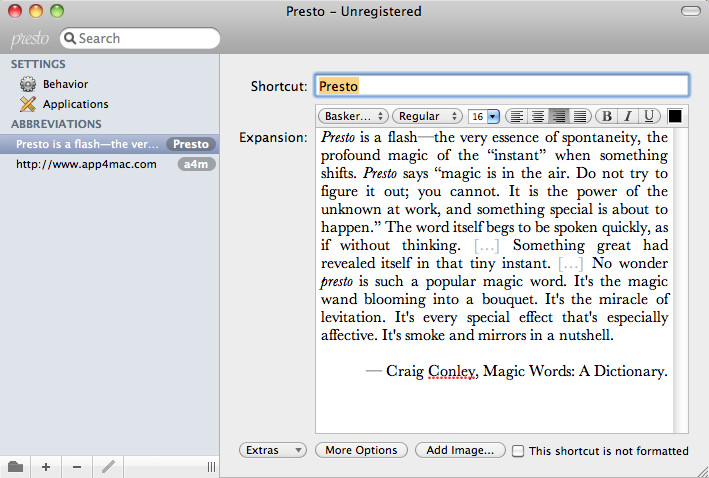
From our Magic Words outpost at Blogger: We just discovered (with help from Gordon) that a Mac app called Presto contains a passage from our Magic Words: A Dictionary. Presto is a utility for quickly pasting in commonly used snippets of text, and the magic word "presto" is the default example. So when one types "presto" into any application, a passage from our dictionary appears, like magic! |
|
|
|
|
|
|
"[W]here are the words to describe the glorious colours that are unknown to earthly eyes? Where the mind or imagination that can grasp the gorgeous scintillations of unheard-of rays as they emanate from the thousand nameless jewels of Barsoom?" — Edgar Rice Burroughs, The Gods of Mars, 1918 (via DJMisc) |
|
|
|
|
|
|
I have worn certain letters off my keyboard. "M" and "N" vanished together (aMNesia?) V is half there? (My half-cocked loVe?) — William Keckler |
|
|
|
|
|
|
Unnecessary Attribution
(of brief, public-domain utterances)
In the word of the great statesman and martyr, Abraham Lincoln, "Alas!" As the legendary Mae West once exclaimed, "Funny!" In the word of the great Persian poet-astronomer, Omar Khayyam, "Who?" To quote the eminent Frenchman, Rousseau, "Indeed!" In the word of the great American slavery abolitionist, Frederick Douglas, "Never." As the celebrated Dr. Johnson once asked, "Why?" In the word of the great Italian poet-philosopher Giacomo Leopardi, "Oh!" As God said, ". . ."
|
|
|
|
|
|
|
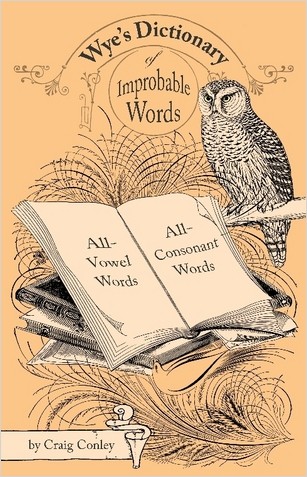
Thanks to the Bananagrammer blog for recommending our Wye's Dictionary of Improbable Words to those "interested in obscure words on the extremes of human language." We love how Bananagrammer says that our collections of all-consonant and all-vowel words "spin off into highly arcane references (at times approaching Borges-level bizarreness)." |
|
|
|
|
|
|
"Writers don’t have to be brilliant conversationalists; it’s not their job to be smart except, of course, when they write. Hazlitt, that most self-conscious of writers, remarked that he did not see why an author 'is bound to talk, any more than he is bound to dance, or ride, or fence better than other people. Reading, study, silence, thought are a bad introduction to loquacity.'" —Arthur Krystal, " When Writers Speak," Sunday Book Review |
|
|
|
|
|
|
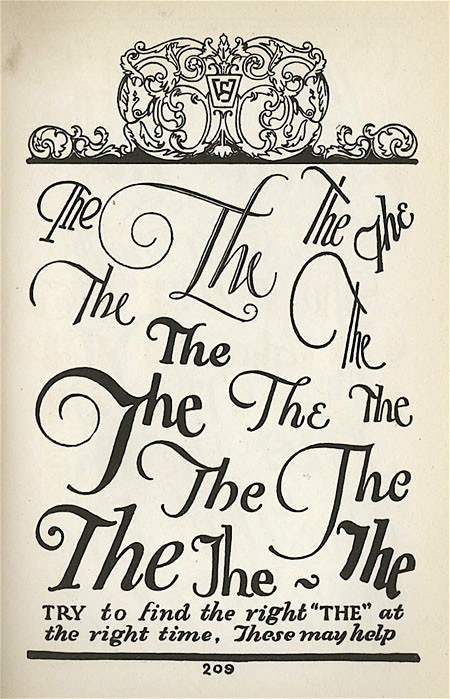
From the 1927 edition of Studio Handbook Letter & Design for Artists and Advertisers by Samuel Welo. Via. ---
J writes:
Is this "the" the "the" the "the" expert recommended?
|
|
|
|
|
|
|
From our Magic Words outpost at Blogger: "[ John Milton's] poetry acts like an incantation. Its merit lies less in its obvious meaning than in its occult power, and there would seem at first to be no more in his words than in other words. But they are words of enchantment. No sooner are they pronounced than the past is present and the distant near. New forms of beauty start at once into existence, and all the burial-places of the memory give up their dead." —Thomas Babington Macaulay, Essay on Milton |
|
|
|
|
|
|
Play it Forward(our guest blog for Bernie DeKoven's Deep Fun) Does the march of progress allow space for somersaults? In other words, can we PLAY toward a better condition? In each of the following quotations, the word WORK has been playfully changed to PLAY. "We need to PLAY toward developing peace in all of our thoughts, words, and actions." — William B. Gudykunst, Bridging Differences, 2003 "We need to PLAY toward a world where healthy anger is the norm and destructive anger the exception." — Jane Middelton-Moz, Boiling Point: The High Cost of Unhealthy Anger to Individuals and Society, 1999 "In order to have clarity, we need to PLAY toward seeing the world as accurately as possible." — Judith V. Jordan, Linda M. Hartling, & Maureen Walker, The Complexity of Connection, 2004 "We need to PLAY toward prevention of overwhelming stress situations that all too frequently result in mental hospitalization." — Robert Lefferts, Getting a Grant, 1978 "We need to PLAY toward ... a collective sense of meaning and significance." — Chris Hackler, Health Care for an Aging Population, 1994 "We need to PLAY toward trusting that whatever happens is 'good.'" — Dzigar Kongtrul, Light Comes Through, 2008 "By accepting the fact that all will not be pleasant at work and that we need to PLAY toward satisfaction and fun in our job, we can more readily dismiss unpleasant happenings." — Jennie Wilting, People, Patients, and Nurses, 1980 "We need to PLAY toward a society that has social policies that reflect humanitarian values." — Emelicia Mizio & Anita J. Delaney, Training for Service Delivery to Minority Clients, 1981 "We need organizational makeovers and we need to PLAY toward the change more rapidly than we have thought in the past." — Lloyd C. Williams, Business Decisions, Human Choices, 1996 "We need to PLAY toward protecting Mother Earth and all living beings." — Jane Middelton-Moz, Welcoming Our Children to a New Millennium, 1999 "We need to PLAY toward our survival as a species." — Bill G. Gooch, Lois Carrier, & John Huck, Strategies for Success, 1983 "PLAY is intrinsically satisfying, ie fulfilling; PLAY means survival; and PLAY provides a level of social connectedness to the larger community." — Samuel M. Natale & Brian M. Rothschild, Values, Work, Education, 1995 Are the altered quotations above still true? Law professor Mary Brandt Jensen reminds us that in the language of copyright law, to "perform" a work is to "recite, render, play, dance, or act it." Perhaps more of our work can be performed with a playful spirit, so as to transform our sense of duty into genuine enthusiasm.
|
Page 62 of 74
> Older Entries...
Original Content Copyright © 2026 by Craig Conley. All rights reserved.
|