CRAIG CONLEY (Prof. Oddfellow) is recognized by Encarta as “America’s most creative and diligent scholar of letters, words and punctuation.” He has been called a “language fanatic” by Page Six gossip columnist Cindy Adams, a “cult hero” by Publisher’s Weekly, a “monk for the modern age” by George Parker, and “a true Renaissance man of the modern era, diving headfirst into comprehensive, open-minded study of realms obscured or merely obscure” by Clint Marsh. An eccentric scholar, Conley’s ideas are often decades ahead of their time. He invented the concept of the “virtual pet” in 1980, fifteen years before the debut of the popular “Tamagotchi” in Japan. His virtual pet, actually a rare flower, still thrives and has reached an incomprehensible size. Conley’s website is OneLetterWords.com.
Featured Book
The Young Wizard's Hexopedia
Search Site
Interactive

Breathing Circle
Music Box Moment
Cautious or Optimistic
King of Hearts of War and Peace
As I Was, As I Am
Perdition Slip
Loves Me? Loves Me Not?
Wacky Birthday Form
Test Your ESP
Chess-Calvino Dictionary
Amalgamural
Is Today the Day?
100 Ways I Failed to Boil Water
"Follow Your Bliss" Compass
"Fortune's Navigator" Compass
Inkblot Oracle
Luck Transfer Certificate
Eternal Life Coupon
Honorary Italian Grandmother E-card
Simple Answers

Collections

A Fine Line Between...
A Rose is a ...
Always Remember
Ampersands
Annotated Ellipses
Apropos of Nothing
Book of Whispers
Call it a Hunch
Colorful Allusions
Did You Hear the One I Just Made Up?
Disguised as a Christmas Tree
Do-Re-Midi
Don't Take This the Wrong Way
Everybody's Doing This Now
Forgotten Wisdom
Glued Snippets
Go Out in a Blaze of Glory
Haunted Clockwork Music
Hindpsych: Erstwhile Conjectures by the Sometime Augur of Yore
How to Believe in Your Elf
How to Write a Blank Book
I Found a Penny Today, So Here's a Thought
Images Moving Through Time
Indubitably (?)
Inflationary Lyrics
It Bears Repeating
It's Really Happening
Last Dustbunny in the Netherlands
Neither Saint- Nor Sophist-Led
No News Is Good News
Non-Circulating Books
Nonsense Dept.
Not Rocket Science
Old News
Oldest Tricks in the Book
On One Condition
One Mitten Manager
Only Funny If ...
P I n K S L i P
Peace Symbols to Color
Pfft!
Phosphenes
Postcard Transformations
Precursors
Presumptive Conundrums
Puzzles and Games
Constellations
D-ictionary
Film-ictionary
Letter Grids
Tic Tac Toe Story Generator
Which is Funnier
Restoring the Lost Sense
Rhetorical Answers, Questioned
Rhetorical Questions, Answered!
Semicolon Moons
Semicolon's Dream Journal
Separated at Birth?
Simple Answers
Someone Should Write a Book on ...
Something, Defined
Staring at the Sun
Staring Into the Depths
Strange Dreams
Strange Prayers for Strange Times
Suddenly, A Shot Rang Out
Sundials
Telescopic Em Dashes
Temporal Anomalies
The 40 Most Meaningful Things
The Ghost in the [Scanning] Machine
The Only Certainty
The Right Word
This May Surprise You
This Terrible Problem That Is the Sea
Two Sides / Same Coin
Uncharted Territories
Unicorns
We Are All Snowflakes
What I Now Know
What's In a Name
Yearbook Weirdness
Yesterday's Weather
Your Ship Will Come In

Archives

June 2026
May 2026
April 2026
March 2026
February 2026
January 2026
December 2025
November 2025
October 2025
September 2025
August 2025
July 2025
June 2025
May 2025
April 2025
March 2025
February 2025
January 2025
December 2024
November 2024
October 2024
September 2024
August 2024
July 2024
June 2024
May 2024
April 2024
March 2024
February 2024
January 2024
December 2023
November 2023
October 2023
September 2023
August 2023
July 2023
June 2023
May 2023
April 2023
March 2023
February 2023
January 2023
December 2022
November 2022
October 2022
September 2022
August 2022
July 2022
June 2022
May 2022
April 2022
March 2022
February 2022
January 2022
December 2021
November 2021
October 2021
September 2021
August 2021
July 2021
June 2021
May 2021
April 2021
March 2021
February 2021
January 2021
December 2020
November 2020
October 2020
September 2020
August 2020
July 2020
June 2020
May 2020
April 2020
March 2020
February 2020
January 2020
December 2019
November 2019
October 2019
September 2019
August 2019
July 2019
June 2019
May 2019
April 2019
March 2019
February 2019
January 2019
December 2018
November 2018
October 2018
September 2018
August 2018
July 2018
June 2018
May 2018
April 2018
March 2018
February 2018
January 2018
December 2017
November 2017
October 2017
September 2017
August 2017
July 2017
June 2017
May 2017
April 2017
March 2017
February 2017
January 2017
December 2016
November 2016
October 2016
September 2016
August 2016
July 2016
June 2016
May 2016
April 2016
March 2016
February 2016
January 2016
December 2015
November 2015
October 2015
September 2015
August 2015
July 2015
June 2015
May 2015
April 2015
March 2015
February 2015
January 2015
December 2014
November 2014
October 2014
September 2014
August 2014
July 2014
June 2014
May 2014
April 2014
March 2014
February 2014
January 2014
December 2013
November 2013
October 2013
September 2013
August 2013
July 2013
June 2013
May 2013
April 2013
March 2013
February 2013
January 2013
December 2012
November 2012
October 2012
September 2012
August 2012
July 2012
June 2012
May 2012
April 2012
March 2012
February 2012
January 2012
December 2011
November 2011
October 2011
September 2011
August 2011
July 2011
June 2011
May 2011
April 2011
March 2011
February 2011
January 2011
December 2010
November 2010
October 2010
September 2010
August 2010
July 2010
June 2010
May 2010
April 2010
March 2010
February 2010
January 2010
December 2009
November 2009
October 2009
September 2009
August 2009
July 2009
June 2009
May 2009
April 2009
March 2009
February 2009
January 2009
December 2008
November 2008
October 2008
September 2008
August 2008
July 2008
June 2008
May 2008
April 2008
March 2008
February 2008
January 2008
December 2007
November 2007
October 2007
September 2007
August 2007
July 2007
June 2007
May 2007
April 2007
March 2007
February 2007
January 2007
December 2006
November 2006
October 2006
September 2006
August 2006
July 2006
June 2006
May 2006
April 2006

Links

Magic Words
Jonathan Caws-Elwitt
Martha Brockenbrough
Gordon Meyer
Dr. Boli
Serif of Nottingblog
dbqp
Phantasmaphile
Ironic Sans
Brian Sibley's Blog
Neat-o-Rama
Abecedarian personal effects of 'a mad genius'
A Turkish Delight of musings on languages, deflations of metaphysics, vauntings of arcana, and great visual humor.
Today — June 1, 2026

I Found a Penny Today, So Here's a Thought (permalink)

The System Hates Free Minds:

How a Music Producer and Eccentric Scholar

Fled the Powers that Be, Got Unstuck in Time, and Made it to Cloudland

One of life's weirdest challenges occurred when quantum physicist Dean Rickles recently interviewed me without asking any questions.  The resulting string of answers comes across as utterly surreal to my own eye — like joining a conversation in progress without there being an actual conversation to provide any context.  This wasn't some form of channeling, or psychic intuition, or stream-of-consciousness improvisation.  I didn't even consider imaginary questions but rather simply began answering.  Dr. Rickles' interviews typically last two hours, but I finished communicating what I didn't know I had to say in a blessedly brief fifteen minutes.  The result seems to be a rather personal portrait of what it's like for a free mind to seek being creative, and what it's like to experience a distorted sense of time passing.  It's all too true that a sort of time sickness has long plagued me and affected my creativity.  So here's a transcript and video of my questionless answers to a quantum physicist.
88
If you're feeling experimental, let's try making this an actual conversation by testing the Sheldrakian morphic field, to see if the group mind might elevate whatever we discuss.  Off the top of my head, as the field enlivens, let's touch upon the uncanny experience of distorted time, whether ideas might come from the future, what happens when independent scholars follow mad whims, how much control an artist actually has over a creative work, how creativity might become cancerous, what our curiously strong affinities might be all about, and what time actually is.  Let's find out if viewer thoughts seem to break through along the way.

Is it possible that academia deliberately warps one's experience of time?  An academic year begins in the autumn, so a college yearbook sports two dates to cover twelve months.  There are 12 to 15 hours in a season or semester, as that's how classroom time is calculated.  A lecture hour itself is 50 minutes.  Don't even ask about summer or winter breaks, when Bardo-like "intersessions" speed and cram an entire season into 1 to 4 weeks.  Yearbook illustrations classically depict freshmen as babies and seniors as elders, as if an entire lifespan covers the four years of a bachelor's degree.  My tenure as an untenured college teacher untethered me from a metronomic experience of time.  Perhaps it's no wonder that in order to create music now for Neons Gone Mad, I incorporate samples of clockwork as percussion so as not to fall into a jazzy chaos.  What's certain is that with only academia to blame, since psychedelics have never been in the equation, I metabolize an hour as I remember metabolizing an entire day in my childhood.  Waiting a day or more for someone's sluggish response is excruciating, as if an entire week has gone by.  I'll look back at what feels for all the world like an old email and marvel, "That was only yesterday?"  With hours like days, one does get a tremendous amount of work done, though at the cost of profound fatigue and disorientation.  You'd think one would feel ahead of the game with such acceleration, yet inexplicably I now feel precisely 20 years behind.  So while Zeno's Paradox may have been debunked, it's yet possible to live it, racing faster and faster to halfway points of halfway points and progressing to the illusion of stasis as the horizon appears fixed.  That's uncomfortable, to put it mildly, and note that I never even mentioned the exacerbations of Daylight Saving Time.  Fleeing academia into what it calls "the real world" didn't reset the body clock.  

As Dr. Charles Stang says, one can't always be certain about the overall vision of one's work, and one seems to be playing catch-up.  That's quite a thing to ponder, catching up to one's own enterprise.  It's like the apocryphal Ledru-Rollin quotation, "I must find out where they are going so I can lead them."  And so one wonders whether our creative projects are, as Dr. Michael Eldred posits, actually from the future.  When we flatter ourselves over having new ideas, are we merely remembering what already exists in the future?  People speak of putting "the cart before the horse" as if that's doing something backward, but what if it's a more accurate metaphor of reality, as Dr. Eric Wargo suggests?  I seriously do have to muse over why, for example, the idea to write a dictionary of one-letter words first popped into my head, why I spent years following through with it, and how such a thing could actually now exist in hardcover by the top-three publisher HarperCollins.  Every stage of the linear path is frankly ludicrous, but playing the filmstrip of life backwards, reverse-engineering a pre-existent book, feels like a tidier explanation.  Interestingly, the hundreds of books I've written have presented themselves to my so-called imagination not as jotted notes or typescript drafts but as finished products, in that I envision formally laid-out pages and even create my books in Photoshop as opposed to word processing software, composing and arranging the presentation simultaneously, as if reconstructing a finished work from mental snapshots of the future.  

B. Dave Walters assures people that they don’t have to believe every thought that pops into their heads, and while it's comforting advice, I'm afraid I do tend to follow and manifest my whims.  That's a perk of being an independent scholar, but it has left a body of work that appears "quirky" at best, spanning several college textbooks on human diversity for McGraw-Hill and a dictionary of magic words for Weiser Books, to works about sheet ghosts, identifying unicorns by sound, reading the palms of crosswalk signal hands, the secrets of chicken whispering, feng shui for seance parlors, writing numbers in cursive, tracing one's genealogy to mythical ancestors, and pencil-based witchcraft.  Some of these whimsies have come close to breaking into the mainstream.  My exploration of Books of the Dead throughout history was commissioned by Wooden Books but ended up being self-released (at no fault of the book, mind you), and The Young Wizard's Hexopedia was commissioned and even titled by Quirk Books, who for mystifying reasons dropped the magic 8-ball and allowed me to release it independently.  Works like How to Be Your Own Cat have been mini hits in independent bookstores like Quimby's in New York and Chicago.  Mixing serious and humorous publications perhaps comes with some risks, as so many lines are blurred.  Yet being independent is freeing, and frankly I take seeming absurdity as seriously as anything else.  Dr. Raymond Moody has studied how nonsense passages, such as those made famous by Lewis Carrol, trigger altered states of consciousness in a psychomanteum chamber.  It's possible that all of my works have that basic purpose, to open the mind to some mysterious realm.  If the overall impression is one of being at least a touch unhinged, I embrace that as Salvador Dalí did, as a deliberate artistic tool.  

It rings true that the act of reading is a form of necromancy in which the ghostly voice of a distant author lives again in one's head.  So, too, does authorship feel like channeling.  My ego is far too embryonic to claim most any of the ideas that manifest through me.  The concept of the Greek Muses sparking creative breakthroughs is appealing.  Feeling in control of creative projects would be a novel experience — it's more like going along for the ride.  On a couple of occasions working as a songwriter and remixer, a collaborator was ultimately disappointed in how my recording veered off expectations, as when he wanted Rudy Vallée and got a jazzy blues treatment.  It was fair for him to expect that I was at the helm, but the music simply developed as it seemed to "wish."  There was no intention to go off script much less to let down a client.  Belatedly, it seems time to include a formal disclaimer for future collaborations.  

Less mysterious than the origin of a creative spark might be why that spark tends to trigger a wildfire.  In full disclosure, outside of the textbooks, my book sales haven't warranted and certainly haven't funded the hundreds of publications that followed.  Why have I kept on writing, with so few accolades not to mention royalties?  Nor have viewership numbers of my horror-comedy tv series Grave Mood Rings encouraged me to produce over 200 episodes and counting.  It's a distressing question, in that creativity can seem to take on a cancerous quality.  A musician friend has fallen into that situation to a profoundly greater degree, seemingly never satisfied by the number or frequency of his album releases and now relying on material to be generated by what I call the Dreaded Two-Letter Acronym to churn out releases faster and faster.  Productivity took precedence over content.  Could this be tied to some sort of evil Muse?  Perhaps someone like the biblical angel Abaddon who rules over the bottomless pit?  It's uncomfortable to consider the drive to create to be a sickness.  Perhaps a paraphrase of Dalí is in order: "The only difference between me and one possessed by Abaddon is that I am not possessed by Abaddon."  An advisor of mine, who is more than something of a mystic, assures me that the work I do is not for the present but for the future, that in fact I do have a sizable readership and viewership in the future and on higher dimensions of reality.  Finding consolation in such a perspective has been a process, but I embrace it because, since I can't know for sure, why not default to optimism?  My nature abhors a vacuum, and I wish my work to be seen and heard.  As Dr. David Temperley has noted, "Why would the great composers have bothered to create such elaborate mental structures if they thought that these structures would never be shared by listeners?"  Hence my perplexity over Emily Dickinson, my 21st cousin 6 times removed, who locked her poems into little drawers.

Perhaps a mad creative drive is tangled within a fear of death.  Leave enough evidence of yourself and surely something will endure as an insurance policy for future readers, viewers, and listeners to serve as mediums for one's departed spirit?  

Possibly a comfort for those conspiring with Abaddon, there's the intriguing idea in esoteric philosophy that one incarnates as a facet of an Oversoul and that an Oversoul manifests as hundreds or thousands of seemingly separate lives — not as in reincarnation but rather multiple lives at once.  That implies that an author, for example, might encounter works by one or more of his parallel incarnations.  The idea is that if one resonates strongly with a book, a piece of music, a painting, or what have you, the reason for the strong attraction is that it's a communication from another part of you via an additional facet of the same Oversoul.  What a rather mind-blowing thing to consider, that all of one's favorite authors, musicians, or other artists might technically be oneself on a higher plane!  It seems a tidy explanation for otherwise baffling affinities, and it's a lovely thought that we might learn and grow from the wisdom of discrete instances of our greater selves. 

While searching the literature for things that third parties might have somehow written on my behalf, I collect bullet lists of wisdom nuggets.  Though the nature of Time remains somewhat mysterious, I've encountered a card deck's worth of things that Time is not.  Let's quickly see if any of these sound true, and I'll save my personal favorites for the end.

Time is not an academic curiosity
an endless corridor
on our side
young itself
nor like mittens snapped to your coat.

Time is not creative
noisy
a linear coordinate
the neutral wallpaper of reality
nor the cask under the faucet.

Time is not a cock.  (That might be a typo.)

Time is not money
change
what we measure
corrected gradually
nor when you get up.

Time is not self-interpreting
the passage of nature itself
a freestanding substance
an independent realm
a bird or a bug.

Time is not the problem
the framework of existence
an arrow
the enemy of eternity
nor is it mad or sane.

Time is not an illusion
a brute fact
autonomous
the one that's passing
nor an orphaned mechanism.

Time is not a prison
punishment
an eternal continuum
under our control
nor is it enough.

Time is not expensive
self-sustaining
a river
an empty box
nor meaningless drift.

Time is not yet ripe
of the essence
the intersection of science and religion
rightly construed
nor what you've been told.

Time is not based on philosophical reflection
not a yardstick but a life
not what we think it is
not available for rent to outside organizations
nor to be exceeded without further authorization.

Well, I've played my last card ...

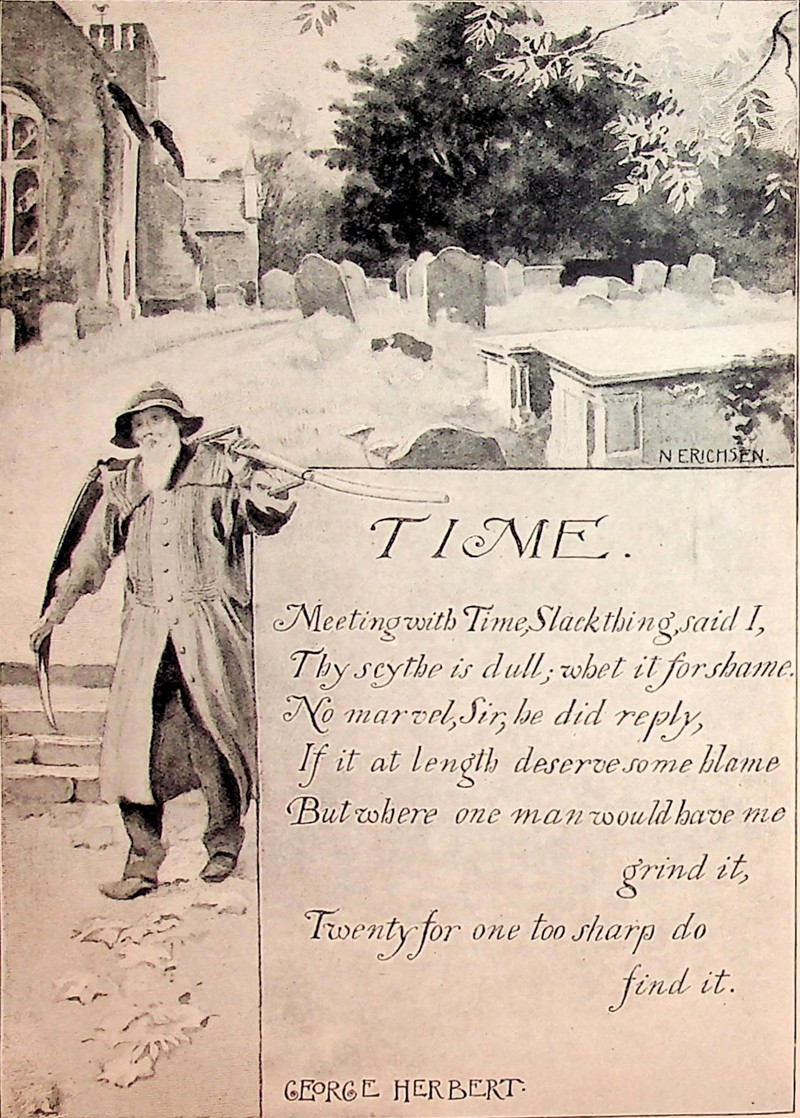
[Time, gentlemen, please!]

... and apparently I'm out of it!  
> read more from I Found a Penny Today, So Here's a Thought . . .
#prof. oddfellow #temporal anomaly #video #independent scholar
Tumblr Twitter Facebook Pinterest


Restoring the Lost Sense (permalink)
From the Daily Mirror, 1914.
> read more from Restoring the Lost Sense . . .
#vintage illustration #illustration #1910s #home economics
Tumblr Twitter Facebook Pinterest


A Rose is a ... (permalink)
From Wee Wisdom, 1923.
> read more from A Rose is a ... . . .
#vintage illustration #magnifying glass #sunbeam #illustration #june #rose #poem
Tumblr Twitter Facebook Pinterest


Restoring the Lost Sense (permalink)
From The Patchwork Girl of Oz by L. Frank Baum and illustrated by John R. Neil, 1913.
> read more from Restoring the Lost Sense . . .
#vintage illustration #porcupine #oz #illustration #1910s
Tumblr Twitter Facebook Pinterest


Restoring the Lost Sense (permalink)
From Our Kings and Queens, 1889.
> read more from Restoring the Lost Sense . . .
#vintage illustration #queen #illustration #1880s #mary the second
Tumblr Twitter Facebook Pinterest


Restoring the Lost Sense (permalink)
From Friends, a Primer by Pennell, Cusack, Macleod & Gates and illustrated by Marguerite Davis, 1900.
> read more from Restoring the Lost Sense . . .
#vintage illustration #fish #1900s #illustration
Tumblr Twitter Facebook Pinterest


Restoring the Lost Sense (permalink)
From Advanced Course in Homemaking by Maude Richman Calvert and Leila Bunce Smith, 1939.
> read more from Restoring the Lost Sense . . .
#vintage illustration #etiquette #1930s #advice #illustration #manners
Tumblr Twitter Facebook Pinterest


Restoring the Lost Sense (permalink)
From Drawing Made Easy by Edwin George Lutz, 1921.
> read more from Restoring the Lost Sense . . .
#vintage illustration #drawing #flower #1920s #illustration #teacup
Tumblr Twitter Facebook Pinterest


Restoring the Lost Sense (permalink)
From Mother Nature's Children by Allen Walton Gould, 1900.
> read more from Restoring the Lost Sense . . .
#vintage illustration #fish #illustration
Tumblr Twitter Facebook Pinterest


Separated at Birth? (permalink)
Our custom widget that checks for duplicated images suggested this unlikely pairing.  Click each image for its source.
110721

104285
> read more from Separated at Birth? . . .
Tumblr Twitter Facebook Pinterest


Restoring the Lost Sense (permalink)
May you hereby be protected against the screams of scrylls.  From Wizardry IV: The Return of Werdna Handbook.
> read more from Restoring the Lost Sense . . .
#vintage illustration #skull #horror
Tumblr Twitter Facebook Pinterest


Yearbook Weirdness (permalink)
"He used to stand right there."  From James Millikin University's 1910 yearbook.
> read more from Yearbook Weirdness . . .
#vintage illustration #vintage yearbook #outhouse #tiny house #men's room
Tumblr Twitter Facebook Pinterest


Yearbook Weirdness (permalink)
"When you get an ominous looking message ... brace up."  From Hamilton Normal School's 1936 yearbook.
> read more from Yearbook Weirdness . . .
#vintage illustration #vintage ad #ominous #vintage yearbook #ad
Tumblr Twitter Facebook Pinterest


Yearbook Weirdness (permalink)
From the University of North Carolina at Chapel Hill's 1917 yearbook.
> read more from Yearbook Weirdness . . .
#vintage illustration #mirror #vintage yearbook #yearbook #dandy #narcissism
Tumblr Twitter Facebook Pinterest


Old News (permalink)
"Bugle for silence."  From The Macdonald Farm Journal, 1958.
> read more from Old News . . .
#vintage illustration #dog #vintage headline #bugle
Tumblr Twitter Facebook Pinterest


Yearbook Weirdness (permalink)
Enjoying crushed pineapple is only as challenging as we make it.  From Hastings College's 1940 yearbook.
> read more from Yearbook Weirdness . . .
#vintage yearbook #yearbook #fishing #1940s #woman #vintage woman
Tumblr Twitter Facebook Pinterest


Yearbook Weirdness (permalink)
From the University of North Carolina at Chapel Hill's 1919 yearbook.
> read more from Yearbook Weirdness . . .
#vintage illustration #vintage yearbook #yearbook #illustration
Tumblr Twitter Facebook Pinterest


The Right Word (permalink)
Here's the proper way to contract "handkerchiefs."  From the Duluth Evening Herald, 1908.
> read more from The Right Word . . .
#vintage illustration #vintage ad #teddy bear #tug of war #1900s #illustration #contraction #handkerchief #ad
Tumblr Twitter Facebook Pinterest


Yearbook Weirdness (permalink)
From Park College's 1938 yearbook.
> read more from Yearbook Weirdness . . .
#worry #vintage yearbook #yearbook
Tumblr Twitter Facebook Pinterest


Yearbook Weirdness (permalink)
From the United States Naval Academy's 1909 yearbook.
> read more from Yearbook Weirdness . . .
#vintage illustration #fashion #vintage fashion #vintage yearbook #yearbook #1900s #illustration #june
Tumblr Twitter Facebook Pinterest


Page 1 of 4164


Original Content Copyright © 2026 by Craig Conley. All rights reserved.