|
|
|
|
|
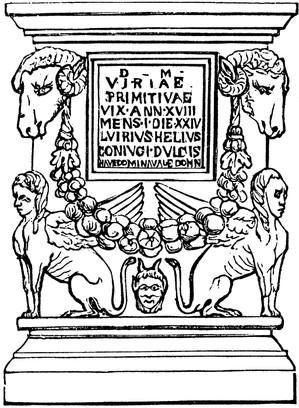
In a discussion of a poem composed via a Ouija Board, we learned that two mediums took dictation in a red dining room, and then a poet edited the transcripts in an adjoining blue room, "supplementing the uppercase text of the dead with his own lowercase commentary." We were beguiled by that phrase, "the uppercase text of the dead." It conjures images of ancient Roman script chiseled into marble.
---
J quips:
Why are they shouting? It must just be high spirits.
|
|
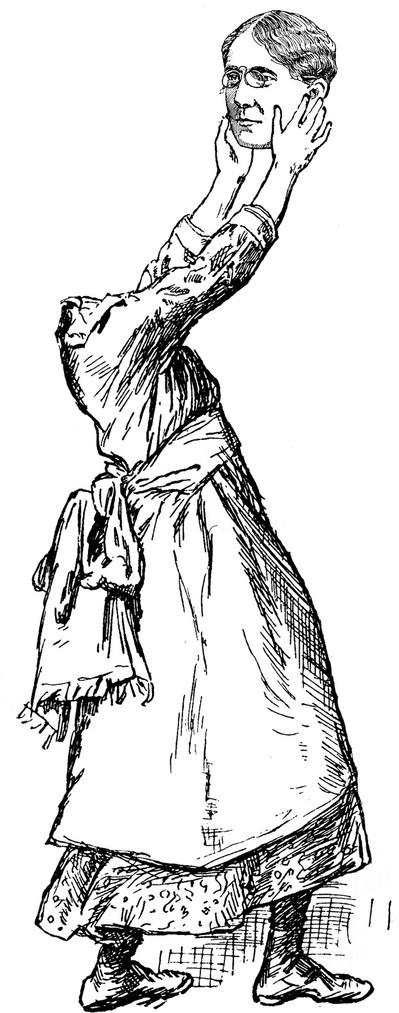
Saint Zab
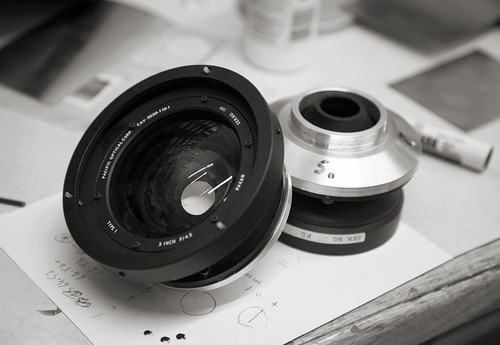
Patron of Huge, Impractical Lenses.
|
|
Don't miss our extensive interview over at Musings from a Muddy Island, in which we reveal all sorts of hidden, half-hidden, and quarter-hidden secrets, arcane details, and latent possibilities. |
|
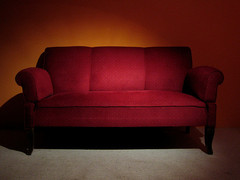
Both of us were able to look in by standing on the basement, and clinging to the ledge, and we saw — ah! it was beautiful — a splendid place carpeted with crimson, and crimson- covered chairs and tables, and a pure white ceiling bordered by gold, a shower of glass- drops hanging on silver chains from the centre, and shimmering with little soft tapers. Old Mr. and Mrs. Linton were not there. Edgar and his sister had it entirely to themselves; shouldn’t they have been happy? We should have thought ourselves in heaven!
—Emily Bronte, Wuthering Heights, 1847.
|
|
| Strange Prayers for Strange Times |
(permalink) |
|
|
|
"Hail to the sacred vowels! Supreme salutations to the holy consonants!" —Prayer to the alphabet, Tibetan monks; quoted by John Stevens in Sacred Calligraphy of the East, third edition, 1995. Via DJMisc.
|
|
|
|
|
|
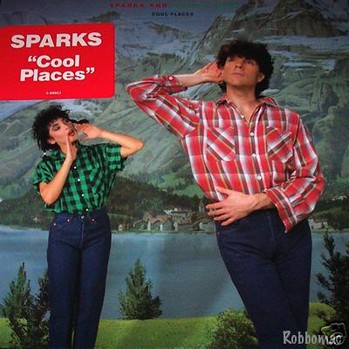
Honorable mention in our PInKSLiP campaign ( read about the concept here) goes to Russell Mael of the band Sparks, for his song " Cool Places," a duet with Go-Go's Jane Wiedlin. Mael defies gender stereotypes when he sings, "I wanna go where nobody's a fool, and no one says uh, 'hey girl, need a light?'" While a homophobic reading of that line is possible, we think it most likely that Mael originally wrote the lyric for Wiedlin to sing, and the two switched lines. Additional kudos to a group of fifth grade boys in a music class who changed "I Kissed a Girl" by Katy Perry to " I Kissed a Squirrel," yet retained the line, "I hope my boyfriend doesn't mind it." |
|
| I Found a Penny Today, So Here's a Thought |
(permalink) |
|
|
|
  by PerlaOctarine: The Imaginary Color of Magic"Octarine" is a color name coined by Terry Pratchett in his Discworld novels. Octarine is said to be the color of magic, as it is apparent in the crackling and shimmering of light. The word refers to the "eighth color," in a spectrum of black, blue, green, yellow, purple, orange, and red. Octarine has been likened to a fluorescent greenish-yellow purple, a combination impossible to perceive with normal human eyes. Imagine, if you can, the marriage of these two swatches:  
Scholar of magic Pete Carroll says he imagines Octarine to be "a particular shade of electric pinkish-purple," a common color in optical illusions. Who can see octarine with the naked eye? Legend has it that only wizards and felines can. That's because an ordinary eye, equipped with rods and cones, would see greenish-yellow purple as gray, black, or nothing at all, while a wizard's eye is said to be equipped with octagons. Some people claim to catch glimpses of octarine in peacock feathers, lightning bolts, rainbows, lens flares, soap bubbles, bonfires, and gemstones. There can be no doubt that octarine is an imaginary color. But is it preposterous to think that normal human eyes might one day be able to perceive a fluorescent greenish-yellow purple? The folks at the Conscious Entities blog posed that very question: "There has to be an octarine, doesn't there? The mere conceivability of another color shows that the spectrum is not an absolute reality. It seems to me that, just as we can always encounter a completely new smell, there would always be scope for a new color, if our eyes were able to develop new responses the way our nose presumably can. But I don't even need to rely on conceivability. Some insects can see ultraviolet light, for example, and some snakes can see infrared. They must assign to those wavelengths colors which we can't see, mustn't they?" Their conclusion, however, is negatory: "Look at the way the spectrum forms a closed circle. If we extended it downwards below red, we should simply get another, lower, violet. Now I grant you that the 'lowerness' would have to expressed in some way - possibly as 'warmth.' The colors of the visible spectrum are differentiated in terms of warmth, so perhaps the lower violet would appear distinctly warmer than the one we're used to (great scope for interior decorators...). I repeat, the spectrum is a reality. You can call it a mathematical reality if that helps, but it's real. If we saw color the way we hear pitch, all this would be obvious. But the fact that we can't see color harmonies or more than a single octave of colors means there's never been any scope for a genius to come along and produce a regularised interpretation of the spectrum, the way J.S.Bach did for the musical scale." [Read the entire article in my guest blog at ColourLovers.com.]
|
|
|
|
|
|
One rarely sees the word Bible in its verb form, but here it is painted across a luxury motorhome: "Bible Across America." We've previously heard of "imbibing across America," in terms of winery tours. If the motorhome got pulled over for speeding, would the patrolman "throw the book" at them, or vice versa? |
|
"We don't form our dreams out of just our own souls. We dream anonymously and communally, though each in his own way. The great soul, of which we are just a little piece, dreams through us so to speak, dreams in our many different ways its own eternal, secret dream—about its youth, its hope, its joy, its peace, and its bloody feast." — Thomas Mann, The Magic Mountain (a mountain of a masterpiece!) |
|
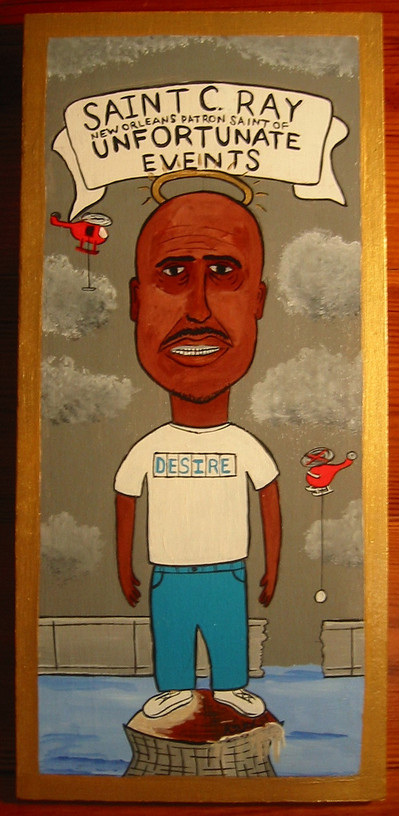
Saint C. Ray
Patron of Unfortunate Events.
|
|
|
|
|
|
| I Found a Penny Today, So Here's a Thought |
(permalink) |
|
|
|
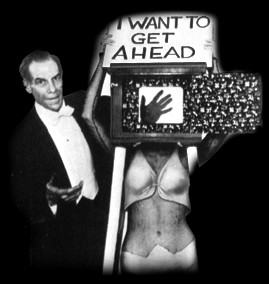
The documentary Women in Boxes, spearheaded by Blaire Baron Larsen, is a springboard for pondering the deeper significance of magicians placing their assistants in boxes. As performers, the duos likely have no idea what archetypal stories they're playing out. But something profound is going on, in light of the renowned psychologist Erich Neumann, a trailblazer in feminine psychology and the Great Mother archetype of world mythology. Applying Neumann's insights to stage magic, the prototypical female assistant symbolizes the anima -- that part of the psyche connected to the world of the subconscious -- the soul, if you will. The anima can be human or animal (hence the great tradition of women magically transforming into tigers). The prototypical male magician symbolizes the hero archetype on a quest toward individuality. In order to be truly creative, the magician's masculine world of ego consciousness must make a link to the feminine assistant's world of the soul. Through "sawing a lady in half," the magician tries to divide the anima, not so much to conquer her but to understand her like a scientist. He tries to contain the anima in a box, not to imprison her but to accommodate, encompass, and give definite form to her curvaceous amorphousness. Indeed, there's nothing inherently "sexist" about the roles of stage magician and assistant; the two form a single personality struggling to become integrated. (Read more of Neumann's wisdom in his indispensable The Origins and History of Consciousness. Here's a link to Camille Paglia's profile of Neumann).
|
Page 4 of 5
> Older Entries...
Original Content Copyright © 2026 by Craig Conley. All rights reserved.
|















 by
by