|
Certainty #21: "The present moment: the only certainty. This night is a single night; and there has never been any other." — Leslie Marmon Silko, Ceremony, 1977 |
|
|
|
|
|
| I Found a Penny Today, So Here's a Thought |
(permalink) |
|
|
|
Loïe Fuller, Illusionist of Light and Color
One of the most spellbinding color illusionists of the last century left her spectators dazzled to near-mystical proportions. Loïe Fuller (1862-1928) was pioneer of choreography and an innovator of theatrical lighting, holding patents for creating color gels and using chemical salts for luminescence. When she took to the stage dressed in flowing silk costumes specially lit according to her own schemes, she transformed into a full-fledged magician. When modern dance founder Isadora Duncan first witnessed Fuller's shape-shifting wizardry, she was bewitched by an alchemy of color and movement that left the impression of a once-in-a-lifetime miracle. Employing only voluminous colored silks illuminated by beams of light, Fuller performed what amounted to a shamanic ritual, convincing her spectators that a sacred metamorphosis was unfolding. Fuller evoked the primal power of the bonfire, depicted the wonder of new life, and enacted the elevation of the soul into boundless essence. Though the experience left Duncan in a state of wordless awe, she couldn't help attempting to account for the sheer magnitude of what she beheld:
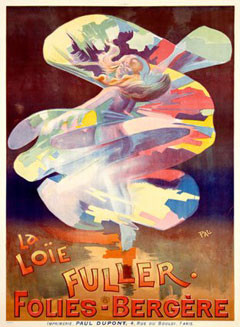 "Before our very eyes she turned to many-coloured, shiny orchids, to a wavering, flowering sea-flower, and at length to a spiral-like lily, all the magic of Merlin, the sorcery of light, colour, flowing form. What an extraordinary genius! No imitator of Loïe Fuller has ever been able even to hint at her genius! I was entranced, but I realized that this was a sudden ebullition of nature which could never be repeated. She transformed herself into a thousand colourful images before the eyes of her audience. Unbelievable. Not to be repeated or described. Loïe Fuller originated all the changing colours and floating Liberty scarves. She was one of the first original inspirations of light and changing colour. I returned to the hotel dazzled and carried away by this marvelous artist. . . . I was more and more enthusiastic about her marvellous ephemeral art. That wonderful creature—she became fluid; she became light; she became every colour and flame, and finally she resolved into miraculous spirals of flames wafted toward the Infinite." (My Life, pp. 71-72)
The significance of Loïe Fuller's performance can hardly be exaggerated. She embodied the Goddess of Light and the Rainbow, whether under the guise of the Greek Artemis or Iris, the Hindu Uma, the Mayan Ix Chel, the Celtic Brigid, or the Roman Diana. Biographers Richard and Marcia Current called Fuller a "magician of light." Befitting a goddess, Fuller had a paradoxical nature, and she created her own mythology. Her biographers explain:
 "A tall and lovely sylph in posters and sculptures, she was in reality a rather chubby woman with a fairly plain face. A dance innovator, she possessed no formal training in choreography. Eventually a cofounder of art museums, she had never even seen an art exhibit before going to Paris at the age of thirty. A close and respected associate of some of the most learned men and women in the world, she could claim no institutional education beyond that offered by the common schools of Illinois in the 1860s and 1870s. What she did have, in addition to her winning ways, was a dauntless will to get ahead, together with enough intelligence, resourcefulness, and ingenuity to give effect to that will. . . . She rose to extraordinary heights from a quite modest background. Her accomplishments were such that she might well have been satisfied with an unadorned account of her beginnings. She was not. Once she had achieved celebrity, she knocked several years off her age and made up fantastic tales about what was left of her early years. She created her own myth." (Loïe Fuller: Goddess of Light, 1997.)
What can we learn from Fuller's color magic?
- Physicality is a limitation only if we allow it to be. Fuller used her earth-mother physique to communicate a sylph-like spirit of the air. Her secrets? Natural, freeform movement and the power of intention.
- Personal history is a limitation only if we allow it to be. One is only as interesting as one makes oneself, so Fuller invented her own legend. Her secret? Reframing the truth to reveal the fascination.
- Formal training is less important than resourcefulness and ingenuity. Fuller's secrets? Banishing doubts and asking "What if?"
- A single silk and a beam of light can unfold a miracle. Fuller created something from nothing. Her secrets? Focusing on simplicity and following her inner guidance.
Before succumbing to breast cancer in 1928, Fuller found herself immortalized on canvas by Toulouse-Lautrec, in verse by Yeats, and on film by Lumiére. Not bad for a girl from a Chicago suburb who marched to her own drummer and followed her own spotlight.
|
|
We got a laugh out of Omegaword's call for omitting the apostrophe when a word is missing a letter. The piece ends with a humorous mention of "infernal punctuation." Did you know that in Hell, periods wear dresses? Here's the documentation: Charles Dickens was persecuted by the demonic prongs of the "infernal dash": Pray take care that they always strike out that infernal dash which I myself have taken out five hundred times.
—a letter to William Henry Wills, his sub-editor
We looked up infernal colons, semicolons, commas, hyphens, question marks, and exclamations, to no avail. Those marks must all be heavenly. By the way, don't miss this page about the anatomy of cloud commas. --- Jeff responds: Following that anatomy of cloud commas link shouldn't be attempted before breakfast. I did it anyway, eventually arriving at a page titled VERTICAL MOTION - OMEGA EQUATION, where I found an "equation [that] is a presentation of the omega equation where the connection between the contributions to vertical motion and the characteristic cloud configurations can be discriminated."
I deny all allegations that I had anything to do with this so-called Omega Equation, just in case anyone decides to allege it.
|
|
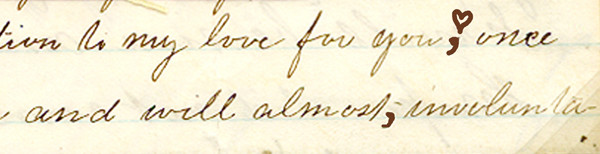
I dreamed a secret admirer sent me a love letter. |
|
Saint TrotterPatron of Fleetfootedness. Also known as "the patron of *flat*footedness, in the Eastern Orthotix Church" [thanks, Jonathan!].
|
|
|
|
|
|
The sail butterfly [Iphiclides podalirius] is migratory.

Artwork by Russian painter Vladimir Kush, via DesignYouTrust. Jeff writes: Yesterday, this remarkable painting greeted me first thing in the morning, setting the stage for a most colorful (if not flighty) day. Thanks for sharing!
|
|
| I Found a Penny Today, So Here's a Thought |
(permalink) |
|
|
|
|
|
The large bulbous nose, the greenish- gray hair and lashes, the gray- white eyes, all had the deathly color of leather buried for centuries in Davy Jones’s locker, and the neatly folled cloth bundle under his arm seemed a mariners’s kit.
—Dawn Powell, The Golden Spur, 1962.
|
|
From the psyche of Jeff: I dreamed I was a cold fish in a warm solar wind. Inhabiting four states of matter, I swam in blue northern water below winter's trees, quiescent in the frosty atmosphere where Aurora lives.
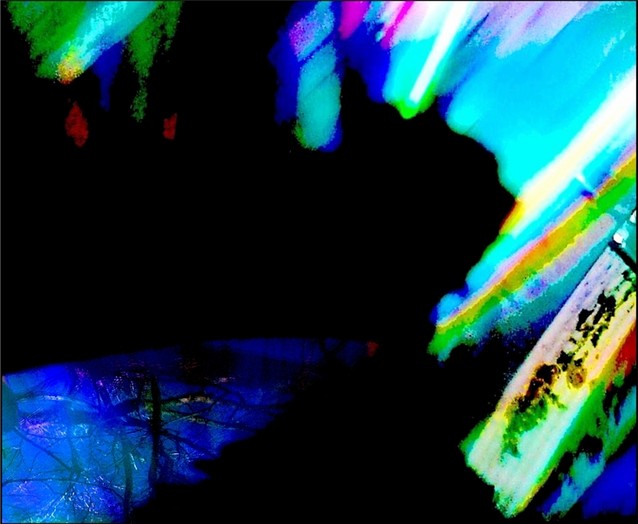
Jeff writes: Very nice! In fact, I'd say it looks better here than it did on my blog. Now I'm getting a little bit sad. In fact, I'm crying. Bitter tears are pooling on the floor, and splashing on my keyboard. My computer is ruined. Now I'm getting a little bit enraged. My forehead is marred with the impressions of the keys on my damaged keyboard. I'm hideous! Why? Why? Why?
|
|
Certainty #19:
"The only certainty is that community pressure will grow."
—Flying Magazine, 1928
|
|
|
|
|
|
Wilfried Hou Je Bek recently asked us to transcribe this ape call. We used our own Do-Re-Midi system of text-based musical notation. The ape's call is rendered in 8/4 time (eight beats per measure) and lasts six measures. The ape's tones range from a low B to a high G (one octave plus six notes). For an explanation of the melody line and tone durations, see the Do-Re-Midi specifications.
See a variety of fascinating transciptions in Wilfried's PDF of Wax Chimpatic.
|
|
In a quest to find the greatest number of words contained within any given word, Lacey Echols put our dictionary of one-letter words to the test. How did we measure up? Even though I have a fairly large vocabulary, I do not know many words which are one-letter words. Ask me to identify three- and four-letter words, and I am at ease. One letter? The only common single letter words are "a" and "I"! However, I was fortunate to hear about a book which could be my saving grace, One Letter Words--A Dictionary, by Craig Conley. I felt my confidence begin to soar because with the help of this dictionary I should easily be able to count all one-letter words in any given word, or could I? Being a bit of a skeptic, I tested my skill with the word "ait". "I" and "a" are legitimate, but what about "t"? Sure enough, Mr. Conley provides 58 instances in which "t" is used as a word. As an example, "it suits you to a T" uses "t" as a word. Hallelujah! But "ait" is a fairly simple word. What about "Mozambique"? I feel a time-consuming project ahead. Actually, the dictionary is foolproof. There are thirty-five examples using the word "z" and even twenty-seven examples of the word "q". Read the full article: "My Visit to Grant's Tome," Word Ways: The Journal of Recreational Linguistics, Aug. 2007. |
Page 2 of 5
> Older Entries...
Original Content Copyright © 2026 by Craig Conley. All rights reserved.
|










 by
by