|
|
 |
|
From Prof. Oddfellow's sketchbook:
|
|
When we're asked to weave stories out of the whimsical dictionaries we compile, we're left scratching our heads [oops—the Majestic Plural gets tricky!]. The lexicographer gathers the words for the writer to combine. The satirist Dr. Boli knows what we're talking about. |
|
| Puzzles and Games :: Which is Funnier |
(permalink) |
|
|
|
 True of False: Soup is as funny today as it was a few years back.
Clue: True of False: Soup is as funny today as it was a few years back.
Clue: This is according to the book The Sense of Humor.
Answer: False. “Soup is still funny, but not as funny as it was a few years back.” (The answer is in black text on the black background. Highlight it to view.)
Citation: Max Eastman, The Sense of Humor (1921), p. 150.
|
|
|
|
|
|
I had a nightmare about a ghost shark.
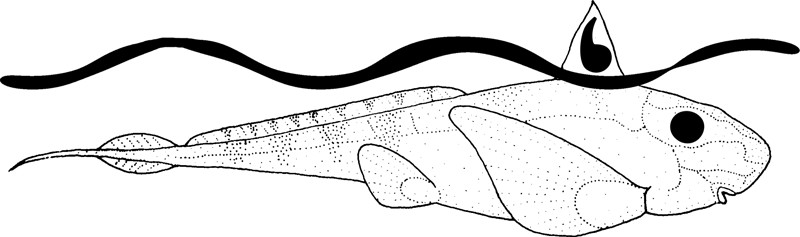
(Illustration incorporates artwork by Dr. Tony Ayling.)
|
|
Saint Robert
Patron of Post Rock.
|
|
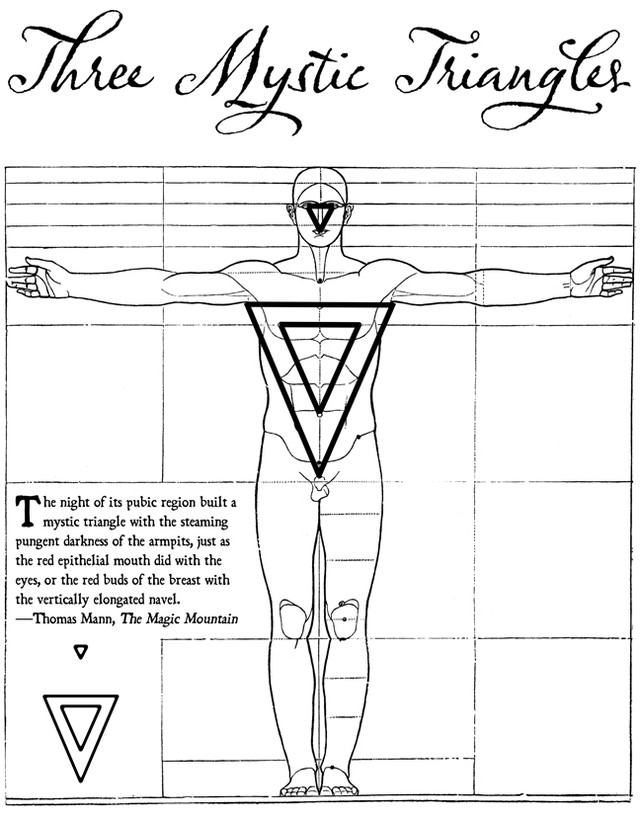
From Prof. Oddfellow's sketchbook, Thomas Mann's three mystic triangles.
|
|
Claggart deliberately advanced within short range of Billy, and mesmerically looking him in the eye, briefly recapitulated the accusation. Not at first did Billy take it in. When he did the rose- tan of his cheek looked struck as by white leprosy. He stood like one impaled and gagged. Meanwhile the accuser’s eyes, removing not as yet from the blue, dilated ones, underwent a phenomenal change, their wonted rich violet colour blurring into a muddy purple. Those lights of human intelligence losing human expression, gelidly protruding like the alien eyes of certain uncatalogued creatures of the deep.
—Herman Melville, Billy Budd, 1924.
|
|
|
|
| I Found a Penny Today, So Here's a Thought |
(permalink) |
|
|
|
  by DerpunkAll the Colors of the WindThe air. A thing too intangible for color you think? ... The truth is all air is colored.
—John C. Van Dyke, The Desert
Anyone who thinks that air is invisible is impaired by a sort of color blindness. Indeed, the air is so alive with color that it could be likened to a rainbow that encircles the entire earth with pink, red, violet, gray, blue, and yellow. Ask a naturalist or a painter, and you'll hear descriptions of an airy spectrum that escapes the unobservant viewer. Carried by swirling dust particles and refracted by the prisms of water vapor, the colors of the air are best observed in a mass. Mountaintop vantages, canyons, desert expanses, or deep valley views are recommended. The warmer the temperature and the stronger the wind, the more color will be detectable. Rising heat carries finer dust particles deepening the air's hues, while high winds carry larger particles, brightening the coloration.1 Here's how naturalist Richard Jefferies poetically recorded seeing the colors of the wind at sunrise one morning: Color comes up in the wind; the thin mist disappears, drunk up in the grass and trees, and the air is full of blue behind the vapor. Blue sky at the far horizon — rich deep blue overhead — a dark-brown blue deep yonder in the gorge among the trees. I feel a sense of blue color as I face the strong breeze; the vibration and blow of its force answer to that hue, the sound of the swinging branches and the rush — rush in the grass is azure in its note ; it is wind-blue, not the night-blue, or heaven-blue, a color of air. To see the color of the air, it needs great space like this — a vastness of concavity and hollow — an equal cauldron of valley and plain under, to the dome of the sky over, for no vessel of earth and sky is too large for the air-color to fill. Thirty, forty, and more miles of eye-sweep, and beyond that the limitless expanse over the sea — the thought of the eye knows no butt, shooting on with stellar penetration into the unknown. In a small space there seems a vacuum, and nothing between you and the hedge opposite, or even across the valley; in a great space the void is filled, and the wind touches the sight like a thing tangible. The air becomes itself a cloud, and is colored — recognized as a thing suspended; something real exists between you and the horizon. Now, full of sun and now of shade, the air-cloud rests in the expanse.2
The COLOURlovers library is full of airy inspiration. There are colors of "thin" to "heavy" atmospheres as well as airless colors of suffocation. NOTES:
[1] John C. Van Dyke, The Desert: Further Studies in Natural Appearances, 1903.
[2] Richard Jefferies, "Winds of Heaven," The Eclectic Magazine, 1886. [Read the entire article in my guest blog at ColourLovers.com.]
|
|
|
|
|
|
| Did You Hear the One I Just Made Up? |
(permalink) |
|
|
|
We found this quotation for fans of This Is Spinal Tap: As far as I'm concerned, going from ten to eleven is like an unbridgeable chasm. You understand: ten was fine, ... so many things could happen for the better. But not with eleven, because to say eleven is already to say twelve for sure, and ... twelve would be thirteen. —Julio Cortázar, "Letter to a Young Lady in Paris" |
|
From Prof. Oddfellow's sketchbook:
|
|
|
|
|
|
| Did You Hear the One I Just Made Up? |
(permalink) |
|
|
|
Here's a fun observation from the folks at Strange Maps: Rorschach inkblot tests were named after the Swiss psychoanalyst Hermann Rorschach, who devised the first such test in 1921. Mr Rorschach's family name derives from an eponymous Swiss town, on the southern shore of Lake Constance. A map of Rorschach unfortunately only demonstrates that it looks like nothing at all. --- NH writes: A pity that Rorschach hadn't hailed, in an eponymous way, from Mörschwil.
|
|
Often confused with "anamorphic," the anthropomorphic format is a photographic projection in which an animal mask is required to view the original aspect ratio. In this example, an anthropomorphic kangaroo ( Prof. Oddfellow) and his silver tabby watch David Lynch's " Rabbits" series.
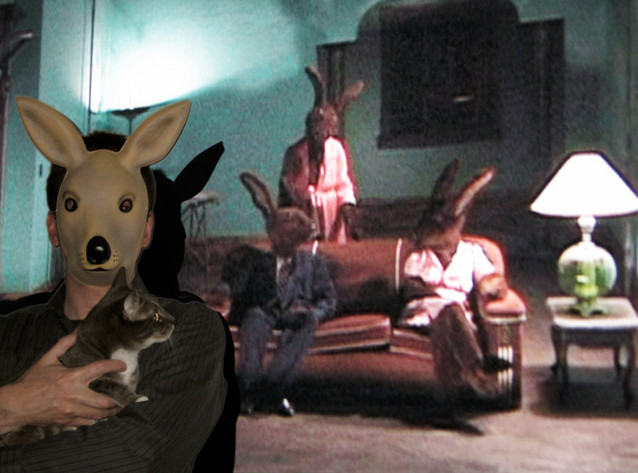
Jonathan quips: There's no stopping Old Man Anthropomorphism.
|
|
From Prof. Oddfellow's sketchbook:
|
|
I felt the eye of the forest staring at me from among cedars, pines, and several species of cypress, all of a green so murky that one perceived it almost as black.
—Kenzaburo Oé, The Silent Cry, translated by John Bester, 1974.
|
Page 3 of 4
> Older Entries...
Original Content Copyright © 2026 by Craig Conley. All rights reserved.
|











 by
by