|
|
 |
|
From our outpost at Blogger, here's an excerpt from Janet Boyer's review of our Magic Words: A Dictionary: The first 48-pages of Magic Words
are utterly fascinating, with Conley an engaging tour guide through
literary, philosophical, cultural and spiritual landscapes—realms
dotted with landmarks that pay homage to the power of magical
utterances (and, sometimes, even to silence and mysterious glyphs).
Not
only does Conley offer examples of poetic incantations and the
mysterious power of words in his introduction, but he also provides
fascinating insight into the vocabulary of ritual (and why we get the
giggles during solemn occasions!), the four archetypes of the Magician,
and our ability to imbue “ordinary” moments with the magic of both
cadence and connation.
The rest of Magic Words is dedicated to, well, magic words!
With
word origins, facts, variations, meanings, mystique and appearances in
literature, this A to Z guide offers a mind-boggling array of
information to be mined by would-be magicians, entertainers, writers
and artists. . . .
Magic Words
is, indeed, a meticulously researched, heavily footnoted, and absorbing
read, especially for lovers of trivia and words. Performers seeking to
spruce up their magic routine would do well to consult this book, as
would all manner of artists who seek to infuse their work with meaning,
mystery, flair or sacredness. See the full review here. Janet is author of The Back in Time Tarot Book.
--- Gary Barwin writes: Those are indeed magic words. Congratulations!
|
|
| Puzzles and Games :: Which is Funnier |
(permalink) |
|
|
|
 What is “more humorous than passionate attempts to invent artificial languages, Volapük, Esperanto and what not, to do the work that the English language is already doing all over the sea, and will, apparently, soon be doing all over the land”?
Clue: What is “more humorous than passionate attempts to invent artificial languages, Volapük, Esperanto and what not, to do the work that the English language is already doing all over the sea, and will, apparently, soon be doing all over the land”?
Clue: This is according to essayist Theodore Watts-Dunton
Answer: Nothing. (The answer is in black text on the black background. Highlight it to view.)
Citation: Ernest Rhys, Modern English Essays (1922), p. 120.
|
|
Certainty #27: "Hold on fast to the only certainty in this world, which is the certainty of Love and Care." —Willa Cather, in a letter to Sarah Wyman Whitman, 1898 |
|
|
|
|
|
"He spoke as if each full sound he uttered was equal to the presence of a new statue in one's courtyard." — Norman Mailer, Ancient Evenings (Highly recommended!)
|
|
There were Saturday mornings when a muddy brown pool was joyous to the test of squatting kids . . . as dewy and mornlike as brown mud water can get, — with its reflected brown taffy clouds —
—Jack Kerouac, Dr. Sax, 1959.
|
|
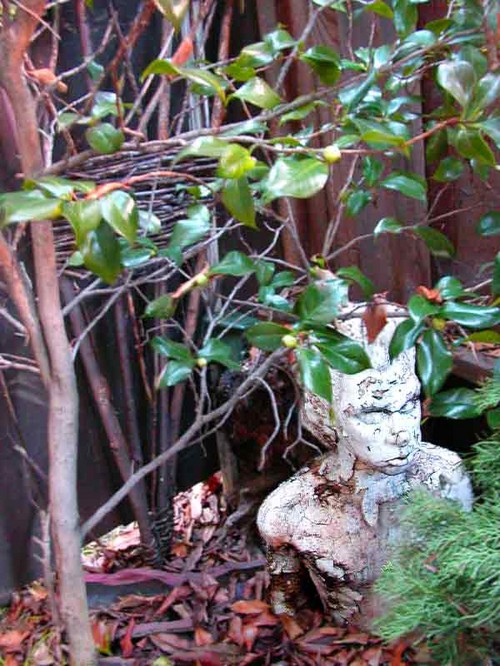
Saint Morass
Patron of the Bog.
|
|
|
|
|
|
| I Found a Penny Today, So Here's a Thought |
(permalink) |
|
|
|

See big version of this photo here. --- Jeff writes: On a cold and snowy morning, nothing says Warm & Gooey like a nap amid floor to ceiling stacks of electronic equipment, especially when they're all about music. Indeed, home is (somebody stop me) where the hertz is. Ahahahahahahaha!
|
|
Certainty #26:
"In modernity the only certainty that seemed to be left was the absence of it."
—Henri Vogt, Between Utopia and Disillusionment, 2004
|
|
| Did You Hear the One I Just Made Up? |
(permalink) |
|
|
|
"Another, who looked like a huge Swede, had empty watery eyes, and a face like a bathtub." — Lauren Gilfillan, I Went to Pit College, 1934

Photo via fffound. --- Jeff writes: Heh. I don't know how you managed to find a photo of uncle Guano. My mother said he'd been eaten by buzzards off the cape of Batmandu, but you can't always trust your mother, or mine.
|
|
The bluish shadows gave the place a ghostly ambiance.
—Dan Brown, Digital Fortress, 2004.
--- Jeff writes: Fast-backward to my first art class, where the guru forced us to gaze without staring at snow shadows, so that we might embrace their True Blueness while giving the snort to fake black, grey, greyish-black, or blackish-grey ones. Yellowish shadows, he said, are permissible, too, sometimes, but not all the time, and only when there are dogs about. Silly guru.
|
|
| Puzzles and Games :: Which is Funnier |
(permalink) |
|
|
|
Which city is funnier: Racine or Oshkosh?
Clue: This is according to comedy t.v. writer Jerry Rannow
Answer: Oshkosh (The answer is in black text on the black background. Highlight it to view.)
Citation: Jerry Rannow, Writing Television Comedy (2004), p. 87.
|
|
|
|
|
|
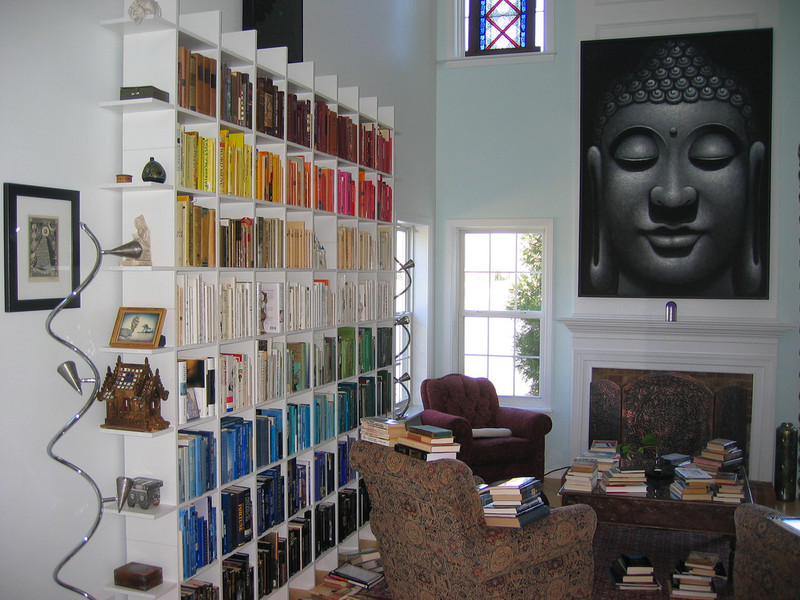
Referring to our bookcase arranged by spine color, the Serif of Nottingblog wrote: "What you've done privileges the unexpected connections between books, between subjects. Despite your blog being 'Abecedarian,' your book organization realizes that knowledge can be organized or accessed via a totally different set of assumptions." |
|
Did you know: "It is not possible to burn a candle at both ends. If one end of the wick is ignited, the other end will immediately be extinguished." Or: "Cardboard is nothing more than wood in an early stage of development." Or: "Cheese never spoils; it simply changes into a different kind of cheese." These and other hilarious facts are part of Dr. Boli's Encyclopedia of Misinformation. |
|
Certainty #25: "The only reality I can possibly know is the world as I perceive and experience it at this moment. The only reality you can possibly know is the world as You perceive and experience it at this moment. And the only certainty is that those perceived realities are different. There are as many 'real worlds' as there are people!" —Carl Rogers, qtd. in Power Partnering by Sean Gadman, 1996 --- Jeff observes: This may be the root of human conflict. The perception is the reality, but everything we think we understand about others is only in terms of what we know about ourselves, which is by no means certain.
It is to hoot.
|
Original Content Copyright © 2026 by Craig Conley. All rights reserved.
|






 by
by