|
|
 |
|
| I Found a Penny Today, So Here's a Thought |
(permalink) |
|
|
|
  by Raf ArtistaHow to Create Sublime ColorsWhat color is so awe-inspiring, so out-of-this-world that it elevates viewers to new heights of wonderment? The quest for the sublime color is as old as pigment and likely older still. Imagine the first humans to witness a majestic sunrise. They’d have had a transcendental experience, in that sublime colors open a window into a realm of grandeur beyond mere human experience. Imagine the first artists experimenting with dyes like alchemists in search of the Philosopher’s Stone, driven to discover the secret of sublime color and to possess the power to turn the ordinary into something extraordinary. Sublime colors are commonly described as being: - incomparably beautiful
- exquisite
- cheerful
- timeless
- soft
- active
- natural (sunrise, clouds, rainbows, mountains, or sea, for example)
- radiant
- sentimental
- magnificent
- glorious
- lofty, divine (in that they foster a spiritual experience)
- shimmering
Ultraviolet and deep indigo are often called sublime, and black more so. Color expert Benjamin Jan Kouwer notes that Western culture once hailed yellow as a sublime color with a favorable symbolic meaning (Colors and Their Character, 1949). Color mixers usually discover sublime beauty by accident, but art teacher Gabriel Boray suggests that artists can hone their sense of the sublime through careful practice. Boray developed a system for sublime color mixing. Through his system, colorists learn to feel when a color is “singing.” Boray instructs the colorist to begin with two complementary colors of the same temperature (such as a warm yellow and a warm ultramarine). “Mix 5 variations between them, from yellow-green to blue-green, paying careful attention to separating them enough to be recognized as a unique variation.” By adding a tiny amount of blue into the yellow, then a bit more, and more again, each variation will be distinct. “After you have 5 clear color variations between those two, create one in between each (there may be many more than one), until you have 10 variations. Now look at those colors. Are they clean and unique? They should be singing. If they aren’t singing, you are to immediately find the correct light to see the variations properly, or rush outside, close your eyes, and take 10 deep breaths while telling yourself you are a master of color! If the colors exist—and an infinite amount of colors exist—then you can identify them.” Boray assures that “When you open your eyes you will see nature as you may never have before. Return to your exercise, choose two more colors and continue. Combine as many pairs of colors, creating 5, then 10, or more variations. Gradually you will begin to feel the changes in your blood. Go outside again and look at something in nature. Make a ring with your thumb and forefinger and look as if through a magnifying glass. See the infinite variations. The same colors you see are available to you for painting. There is no barrier between your mind and your brush.” [Read the entire article in my guest blog at ColourLovers.com.]
|
|
That marvellous landscape of my dream — / Which no eye knows, nor ever will — / At moments, wide awake, I seem / To grasp, and it excites me still. . . .
Blue sheets of water, left and right, / Spread between quays of rose and green, / To the world’s end and out of sight, / And still expanded, though unseen.
Enchanted rivers, those — with jade / And jasper were their banks bedecked; / Enormous mirrors, dazzled, made / Dizzy by all they did reflect.
And many a Ganges, taciturn / And heedless, in the vaulted air, / Poured out of the treasure of its urn / Into a gulf of diamond there.
As architect, it tempted me / To tame the ocean at its source; / And this I did, — I made the sea / Under a jewelled culvert course.
And every colour, even black, / Became prismatic, polished, bright; / The liquid gave its glory back / Mounted in iridescent light.
—Charles Baudelaire (1821–1867), "Parisian Dream," translated by Edna St. Vincent Millay, 1936.
|
|
Piecing together the secret of secrets . . . |
|
|
|
|
|
| Hindpsych: Erstwhile Conjectures by the Sometime Augur of Yore |
(permalink) |
|
|
|
Today's Question: Did Britney Spears shave her head in February 2007?With
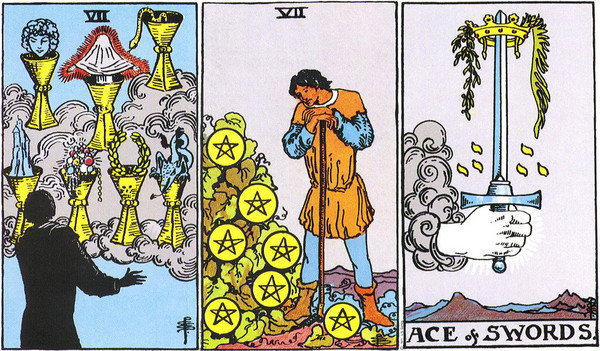
hindpsych, the answer is "yes"! In our Tarot spread, we see an imagination running rampant in the first card, the Seven of Cups. Here are depicted dreams, illusions, and seemingly limitless possibilities, all symbolic of a crazy environment marked by self-indulgence. Note that the person in this card is imagining a full head of hair in the top left cup, followed by the smooth head of a draped figure next to the serpent of temptation. The middle card is the Seven of Pentacles, symbolic of assessing one's status. The figure in this card has reached a milestone and is enjoying the fruits of his labor. This card suggests that Britney has reached a crossroads and is thinking about change. The final card, the Ace of Swords, depicts a blade on a crown, and by extension scissors upon a head. We can say with confidence that Britney shaves her head in 2007,
and we can now move on. |
|
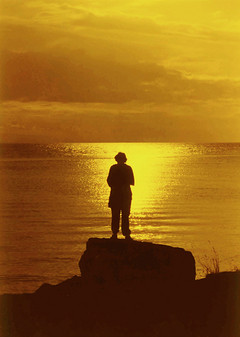
It is now one of those intensely golden sunsets which kindles the whole horizon into one blaze of glory, and makes the water another sky. The lake lay in rosy or golden streaks, save where white- winged vessels glided hither and thither, like so many spirits, and little golden stars twinkled through the glow, and looked down at themselves as they trembled in the water.
—Harriet Beecher Stowe, Uncle Tom’s Cabin, 1852.
|
|
|
|
|
|
"When picking code names for new software versions, generally you want to stay away from anything that implies mythological or 'often mentioned, never seen' status -- users may get the wrong idea. That said, given the long wait that loyal Retrospect users have had for new developments on the Mac side from EMC Insignia (formerly Dantz), I'll forgive the unfortunate choice of 'Unicorn' for the beta of the Retrospect client for Mac ..." —Michael Rose, The Unofficial Apple Weblog. |
|
| Did You Hear the One I Just Made Up? |
(permalink) |
|
|
|
Doctor Who riddles: 1. What's Doctor Who's favorite English rock band? 2. What's Doctor Who's favorite household appliance? 3. What's Doctor Who's favorite American sitcom from the mid-to-late 1980's? 4. What's Doctor Who's favorite American restaurant chain that targets male customers with a serving staff comprising only waitresses? 5. What's Doctor Who's favorite genre of book or film? 6. What's Doctor Who's favorite chocolate-flavored soft drink? 7. What's Doctor Who's favorite improv comedy show? 8. What's Doctor Who's favorite Dr. Seuss story? 9. What's Doctor Who's favorite Australian rock band that combines elements of sixties power-pop, bubblegum pop, Beatle-esque harmonies, psychedelia and grungy garage rock? 10. What's Doctor Who's favorite smoking device? 11. What's Doctor Who's favorite Wham-O toy? 12. What's Doctor Who's favorite Mayan deity? 13. What's Doctor Who's favorite escapologist? (Thanks Ken and Ann!) 14. What's Doctor Who's favorite Spanish crooner? (Thanks Ken and Ann!) 15. What's Doctor Who's favorite glam-rock group? (Thanks Ken and Ann!) 16. What's Doctor Who's favorite Greek chickpea dip (Thanks Ken and Ann!) 17. What's Doctor Who's favorite bootleg liquor? (Thanks Ken and Ann!) Answers: 1. The Who2. A Hoover. 3. " Who's the Boss?" 4. Hooters. 5. the Whodunnit6. Yoo-hoo7. "Whose Line is it Anyway?" 8. Horton Hears a Who!9. Hoodoo Gurus10. A hookah11. the Hula Hoop12. Hunab Ku13. Houdini14. Julio Iglesias15. Mott the Hoople16. Hummus17. Hooch (or in Chinese, Huangjiu)
|
|
Piecing together the secret of the sea . . .
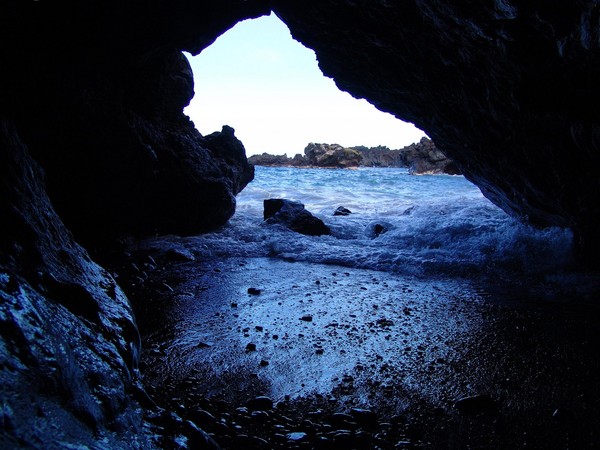
Waianapanapa Secret Sea Cave, Island of Maui. By Rickreh. See large version here.
|
|
|
|
|
|
From A Surrealist Dictionary by J. Karl Bogartte: SOLSTICE: The luminous blue fog surrounding a human body when the mind is elsewhere.
|
|
It was a green sunset. The reds, the oranges, the purples which Amanda automatically associated with sunsets had been snuffed out in the soggy cloud pile, and the nearly invisible sun that sank — beyond the fields, sloughs, rock islands and tide flats — into Puget Sound, it looked like an unripe olive photographed through gauze.
—Tom Robbins, Another Roadside Attraction, 1971.
|
|
|
|
|
|
Come in the evening, or come in the morning; Come when you're looked for, or come without warning; Kisses and welcome you'll find here before you, And the oftener you come here the more I'll adore you! — John Williamson Palmer, Folk Songs (1861) Don't miss the twee pop band Original Silly Pillows, who coincidentally have a song called "Come in the Evening" (hear it on their MySpace page). |
|
| I Found a Penny Today, So Here's a Thought |
(permalink) |
|
|
|
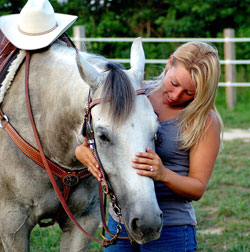
 by superdoveBlonde Pony Tails: The Human-Horse ConnectionHumans have been fascinated by white horses for millennia. Geneticists have now pinpointed the "genetic architecture" that connects blonde manes in people and equines. The study of white horses goes all the way back to ancient Rome, where depigmented horses were identified as "candidus" (white) or "glaucus" (gray). The PLoS Genetics journal notes that two thousand years ago, the white horse was held sacred by the Saxons. It served as an augur for the German tribes, its behavior considered a sign of divine approval or disapproval. The white horse was so revered that it featured on the flags of Lower Saxony and North Rhine-Westphalia. Even earlier, white horses were celebrated by the Celts in Great Britain. The White Horse of Uffington (Oxfordshire, England) is Bronze Age hillside artefact, dating back approximately 3,000 years. The figure of a 374-foot long horse (perhaps representing the Celtic horse goddess Epona) was cut into the soil, its white coat naturally pigmented by the chalk beneath the turf. The PLoS Genetics journal points out that most white horses carry a "graying-with-age mutation." They are born with a solid-colored coat which turns white by age of four to six. However, occasionally a pony is born with a solid white coat. Take, for example, the solid white mare named Cigale, born in 1957 out of solid brown parents from the Swiss Franches-Montagnes Horse population. Geneticists have studied all of Cigale's white-born descendants and isolated an inherited mutation in their pigment forming cells. Different horse populations, such as white Thoroughbreds, Arabians, and Camarillo White Horses, reveal independent pigmentation mutation events. In other words, the white horses in each equine family exhibit their own special brand of mutation leading to their white coats. But the common chromosomal factor appears to be what geneticists call the KIT gene, responsible not only for white horses but also for blonde people. White horses appear in the religious literature of many lands. Here's a small sampling: - In the New Testament's Book of Revelation, one of the four horsemen of the Apocalypse rides a white horse.
- In Japan, the white horse is a Shinto symbol of purity and divine authority.
- In Islam, the Prophet ascended to heaven on the back of a white horse.
- In Hinduism, the god Kalki rides a white horse while brandishing a comet-like sword.
- In Nordic lore, the god Odin rises a white horse named Sleipnir.
- In Greek mythology, the white and winged Pegasus sprang from the blood of Medusa when Perseus decapitated her.
[Read the entire article in my guest blog at ColourLovers.com.]
|
|
|
|
|
|
"When the smoke from the fire seeps in through the nostrils, irritates the throat, and stings the eyes, we shut out the world of burning text, unable to remember what letterforms once lived on those sheets curling into ash." — Geof Huth
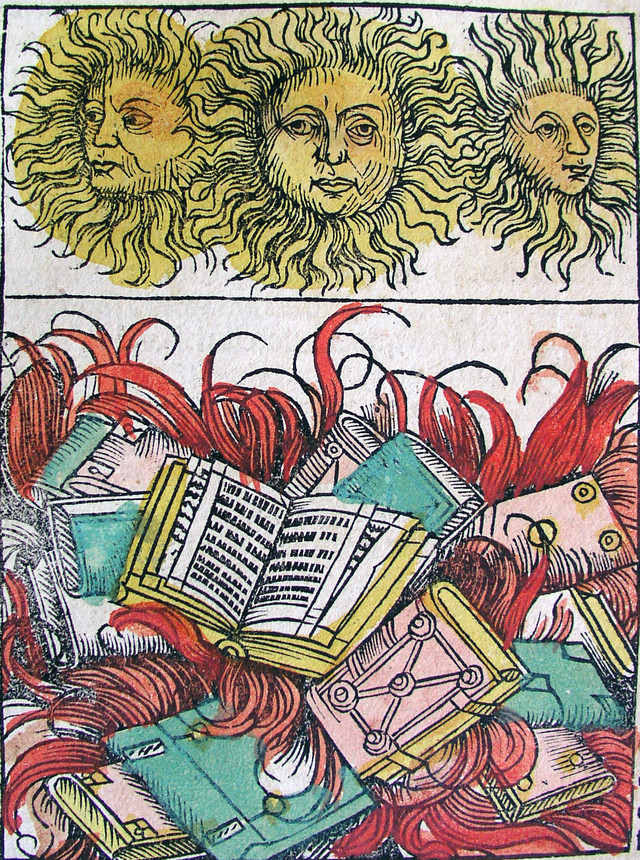
Suns & Book Burning, from Hartmann Schedel, ‘Nuremberg Chronicle’ (1493), XCIIv. Via.
|
|
I sit on a purple bed, / Outside, the wall is red, / Thereby the apple hangs, / And the wasp, caught by the fangs, . . .
Gold wings across the sea! / Moonlight from tree to tree, / Sweet hair laid on my knee, / O, sweet knight, come to me!
—William Morris, "Golden Wings," 1858.
|
|
|
|
|
|
From Prof. Oddfellow's sketchbook:

The writings of J. Karl Bogartte are available here.
|
|
Piecing together the secret of the scarab . . . |
Page 2 of 4
> Older Entries...
Original Content Copyright © 2026 by Craig Conley. All rights reserved.
|






 by
by