Found 383 posts tagged ‘map’ |
|
Restoring the Lost Sense –
January 9, 2016 |
(permalink) |
|
 |
|
|
|
|
|
Uncharted Territories –
October 9, 2015 |
(permalink) |
|
|
|
|
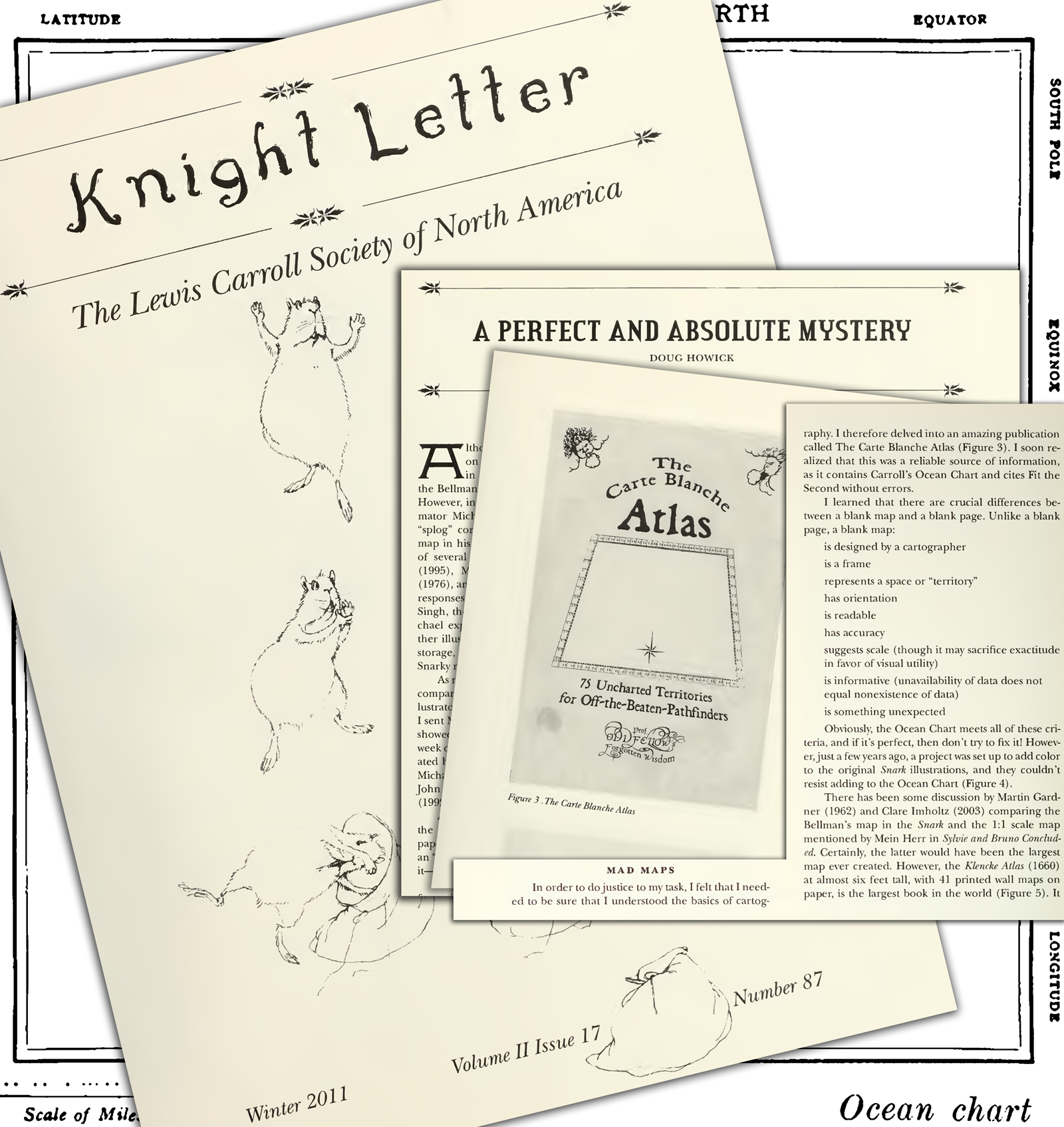
Scholar Doug Howick has pondered the mysterious dots in the Scale of Miles on the blank map in Lewis Carroll's The Hunting of the Snark. Howick writes, "The sequence of dots on the scale has always intrigued me. The original has a '22132' arrangement, but I have been unable to make anything of that. I've also wondered whether it was a message in Morse code, which had been invented by Samuel Morse in 1844. If so, it would spell 'IIESI,' which doesn't make any sense to me either." We might suggest that the dots are "blind spots" indicating the "forgetfulness of antecedent spatial configurations," the "discrepancies and approximations" which cannot be obliterated (as per José Rabasa's critical reading of Mercator's 17th-century Atlas). And/or, the scholar of silliness and its metaphysics, Nina Lyon, writes of how a place inevitably becomes a metaphor, " an elastic description of its describable characteristics as required to illustrate a point plucked from the mind's ether." She writes about how the bumps of a terrain's anatomy become apparent "only with movement" as one repositions oneself in time and space so as to perceive "the multiplicity of it. The many bits of detail, those many geographical features marked out in contour lines and dots of scree on maps, all unfold from the single furrowed surface of the earth upon which your feet continue to move, with slow determined pace. ... The features exist for as long as you can see them, and then you keep on moving and they fall back into where they were before, into the mass again. What seem to be individual entities all fall back into one thing in the end. They are merely attributes of it. The one is ontologically prior to the many." Yes.
|
|
|
Uncharted Territories –
October 6, 2015 |
(permalink) |
|
|
|
|
The artist of this blank map, David Waywell (a.k.a. Stan Madeley), admits that " some people might say that it's a bit obscene." Almost by way of apology, he notes "how much skill was involved in drawing licorice with white ink."
|
|
|
Uncharted Territories –
October 5, 2015 |
(permalink) |
|
|
|
|
|
|
|
|
|
|
|
Here's a precursor to the pushpin marker in Google Maps, from Millsaps College's Bobashela yearbook, 1905. (For some unbelievably weird yearbook imagery, see our How to Hoodoo Hack a Yearbook.)
|
|
|
This May Surprise You –
March 30, 2015 |
(permalink) |
|
|
|
|
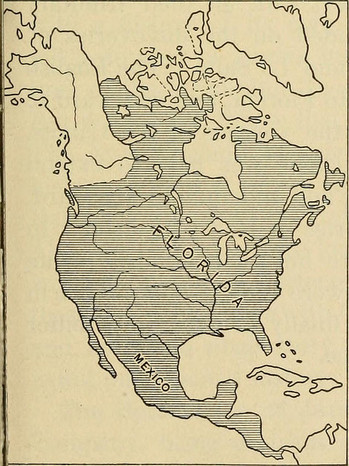
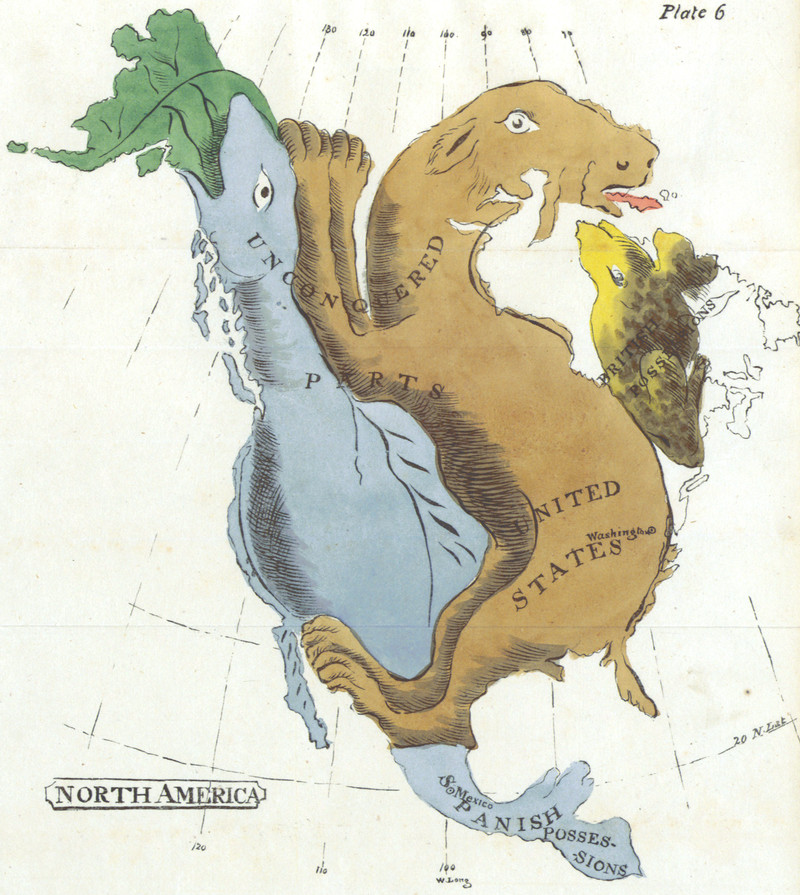
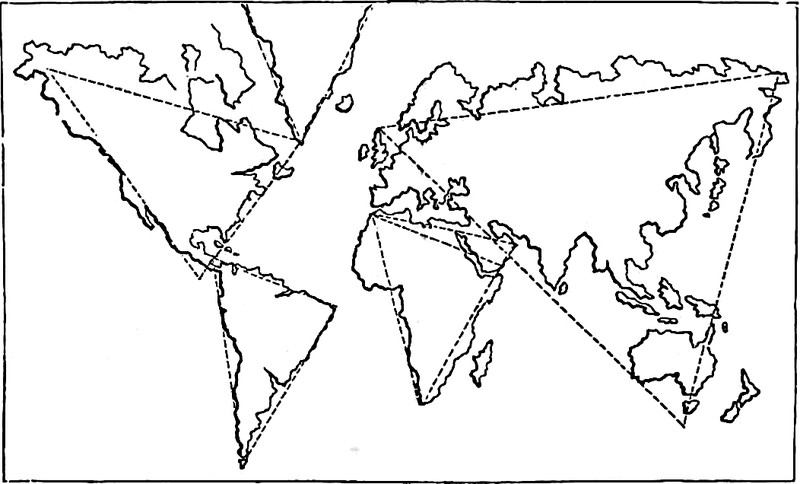
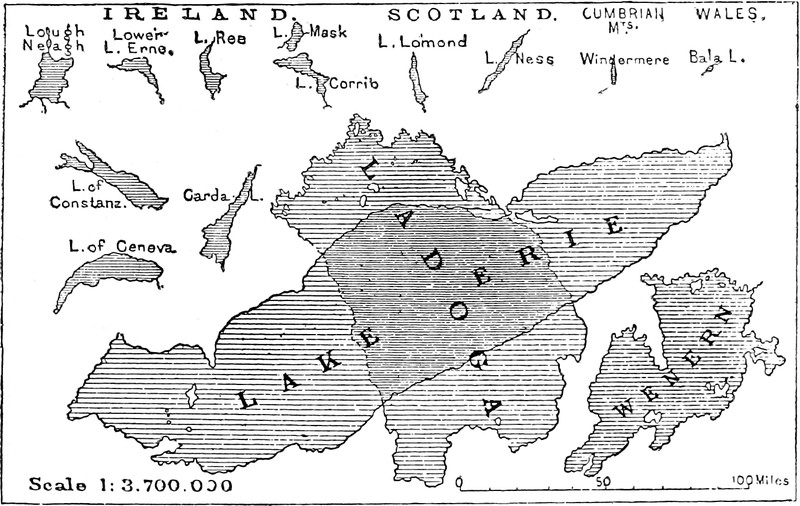
As we see in this vintage map, Florida once occupied most of North America. But one could also make an argument that most of North America was once Scotland, just as absurdist playwright N. F. Simpson has argued that the Mediterranean could technically fall under Scottish law:
Lawyer: It would be enough to show that it [the Mediterranean] is in what — for the present purposes — can be deemed to be Scotland, and here we might usefully explore the possibility that Scotland, as we know it, may not always have occupied the precise position north of the border that it is commonly thought of as occupying today. We are assisted here by the known fact that the general configuration of the Earth's surface, such as it is, was not arrived at overnight. It is the end product of a not unlengthy process involving widespread upheaval over a period of several millennia, during the course of which things were in a considerable state of flux ... and it should not be difficult to demonstrate as an a priori possibility that Scotland — or what was subsequently to become known as Scotland — might, in one of the remoter periods of geological time, have occupied, however fleetingly, and prior to making its journey northwards to the position on the map that it has occupied ever since, [the Mediterranean]. If so, there would be a strong prima facie case for a reappraisal of the whole situation with a view to bringing the whole matter fairly and squarely within the jurisdiction of the Scottish courts.... Senior: Sounds promising. Minister: Yes — I think one could give voice to a tentative eureka there.
|
Page 18 of 20
> Older Entries...
Original Content Copyright © 2026 by Craig Conley. All rights reserved.
|