CRAIG CONLEY (Prof. Oddfellow) is recognized by Encarta as “America’s most creative and diligent scholar of letters, words and punctuation.” He has been called a “language fanatic” by Page Six gossip columnist Cindy Adams, a “cult hero” by Publisher’s Weekly, a “monk for the modern age” by George Parker, and “a true Renaissance man of the modern era, diving headfirst into comprehensive, open-minded study of realms obscured or merely obscure” by Clint Marsh. An eccentric scholar, Conley’s ideas are often decades ahead of their time. He invented the concept of the “virtual pet” in 1980, fifteen years before the debut of the popular “Tamagotchi” in Japan. His virtual pet, actually a rare flower, still thrives and has reached an incomprehensible size. Conley’s website is OneLetterWords.com.
We're honored that VJ Bat (a.k.a. the electro-goth industrual pioneer Xorcist) debuted on his live Twitch show our clockwork remix of Michael Ash Sharbaugh's "Fog Rise Echo." To create his 8-bit light show overlay, VJ Bat has in the studio an Apple 2e computer with special hardware that listens to the room during the set and displays the waveform of the music on the side of the screen. In the dead center of the screen is a live feed from his Atari C-240 Color Light Organ decoding the audio signal. Surrounding that is his Radio Shack Color Computer II with a Music Kaleidoscope hardware cart also decoding the audio feed. Both the Atari and Radio Shack video feeds are combined by a Gefen video mixer. All 3 of these feeds are then sent to a separate computer that has a 4xHDMI PCIe input card and OBS where the APPLE 2e feed is layered. The whole mess is then sent to his VJ laptop, which streams as an NDI source while Bat performs.
Thanks to Michael Ash Sharbaugh, who said: "I am blessed, Gents! Thanks! It is soooooo great! You gentlemen have outdone yourselves: the video is spooky, comical at times, and well orchestrated and planned out. I am humbled, and appreciate it!" Here's the video of Neons Gone Mad's clockwork remix of "Fog Rise Echo":
5 stars. Another excellent offering from one of the giants of Magick & Mysticism writing in English today, Professor Oddfellow, brings us a humorous and yet wise and tempered practical guide to Sorcery both ancient and modern and fresh! As always, the Good Professor reaches back in time to make the Wisdom of the Ages accessible to modern readers in a way unique and yet as American as a Mark Twain short story. That isn't to say that an individual from anywhere else in the world wouldn't understand or like this fine book, but to say there is a breezy, almost casual style with which our Sage Professor takes complex ideas and practices and makes them easy for the layman or Neophyte to grasp. Professor Oddfellow has outlined here a neat system of Magick and Mystical thought that could stand alone, or be added to the accomplished Wizard's repertoire for a Greater understanding of The Hidden Mysteries of Life and also the complexities of the English Language, which the Good Professor uses with a graceful ease that soothes and awes the reader. So, whether you are a Neophyte, yet to enter the Ancient Halls of Knowledge, a seasoned Magi ready to add to your vast understanding of the intricacies of the Universe, or just a man amongst men (or woman among women, or just a person among people, as thou wilt) the book will thrill you with interesting excercises, wow you with new perspectives, and keep you coming back for more! So, three cheers for The Good Professor and his Book of Wizardry, Wonders, and Wise Words! —Holy Mountaineer
Delightful to see our The Young Wizard's Hexopedia in the mirror world, under the light of a fireball, courtesy of the Holy Mountaineer, who says: "In which the protagonist burns away certain impurities, including the hair on his right hand, in celebration of the Great Work of one Professor Oddfellow, famous Sorcerer, Electronic Musician, Expounder of Ancient Mysticism, and Wise Sage to the Lawless, Wild Interweb."
Fortune telling with invisible dice, and why everybody's goat looks better than mine: it's Prof. Oddfellow's Penetralia.
We're honored that film critic Grumpy Andrew said: "So much to enjoy here. Hands down one of my favourite Penetralias. Two genuine laughs out loud (which I don't tend to do in real life, only on text, lol) - a song which spoke to me - and a fortune telling. A meal for the mind in five minutes!"
And Pilfering Apples wrote: "Thank you for introducing me to surely the most effective means of fortune-telling yet devised! As always , your approach to the mysteries of life is unequalled. Thank you also for the introduction to the finest of goat society! While I noted many familiar faces, there were even more delightful new acquaintances. Always a joy!"
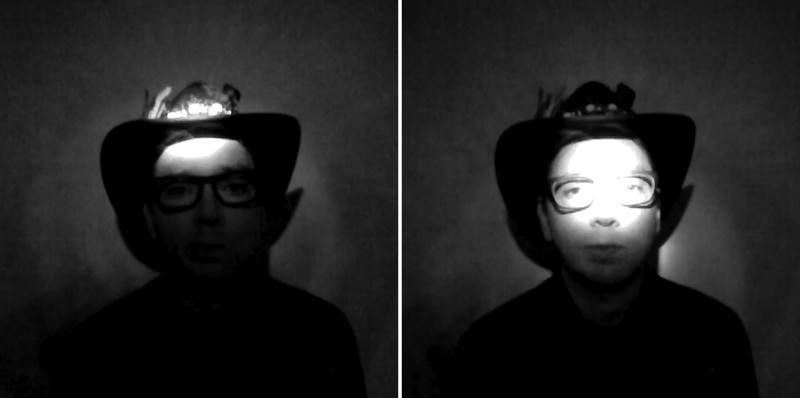
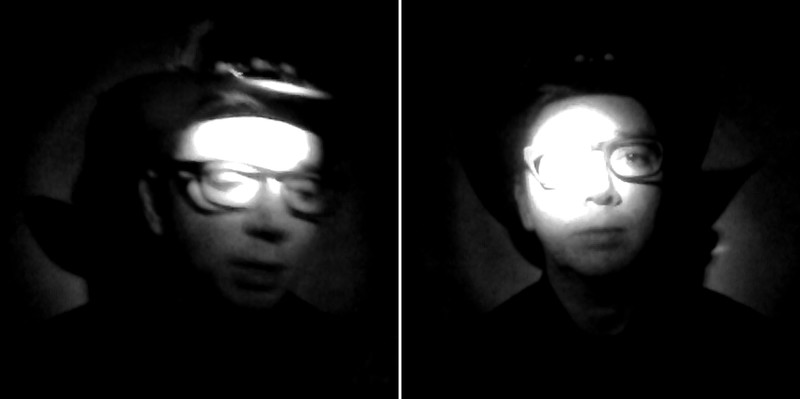
In this One Odd Minute, not only do we show how we use an etheric transducer to recharge our fedora, but we also reveal our secret to looking amazing at 5,000+ years old.
DJing music from a parallel universe: the spirit radio connected to a haunted grandfather clock picked up an alternate version of "Cross Purposes" by Silly Pillows.
KlingonCaptain kindly asked, "So... When is the album coming out?" That brings up another question: what would such an album be titled? A band in England once asked me for weird words for album names, but they ended up not taking any of my suggestions. (Sad.) I suggested Eellogofusciouhipoppokunurious (meaning "very good," from a slang dictionary of the 1930s), Pentadecylparatolylketone (the chemical composition of limelight), Poluphlosboiothalasses (from Punch magazine, 1859 ... I don't recall what it means), and "Hysterico Vaporous Hypo Megrins" (a fictional diagnosis for a condition in which one is unstuck in time; the patient is lost to the present even as the future and the past loom up before his half-closed eyes. This phrase appears in a poem entitled "Heroic Treatment," by a certain G.A.K., printed in Harper's, Aug. 1887).
Lord Entourage wrote: "It was fun looking up the original song's lyrics and comparing them to this version from a parallel universe. As Ornam Rotem said, 'Different worlds can overlap and interact and they need not have well defined boundaries. Works of art can be considered as worlds, as can genres or whole media. Worlds can be imaginary or imagined.'"
Is an electro-spectre a ghost who haunts currents of charged particles? It’s also the name of a Norwegian band who invited me to transmogrify a new song through my haunted clockwork for an album of remixes. I could hardly believe the sounds that came out when I attached the spirit radio to the grandfather clock via a strand of cobweb. Don’t ask me how that even works — I’m just rolling with it myself! You might recall from a previous episode that the clock face has inexplicably been pulled backwards, beyond the back of the cabinet, and a ghostly face floats within. All I know is that it transmogrifies better music now. I wonder if I can tune into the clockwork version of Electro Spectre’s song, to find out if you agree how astonishing it is.
It's the cover version that left the band Vaylon utterly speechless: "Numb" by Neons Gone Mad:
A brief explanation of how we approached recording a cover of “Numb” by the Danish band Vaylon: we hear the line “As I walk along the shore” to be the key, because the songwriter is in a timeless moment as he reflects upon his past, his regrets, his addictions, his disgraces. His mind, as he walks, is outside of time — he’s in a sort of “eternity” of the soul. And that makes the shore, perhaps, like the River Styx, for the songwriter is at a threshold or liminal zone, trying to separate himself from the chains of the past. He is tied down by his habits, not really able to progress or to find a new freedom. He is so full of doubts bottled inside him that he can’t fully detach from his old life. And so we hear these lyrics as describing a state of existence described in the Tibetan Book of the Dead, in which a soul finds himself in the in-between existence of “the Bardo.” Because the songwriter keeps trudging forward against the wind, we made the chorus #2 and chorus #3 more and more far-away, more and more ghostly, as if a fading signal on Tesla's spirit radio. The songwriter ever walks along the shore and finally leaves the listener behind. The listener inevitably loses the songwriter, but the songwriter surely finds eventually himself. We created the rhythm out of clockwork sounds, to symbolize the relentlessness of time. Even in limbo, the seconds click away for the songwriter with each step he takes down the shore.
In the music video we created for the cover version, two paranormal investigators are trying to tune into a frequency to make contact with that distant shoreline. By the end of the song, when the singer has finally drifted into the mysterious ethers, the investigators realize that Vaylon was never there (meant to be something of a joke, in that this wasn’t Vaylon’s original recording but rather a cover version; plus, some folks will recognize it as a quotation from the David Lynch film Fire Walk With Me, when David Bowie makes a cameo appearance but doesn’t show up on the security cameras because “he was never here.”)
We should note that we changed only two words, “being social” to “hollow seashells” … the seashells being a hint at the shore mentioned in the chorus, as well as literally being Tibetan horns (further tying into the Tibetan Book of the Dead). Don't miss the original track: vaylon.bandcamp.com/track/numb