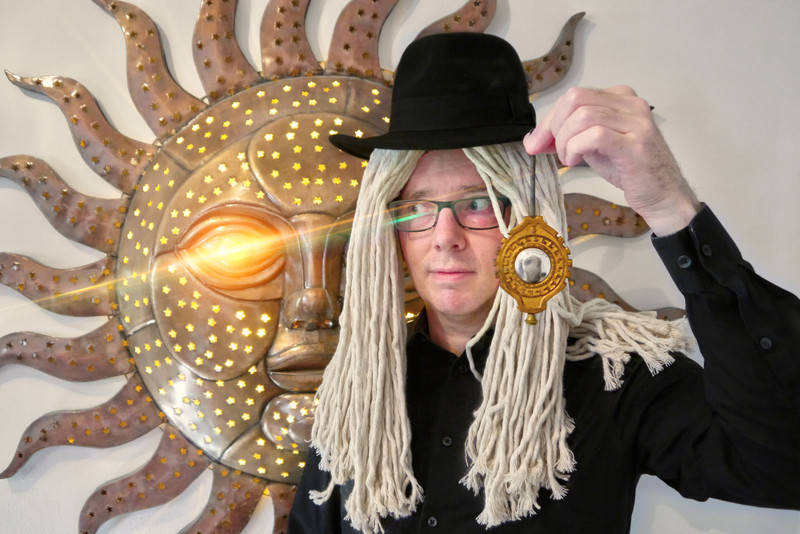
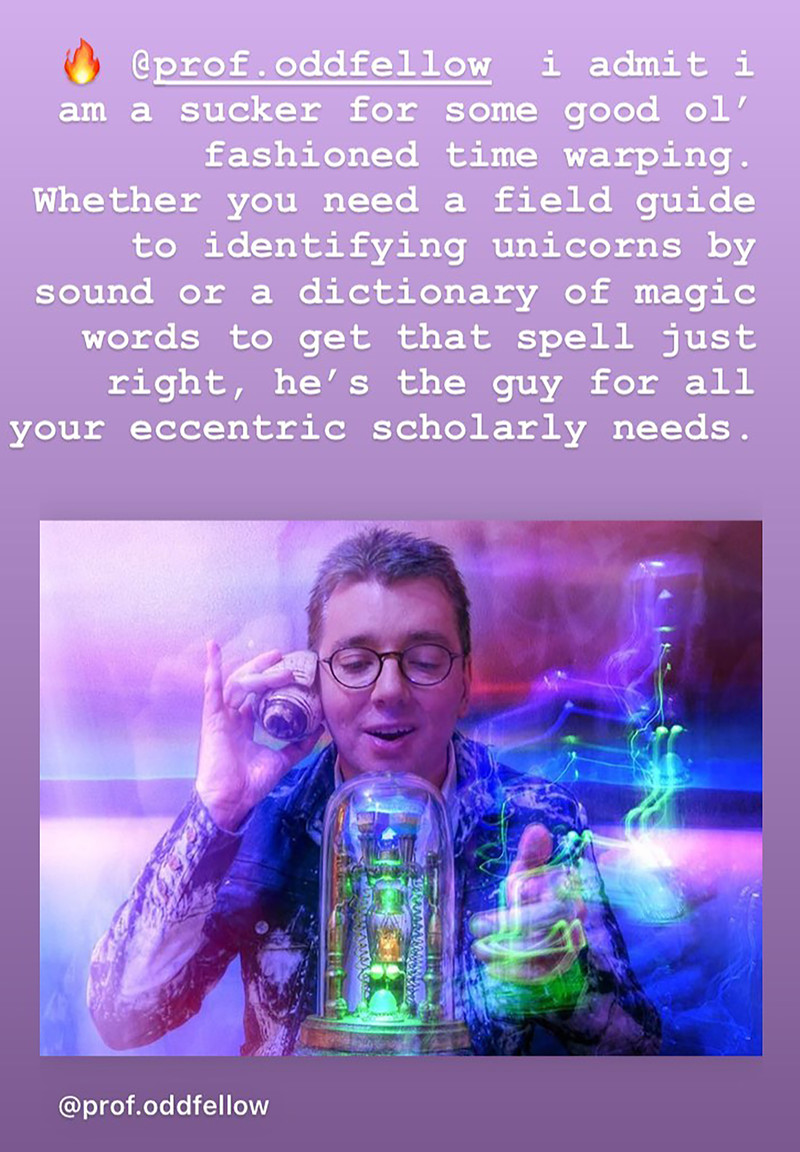
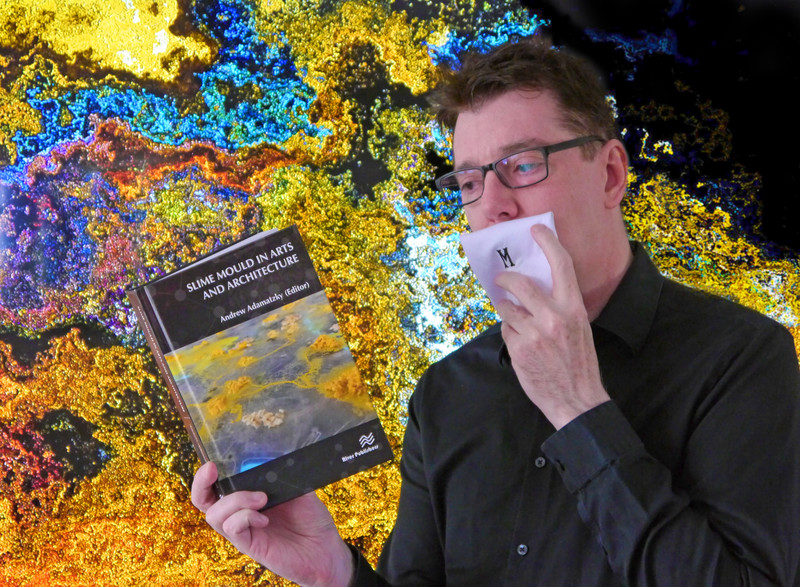
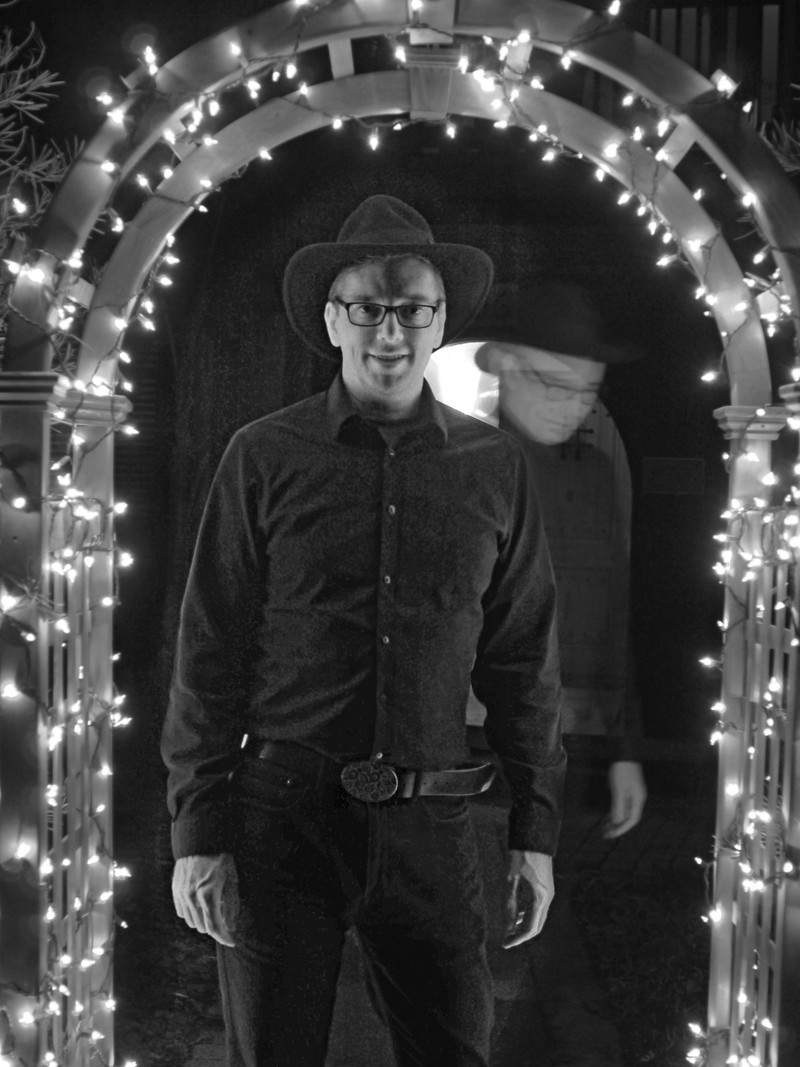
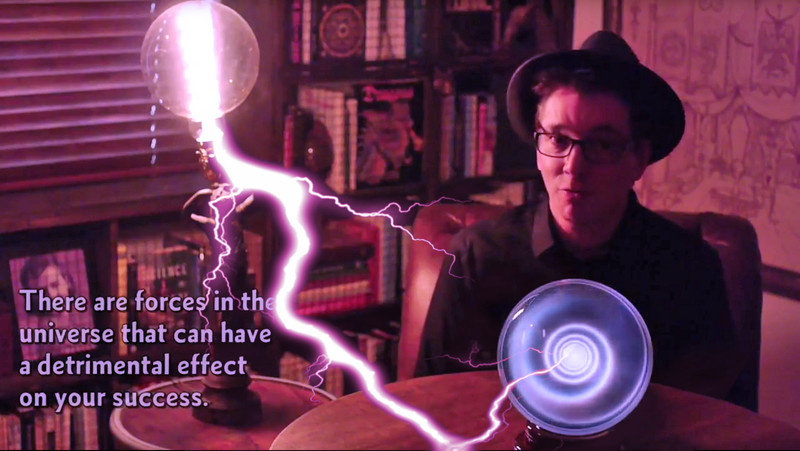
CRAIG CONLEY (Prof. Oddfellow) is recognized by Encarta as “America’s most creative and diligent scholar of letters, words and punctuation.” He has been called a “language fanatic” by Page Six gossip columnist Cindy Adams, a “cult hero” by Publisher’s Weekly, a “monk for the modern age” by George Parker, and “a true Renaissance man of the modern era, diving headfirst into comprehensive, open-minded study of realms obscured or merely obscure” by Clint Marsh. An eccentric scholar, Conley’s ideas are often decades ahead of their time. He invented the concept of the “virtual pet” in 1980, fifteen years before the debut of the popular “Tamagotchi” in Japan. His virtual pet, actually a rare flower, still thrives and has reached an incomprehensible size. Conley’s website is OneLetterWords.com.
"The sea is a cruel mistress. Yet again the sea has behaved unconscionably. It's time to address this terrible problem that is the sea." —Captain Neddie, from the hilarious BBC series Broken News
"You want to go into the desert and learn higher magic, nebbich, when you … cannot distinguish a Hall of Riddles from the real world and do not even suspect that the books of life contain something other than what is written on the spine?" —Gustav Meyrink, The Green Face
Thanks to Jaybee for letting us know: "Your last video really, REALLY helped me. I was in tears. Seriously. I struggle with that. Very. Thing. A lot. But your video helped me remember that I’m not here to win a popularity contest."
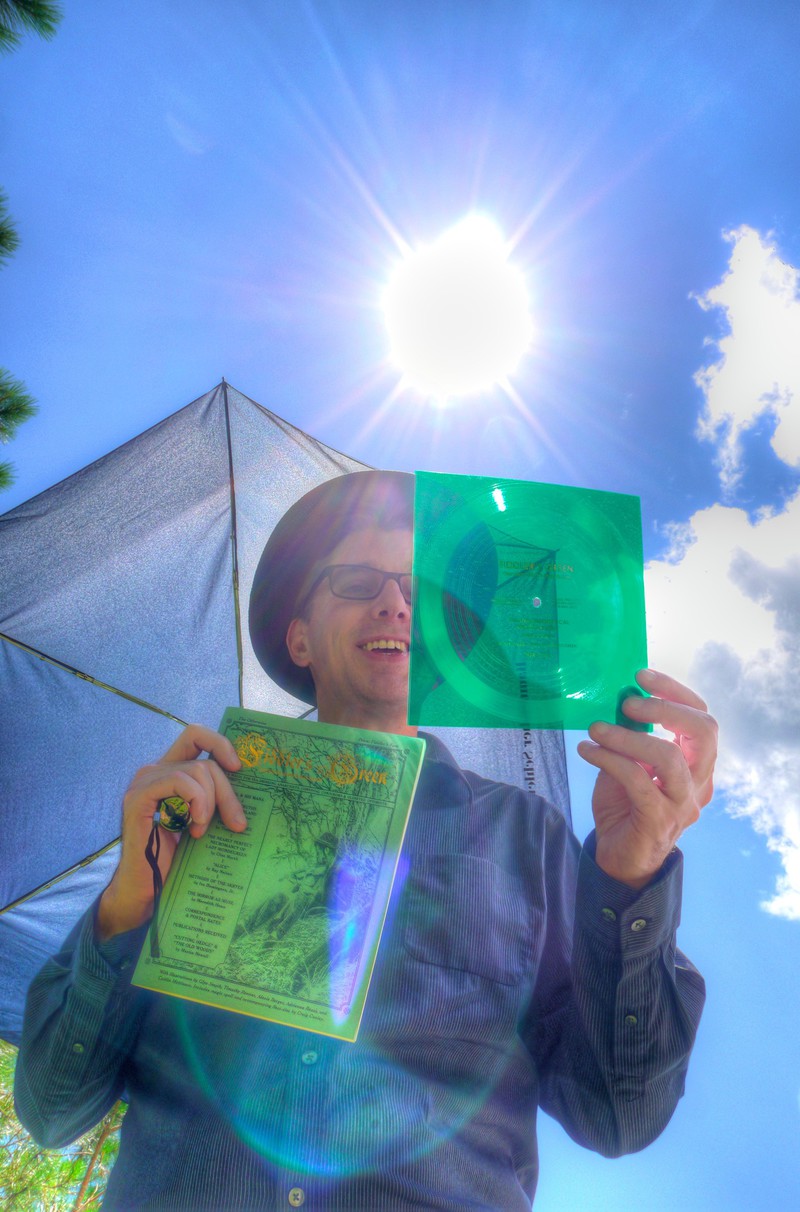
Having already seen the world through rose-colored glasses, we're now enjoying the view through lurid Jello-green flexi-discs! The grass is definitely greener on the flip side! We're celebrating the Retroactive Lifetime Goal of having our voice recorded onto a lurid Jello-O green flexi-disc in the new issue of Fiddler's Green magazine!
"[W]henever I closed my eyes, the letters of the alphabet shifted around like Scrabble pieces and formed words. Those words lined up and soon I imagined entire pages of writing so clearly that I could actually read them, sentence after sentence, as if I were reading straight from a book. A book I had written, with my name on the cover ..." —Jack Gantos
Here's 59 seconds on how to make a physical reality of your imagination:
Mindful attention was the meditative practice of Portuguese philosopher Fernando Pessoa. His technique empowered him to make a physical reality of his imagination, through what he called a great act of intellectual magic. His Book of Disquietdemonstrates exactly how to do that, entertainingly. Pessoa kept notes on what happened around him, from a sudden thunderclap to what the office boy just said, and he allowed every occurrence to inform and illustrate his personal philosophy, that we can sift out what parts of reality are illusions and which illusions have reality, and that we can prevent any act from being in vain so as to conserve energy. Depending upon how you look at it, Pessoa said, anything can be either astonishing or an obstacle. His secret was to look at each thing that happened differently every time, as a way of renewing and multiplying it. He said a contemplative soul who never left his village could in this way have the entire universe at his disposal. Pessoa's meditation was a magical act of transformation. I'm Prof. Oddfellow.
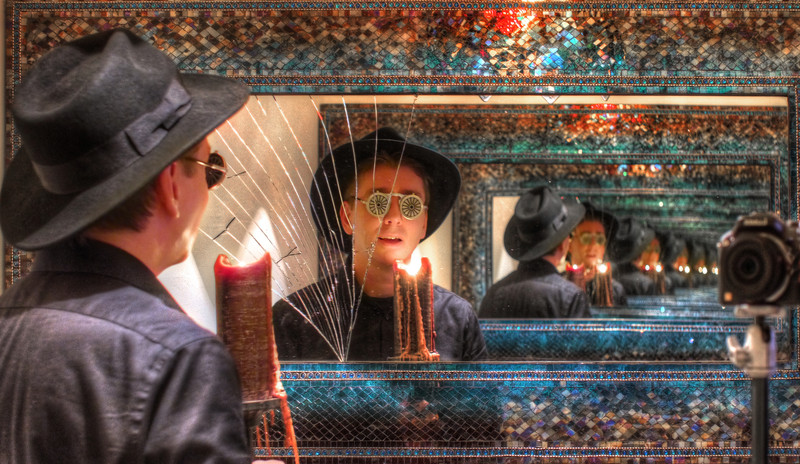
We peeked into the haunted mirror and gained a pupil. (They say that when the teacher is ready, the pupil will appear.) See our haunted mirror in action in our video about a lucid waking experiment gone wrong.
"There at last he was free and forever from those halls hung with enigmas, tapestried with tears, before which the sphinx in fight gallops like a jackal." The final line in The Ghost Girl by Edgar Saltus, 1922.
Eerily, this passage seems to describe our very own sanctum!
Revealed at last: our actual age, as well as how to use a spooky old mirror to test whether you're dreaming or awake. We didn't know how this video would end ... until we posed a question to the mirror and then had to face the uncanny answer.
If you like our video, please leave a thumb-up so we know. It's lonely out here in cyberspace!
Jim writes: "Definitely by far your very best video yet... it's hysterical... it leaves you completely baffled at the end... posted it on Facebook."
Marja writes: "I can see this over and over and over. Your story, the way you tell it, leads me away from all the ordinary things. Love the non-ending. Grace Jones might not be impressed. I am. Thank you."
J writes: "So entertaining! The 'lucid waking' premise is terrific, and I LOVE the concept of your appearing only in stained-glass lighting (and, of course, carrying the windows around!!). And then the way the hilarious recursiveness paradigm morphs into a salad bar, hahahaha! (Oh, and you're really rocking the fedora, by the way.) Bravo!!"
George writes: "What a f#$#%$g treat this clip was!! Loved the sliding in and out of reality both in script and video. Great structure leading us in, adding the glitches that woke us up, creating the shock of a non-mirrored reflection except for the ?, and then diving into what that means and leaving us with a haunting last image. Brilliant!"
G writes: "Oh my! The visual and SFX in this are great! Loved the little echoes and jumps; timed perfectly. The mirror writing was unexpected and fun, and the ¿ definition was the perfect ending (complete with old school incremental zoom steps on your shocked face!). I love that you’re getting some good mileage out of the haunted mirror, and I enjoyed using it to reflect the window, which of course is symmetrical, so it nicely foreshadowed the ending. Oh, and finally, the title of the video on YouTube is, of course, so up-to-date. I laughed out loud and how well, sadly, it fits into the moment. Thanks, I enjoyed it! A good way to start the new year."
We had been wondering whether 2018 will be any easier than 2017 was. Because we'd found ourselves in some sort of subterranean dimension these past two years, we used a deck of cards from the U.K. with sections of dungeon maps (inkedadventures.com) to find out how one can navigate the labyrinths of the coming year. Thankfully, there's good news, which we explain in this video.
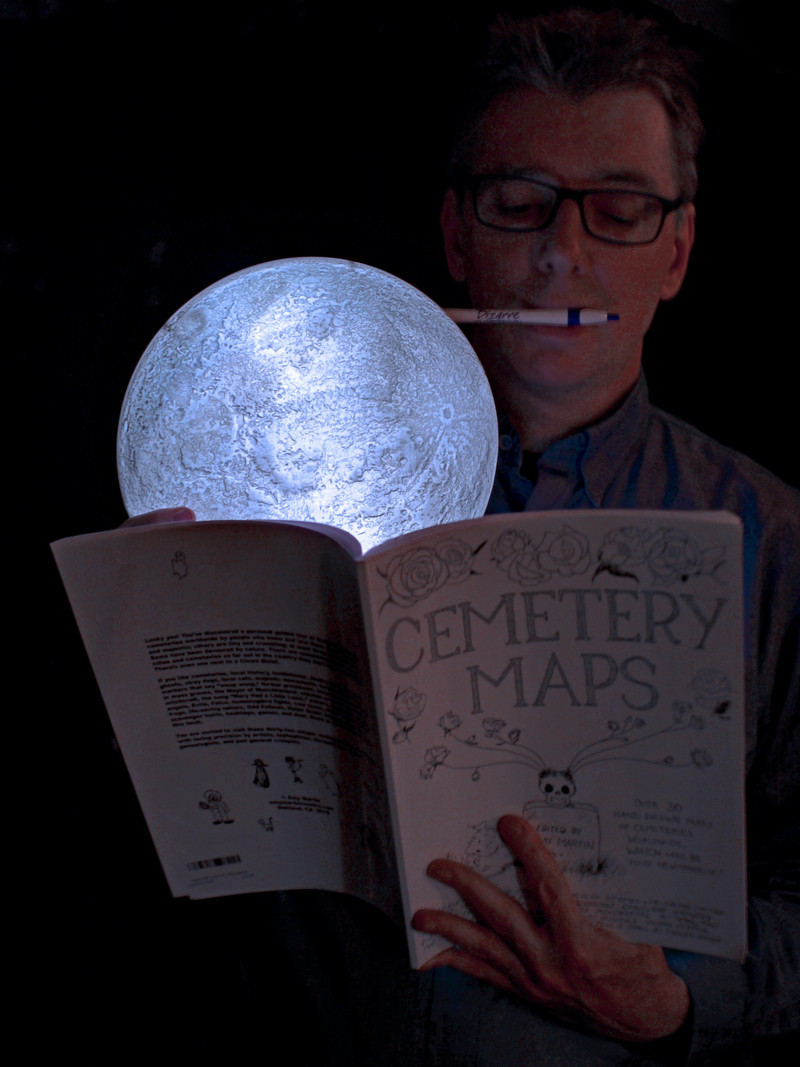
Quimby's Bookstore NYC knows that some books are best lit by a cloven-footed lamp. Owner Steven Svymbersky writes: "Just got in a fine selection of the esoteric and amusing books by Prof. Oddfellow. Special."
In the second photo, our display table is on the right.
This fine indie bookstore welcomes heart-clicks over at Instagram:
If there's a skull lock and you forgot your skeleton key, try working a beam of light into the mechanism. Recall how "She springs a light, / Unlocks the door" (Dryden). Similarly, "Morning with its key of light / Unlocks the dusky portals of the night" (Albert Laighton, Poems, 1878). And "My light unlocks the stalls, / two dozen and one windows open— / all, except the window of the moon, / already painted on as shining" (Jane Shore, Eye Level, 1977).
Here are cut-out paper spectacles for seeing more than is readily apparent in any book. They're from ourMachinarium Verbosus: A Curiosity Cabinet of Gadgets To Transform Any Book & Reader, To Be Sure. But please note that Machinarium Verbosus is a book for the few—the very few. If it's important to one's psychological well-being that the machinations of the Universe be neat and tidy and wholly comprehensible by the human mind, then absolutely do not proceed with this book's experiments. Let this constitute a very serious warning: do not take these experiments lightly, as any one of them may induce an existential crisis.
Cut out and don these transformative specs before you read. (Wear them along with your prescription glasses, if necessary.) Reading offers "new lenses for seeing [one]self and the world in different ways. Reading transforms [oneself]" (Jeffrey Wilhelm, Action Strategies For Deepening Comprehension, 2002).
Why symbolic glasses? Symbols invite us "to see more than is readily apparent, to intuit something other than the obvious" (Krzysztof Kieslowski).
"You can learn to keep the lenses of your symbolic glasses fairly free of the dust of ignorance, the grease spots of prejudice, the grime of hatred and fear. You can learn to bend and stretch the frames if they don't fit comfortably; but you can never take the glasses off" (Lew Sarett, Basic Principles of Speech, 1958).