CRAIG CONLEY (Prof. Oddfellow) is recognized by Encarta as “America’s most creative and diligent scholar of letters, words and punctuation.” He has been called a “language fanatic” by Page Six gossip columnist Cindy Adams, a “cult hero” by Publisher’s Weekly, a “monk for the modern age” by George Parker, and “a true Renaissance man of the modern era, diving headfirst into comprehensive, open-minded study of realms obscured or merely obscure” by Clint Marsh. An eccentric scholar, Conley’s ideas are often decades ahead of their time. He invented the concept of the “virtual pet” in 1980, fifteen years before the debut of the popular “Tamagotchi” in Japan. His virtual pet, actually a rare flower, still thrives and has reached an incomprehensible size. Conley’s website is OneLetterWords.com.



Can particular colors affect a student's performance on exams? Color expert Mark D. Fairchild says yes. He cites recent research establishing an "aversion" response to the color red. "If people are exposed to red just before taking an exam they perform slightly less well than if they were exposed to a different color. The cause of this aversion response is not yet known; it could be learned or it could be something intrinsic that causes us to 'fear' red (just a little). This has also been found in sporting events where athletes dressed in red tended to be more successful . . . perhaps because their opponents were viewing it and having an aversion response (rather than the red having an effect on the athlete wearing it)."
Colin Wilson, an investigator of mysteries, offers a reasonable explanation for the red-aversion phenomenon. "Psychological tests have shows that when subjects are exposed to bright red, blood pressure increases and the heartbeat speeds up. (Exposure to green causes a drop in blood pressure; the same is true of dark blue.) . . . This is largely explainable in perfectly ordinary terms. Green soothes us because it is the color of nature. . . . Red excites because it is the color of blood and therefore of violence. Blue has a subduing effect because it is the color of nightfall. This has always been so, since animals first developed color vision" (Mysteries, 2006).
Prof. Fairchild concurs that color most certainly plays a large role in one's emotional life, though the effects are inconsistent. "The effects (both the type and strength) are very individual. A color that makes me feel happy or energized might make you feel sad or tired. There are various reasons for these responses, but essentially they are learned from either cultural practices or significant individual events. There is a lot of misinformation on this topic. A good book for more information is Faber Birren's Color and Human Response."
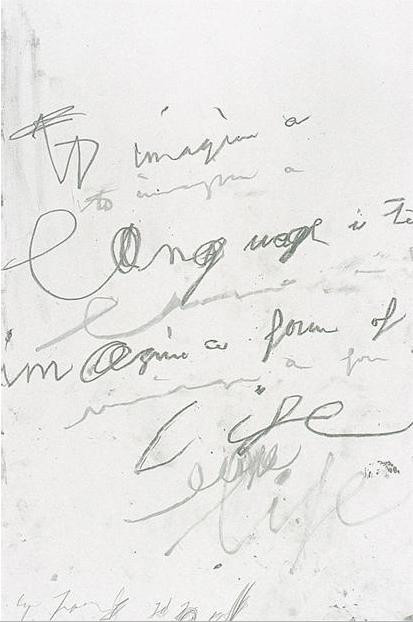
"Language is civilization itself. The Word, even the most contradictory word, binds us together. Wordlessness isolates." —Thomas Mann, The Magic Mountain, translated by John E. Woods.
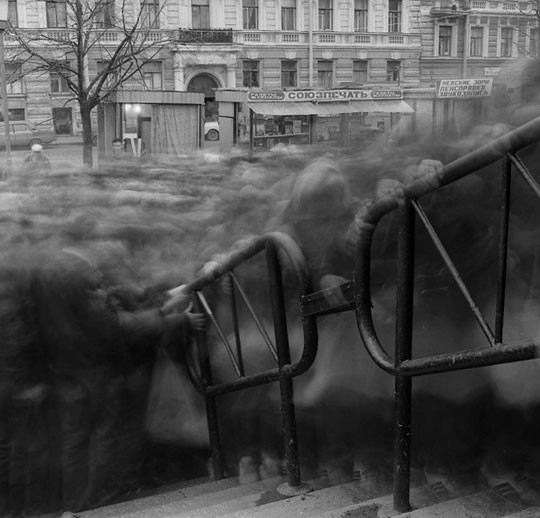
"In a cloud of people, we humans still can easily recognise and then be attentive to the voice of a particular person(s) we know." —Tetsuya Hoya, Artificial Mind System
In a discussion of a poem composed via a Ouija Board, we learned that two mediums took dictation in a red dining room, and then a poet edited the transcripts in an adjoining blue room, "supplementing the uppercase text of the dead with his own lowercase commentary." We were beguiled by that phrase, "the uppercase text of the dead." It conjures images of ancient Roman script chiseled into marble.
---
J quips:
Why are they shouting? It must just be high spirits.
Don't miss our extensive interview over at Musings from a Muddy Island, in which we reveal all sorts of hidden, half-hidden, and quarter-hidden secrets, arcane details, and latent possibilities.