|
|
 |
|
| I Found a Penny Today, So Here's a Thought |
(permalink) |
|
|
|
  by pootjThe Search for Silent ColorsWe all know garishly loud colors when we see them. Typically in the range of red, orange, and yellow, loud colors are unwelcome in business attire, unless one's business happens to be the circus. And we all know quiet colors by their instant calming effect. The quiet range of blue, green, and violet is beloved by home designers. But what of silent colors? If they exist, would we find them in cloistered monasteries, or hushed libraries, or ruined castles? The American ornithologist Roger Tory Peterson found a "sea of silent colors" when he tearfully witnessed the grandeur of the Grand Canyon for the first time. He reported a vivid array of silent reds, yellows, grays, and lavenders ( Wild America, 1997).  by davidanthonyporterThe poet A. F. Moritz found silent colors within the curves of a white seashell. He described a "diminished spectrum" of "shades of milk" ("You, Whoever You Are," Early Poems, 1983). The naturalist Timothy Duane found "the silent colors of winter" blanketing the Sierra mountain chain ( Shaping the Sierra, 2000). When feminist activist Ginny Foat found herself incarcerated, she discovered silent grays, blacks, and greens in the steel and cinder blocks of her cell ( Never Guilty, Never Free, 1985). [Read the entire article in my guest blog at ColourLovers.com.]
|
|
|
|
|
|
"He was a many-faceted man who combined the unlikely qualities of both daring adventurer and scholar." —Mary Lovell, A Rage to Live
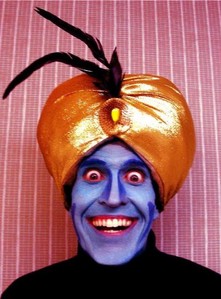
----- Jonathan responds: I followed a trail to find the context for this image. I thought it was going to be a 1960s Batman episode, in which "Diamond Head" and his gang knock over Tiffanelbow & Co.
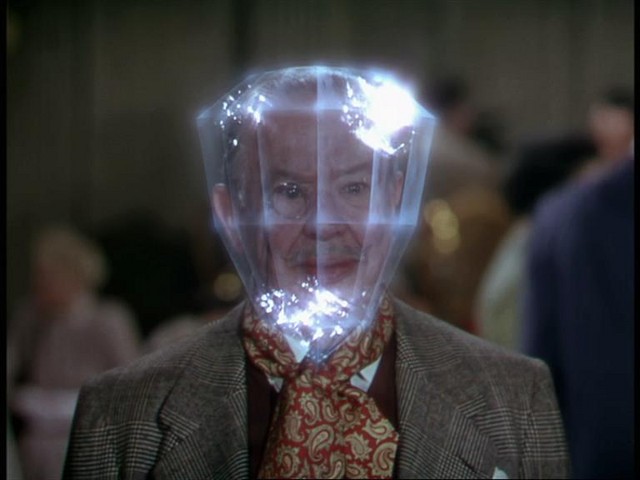
See full size photo here.
|
|
Her evening gown was of an ivory- colored taffeta. The billowing skirt did justice to the effect of the stiff, cold, voluminous taffeta, on which the grain of shifting light flowed and opened up its quiet, silver, dead, long, slender eyes. Color was provided by a cattleya pinned to her bodice. The faint yellow, pink, and purple velum, surrounded by violet petals, imparted the coquetry and shyness peculiar to members of the orchid family. From her necklace of little Indian nuts strung on a yellow gold chain, from her loose lavender elbow- length gloves, from the orchid on her bodice, the fresh odor of perfume like the air after a rain wafted its charms.
—Yukio Mishima, Forbidden Colors, 1953. Translated from the Japanese by Alfred H. Marks, 1968.
|
|
|
|
|
|
The "Spirit of the Game"(an Abecedarian guest blog for DeepFun.com) Without the spirit of the game,
what would the game be?
—Nevin H. Gibson,
The Encyclopedia of Golf
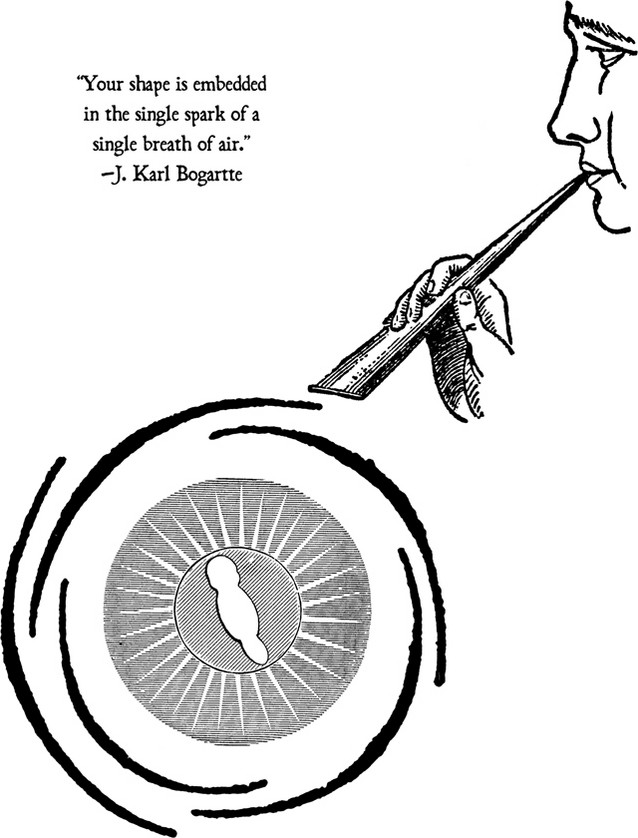
Arabian folklore tells of a wish-granting genie imprisoned in an oil lamp or bottle. Might players innocently conjure such a spirit in a game of spin-the-bottle? Indeed, every game has a motivating force at the heart of it -- its own sort of soul. Whatever we might call it -- essence, atmosphere, intention, or ethos -- it's that special spark that distinguishes the game from all others. Like a genie of folklore, the Spirit of the Game grants good sports a wish -- the ultimate wish. (We'll get to that in a moment.) The Spirit of the Game is not necessarily spelled out in the rules. Indeed, "There are situations in which adherence to the so-called letter of the rules can be taken to violate the spirit of the game."[1] The Spirit of the Game is a distillation of the intent of the rules. It has been called "a self-regulating set of norms without which some games would degenerate into anarchy."[2] It is a frame of mind, not a commandment carved in stone. It's a point of view, a sense of humor, a strength of character. Novelist Richard Le Gallienne summed it up perfectly: "To be whimsical, therefore, in pursuit of a whim, fanciful in the chase of a fancy, is surely but to maintain the spirit of the game."[3] Because it is typically undefined, the Spirit of the Game can be abused. Unsportsmanlike conduct (like taunting and intimidation) is one indication of abuse; bringing the game into disrepute is another.[4] When honored across the board, the Spirit of the Game turns opponents into equals. Most importantly, it engenders fun. While camaraderie is jolly and competition is stimulating, "the real spirit of the game is all about having fun."[5] Though each game has its own unique Spirit, there are some universal characteristics. The Spirit of the Game is: • even-tempered • self-possessed, yet unselfish • levelheaded • well-balanced • untroubled • either easygoing or animated • motivated • spontaneous • committed • earnest • disciplined • wholehearted • courteous • honorable • responsible • idealistic Ultimately, the Spirit of the Game "is the only thing in the game which is lasting."[6] Corporate trainer Julius E. Eitington makes an interesting observation: when players become caught up in the Spirit of the Game, they "become themselves."[7] What is one's true self, but that of a player on the grand game board of life? Edward Clark Marsh once described being enlivened by the Spirit of the Game: "If it was not for a moment real life, it at least made you wish it were."[8] Other signs that the Spirit of the Game is present include: • both sides wish each other good luck • both sides cheer one another (winning or losing is secondary; the game itself is a victory for all [9]) • everyone plays fair (no cheating, no bending of the rules) • players celebrate the game's tradition, safeguard its precedent, and carry on its legacy • players supervise themselves. Game scientist Andrew Thornton notes that "There is no agreed upon definition of the Spirit of the Game, but there is a pervasive sense that one should play by it. The Spirit of the Game is the Police" inside each player's head.[10] But we've neglected the quintessential sign that the Spirit of the Game is present. And that's when the ultimate wish is granted: the firing shot that sets play into motion. When the game is afoot, all else is inconsequential! Fun Facts about the Spirit of the Game: • In Ultimate Frisbee, where there are no referees and no penalties, the Spirit of the Game is the underlying philosophy. "The Ultimate player will always praise and support successful actions on both teams. It is a normal thing to introduce yourself to the opponent at the beginning of every point and to wish him a good game. And after the game both teams stand in a circle talking about the game and singing a song for the opponent team. So it is a lot more than just a short handshake after a game."[11] • The Spirit of the Game comes into play "before the game has even begun."[12] • "Soccer is unique among sports in that the official's job is first and foremost to maintain the spirit of the game as well as the safety of all concerned; this concern outweighs all other laws of the game."[13] • The Spirit of the Game of soccer has been traced back to the early to mid nineteenth century, when the game developed from its folk roots into its modern form.[14] • The Spirit of the Game of curling "demands good sportsmanship, kindly feeling, and honourable conduct."[15] • The Fighting Spirit of the Game of American football is persistently aggressive in nature: "Throughout the history of football, the violent spirit of the game has endured, even as other elements of the game have changed."[16] • The Spirit of the Game of lacrosse "is a feeling of honor and dignity."[17] • The Spirit of the Game reminds players that not everything is a matter of life and death, that consequences are temporary, and that results are not critical.[6] • The Spirit of the Game teaches players to "accept success with grace and failure with restraint."[18] • The Spirit of the Game of golf is characterized by disciplined conduct, courtesy, and sportsmanship at all times.[19] [1] Allan C. Hutchinson, It's All in the Game, 2000, p. 195. [2] Lincoln Allison, Amateurism in Sport, 2001, p. 161. [3] The Quest of the Golden Girl, 1897, p. 35. [4] William John Morgan, Ethics in Sport, 2007, p. 126. [5] Richard Carlson, The Don't Sweat Guide to Golf, 2002, p. 205. [6] Division for Girls' and Women's Sports, Sports Programs for College Women, June 21-27, 1969, p. 23. [7] The Winning Trainer, 2001, p. 142. [8] "Anthony Hope's 'Sophy of Kravonia,'" The Bookman, 1907, p. 381. [9] Modris Eksteins, Rites of Spring, 2000, p. 124. [10] Belinda Wheaton, ed., Understanding Lifestyle Sport, 2004, p. 187. [11] Jorg Bahl, Ultimate Frisbee, 2007, p. 4. [12] John Byl, Co-Ed Recreational Games, 2002, p. 205. [13] Andy Caruso, Soccer Coaching, 1996, p. 29. [14] Sharon Colwell, "The 'Letter' and the 'Spirit': Football Laws and Refereeing in the Twenty-First Century," The Future of Football, 2000, p. 201. [15] Gary Belsky & Neil Fine, 23 Ways to Get to First Base, 2007, p. 209. [16] William D. Dean, The American Spiritual Culture, 2002, p. 148. [17] Steve Bristol, quoted in Our Game: The Character and Culture of Lacrosse by John M. Yeager, 2005, p. 79. [18] Hubert Vogelsinger, The Challenge of Soccer, 1973, p. 274. [19] United States Golf Association, Golf Rules Illustrated, 2004, p. 4.
|
|
Piecing together the secret of serenity . . . |
|
From Prof. Oddfellow's sketchbook:
|
|
Mr. Wonka was standing all alone just inside the open gates of the factory. / And what an exraordinary little man he was! / He had a black top hat on his head. / He wore a tail coat made of a beautiful plum- colored velvet. / His trousers were bottle green. / His gloves were pearly gray. / And in one hand he carried a fine gold- topped walking cane. / Covering his chin, there was a small neat pointed black beard — a goatee. And his eyes — his eyes were most marvelously bright. They seemed to be sparkling and twinkling at you all the time.
—Roald Dahl, Charlie and the Chocolate Factory, 1964.
|
|
| I Found a Penny Today, So Here's a Thought |
(permalink) |
|
|
|
The best place to learn long division is at a multiplication table. |
|
|
|
|
|
Information Prose :: A Manifesto in 47 Points :: Version 1.0
by Jeremy P. Bushnell, jeremy@invisible-city.com
26.
Our daily thoughts appear whole only within contexts which run deep and
often go unthought: were anyone to inspect the running ticker of our
mental dialogue, much of it would seem to be fragments. Writing which
purports to be interested in the complexity of other human beings must
reflect this.
27. Incorporating uncited or decontextualized
fragments and samples into a creative work brings a certain level of
noise into the signal. This admittedly runs the risk of creating
confusion in the mind of the audience.
28. The initial
communication of new information always creates some confusion. But
that confusion indicates promise to certain recipients.
29.
There is no evidence that what audiences want most from a creative work
is the clear transmission of simple information. Audiences will accept
high levels of noise in a creative work if the creative work is
achieving other effects or satisfying other needs.
30. "[We
take] the text, with its unreliable transmission of information, to be
a component of a larger system, that of cultural circulation, in which
what seemed like a dysfunction at a first level of communication would
turn out to be a positive element contributing to the complexity of the
larger system." —William Paulson, The Noise of Culture
31. To
remove it from a creative context for a moment, consider: one reason
meeting new people is appealing is because they may know things that
you don’t know, or they may understand things in a different way from
you. The process of communicating with someone who thinks differently
from you (because their thoughts are defined by different contexts)
carries with it a necessary degree of noise, but the process of
translating that noise into new meaning can be immensely rewarding,
intellectually, emotionally, and creatively.
32. "[Disorder and
noise] can become information to us, can bring us to more subtle forms
of understanding, because it is the unexpected, the radically different
to which we can respond only because we are already complex beings
capable of yet more complexity." —William Paulson, The Noise of Culture
33.
Experiencing characters in a work of fiction should be rewarding in
that same fashion. Reducing the noise in the signal simplifies out
human difference for the sake of accessibility and creates work that is
pleasant but does not bring us to new understanding.
34.
Information prose writers must write for an audience that finds noise
and its attendant uncertainty stimulating. Much contemporary writing
neglects them.
35. "[Young people] are more tolerant of being
out of control, more tolerant of that exploratory phase where the rules
don’t all make sense and few goals have been clearly defined. The hard
work of tomorrow’s interactive design will be to explore that tolerance
— that suspension of control — in ways that enlighten us." —Steven
Johnson
36. Currently, the writers doing the most work towards some of information prose’s goals are hypertext writers.
37.
Hypertext writers are not necessarily information prose writers, and
not all information prose writers will seek to be hypertext writers,
but hypertext has merits that should be considered by writers of
information prose.
38. Some hypertexts consist solely of
navigable webs of interlinked fragments. Some information prose writers
may find this approach fruitful. But hypertextuality need not be
incompatible with more traditional narrative. Utilizing hypertext does
not mean that writers need to relinquish the many obvious merits of a
linear story; the comfort of a prescribed order, of a beginning,
middle, and end.
(to be continued)
|
|
Piecing together the secret of self-recognition . . . |
|
|
|
|
|
| I Found a Penny Today, So Here's a Thought |
(permalink) |
|
|
|
 by Raf ArtistaHow to Create Sublime ColorsWhat color is so awe-inspiring, so out-of-this-world that it elevates viewers to new heights of wonderment? The quest for the sublime color is as old as pigment and likely older still. Imagine the first humans to witness a majestic sunrise. They’d have had a transcendental experience, in that sublime colors open a window into a realm of grandeur beyond mere human experience. Imagine the first artists experimenting with dyes like alchemists in search of the Philosopher’s Stone, driven to discover the secret of sublime color and to possess the power to turn the ordinary into something extraordinary. Sublime colors are commonly described as being: - incomparably beautiful
- exquisite
- cheerful
- timeless
- soft
- active
- natural (sunrise, clouds, rainbows, mountains, or sea, for example)
- radiant
- sentimental
- magnificent
- glorious
- lofty, divine (in that they foster a spiritual experience)
- shimmering
Ultraviolet and deep indigo are often called sublime, and black more so. Color expert Benjamin Jan Kouwer notes that Western culture once hailed yellow as a sublime color with a favorable symbolic meaning (Colors and Their Character, 1949). Color mixers usually discover sublime beauty by accident, but art teacher Gabriel Boray suggests that artists can hone their sense of the sublime through careful practice. Boray developed a system for sublime color mixing. Through his system, colorists learn to feel when a color is “singing.” Boray instructs the colorist to begin with two complementary colors of the same temperature (such as a warm yellow and a warm ultramarine). “Mix 5 variations between them, from yellow-green to blue-green, paying careful attention to separating them enough to be recognized as a unique variation.” By adding a tiny amount of blue into the yellow, then a bit more, and more again, each variation will be distinct. “After you have 5 clear color variations between those two, create one in between each (there may be many more than one), until you have 10 variations. Now look at those colors. Are they clean and unique? They should be singing. If they aren’t singing, you are to immediately find the correct light to see the variations properly, or rush outside, close your eyes, and take 10 deep breaths while telling yourself you are a master of color! If the colors exist—and an infinite amount of colors exist—then you can identify them.” Boray assures that “When you open your eyes you will see nature as you may never have before. Return to your exercise, choose two more colors and continue. Combine as many pairs of colors, creating 5, then 10, or more variations. Gradually you will begin to feel the changes in your blood. Go outside again and look at something in nature. Make a ring with your thumb and forefinger and look as if through a magnifying glass. See the infinite variations. The same colors you see are available to you for painting. There is no barrier between your mind and your brush.” [Read the entire article in my guest blog at ColourLovers.com.]
|
|
That marvellous landscape of my dream — / Which no eye knows, nor ever will — / At moments, wide awake, I seem / To grasp, and it excites me still. . . .
Blue sheets of water, left and right, / Spread between quays of rose and green, / To the world’s end and out of sight, / And still expanded, though unseen.
Enchanted rivers, those — with jade / And jasper were their banks bedecked; / Enormous mirrors, dazzled, made / Dizzy by all they did reflect.
And many a Ganges, taciturn / And heedless, in the vaulted air, / Poured out of the treasure of its urn / Into a gulf of diamond there.
As architect, it tempted me / To tame the ocean at its source; / And this I did, — I made the sea / Under a jewelled culvert course.
And every colour, even black, / Became prismatic, polished, bright; / The liquid gave its glory back / Mounted in iridescent light.
—Charles Baudelaire (1821–1867), "Parisian Dream," translated by Edna St. Vincent Millay, 1936.
|
|
Piecing together the secret of secrets . . . |
|
|
|
|
|
| Hindpsych: Erstwhile Conjectures by the Sometime Augur of Yore |
(permalink) |
|
|
|
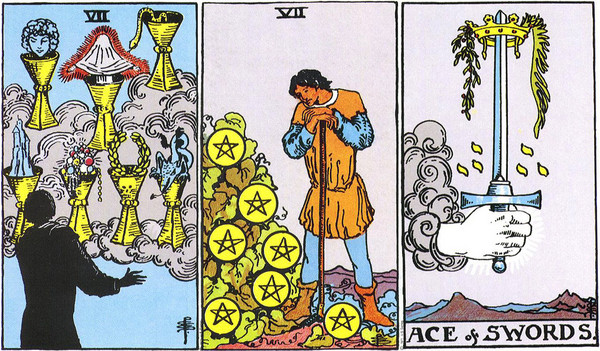
Today's Question: Did Britney Spears shave her head in February 2007?With
hindpsych, the answer is "yes"! In our Tarot spread, we see an imagination running rampant in the first card, the Seven of Cups. Here are depicted dreams, illusions, and seemingly limitless possibilities, all symbolic of a crazy environment marked by self-indulgence. Note that the person in this card is imagining a full head of hair in the top left cup, followed by the smooth head of a draped figure next to the serpent of temptation. The middle card is the Seven of Pentacles, symbolic of assessing one's status. The figure in this card has reached a milestone and is enjoying the fruits of his labor. This card suggests that Britney has reached a crossroads and is thinking about change. The final card, the Ace of Swords, depicts a blade on a crown, and by extension scissors upon a head. We can say with confidence that Britney shaves her head in 2007,
and we can now move on. |
Page 4277 of 4337
Original Content Copyright © 2026 by Craig Conley. All rights reserved.
|






 by