|
From Prof. Oddfellow's sketchbook:
|
|
|
|
| Puzzles and Games :: Letter Grids |
(permalink) |
|
|
|

This puzzle grid contains several big words. Can you find them?
• 7-letter words: 17
• 8-letter words: 2
• 9-letter words: 2
• 10-letter words: 1
All letters in the word must touch (in any direction), and no square may be reused.
Click to display solutions
|
| 7-letter words: |
• coagent
• cognise
• congoes
• contend
• content
• dieting
• dingoes
• dinting
• dotting |
• fitting
• integer
• jetting
• jingoes
• setting
• sitting
• teasing
• tinting |
| 8-letter words: |
| • agenting |
• knitting |
| 9-letter words: |
| • incognito |
• recognise |
| 10-letter words: |
| • reknitting |
|
|
|
“The One Y’ See Ain’t the One Y’ Get”—Carl Safina, Song For the Blue Ocean (1999)
|
|
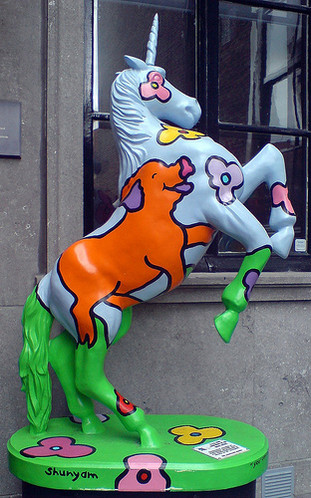
One of many unicorns in Hoorn, The Netherlands. The city is celebrating its 650th birthday in 2007, and the unicorn features on its coat of arms. Photo by FlickrDelusions.
Some unicorns are real pigs.
|
|
Piecing together the secret of letters . . . |
|
|
|
|
|
| I Found a Penny Today, So Here's a Thought |
(permalink) |
|
|
|
  by nalilo. No Name ColorsWe are the nameless colors. No mere words can encapsulate our radiance. We are questions without easy answers. We are puzzles for the sake of enigma. We are the cats that get your tongue, leaving you speechless in our wake. We are anonymous yet individual, handleless yet graspable, inscrutable yet deep. Would a color by any other name look as sweet? We are the nameless colors--the only colors truly beyond description. Art expert Joseph H. Krause notes that "In the English language, there are fewer than thirty words whose major function is to designate a specific color. These include auburn, azure, brown, black, blue, cerise, crimson, cyan, dun, ecru, gray, green, indigo, khaki, maroon, mauve, puce, purple, red, russet, scarlet, sepia, taupe, ultramarine, white, and yellow—they are all defined in the dictionary as either a specific location on the spectrum or with the phrase 'as having the color of' or 'being the color' followed by the names of objects bearing the color. . . . "There are also colors that are named after specific objects—animals, vegetables, or minerals; their names, having been in use for a long time, have come to be regarded, when used in the proper context, primarily as colors. Within this group are such names as beige, buff, lavender, lilac, orange, pink, sienna, umber, rust, turquoise, silver, gold, emerald, sapphire, and fawn. And some of these names have lost their original meaning and now stand for the color alone. However, even with this list, the number of color names remains fairly small. Therefore we use a variety of linguistic devices to extend it. - Combining names for a single color that has two hue qualities, e.g., yellow-green, blue-violet, yellow-orange
- Limiting names by the use of a modifier denoting lightness, e.g., dark blue, dark red, light red, light blue, light green
- Limiting names by the use of a modifier referring to the degree of color saturation, e.g., dull red, bright red, dull green, bright green
- Adding the suffix ish, e.g., yellowish, greenish, reddish
- Using such descriptive adjectives as mellow, harsh, garish, or subtle
[Read the entire article in my guest blog at ColourLovers.com.]
|
|
|
|
|
|
| I Found a Penny Today, So Here's a Thought |
(permalink) |
|
|
|
 by Jonathan AssinkThe Electrifying Colors of CandlelightWarm, romantic, rich, enlivening, homey, flattering to the complexion, prayerful, even mysterious and mystical—there's nothing quite like the atmospheric glow of candlelight. Though typically classified as yellow or golden, a flickering candle flame actually exhibits all the colors of the rainbow. A touch of candlelight can offer emotional appeal, a festive air, or a seductive sparkle to virtually any color palette. According to Celtic lore, candlelight is the only illumination hospitable to shadow. "The ideal light to befriend the darkness, it gently opens up caverns in the darkness and prompts the imagination into activity. The candle allows the darkness to keep its secrets. There is shadow and color within every candle flame" (Anam Cara, A Book of Celtic Wisdom, 1997). A candle flame is composed of four distinct layers, visible to the naked eye. Each layer is a distinct color: white, light yellow, dark red (or brown or orange), and blue. At the base is a relatively cool blue layer (800° C), where the material of the burning candle is in contact with oxygen. A dark red cone surrounds the wick. Of low temperature (1000° C), this cone is formed of vaporized carbon molecules. Around the dark cone is a brighter layer of incandescent carbon (1200° C), light yellow in color. A thin outer envelope of hot white light (1400° C) is faintly luminous and tends toward yellow at the tip (where the carbon is completely combusted). A spectroscope reveals bright gaseous bands surrounding the outer envelope, colored yellow, green, blue, red, and violet. The magic of candlelight offers a gold leaf finish to even the most squalid surroundings. "Candlelight takes the edge off clutter, mutes the blemish of poverty—the unupholstered, the unplastered, the peeling the tarnished, the unfinished. Candlelight relegates dust and dinge to the shadows, antiques all objects in a golden sepia tone and casts an oscillating incandescence that romanticizes even the sparest of dwellings. Candlelight elevates the street-picked, the shabby, the scavenged to haunting grandeur" (Laren Stover, Bohemian Manifesto, 2004). [Read the entire article in my guest blog at ColourLovers.com.]
|
|
What Can Be Said of a Non-Book?"I have always had a sneaking desire to write a non-review of a non-book. ... After all, what can be said of a non-book?"
—Frank Bechhofer, review of The Sociology of the Blue-Collar Worker by N. F. Dufty
A mention of "non-book indexing" led me to explore the current state of non-book literature. The first item I found was entitled Energized Hypnosis: A Non-Book for Self Change. It promises to put the reader into a hypnotic state, automatically. (A marketing idea for computer manuals?) This non-book has received several five-star reviews, but then again, by definition the raves would suggest themselves, eh? One five-star review noted that, "For one thing, you don't have to do, think, or know anything." Finally--the act of reading made as mind-numbing as watching television! One three-star review had me in stitches: I certainly didn't feel entranced, hypnotized, or otherwise 'sucked in' by the writing style. After reading the descriptions, I was expecting a much stronger hypnotic impact. Instead, I found it to be very much like a 'normal' book--with information introduced in a direct manner, with the occasional attempt at 'blowing your mind' with italicized suggestions, odd questions and unexpected statements.
I suppose I can agree that the market is saturated with "normal" books. And I agree that while italics can blow one's mind on an occasional basis, they become dangerous with long-term use. But to complain about directly communicated information?! (Going back to that line, "I certainly didn't feel entranced," imagine a bad review of a horror film saying, "It's bullshit -- I didn't puke even once!") Trivia about non-books: "Many times the cataloging record for non-book items is much longer than the record for books. This is due to the fact that there are more pieces of information needed in a non-book record. The physical description is often longer, and there are usually more notes that are useful or required in a non-book record" (Idaho's Alternative Basic Library Education Program). "A non-book is a non-book is a non-book, even if it comes from the pen of a distinguished political scientist" (Lewis A. Coser, review of Political Promises: Essays and Commentary on American Politics by Nelson W. Polsby). "A publisher selling to a non-book retailer might well be asked to provide books marked with the Universal Product Code (UPC)" (Barcode-US.com). "The non-book book is not a new phenomenon in publishing, but it has become more commonplace. ... A non-book differs from a book in several respects. It feels padded, reading more like a newspaper or magazine story in which a lack of time, adequate space, or brain matter keeps the writer from conveying complexity, perspective, gravitas. It trains its eye too much on today's headlines. And it too often prosecutes rather than explains" (Ken Auletta, review of Hit & Run: How Jon Peters and Peter Guber Took Sony for a Ride in Hollywood by Nancy Griffin and Kim Masters). "In dealing wlth a 'non-book collector' who has a rare and valuable volume, express surprise and enthusiasm" (Delmar French, NYT Review of Books and Art).
|
|
The Old “Separated for 15 years, and Back from the Dead” RuseThe old “Separated for 15 years, and back from the dead” ruse.
The oldest trick in the book.
—Ricky Lax, The Black Wizard with the White Thumb Tip (2002)
|
|
|
|
|
|
| I Found a Penny Today, So Here's a Thought |
(permalink) |
|
|
|
 by MrUllmi. Lens Flares: Sunbeams at PlayStray rays of sunlight bouncing inside the lens barrel of a camera leave ghostly trails of stars, glowing halos, subtle rainbows, and specular orbs. Photographers may abhor these secondary traces of light, but lens flares serve a purpose: they create a sense of depth, focus intensity, provide an accent, and lend a dreamy glow to the scenario. The colors of lens flares are typically bright, desaturated, somewhat foggy, and somehow ethereal. Their charm lies in their uncontrolled, unpremeditated, and exuberant nature. Lens flares represent light at play within the tools we use to capture it. They offer brilliant highlights beyond our normal reach. 
A lens flare bathes a street preacher in a veritable patchwork quilt of colors (left). A sunrise over a church spire creates a lens flare rainbow of bright reds and blues (right).
by Ouij and Guerito.
|
[Read the entire article in my guest blog at ColourLovers.com.]
|
|
Piecing together the secret of the lamp . . . |
|
Ne'er-do-wells shouldn't get all the attention. What about:
Someone who is always helpful: an "e'er-do-well"
A kindly atheist: a "non-belie'er-do-well"
A most fetching labrador: a "retrie'er-do-well"
A protector of broad-tailed semi-aquatic rodents: a "bea'er-do-well"
A butcher who expertly wields his heavy broad blade: a "clea'er-do-well"
A mechanism's reliable projecting arm: a "le'er-do-well"
A 24-hour do-gooder: a "whene'er-do-well"
Someone who attempts to do the right thing: a "endea'or-do-well" (Brit. "endea'our-do-well")
|
Page 4291 of 4337
Original Content Copyright © 2026 by Craig Conley. All rights reserved.
|