|
|
 |
|
|
unearths some literary gems.
From Swiss Family Manhattan, by Christopher Morley:
***
Although so young, Otto was a persistent arguer; he rarely assented without reservation to anything his brother said, and so often began his sentences with "Yes, but"--which he pronounced Yebbut--that the word had become his nickname.
***
"Dictate to me!" she cried at last. "I don't mind dying if I can take dictation."
***
[Mannequin dept.]
Like birds of paradise rich millinery idols perched in caves of glass, looked out in a bright fixity of simper.
***
I was no longer just the perplexed father of a castaway family and the conscientious breadwinner. I was a thoughtwinner.
***
[Things pick up when we meet a Jeremy Edwards female protagonist type called Gazelle(!). (I thought there might be a Giselle in Swiss Family Robinson, which this would be meant as a play on, but I found no evidence of that, so I think "Gazelle" is just pure whimsical aptness.)]
"I am usually the most conventional of men, but circumstances very extraordinary--"
"That's the kind of circumstances I like."
***
[Instead of messages in bottles...]
"So I considered," she said, "that in such an emergency it was more than ever desirable for us to get in touch with the more thoughtful class of the inhabitants. I could think of no more certain way of doing so than by throwing out some of your index-cards."
***
"O noble hyperbole, said I (addressing the Empire State Building), I will be worthy of thee!
[N.B. The parenthetical there is Morley's, not mine.]
***
It boasted "the largest Little Theatre in the world."
***
"Voltaire at Ferney, like an electric refrigerator secreting his crystalline cubes of clear reason!"
***
Congenially squeezed into Gazelle's yellow car, the Scrambled Egg, we three drove downtown to the address given us.
***
[Living Punctuation dept.]
The rising fragrance of Gretchen's admirable grilled kidneys or veal cutlets broiled in Gruyère put a period to my application. [I.e., his work came to a full stop.]
***
That is what a philosopher should be, a windshield wiper for humanity.
***
[Bonus: The nickname "Moonlight Saving," borne by a minor character who comes to life after dark.]
[Incidentally, I could find no literary evidence of those two dedicatees whom Morley calls "Practitioners of Laughter." Maybe he meant it literally, and they were professional first-night claquers!]
|
|
|
|
|
|
|
unearths some literary gems.
Where's the emphasis?
1. Front cover: "MR. PINKERTON AGAIN/!/" (Only the exclamation point is italicized.)
2. "Half-title" page: "Mr. Pinkerton Again!" (Nothing is italicized.)
3. Title page: "Mr. Pinkerton Again!" (Entire subtitle is italicized.)
Also, WHY the emphasis? (Granted, subtitles are sometimes set in italics just for show, or so that they don't feel slighted by being in smaller type.) Why the astonishment? This was book 9 in the series, and at this point (1937) they'd been coming out with great regularity. I'm not sure that anyone would have been surprised at this stage of the game to find that David Frome had written about Mr. Pinkerton AGAIN(!). They might have been more astonished in 1934, when, according to Goodreads, THREE Mr. Pinkerton books were published within the year. However, books 4 through 8 all had Mr. Pinkerton's name in the primary title, so I can understand why they wanted to supplement the Pinkerton-deficient title of #9 with a subtitle that namechecked him. And "Mr. Pinkerton Again!" is more fun than just "A Mr. Pinkerton Book," right? And maybe we're just kind of excited about it. I suppose it might represent the attitude of Pinkerton's co-star, Humphrey Bull. Bull is the Scotland Yard inspector, and Pinkerton is his old civilian friend who is always popping up innocently but intricately in the midst of some tangled mystery that Bull is investigating. So there may be an implied "[Oh no,] Not" in front of "Mr. Pinkerton Again!"
From The Black Envelope, by David Frome:
***In the cinema people in his position usually took it on the lam. He would gladly have done so too, except that he had no clear notion, really, of what the lam was.***[Dr. Johnson Or Just Some Other Dr. Johnson dept.]"[The Brighton Pavilion is] dreadful, isn't it? Dr. Johnson said it looked to him as if St. Paul's had come to Brighton and pupped."[...]"I'm not interested in what your doctors say about anything!" the old lady snapped.[But there's more! Now, a chapter later, a tour guide is doing his spiel.]"Sidney [sic] Smith said it looked as if St. Paul's had come to Brighton and..."[So I did some quotation research on this. Smith is the standard attribution, though I found no evidence of a documented primary source or context for the quip, only people claiming he said it--so he probably didn't. (Incidentally, I also observed that Frome is not the only one who spells Sydney Smith's name wrong.) In any event, I love Frome's sly planting of mutually contradictory attributions among her characters.]***It was best to make haste slowly.[Ah, I see that making haste slowly is a "thing": https://en.wikipedia.org/wiki/Festina_lente]***[And this novel, which is set in Brighton and London, ends with a completely unexpected cameo by a proverbial farmer's daughter! Here Mr. Pinkerton, whose understanding of American idioms is limited to what he's been able to glean from the cinema, is speaking with Andy Read, an American friend, about the future of a fortune hunter, Quentin Sellers, who is now destined to work for a living. Pinkerton is sort of jokingly telling Read to tell Sellers that he's seen a suitable position advertised.]"And he hasn't got to have any particular training. Why, they need a traveller in portable water softeners..."Andy Read grinned."OK," he said. "OK for Mr. Sellers, that is.--But what does it make the farmer's daughter?"[And that's the last line of the story! Pinkerton, we are to assume, won't get the "farmer's daughter" allusion because it's presumably an Americanism (and a bit racy for the sheltered Mr. Pinkerton). So we just leave him there puzzling over it!]***
|
|
|
|
|
|
|
unearths some literary gems.
From Pandora Lifts the Lid, by Christopher Morley and Don Marquis:
1. The map on the frontispiece shows an evidently fictitious, Janusesque "Thatcher's Island," whose profile includes two symmetrical peninsulas called West Whisker and East Whisker.
2. The book is dedicated to a *room*: "To Room 515, the Traymore"
3. Among the characters are a pair of twins who are "not only twins, but...facsimiles."
|
|
|
|
|
|
|
unearths some literary gems.
[Sure, law-practice-partner-name humor is old hat, but I like the way the "Lenley, Thompson, Dixon and Lenley" gags roll out here.]
"It has something to do with a client of ours..."
"Of ours?"
"Lenley, Thompson, Dixon and Lenley."
"Oh."
[...]
"Are you a good lawyer?" she asked.
"I don't know. Lenley, Thompson, Dixon..."
"And Lenley?"
[A little later]
For the first time in his life he felt stirred to send a post card, perhaps even four, one to each Lenley, one to Thompson, one to Dixon.
***
The party zoomed through the evening and, at one in the morning, it collapsed like a tired tent.
***
[The protagonist is speaking to a mysterious person in a dark corridor.]
"Who is it?"
A voice whispered back. "Elsa Maxwell."
He wasn't certain he had heard correctly. "Who?" he said again.
"Dr. Spock," the whisper said.
Brady laughed. "Anybody else?"
"The Rhythm Boys. Won't you join us?"
***
"What is this, please?"
"The Illumination. We have it every year."
"I don't blame you," Zita said.
***
"Clear your throat, speak up! What? What did you say?"
"Nothing, sir. I was clearing my throat."
[...]
"Where?"
"Menemsha."
"Are you clearing your throat again, Smith?"
***
She seemed...like something out of Ibsen, sensationalized by Elia Kazan.
***
"There's nothing like seeing a man fall into a swimming pool to bring a girl to her senses."
***
|
|
|
|
|
|
|
unearths some literary gems.
***
[No sentiment wasted on the minor characters in the final wrap-up.]
What happened to Fanny East and James Arbuthnot history tells not, nor cares.
[Ouch!]
|
|
|
|
|
|
|
unearths some literary gems.
From Mr. Pinkerton Finds a Body, by David Frome:
***
He twisted an imaginary hat round and round in his hands.
***
[Precursing the Pleasure Dial "Candied"/"Candid" Business dept.]
"There's a tea shop called The Candied Friend."
***
Mr. Pinkerton watched his beaming countenance undergo a gradual change that reminded him of the Cheshire Cat, except that with Mr. Kewly-Smith the smile faded and left a face.
***
It had got him out of breath just to listen to her.
***
"That's the way Lucy meets all problems--by having them to dinner."
***
[I fear I may have been neglecting an "Anthropomorphized Bells" department that was asking to be acknowledged.* Oh well, better late than never!]
[*Anthropomorphized Departments department]
A distant bell sounded, then another. In a moment the night was filled with them, hurrying high in the pelting rain. A deep sombre note [the largest bell in the area] dropped in among them, and sent them scattering like sparrows at a pool.
|
|
|
|
|
|
|
unearths some literary gems.
From To Bed at Noon, by Val Gielgud:
***
The loudspeaker reminded intended passengers on Flight No. Whatever-it-was that the moment had come....
***
"But time and typewriters are inexorable."
***
[I love how the force of the assertion is undercut by the admission that he never wears the hat anyway!]
If they hadn't cross-checked what they had written or dictated they weren't human, and I would eat the bowler-hat I never wore.
***
|
|
|
|
|
|
|
unearths some literary gems.
From Max Smart and the Perilous Pellets, by William Johnston:
***
"Well, you know how we brilliant doctors are...a little absent-minded sometimes."
"Indeed I do," Dr. Medulla replied. "In fact, I practice absent-mindedness every morning for a half-hour. I hope to be a brilliant doctor myself someday."
***
"I can prove I'm the doctor," the man said. "Look--here is my little black bag!"
"But he has a little black bag, too," Dr. Medulla said, indicating Max.
"My little black bag is blacker than his little black bag!" the man raged.
[...]
"Yes," Max pointed out, "but my little black bag is littler than his little black bag."
|
|
|
|
|
|
|
unearths some literary gems.
From Mr. Pinkerton Has the Clue, by David Frome:
***
Mr. Pinkerton...settled his brown bowler on his head with a sort of tentative firmness.
***
"He's so awfully smooth. Like cold cream after the jar's been near the fire."
***
An expression heard in the cinema popped into Mr. Pinkerton's head, but he could not allow himself to use it, not having quite made out just what a sour puss was.
***
Many of the things that Major Peyton had called the Chief Constable Mr. Pinkerton had never even heard of.
***
The green buses to Wells, Devises and Frome were lined up against the kerb.
[As you may know, there really is a placed called Frome in England--I looked it up--but I still think we can assume that the author made a point of sneaking in her pen surname.]
***
He had a head the shape and colour and texture of a large white cheese, punctuated, of course, with eyes, a nose and a smile.
***
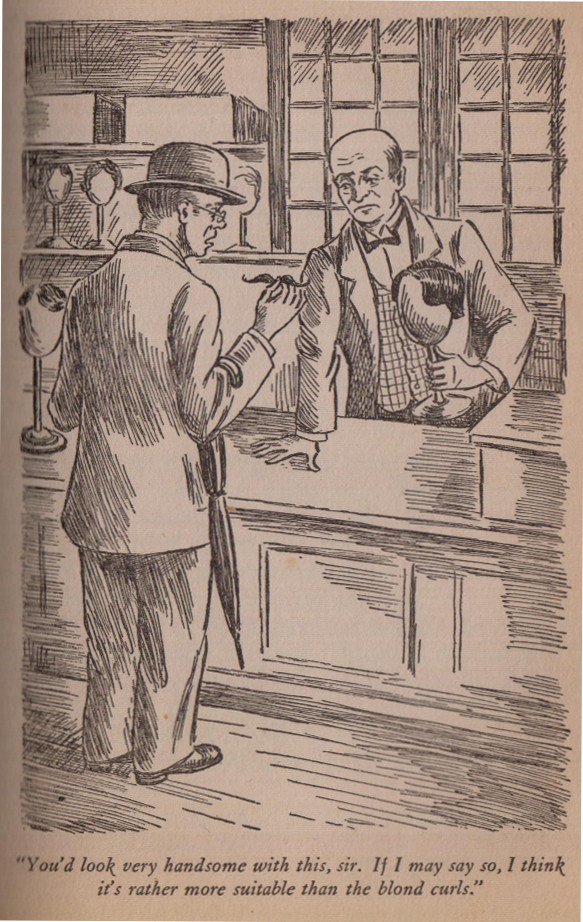
He held up a small, rather surprised looking toupée. [See attached.]
***
If he were somebody in a story....she would just be getting off a bus in Duncannon Street, or coming out of the National Gallery, or be waiting for the green light with "Cross" written on it to show, or she would pop out of the mouth of one of the lions.
[For those keeping score, this is at least the third whimsical reference to the Trafalgar Square lions in the Pinkerton oeuvre. (But they don't appear in every book, so it's not quite a "Hitchcock cameo" thing.)]
***
Mr. Pinkerton shook his head gently. This was completely out of his field. He had never been quite sure of just what his field was, but surely this was not it.
***
"Made pots of money taking alcohol out of beer or caffeine out of coffee--something out of something--and they can take the fun out of a party the same way."
***
"I told him...that I'd not be caught dead drinking water of any sort--hot, cold, mineral or...or animal." [Note: That last ellipsis is part of the text, not my own.]
***
[Who Needs Context? dept.]
She was at the very heart of the wig and mustache business.
***
[Bonus/Spoiler]toupee copy
I recently mentioned the second-hand information that Picadilly Jim involves the protagonist impersonating himself. Well, it turns out in this Mr. P. novel that someone has impersonated himself--doing it just unconvincingly enough so as to make people decide someone *else* was impersonating him, and thus diverting suspicion. And I realize I've encountered this clever device in some other mystery novel as well.
|
|
|
|
|
|
|
unearths some literary gems.
From The Fever Cabinet, by Frankie Bow
***
Dan always looked kind of gray....But today he looked like his own ghost. [How to Be Your Own Ghost?]
***
I have a theory that Iker may be an angel in human form, except I can't work out why an angel would have been sent to earth to teach accounting.
***
"You don't think the flowers are a bit garish?" Fiona asked us.
"I think Nature is allowed to be garish," I said. "Things like orchids and sunsets should be colorful. I mean, who wants a tasteful rainbow, right? What would that even look like?"
***
Talking with her mother often made Fiona feel like she was trying to read a book that had random pages torn out.
***
"Fiona told you Emmett was, wait, how's the British way to say it, getting a leg up on Maureen? Bubbling her squeak?"
***
|
|
|
|
|
|
|
unearths some literary gems.
From "Lessons for Leona," by Tenille Brown:
[Normally my "Mrs. Somebody" encounters happen in vintage or period mystery novels; but this "French twist" comes from an erotica story.]
***
Ida would be personally trained by French Chef Something-or-Other.
|
|
|
|
|
|
|
unearths some literary gems.
From The Case of the Defunct Adjunct, by Frankie Bow:
***
It was part of a yarn tree on an orange construction paper background. I wondered what possible educational purpose it served. Maybe to illustrate what trees would look like if they were made of yarn?
***
[Bonus: This book offers a malaproping character!]
"This thing makes me madder than a wet blanket."
"It is a scandal that stinks to Betsy's Heaven."
"You must not try to escape your conscience by drinking yourself into Bolivia."
"What is the expression, the third time is the most charming?"
|
|
|
|
|
|
|
unearths some literary gems.
From The Man from Scotland Yard, by David Frome:
***
Everyone always knew—to his great relief—what Archie meant after the first three words. Thus he never had to bother about knowing what he meant himself. Schoolmasters were the only people who had never seemed to know. Waiters to Archie's mind were much more intelligent. He'd had doubts about train people since his first long vacation when he was up at Oxford. A man sold him a ticket to northern Italy. He'd wanted to go to Iceland. Not that it made any difference to Archie, except that he met Aunt Gertrude in Florence and had to look at pictures in galleries.
***
His eyes were lost in the concentric depths of his glasses.
***
There was loud and insistent clamouring in the wings of the stage where Mr. Arthurington trod the boards in the latest song and dance hit called Life. It seems hardly fair that the actors in any given rôle in the universal tragi-comedy are never allowed to see the book with their parts clearly down in black and white. They simply have to blunder on and off, getting their cues as they may. They are not permitted to put in lines of their own when they think the piece is falling flat, and they can never leave lines out, because the Prompter is always in the wings. The unfortunate part of it is that they never know who the Management is; thus there is no way of lodging a formal complaint.
***
"How the devil's a fellow expected to sleep with you next door blowing and snorting like a sacred buffalo wallowing in the Andes?" ....
"You mean Ganges."
"It's the same thing when you're trying to sleep."
***
Mr. Pinkerton was as familiar with Bull's habits as Nelson is with those of the lions in Trafalgar-square.
***
"When does St. John get home, by the way?"
"Not before dinner. The Royal Society of something or other is meeting."
***
"He's what a friend of mine calls a pillow of the Church."
***
There was something uncanny in this apparently simple yet really intricate game of cat and mouse. In his rôle of cat he was threading a maze with the mouse holding the other end of the string. The mouse knew the ins and outs of this maze. Inspector Bull had the very uncomfortable feeling that while he was blindly feeling his way, the mouse had tied up his end of the strong to a post somewhere, and had simply gone home.
***
|
|
|
|
|
|
|
unearths some literary gems.
From The Perfect Body, by Frankie Bow:
***
The handwriting was like the man himself, small and spidery.
***
"It's not like Gunderson can just take the money and go spend it all at Ye Olde Elbow Patch Shoppe or wherever he buys his clothes."
***
[This time the monocle-in-motion is a hypothetical/nonexistent one!]
Gunderson turned to stare at Emma. If he had been wearing a monocole, it would have dropped into his lap.
|
|
|
|
|
|
|
unearths some literary gems.
From And Death Came Too, by Richard Hull:
***
"Now you're being both ponderous and arch at the same time, which definitely is unwise."
***
Lansley was one of those people who was capable of extracting the maximum of noise from a piece of paper.
***
|
|
|
|
|
|
|
unearths some literary gems.
From The Maltese Herring, by L. C. Tyler:
***
"I've constructed a timeline."
"Am I paying you to construct timelines?" I asked.
"You're not paying me at all."
[Cf. The Can of Yams: "Look, I’m not paying you to undermine my sense of artistic mission." / "At the moment, you’re not paying me at all."]
***
Our tyres screeched alarmingly as Ethelred put his foot down and the Ashmolean Museum flashed past the passenger window in a blur of Cotswold stone.
***
I wondered whether to point out that fluttering her eyelashes like that was causing a nasty draught, but I let her continue.
***
"He told me his grandfather was worth ten of mine--not that I ever had any plans to have more than two."
***
[And, though this book is hot off the press, the author demonstrates that the art of author-disclaimer variations lives on!]
None of my characters (as they say) resembles a real person in any way whatsoever. If you don't believe me, check out a few real people.
***
|
Page 46 of 64
> Older Entries...
Original Content Copyright © 2025 by Craig Conley. All rights reserved.
|