|
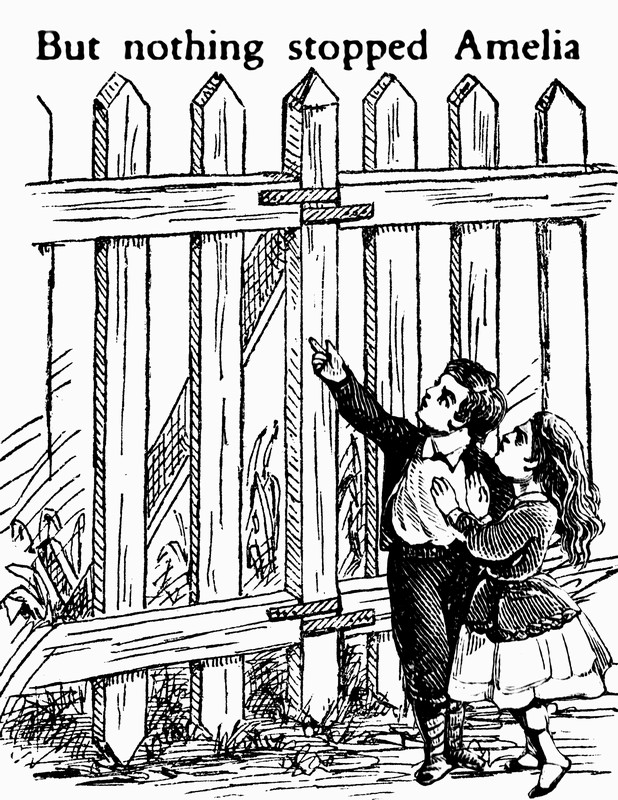
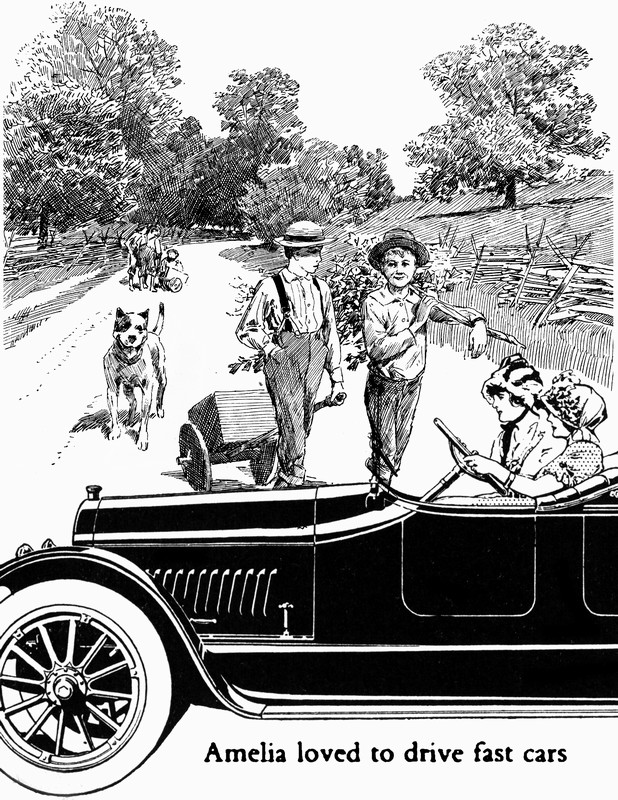
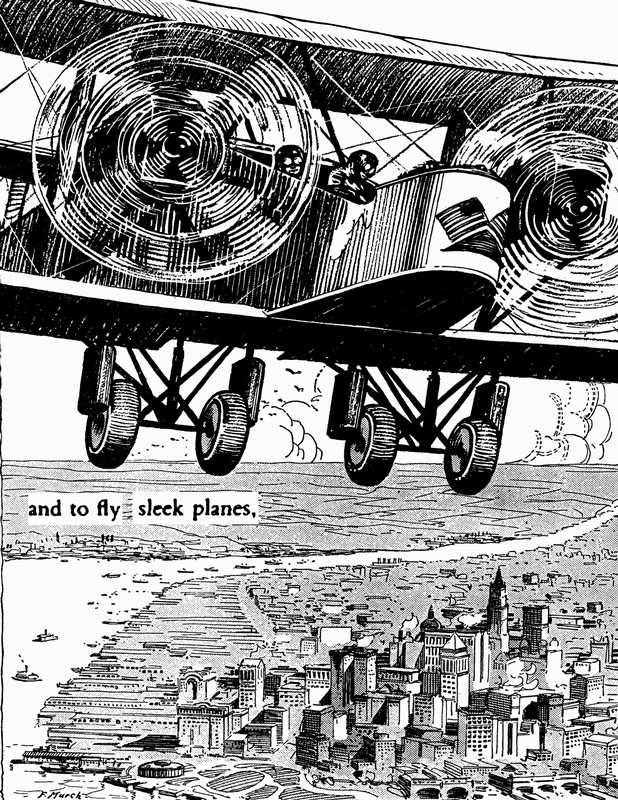
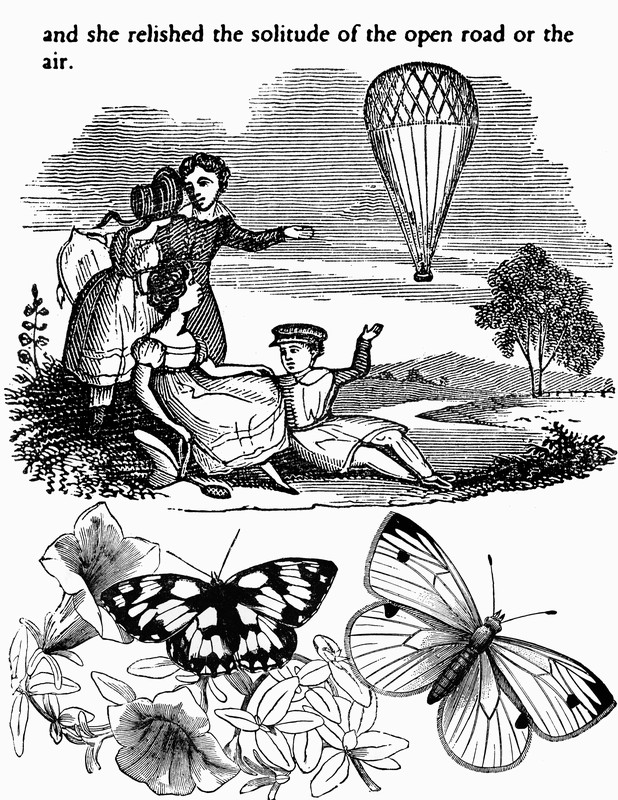
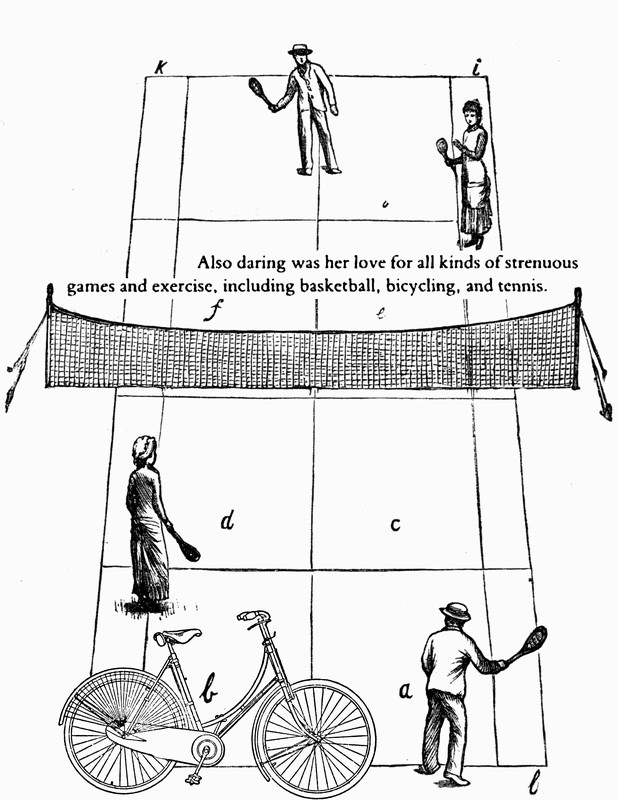
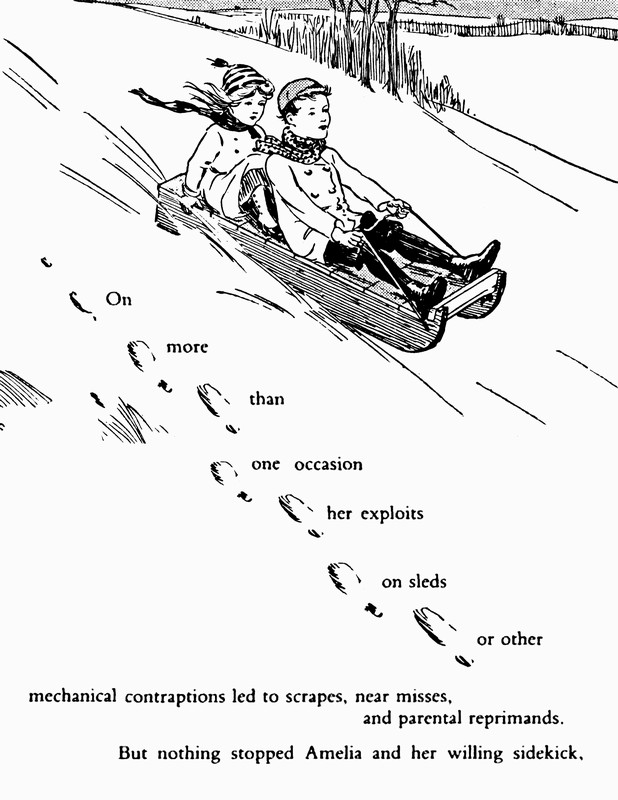
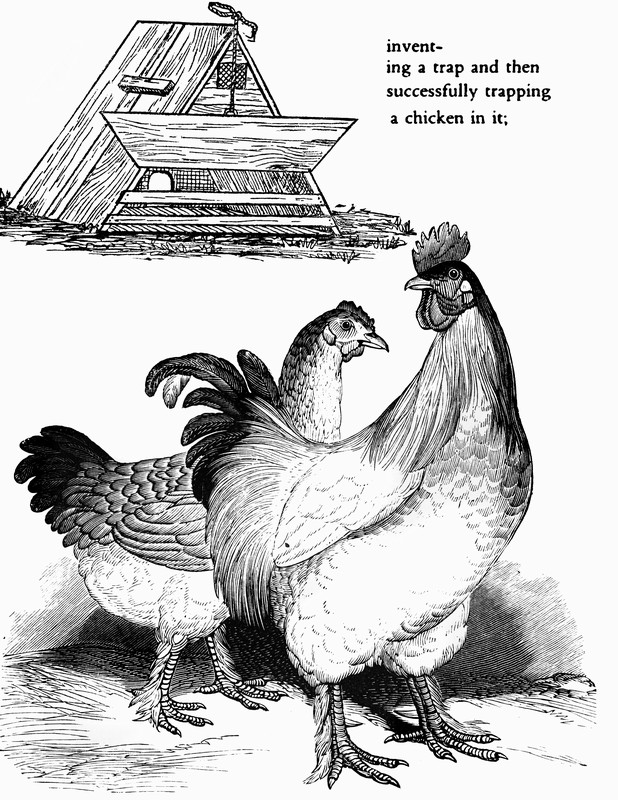
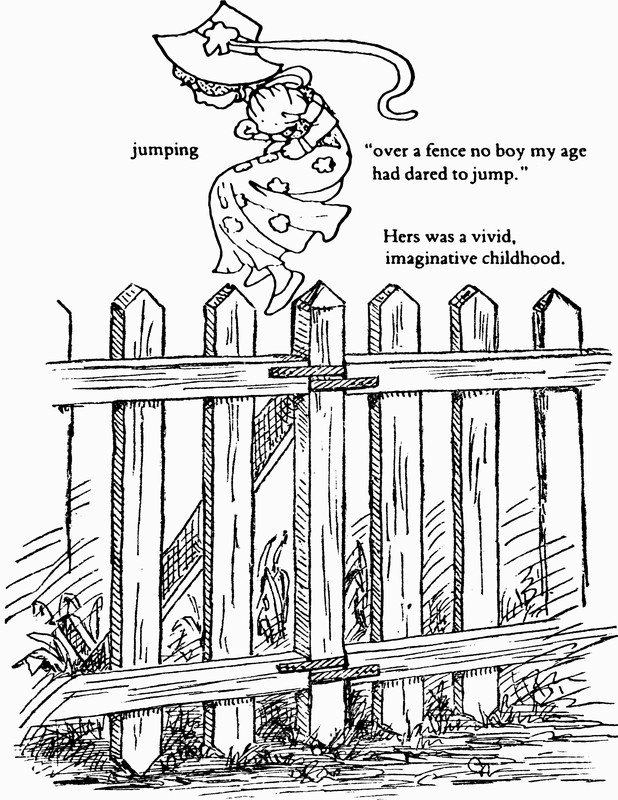
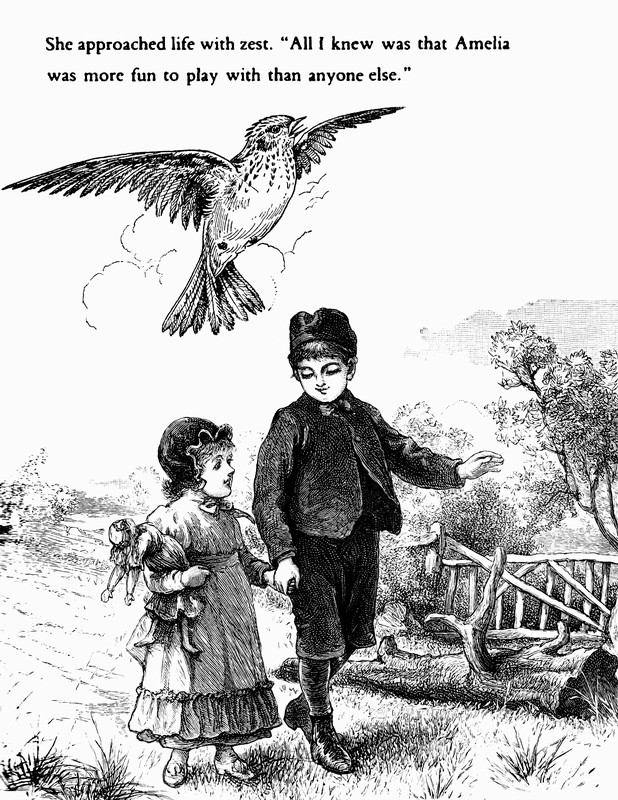
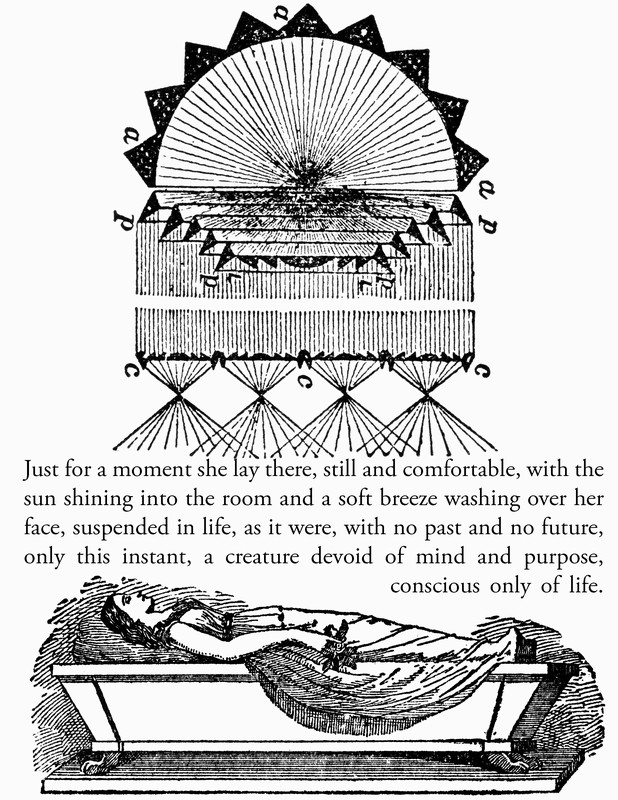
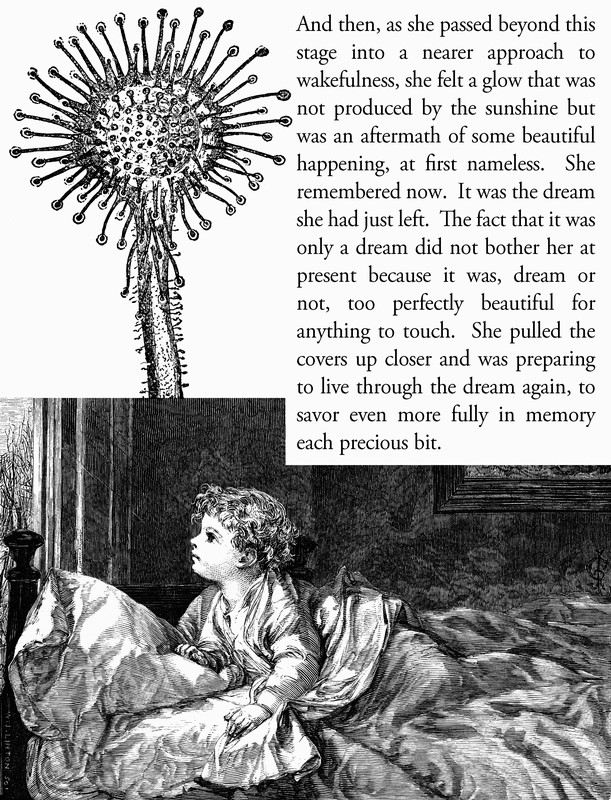
A collaged story we assembled for a singular Beverly and henceforth dedicate to all the Beverlies of the world. Click on the thumbnails below to view an enlarged version in a new window. |
|
Now I know why Baby Suggs pondered color her last years. She never had time to see, let alone enjoy it before. Took her a long time to finish with blue, then yellow, then green. She was well into pink when she died.
—Toni Morrison, Sethe pondering her mother’s last days in Beloved, 1987.
|
|
|
|
|
|
| Hindpsych: Erstwhile Conjectures by the Sometime Augur of Yore |
(permalink) |
|
|
|
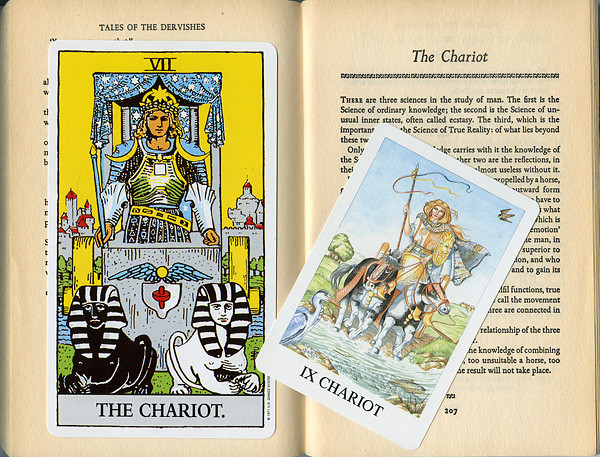
An Insight into The Chariot, from Sufi Lore
(a guest blog for Tarot Dame)
There has been age-old speculation that the Tarot was handed down by wandering Middle Eastern mystics and alchemists. The speculation is well-founded, in that the imagery of Sufi lore is reflected in Tarot iconography. For thousands of years, Sufi masters have used dervish folktales as tools to unlock insights in would-be illuminates. Like the cards of the Tarot, esoteric dervish parables shine light upon hidden trends in the events of life, revealing the significance of seemingly unimportant details. The allegorical stories are meant to constructively affect the inner consciousness of the seeker, develop higher mental functions, raise awareness, and ultimately foster self realization.
One particular fragment of Sufi wisdom offers insights into the psychological meaning of The Chariot card. The fragment was recorded by scholar Idries Shah from the notebook of a Persian dervish. The fragment invites us to picture a charioteer, seated in a vehicle, propelled by a horse, and guided by himself. These three symbolic forces must work in tandem to attain their goal:
"Intellect is the 'vehicle,' the outward form within which we state where we think we are and what we have to do. The vehicle enables the horse and man to operate. This is what we call tashkil, outward shape or formulation. The horse, which is motive power, is the energy which is called ‘a state of emotion’ or other force. This is needed to propel the chariot. The man, in our illustration, is that which perceives, in a manner superior to the others, the purpose and possibilities of the situation, and who makes it possible for the chariot to move towards and to gain its objective."
The fragment notes that any one of the forces may be able to fulfill a function, "but the combined function which we call the movement of the chariot cannot take place unless all three are connected in the Right Way. Only the ‘man,’ the real Self, knows the relationship of the three elements, and their need of one another. Among the Sufis, the Great Work is the knowledge of combining the three elements. Too many men, too unsuitable a horse, too light or too heavy a chariot—and the result will not take place.”
The reference to the "Right Way” will be familiar to anyone versed in Taoist philosophy, just as the "Great Work” echoes the symbolism of Alchemy. Naturally, we also find parallels to Sufi wisdom in the metaphysical literature of Gnostic Christianity, Hasidic mysticism, Vedantic Hinduism, and indeed all of the Mystery schools.
In Tarot for Your Self, Mary K. Greer explores John Blakeley’s attempt to trace a Sufi origin of the Tarot. Parables of the Spanish Muslim mystic Ibn Al-‘Arabī are compared to imagery of the Marseilles Tarot in Islamic Sainthood in the Fullness of Time: Ibn Al-‘Arabī’s Book of the Fabulous Gryphon by Gerald Elmore. Any collection of Sufi allegories may indirectly yield insights on the meanings of Tarot cards. The fragment about The Chariot is featured in Tales of the Dervishes by Idries Shah.
|
|
From Prof. Oddfellow's sketchbook:
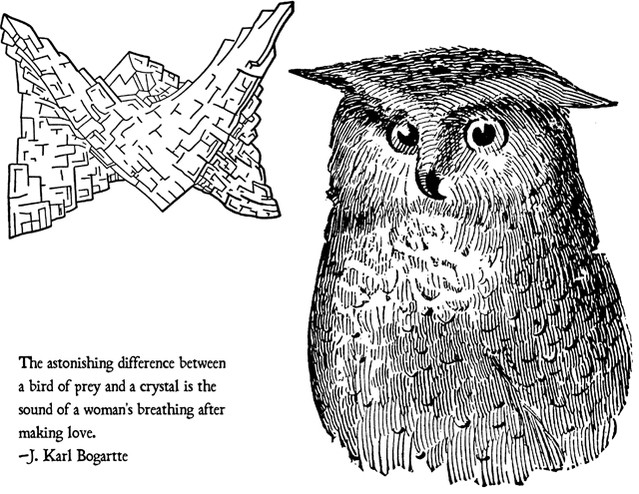
Read about J. Karl Bogartte's avant-garde writings here.
|
|
|
|
|
|
| I Found a Penny Today, So Here's a Thought |
(permalink) |
|
|
|
  by jovikeThe Little-Known Meanings of Crazy Color Names vol. 3
Seemingly incomprehensible color names often tell intriguing and funny stories, at least to those who are willing to delve beneath the surface. We continue our strange and wonderful adventure into the uncharted fringes of language, where we'll discover new "shades of meaning." The dark gray color called fsck refers to a Linux system administration command and is also the title of an album of experimental electronic music by the band Farmers Manual. 
The bright pink color called fzzk recalls the sound of “flash panties,” a weapon disguised as underwear, as in the comic book Dirty Pair: Run From The Future #3 by Adam Warren. 
The light purple color called ggg echoes the gulping of a noisy drinker, as described in “More Than Words” by the New Zealand Ministry of Education. 
The light green color called gggg refers to a baby’s giggle, as described in the novel Edwin Mullhouse by Steven Millhauser. 
The gray color called gnch refers to the sound of someone gorging on a giant mushroom, as in the graphic novel Uzumaki 2 by Junji Ito. 

by sahmeepee
The bright red color called grrl refers to a girl who riots, usually associated with punk music. 
The bright orange color called grrrr refers to the squeak of vinyl pants rubbing against vinyl furniture, as in the novel The Final Detail by Harlan Coben. 
The ominous color called grrrrrr echoes the sound of one’s shadow self explosively releasing “a great amount of repressed energy” in a “giant over-reaction” (Jacquelyn Small, Awakening in Time: The Journey from Codependence to Co-Creation). 
The frothy color called hgkh refers to the sound of someone struggling not to drown in a vat of fresh cream, as in the graphic novella Hearts and Minds by Scott McCloud. 
The luminous green color called hhh conjures the silent moment of Buddha-nature, when “the breath is completely out” and one effortlessly experiences the moment of death (Osho, The Book of Secrets). 
All of these color name insights are derived from my Dictionary of Improbable Words, which is available for online reading. [Read the entire article in my guest blog at ColourLovers.com.]
|
|
|
|
|
|
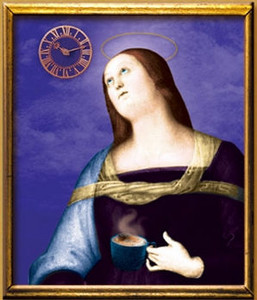
W. Lynn Garrett reminds us of six patron saints of graphic design, including:
Saint Concepta
Patron of Brainstorming and Procrastination.
Read about her history here. Saint AnxietéMartyr and Patron of Impossible Deadlines and Foamy Coffee. Read about her history here. |
|
Who saw the first / green light of the sun? / I, said the night owl, / The only one.
Who saw the moss / creep over the stone? / I, said the grey fox, / All alone.
—Margaret Wise Brown, "The Secret Song," from the collection Piping Down The Valleys Wild: A merry mix of verse for all ages, edited by Nancy Larrick, 1968.
|
|
|
|
|
|
SONG: Crybaby
ARTIST: Information Society
ORIGINAL LYRIC:
If I could stop the hands of time I would do it, on a dime
ADJUSTED FOR INFLATION:
Sands in the hourglass refill If you fold space like a bill |
|
What I have to do is get in my bed and lay down. I want to fix on something harmless in this world.”
“What world you talking about? Ain’t nothing harmless down here.”
“Yes it is. Blue. That don’t hurt nobody. Yellow neither.”
“You getting in the bed to think about yellow?”
“I likes yellow.”
“Then what? When you get through with blue and yellow, then what?”
“Can’t say. It’s something can’t be planned.”
—Toni Morrison, Baby Suggs and Stamp Paid conversing in Beloved, 1987.
|
|
|
|
|
|
| I Found a Penny Today, So Here's a Thought |
(permalink) |
|
|
|
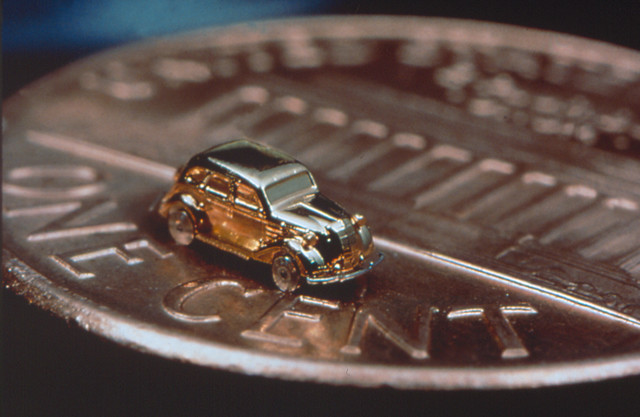
Who's driving the world's smallest car (1/1000th the size of the actual car, the size of a grain of rice)? Our guess: a " copper." --- J writes: I've heard of a "subcompact," but this is ridiculous!
|
|
From Prof. Oddfellow's sketchbook:
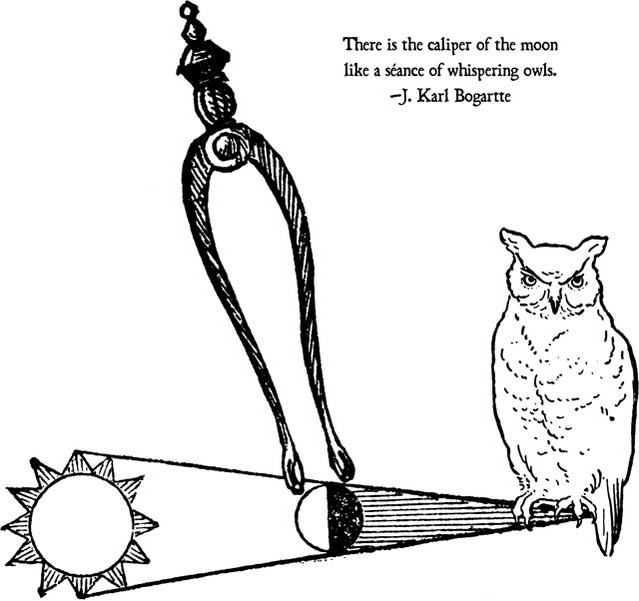
J. Karl Bogartte's avant-garde works are available here.
|
|
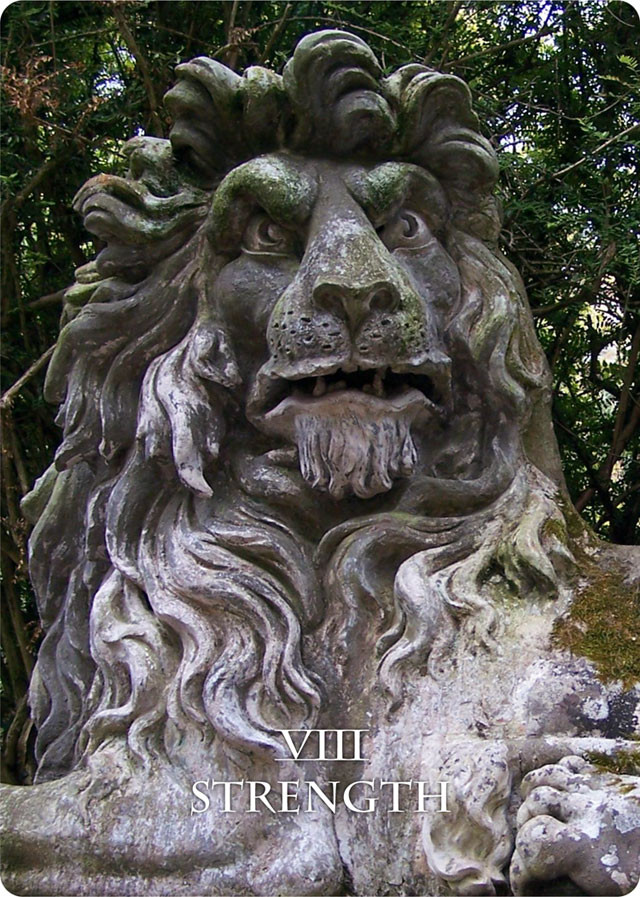
Piecing together the secret of strength . . . |
|
|
|
|
|
| I Found a Penny Today, So Here's a Thought |
(permalink) |
|
|
|
 by creaturaWhich Came First? The Chicken Color or the Egg Color?Pearly white, cream, yellow, brown, gray, blue, violet, green, olive. Chicken eggs are colorful even before they're dyed and decorated for Easter celebrations. "The color of eggs comes exclusively from the pigment in the outer layer of the shell and may range from an almost pure white to a deep brown, with many shades in between. The only determinant of egg color is the breed of the chicken. . . . A simple test to determine the color of a hen's eggs is to look at her earlobes. If the earlobes are white, the hen will lay white eggs. If the earlobes are red, she will produce brown eggs" (David Feldman, Why Do Clocks Run Clockwise? and other Imponderables, 1988. Poultry expert Katie Thear notes that "All eggs are initially white, and shell color is the result of the pigments called porphyrins being deposited while the eggs are in the process of formation. In the case of the Rhode Island Red, the brown pigment protoporphyrin, derived from haemoglobin in the blood, is what gives the shell its light brown color. The Araucana produces a pigment called oocyanin, which is a product of bile formation, and results in blue or bluish-green eggs. Interestingly, the color goes right through the shell, making the eggs difficult to candle [i.e., test for freshness by holding up to the light] during incubation." 
by kit
Interestingly, the light of the sun can fade the color of an egg's shell, even before it has been laid. This is a phenomenon that especially affects free-range chickens in hotter climates. "Although shell color is mainly determined by genetics, the effect of strong sun and high temperatures on the hens can produce a fading effect on the shells. Why too much sun affects the surface pigmentation in this way is unknown, but it can be a problem for those who sell such eggs," Thear says. She notes that stress, premature laying, changes in diet, bullying, viral infections, and the presence of predators can also lead to eggs with pale colors. [Read the entire article in my guest blog at ColourLovers.com.]
|
Page 3 of 4
> Older Entries...
Original Content Copyright © 2026 by Craig Conley. All rights reserved.
|










 by
by