|
An illustration from a 1914 issue of Saturday Evening Post magazine.
|
|
 "But then perhaps it's true for all of us; if the paradox is that it's our hopes and aspirations which imprison us, then maybe in the end we're all women." — People Like Us, series 2
|
|
|
|
|
|
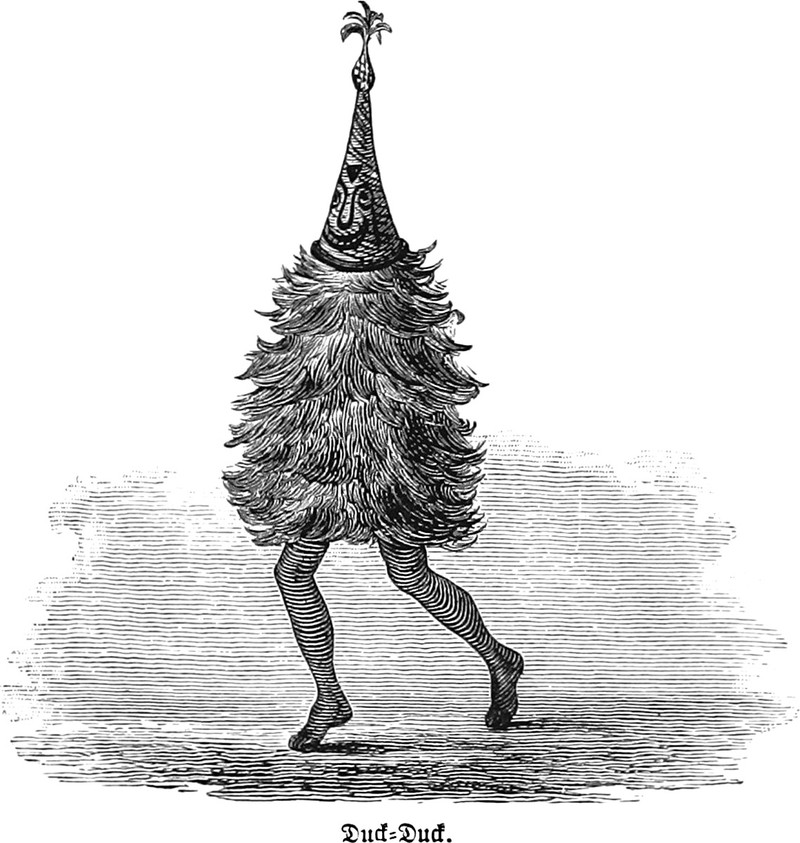
A person disguised as a Christmas-type tree, from Die Deutschen Kolonieen by Carl Hessler (1889). The caption reads: "Dud=Dud." |
|
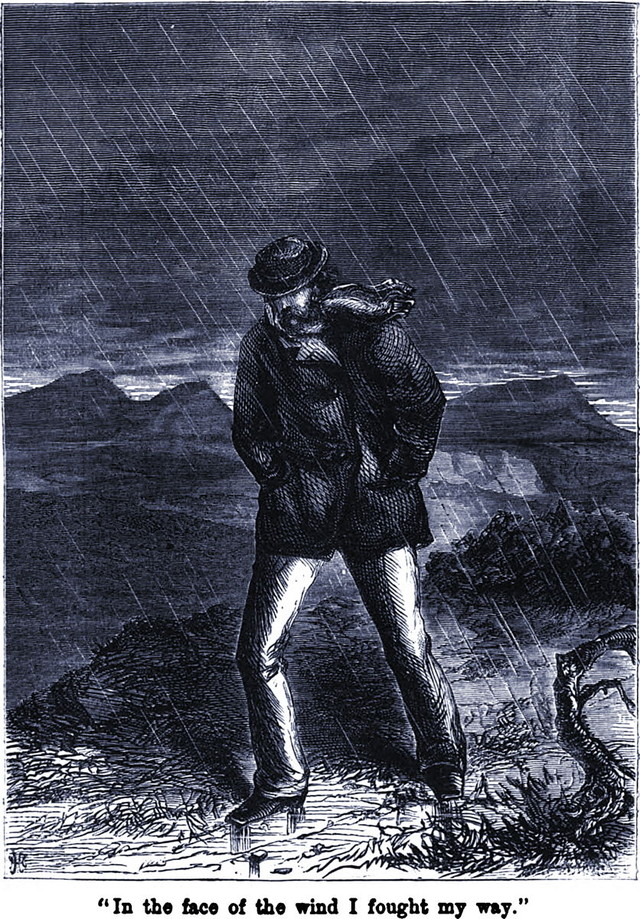
An illustration from an 1870 issue of The Quiver magazine. The caption reads: "In the face of the wind I fought my way."
|
|
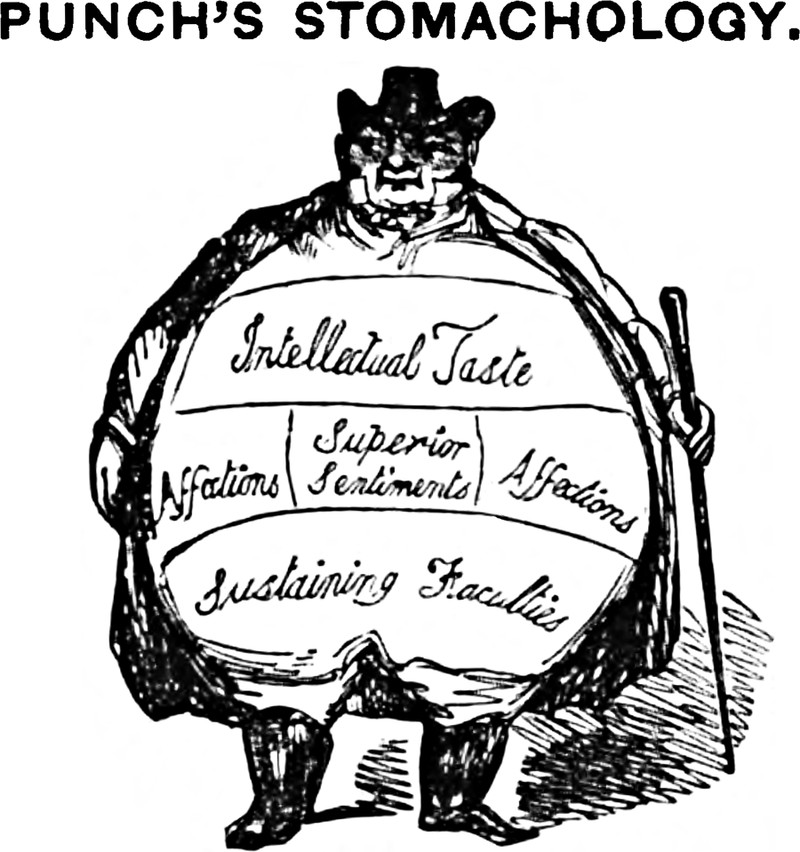
With this diagram, Punch (1841) pokes fun at phrenology by classifying the four great divisions of the stomach. Amazingly, the spoof is perfectly accurate! The "Sustaining Faculties" at the lower belly take cognizance of those staple foods which are essential to the sustenance of animal life. The "Affections" govern the more delicate appetites gratified by the contemplation of finer meals to come. The "Superior Sentiments" at the center "direct the stomach to the investigation of sauces, French cookery, and other abstruse subjects." The "Intellectual Taste" at the top of the belly is "the faculty of reasoning and reflecting upon the abstract qualities of olives, the Italian salads, of comparing Stilton with Gruyère cheese, and tracing the relation between turtle-punch and headache."
|
|
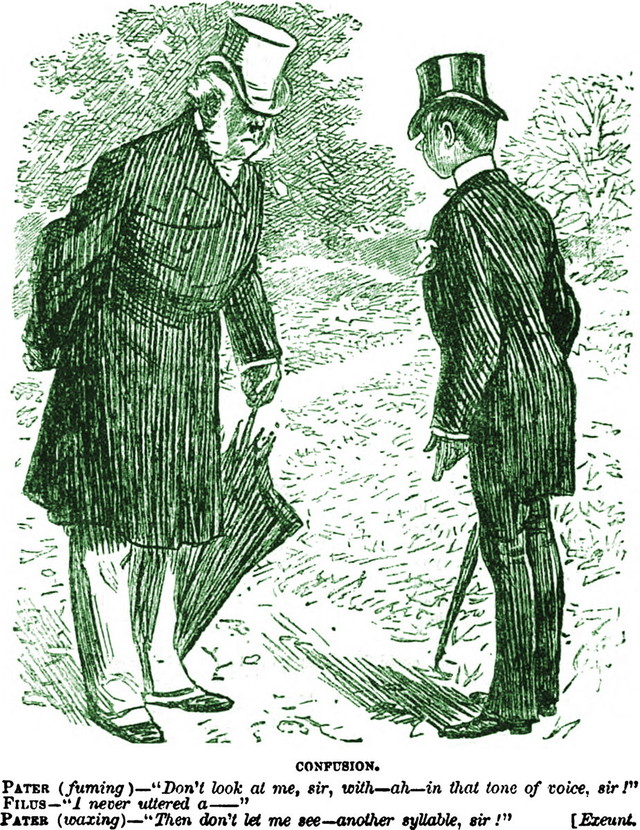
"Confusion": an illustration from an 1885 issue of Frank Leslie's Pleasant Hours magazine. The dialogue reads:
Pater (fuming) — "Don't look at me, sir, with—ah—in that tone of voice, sir!" Filus — "I never uttered a—" Pater (waxing) — "Then don't let me see—another syllable, sir!" [Exeunt]
|
|
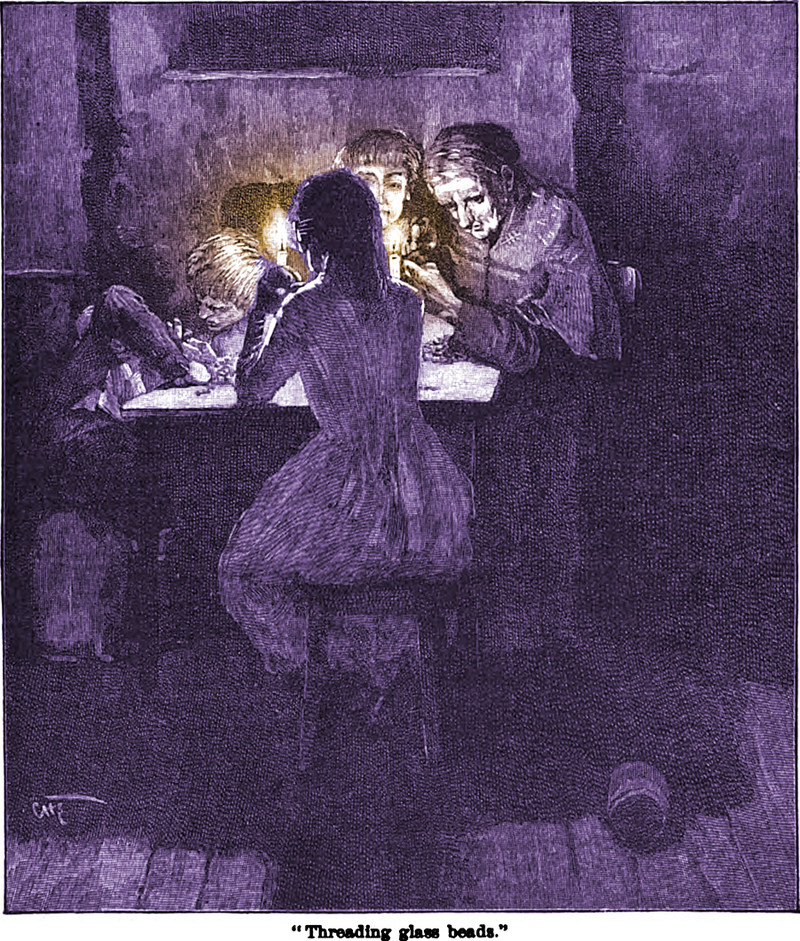
Threading glass beads by candlelight reveals the (archaic, chiefly literary) rarefied substance that permeates all space, the [a]ether. Our illustration appears in The Quiver, 1895.
|
|
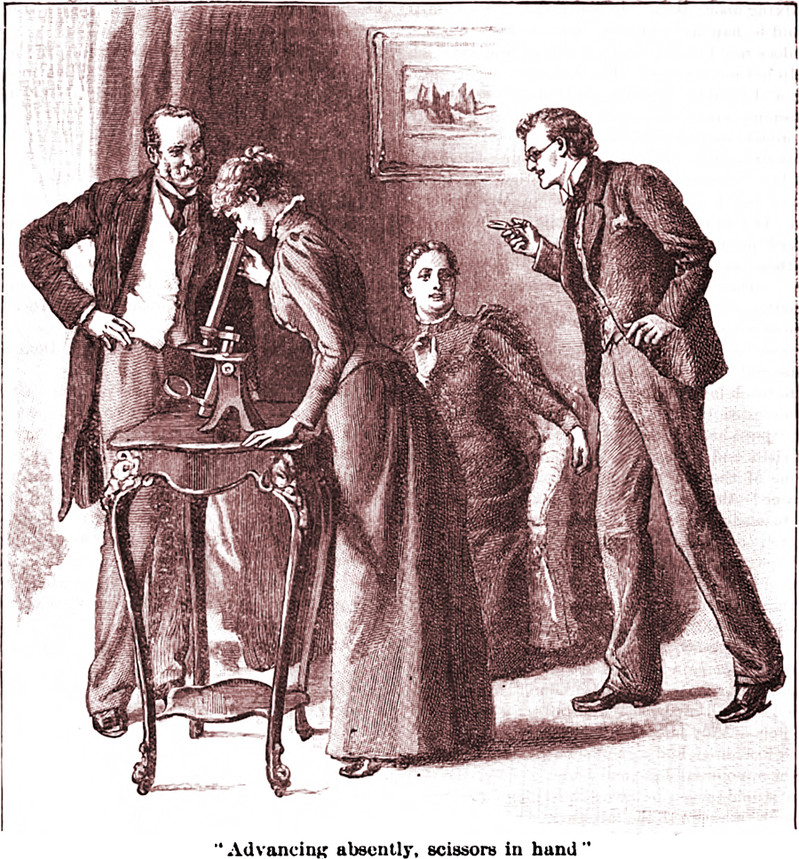
Here's a precursor to Augusten Burroughs' memoir Running with Scissors. The caption reads: "Advancing absently, scissors in hand" ( The Quiver, 1894).
|
|
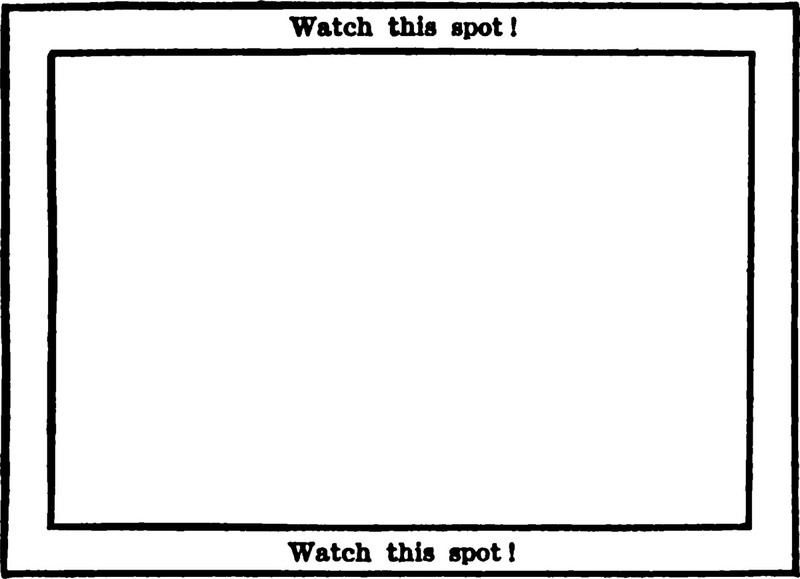
"Watch this spot!" A precursor to the animated gif craze (requiring low-tech imagination), from The Mystery of June 13th by Melvin Linwood Severy (1905). |
|
|
|
|
|
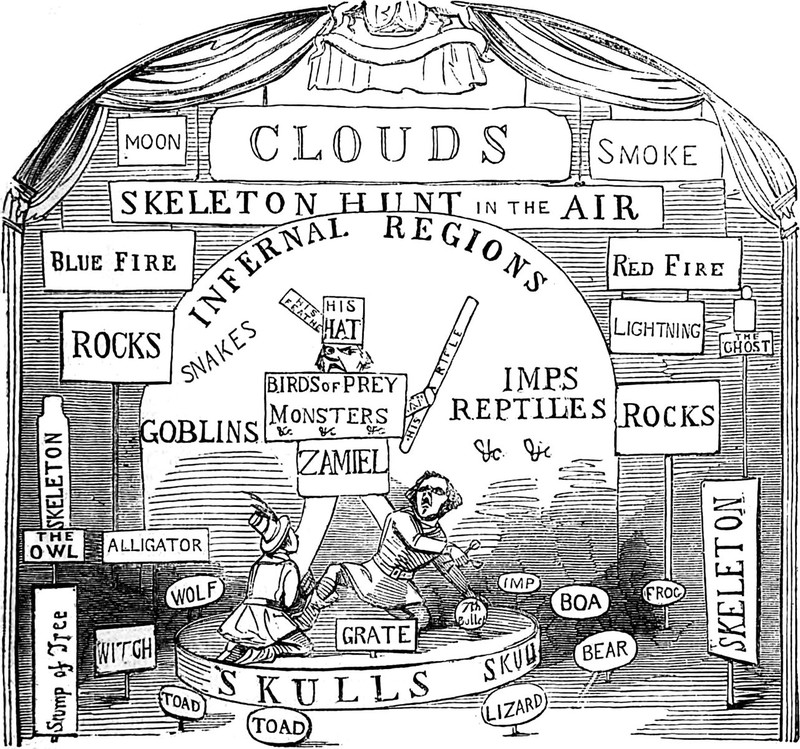
An illustration from an 1844 issue of Punch magazine. The items named include: "Moon, clouds, smoke, skeleton hunt in the air, blue fire, rocks, red fire, lightning, infernal regions, snakes, his hat, his feather, his rifle, birds of prey, monsters, goblins, imps, reptiles, Zamiel, alligator, the ghost, the owl, skeleton, stump of tree, witch, wolf, toad, skulls, grate, 7th bullet, lizard, boa, bear, and frog." |
|
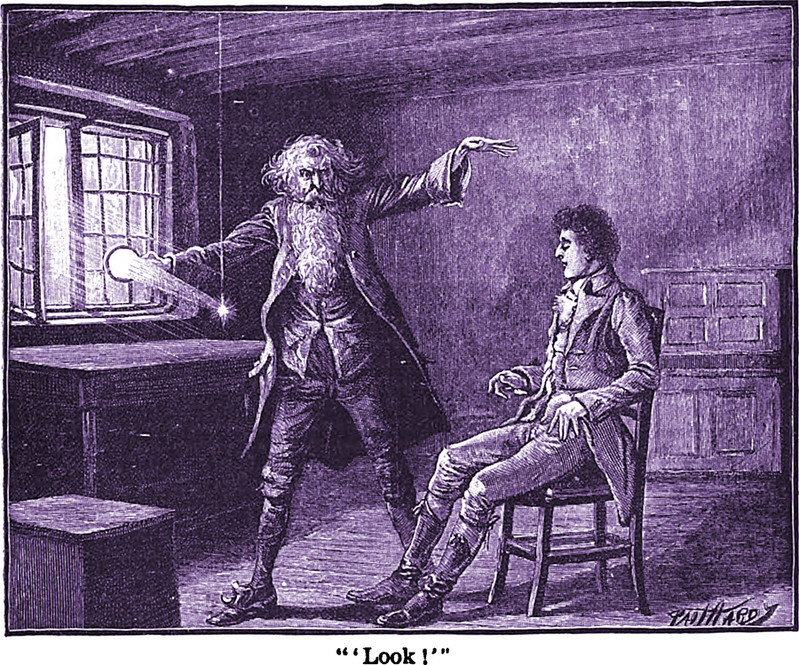
The context for this illustration is rather lovely. A Jewish mystic fixes a precious opal in a frame "not unlike that of a looking glass," hangs it on a silk thread attached to the ceiling, and then opens a window to allow in a stream of sunlight. "It was never known what the old Jew said, but he whispered to the stone just as if it could hear, and then said to his son, 'Thou seest that that crystal focuses the light from heaven, and thou seest that the focus is at the end of this silken thread. Now, this precious opal will go forth in search of truth, and it will tell thee whether this marriage, if it be undertaken, will be for thy good or not. Thou must sit with closed eyes at the other side from the crystal; the rays from the sun will fall direct upon the gem when it is at rest; then when I tell thee to open thine eyes, mark well the colour thou first seest, and, according to that, we will settle how this matter is to be.'" The mystic then swings the gem to and fro, like a pendulum, then leaves it to itself. "Gradually its oscillations became less and less, until at last, just as he was getting somewhat impatient, the young man heard a quick, sharp word, 'Look!' and he opened his eyes and fixed them upon the stone. A blue blaze of fire met his eye, blue as the heavens, bright as the sun in those heavens." Yellow would have indicated gold. Red would have been danger. Blue meant: "Prize above all its heavenly hue; It guides to what is just and true." (The Quiver, 1889, p. 871.)
|
|
|
|
|
|
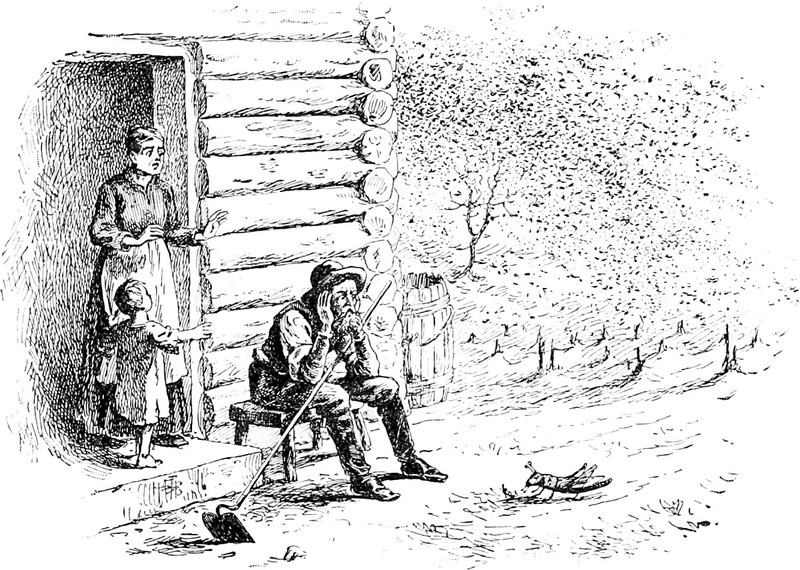
Merriam-Webster suggests that the first known use of slumgullion (a meat stew reminiscent of the slime [ slum] from a cesspool [ gullion]) was 1890. We can do better than that, with this one from 1872, in Mark Twain's Roughing It. |
Page 3 of 5
> Older Entries...
Original Content Copyright © 2026 by Craig Conley. All rights reserved.
|