|
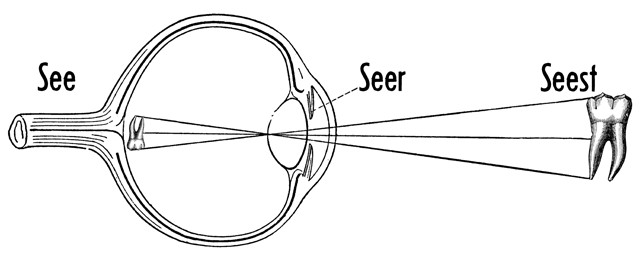
We recently stumbled upon a surprising tip involving one-letter words: someone suggested using them as commands to keep a dog from barking. (The logic seems to be that dogs can't understand sentences.) We happily note that in Shakespeare’s time, R was called littera
canina, "the dog’s
letter," because it sounded like a dog's growl. |
|
|
|
|
|
 Is it true, as Momus
suggests, that there are "few tales which would not be improved by the
addition of the phrase 'suddenly, a shot rang out'"? Decide for
yourself as we alter the opening lines of . . . KUBLA KHAN by Samuel Taylor Coleridge In Xanadu did Kubla Khan A stately pleasure dome decree. Suddenly, a shot rang out Through caverns measureless to trout Down to a sunless sea.
|
|
“Your boat must be able to move in very light airs.” —Lin Pardey
|
|
|
|
|
|
A bit of irony from a scanned book over at Archive.org: a notice to handle the text carefully due to brittle paper. --- Alsop Peanutworthy notes: In my experience, poets are much more brittle than the paper they write, type or publish upon. And this was true even in the pre-acid-free era.
|
|
|
|
|
|
|
|
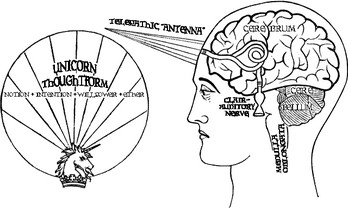
Clint Marsh, author of The Mentalist's Handbook, shares his lovely review of our unicorn field guide. We've bolded our favorite bits: Craig Conley is a true Renaissance man of the modern era, diving headfirst into comprehensive, open-minded study of realms obscured or merely obscure. A voracious researcher, he possesses both the focus required to compile book-length arcana on a given topic and the objectiveness to consider sources other scholars might ignore. It is precisely this tendency to "overlook" that forms the basis for Conley's Field Guide. As he states in the book's introduction, "Because we live in a highly visual world, we rarely exercise the full range of our hearing. Yet our ears can detect things that our eyes automatically reject. By listening as opposed to looking, we can avoid overlooking. Practice can be richly rewarding, whether one is listening for unicorns in particular or neglected delights in general." And so Conley mines the known literature on unicorns, nobly eschewing distinctions between historical accounts, fantasy novels, and instances of metaphor, organizing the brief excerpts and other tidbits found into 51 short lessons in the art of "deep listening" necessary to perceive the fabulous beasts. Soundwave diagrams impart insight into audible tendencies of the unicorn as rustling, laughter, mimicry of orchestral instruments, soft nickering, cries of ruin, and the creature's alarm "sneeze." More complex diagrams contribute to the mapping of the once well-maintained highways between magic and science, illuminating such correspondences as the Fibonacci Spiral with the shape of the outer ear and the comparative curl of the unicorn's horn with that of the human cochlea. Conley also offers an companion compact disc with four tracks of listening exercises set in a sylvan soundscape. Narrator Michael Warwick guides the listener through the first half of the CD, then departs, leaving only the birdsong and delicate, layered crackle and murmur of the forest and whatever one might discover there. This book and recording are fine works of practical esoterica. Highly recommended. — The Pamphleteer |
|
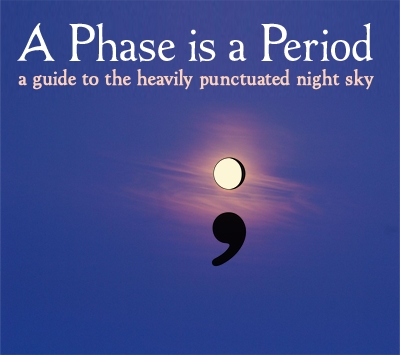
WANING GIBBOUS (FUTURE)"There followed the period of nothing-to-do-but-wait." —Ivan Doig, This House of Sky (1980)
|
|
| Puzzles and Games :: Which is Funnier |
(permalink) |
|
|
|
 Which number is funnier: 16 or 18?
Clue: Which number is funnier: 16 or 18?
Clue: This is according to the play Mr. 80% by James Sherman
Answer: 16 (The answer is in black text on the black background. Highlight it to view.)
Citation: James Sherman, Mr. 80% (1987), p. 14
|
|
|
|
|
|
| I Found a Penny Today, So Here's a Thought |
(permalink) |
|
|
|
We're honored to be referenced in an article about " A Surprising Historical Source of Sustainability": Perhaps Portmeirion’s greatest achievement is the creation of a built environment that forces its occupants to question preconceptions about the world that they inhabit. As author Craig Conley points out, the setting is more of a virtual reality. The project exists as a series of contradictions that allow nothing to be taken at face value. The village has a town hall, but no residents and a lighthouse with no light. It is a port on an estuary too shallow for most watercraft. The result is a series of opportunities for expectations to be defied which, in turn, prompts visitors into a mindset of inquisition. See the entire article here. |
|
| The Ghost in the [Scanning] Machine |
(permalink) |
|
|
|
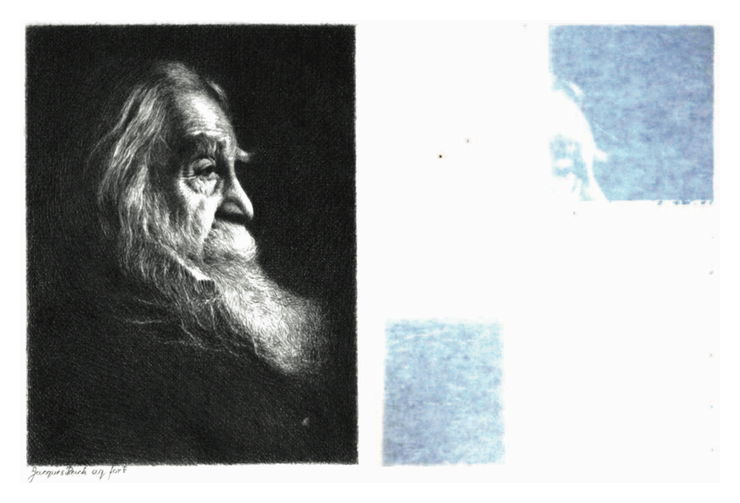
~ Mysterious Beards ~ 
Portrait of Henry Longfellow from Evangeline.
In the ghostly signature, there is no “fellow” in “Longfellow,” as befits the nature of the spirit world.
|
|
Is it true, as Momus
suggests, that there are "few tales which would not be improved by the
addition of the phrase 'suddenly, a shot rang out'"? Decide for
yourself as we alter the opening lines of . . . MOBY DICK by Herman Melville Call me Ishmael. Some years ago—never mind how long precisely—having little or no money in my purse, and nothing particular to interest me on shore, I thought I would sail about a little and see the watery part of the world. Suddenly, a shot rang out.
|
|
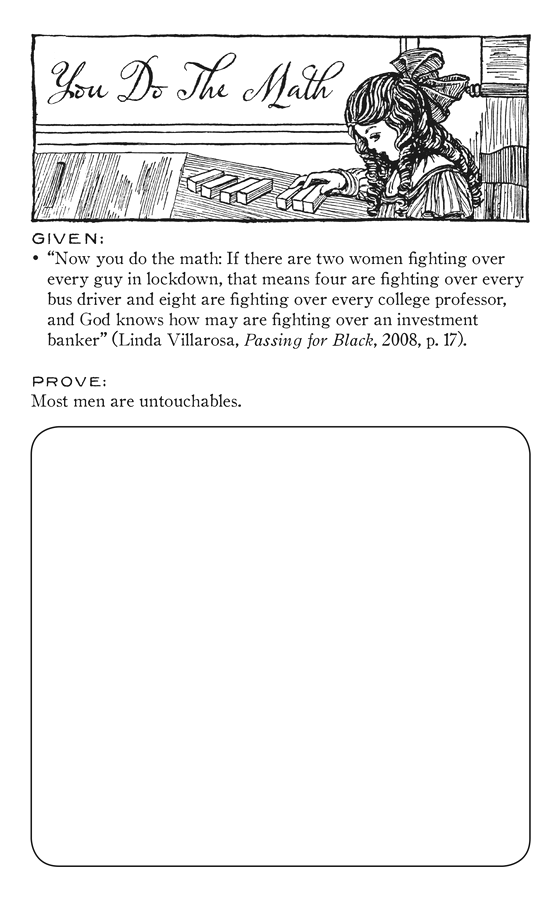
INSTRUCTIONS: Click on the puzzle image below to reveal one possible solution.
|
|
From Prof. Oddfellow's sketchbook:
|
|
|
|
|
|
Saturn's ethereal aura has a heartbeat.
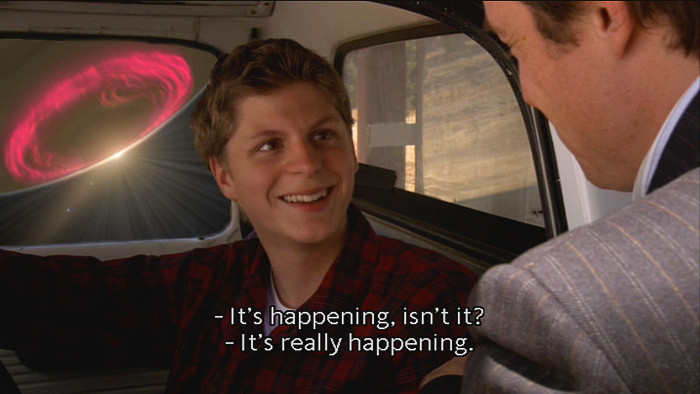
The foreground photo of this collage is from the wrongfully-canceled comedy series Arrested Development.
|
|
"The joker-god Maui has the same attitude as Ludwig II—you can't have too much loud color and bright contrast, and to hell with critics who want the 'understated.'" — Robert Anton Wilson, Cosmic Trigger II
|
Page 3 of 4
> Older Entries...
Original Content Copyright © 2026 by Craig Conley. All rights reserved.
|