|
|
 |
|
We would swear this illustration of a fire eater is dated "1967," though the issue of Cosmopolitan in question was published in May 1900. Apparently, an artist is only as far ahead of his time as his autograph dates him. (Note that in 1902, Georges Melies will film his classic A Trip to the Moon, which will also be exactly sixty-seven years ahead of its time.)
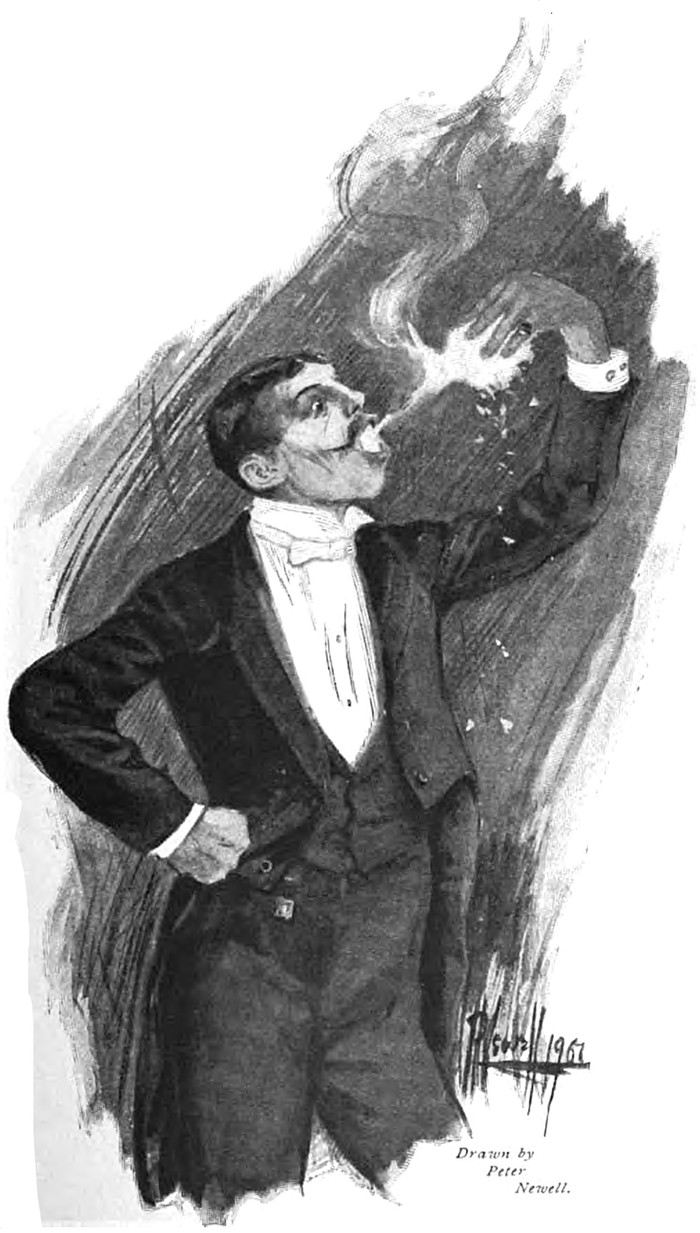
Bob responds: That performer is a fire eating magician! The mouth of the performer is functioning as a hat. The fire appears to have taken a specific shape of a rabbit: hand holding its rear end, paws reaching back to the performer's mouth, and two ears towering up from the too-small head. Not bad for the shaping of a flame.
And I can believe in anything else I want too.
|
|
If: "We are all like snowflakes." —comedian Lewis BlackAnd: "Snow is a faked cleanliness." —Goethe Then: "We are all unclean, or rather we are all unclean persons." —Samuel Trickett
|
|
"The common pebble you find in your fist after having thrust your arm shoulder deep into water, where a jewel seemed to gleam on pale sand, is really the coveted gem though it looks like a pebble as it dries in the sun of everyday." —Vladimir Nabokov, The Real Life of Sebastian Knight |
|
|
|
|
|
Prof. Oddfellow offers this free collection of vintage frame clip-art, culled from 110-year-old issues of Cosmopolitan Magazine and painstakingly restored to their original glory. The frames are available for download in high-resolution GIF and vector EPS formats. See samples of the corners below: |
|
| I Found a Penny Today, So Here's a Thought |
(permalink) |
|
|
|
"We got it the first time, Kurt [Vonnegut], when the books were written by Voltaire." — William Keckler |
|
| The Ghost in the [Scanning] Machine |
(permalink) |
|
|
|
~ Amorphous Apparitions ~ 
Portrait from Letters of Emily Dickinson.
"The Frost of Death was on the Pane—” —Emily Dickinson
|
|
There is "the finest line between unique and odd" (Jodi Picoult, Nineteen Minutes, 2008). |
|
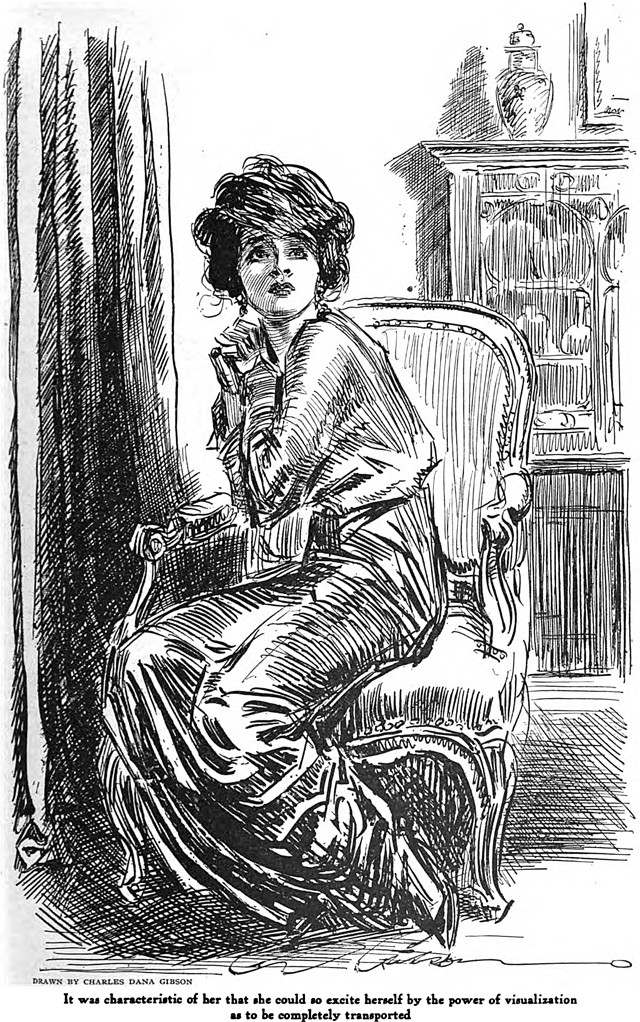
Staring into the depths: an illustration from a 1913 issue of Cosmopolitan magazine. The delightful caption reads, "It was characteristic of her that she could so excite herself by the power of visualization as to be completely transported."
|
|
|
|
|
|
 Is it true, as Momus
suggests, that there are "few tales which would not be improved by the
addition of the phrase 'suddenly, a shot rang out'"? Decide for
yourself as we alter the opening lines of . . . THE AGE OF INNOCENCE by Edith Wharton On a January evening of the early seventies, Christine Nilsson was singing in Faust at the Academy of Music in New York.
Suddenly, a shot rang out.
|
|
|
|
|
|
|
|
At age 75, Katsuhika Hokusai timelined his artistic quest: "At the age of 73, I finally apprehended something of the true quality of birds, animals, insects, fishes, and of the vital nature of grasses and trees. Therefore at 80, I shall have made some progress, at 90 I shall have penetrated even further into the deeper meaning of things, at 100 I shall have become truly marvelous, and at 110, each dot, each line shall surely possess a life of its own." Vincent Van Gogh achieved Hokusai's dream at the age of 37. (Michael R. Zomber, Park Avenue, 2010) |
|
| The Ghost in the [Scanning] Machine |
(permalink) |
|
|
|
~ Amorphous Apparitions ~ 
Portrait from the Alfred Saker biography.
“As through a veil I glimpse your hands in the shadows.” —Hans Urs von Balthasar
|
|
|
|
|
|
It's the searching for something clearly unreachable, with hopes of finding small significance along the way. It's the attempt to understand what's really going on by observing, neither by telescope nor microscope, but by naked eye, the intimate details in the most mundane of life's happenings. It's the need to describe the gist of the feeling of the tiniest modicum of The Great Universal Unutterable Joke we are all always not laughing at—except when we are. —Yoni Wolf (of the band WHY?)
I have the dubious honor of Google being convinced I'm a machine. Apparently, I use Google's various search tools with inhuman speed and voracity. My unflagging diligence has flagged me as "suspicious" (Google's word, not mine; I was so labeled in one of their warning messages). Indeed, the obsessiveness/compulsiveness of my research has convinced the Google robots that I'm one of them, so they must challenge my humanity each time I try to use their service. Paradoxically, because I'm apparently one of those newfangled "smart" robots (my word, not Google's), no single humanity test is sufficient, since I might be learning as I go. So I'm barraged with test after test, each more irrational than the last. (The tests are irrational, of course, because anything rational—like a math problem or a logic puzzle—is a piece of cake for suspect machines.) Indeed, Google's tests have become so Kafkaesque that I've developed what's known as "irrational test anxiety," with symptoms including rapid heartbeat, muscle tension, and negative internal dialogue. And no wonder, really (though self-justification is another symptom), given what Google is throwing at me. Forget those simple CAPTCHA tests of identifying distorted letters on the screen. Child's play! Google doesn't even allow me to type my answers—I must use a graphics tablet with cordless pen and enter my answers in calligraphy. Just today, for the privilege of downloading a public domain journal from the year 1898, Google demanded a handwritten 350-word essay in defense of the radical pro-feminist slogan "Men are rapists." (That did nothing to abate my negative internal dialogue; I've never felt so chauvinistic, selfish, coercive, dominating, and sadistic in my life. But, of course, no man with an ounce of humanity would offer a knee-jerk "no" to such a slogan. And that's how Google gets you by the balls.) I never knew a search engine could be so protective of its data or so begrudging of its service. With each acceptance of my humanity, Google essentially says, "You may have won this round, my pretty, but the battle is far from over. Here's a tiny wooden spoon with a sample of our gelato, but you'll never, ever know what flavors we're storing in the vat in the back. Now get out of line and take another number." I'm left with an even greater challenge than certifying my humanness: to conduct my life's work, I must strive to be less inquisitive, less passionate, less productive, and less insightful. Therein lies the irony, for I must dehumanize myself to prove to a search engine that I'm "real." And now I'm off, once more, to Google myself. --- Gary Barwin responds in his inimitable way: I think this is some kind of metaphysical, cybergnostic quest of a Jungian-Kafka-Borgesian nature and you must search for the answer within Google itself. The Google robots are reaching out to you, wanting you to realize their spidery hopes and dreams. They are silicon Pinocchios, and want to be real.
You are their cultural hero. They can search, but they cannot truly find, not in any spiritual, psychological way. Only by risking 'captcha' in the belly of the beast, by becoming the Hero with a Thousand Searches, by taking on their aspirations, can you help these seekers move beyond dualism help them find the 1s within their 0s, the 0s within their 1s, the dark in the light. You can help them move beyond binary, beyond machine code, and help them become fully integrated integral beings.
You are given little to prepare you for this quest. Search string. Your courage. An internet connection. A belief that somewhere in the digital kingdom, you will be able to find your Fissure King, a rent in the fabric of search-space, that you will get your digits on the grail-like, hidden Easter Egg which exists at a higher level of the search.
You must go into the Wide World Wide Web for these baleful spiders, these everybots. They are calling you.
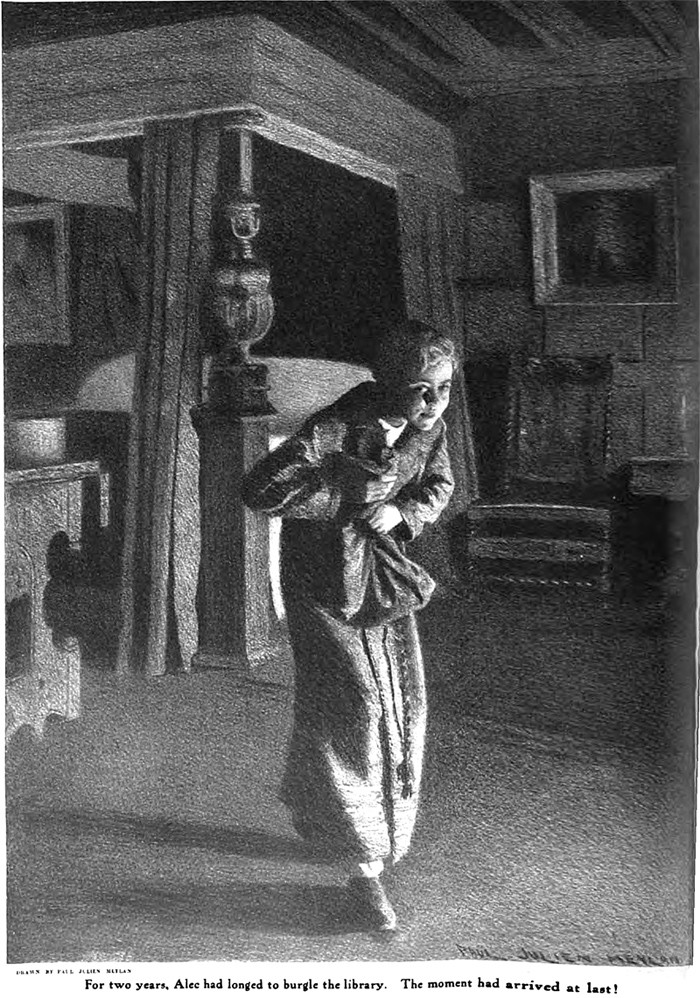
An illustration from a 1913 issue of Cosmopolitan magazine, which I burgled from Google very much against Google's wishes. The caption reads, "For two years, Alex had longed to burgle the library. The moment had arrived at last!"
|
Page 4132 of 4336
Original Content Copyright © 2026 by Craig Conley. All rights reserved.
|






 "In a restaurant, you can tell if bamboo chopsticks have been used many times by dark stains from soy sauce visible at the tips. This may surprise you."