|
|
|
|
|
I dreamed of Lord Whimsy's elegant quill pen, its down-like barbs quavering between waggish quips. "Call me partisan," I recall him saying, "but I've always enjoyed the brief conversational pauses [semicolons] create. They also allow for a complexity and artistry in the text; without them, language seems to devolve into a series of hard, curt, declarative chirps." |
|
A collaged story we assembled for a singular Norris and henceforth dedicate to all the Norrises of the world. Click on the thumbnails below to view an enlarged version in a new window. |
|
Piecing together the secret of the wand . . . |
|
|
|
|
|
| I Found a Penny Today, So Here's a Thought |
(permalink) |
|
|
|
|
|
|
|
|
|
Saint KaikiasPatron of the Northeasterly Winds.
- WELCOME, wild Northeaster!
- Shame it is to see
- Odes to every zephyr;
- Ne'er a verse to thee.
- Welcome, black Northeaster!
- O'er the German foam;
- O'er the Danish moorlands,
- From thy frozen home.
- Tired are we of summer,
- Tired of gaudy glare,
- Showers soft and steaming,
- Hot and breathless air.
- Tired of listless dreaming,
- Through the lazy day--
- Jovial wind of winter
- Turn us out to play!
- . . .
- Come, as came our fathers,
- Heralded by thee,
- Conquering from the eastward,
- Lords by land and sea.
- Come; and strong, within us
- Stir the Vikings' blood;
- Bracing brain and sinew;
- Blow, thou wind of God!
- —Charles Kingsley
|
|
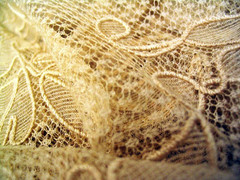
She was dressed in rich materials — satins, and lace, and silks — all of white. Her shoes were white. And she had a long white veil dependent from her hair, and she had bridal flowers in her hair, but her hair was white. . . . [Then] I saw that everything . . . which ought to be white, had been white long ago, and had lost its lustre, and was faded and yellow. I saw that the bride within the bridal dress had withered like the dress, and like the flowers.
—Charles Dickins, Great Expectations, 1861.
|
|
A collaged story we assembled for a singular Ken and henceforth dedicate to all the Kens of the world. Click on the thumbnails below to view an enlarged version in a new window. |
|
Piecing together the secret of the void . . . |
|
These flowers of the plum — / How red, how red they are, / How red, indeed!
—Izen (17–18th c.), a haiku; from The Moment of Wonder: A Collection of Chinese and Japanese Poetry, edited by Richard Lewis, 1964.
|
|
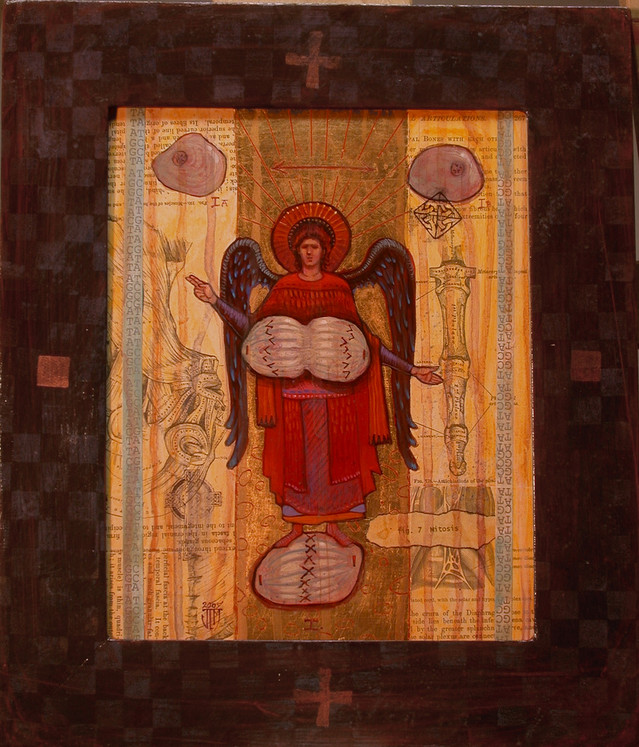
Saint EugenePatron of Normal Cell Division. HaggisVitae explains how Saint Eugene came to be: Everyone I know has been deeply affected by cancer. Either someone in their family has it, or has had it, or they have or a friend or someone they know and respect. I sit at a microscope all day long looking for cells that have changed, lost control, gone wrong and turned into cancer cells.
One day I was sitting thinking that there should be someone to take up the job of Patron Saint for normal cell division. Because if there is something to pray for, it's just that. And there are just so many patron saints for such unimportant things--this seemed very important. I am not catholic, nor religious for that matter, but I wanted to create an image that could be a place where science and religion could co-exist and use their powers for good.
So, may all your cells divide normally.
I chose the name Eugene because the prefix EU in science means normal or good. And gene--well that speaks for itself. I've uploaded the huge image straight from my camera so you could tool around and see the background details if you'd like to. Eugene may already be a patron saint of something else. That's ok, I don't think he'll mind this task.
He stands on a cell in metaphase where all the paired chromosomes are lined up. In front of him is that same cell in telephase, where the chromosomes have gone to their respective sides and are ready to be the nuclei of their own daughter cells. Above him to each side are the final two daughter cells, perfect and just like each other.
Unrelated: The Patron Saint of Mud Puddles.
|
|
|
|
| I Found a Penny Today, So Here's a Thought |
(permalink) |
|
|
|
  by Adventure AddictColors for Life with Tattoo InksColors inserted into the skin's dermis are known as tattoos or dermal pigmentation. A practice traced back to Neolithic times, tattooing remains popular worldwide for body decoration, initiatory rites, religious observance, love vows, and identification, to name but a handful of uses. Tattoo inks come in nearly unlimited variations, the most popular being red, green, yellow, blue, and white, which is used as a tint (source). Tattoo inks comprise of a variety of pigments in carrier solutions. The pigments may be organic-based, mineral-based, or plastic-based. The plastic-based pigments offer the most vibrant colors. "The inks used in tattoos and permanent makeup (also known as micropigmentation) and the pigments in these inks are subject to FDA regulation as cosmetics and color additives. However, FDA has not attempted to regulate the use of tattoo inks and the pigments used in them and does not control the actual practice of tattooing. Rather, such matters have been handled through local laws and by local jurisdictions. . . . Although a number of color additives are approved for use in cosmetics, none is approved for injection into the skin. Using an unapproved color additive in a tattoo ink makes the ink adulterated. Many pigments used in tattoo inks are not approved for skin contact at all. Some are industrial grade colors that are suitable for printers' ink or automobile paint" (source). How permanent are tattoo pigments? Even severe burning often fails to obliterate them. However, tattoo pigments can fade over time, especially red and yellow. Lighter tattoo colors, such as pink, fade more quickly than darker ones. Tattoo colors typically fade with sun exposure, so sunscreen is recommended to keep them looking vivid. Over time, tattoo pigments drift deeper into the dermis, blurring their detail. "At present, no one laser can remove all tattoo colors well. Black, blue, and green inks are all well absorbed by red and infrared light lasers," says dermatologist Randall Roenigk. "Red inks are not well absorbed by red or infrared light lasers, but are well absorbed by green light lasers. . . . Purple, yellow, and orange pigments are often more difficult to eradicate and respond variably well to green, red, and infrared light lasers" (Roenigk & Roenigk's Dermatologic Surgery, 1996). 
Tattoo inks carry the risks of allergic reactions and toxicity triggered by sunlight exposure and heavy metals.
[Read the entire article in my guest blog at ColourLovers.com.]
|
|
Piecing together the secret of vitality . . . |
Page 4266 of 4337
Original Content Copyright © 2026 by Craig Conley. All rights reserved.
|














 by