|
|
 |
|
The sky had no colour, the earth was coloured only with dim toneless colour, swimming and indistinct. Then she looked up and saw that the Himalayas were showing in their full range, and were coloured in ash and orange and precious Chinese pink, deeper in the east, paler in the west.
The people called it ‘the flowering of the snows’; and she thought that it was true: the mountain looked as if it flowered, stained with brilliant flowery pink; the spring of pink, of hill crocuses and almond trees and girlish cotton clothes. It seemed to come nearer, to spill across the valley and the terrace, to her feet.
It was light.
—Rumer Godden, Black Narcissus, 1939.
|
|
Here's how Marcus J. Borg explains away all the magic of the metaphor, "My love is a red, red rose": "My beloved is not a rose, unless I am literally in love with a flower. Rather, there is something about my beloved that is like a rose." Gee, thanks, Mr. Borg. Meanwhile, against all odds, my own beloved is an entire bouquet (long-stemmed). --- Chris writes: Of course, the lyric is "My love is *like* a red, red rose [that's newly sprung in June]"... which makes the exegesis extra redundant.
|
|
|
|
|
|
O the month of May, the merry month of May, / So frolic, so gay, and so green, so green, so green; / O and then did I unto my true love say, / Sweet Peg, thou shalt be my summer's queen.
—Thomas Dekker, The Shoemaker's Holiday, first performed at the Rose Theatre, London, in 1599. Edited by Anthony Parr, 1975.
|
|
Piecing together the secret of the stone circle . . .
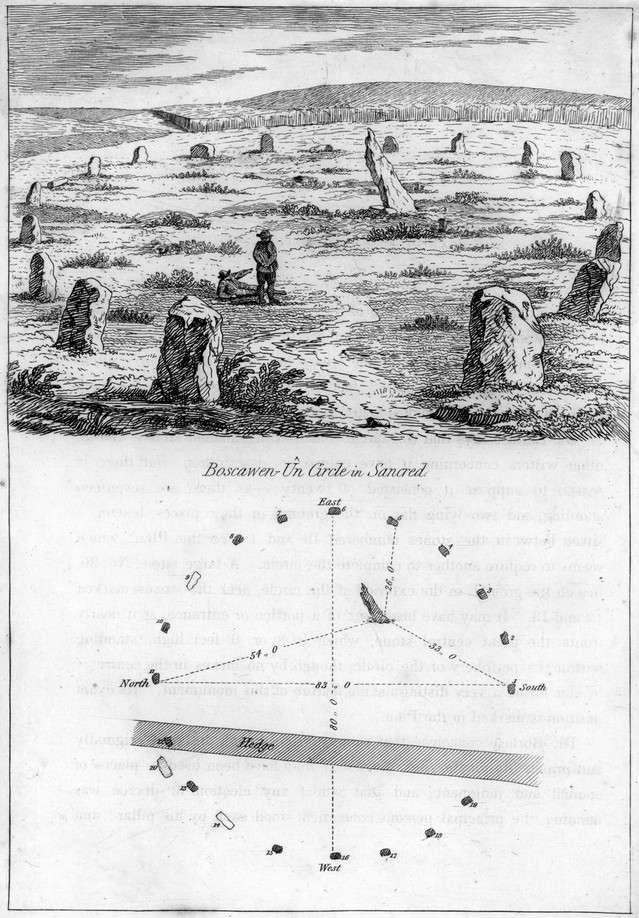
See full size stone circle image here.
|
|
|
|
|
|
A book of secrets by Keri. |
|
I dreamed I waited for a bus that never did arrive.
|
|
"Every series of letters has a meaning waiting to be found."
— Geof Huth |
|
|
|
|
|
Encarta covered our Semicolon's Dream Journal this week. In her witty and mirthful defense of the semicolon, columnist Martha Brockenbrough, author of Things That Make Us (Sic), wrote: Best, however, is the advocacy of Craig Conley, America's most creative and diligent scholar of letters, words and punctuation. To wit: Conley has created a punctuation mark (the rhetorical question mark), he has written a book of one-letter words, and he is so closely related to the semicolon's spirit that he has been appointed official keeper of its dream journal.
That's right, all you haters. The semicolon has dreams: dreams of rest and relaxation at Semicolon Lakes, of conversations about Shakespeare with the mischievous Puck, and even -- gasp -- of the nightmare that is semicolon cancer.
As Conley explained his close relationship with the semicolon, "I first dreamed that I was a semicolon when I was 6 years old. I vividly recall the uncanny experience of being frozen betwixt two closely related sentences. They called me 'the Go-Between.' In my dream, the words all glowed with an otherworldly green life force. Little surprise, then, that when I got my first IBM PC a decade later, typing my first glowing green semicolon brought the dream rushing back. For the past two decades, I've kept a dream journal from the semicolon's point of view."
Conley is happy when semicolons visit not just his dreams, but his discourse. He agrees with the music essayist Steven Harvey, who said in "Bound for Shady Grove" that the semicolon creates a "ringing emptiness" that "clears a space," a space for sacred silence that seals thoughts together. And he quotes Jesus Urzagasti from "In the Land of Silence," who said semicolons give us the air we need.
It's true, Conley said, that semicolons are asymmetrical. Beauty and symmetry are traditionally linked. But who doesn't admire the crooked Venus de Milo, who is one decapitated head away from being a sculptural semicolon herself?
Read the full article here.
|
|
Fast asleep. Singing birds in their leafy cover / Cannot wake her, nor shake her the gusty blast. / Under the purple thyme and the purple clover / Sleeping at last.
—Christina Georgina Rossetti, "Sleeping at Last," 1896.
|
|
|
|
|
|
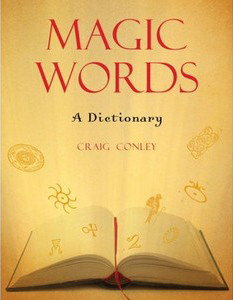
A new softcover edition of the groundbreaking Magic Words: A Dictionary is available for pre-order at Amazon.com at a 34% discount (plus an additional 5% pre-order discount). For the skinny on this beguiling reference, see our sister site MysteryArts.com. |
|
"Eventually, the night will be my only companion." — Geof Huth |
|
Information Prose :: A Manifesto in 47 Points :: Version 1.0
by Jeremy P. Bushnell, jeremy@invisible-city.com
39. There is nothing about hypertext that
demands that a story incorporating it must be written with forking
paths and multiple endings.
40. Hypertext writers who write
"closed" hypertexts — works that only contain links to other parts of
themselves — deprive hypertext of its most radical feature: the ability
to refer to information outside of itself. The bibliography is the
model here.
41. Information prose writers should embrace the
elements of hypertextuality which aid documentary. Think of the
hypertextual features long used by encyclopedias (cross-references).
42.
Information prose writers should, furthermore, embrace the elements of
multimedia which amplify the power of documentary. Compare an
encyclopedia with illustrations to one without. Compare a traditional
encyclopedia to Encarta.
43. To put it in the words of a friend: "You can now footnote a sound."
44.
Inasmuch as the Web supports hypertextuality and (to a lesser extent)
multimedia, the Web helps to make information prose possible.
45.
However, the Web is not the only thing that makes information prose
possible. Information prose is not dependent on hypertextuality, and
hypertextuality is not dependent upon computers. Think of indexes,
think of tables of contents, think of the numbers in the corners of
pages.
46. Aside from the merits of supporting hypertextuality
and multimedia, there are other advantages of writing for the Web, two
of the most obvious being the ability to make unlimited copies and the
ability to distribute copies worldwide at minimal (or no) expense.
These merits have been amply written on elsewhere. There are obvious
disadvantages as well. Information prose writers should support and
contribute to efforts to overcome these, which will help to secure the
Web as a vital medium for their future expression.
47. The present is here. It it time to begin. Pass it on.
|
|
Piecing together the secret of the stars . . . |
|
A palette nowadays is absolutely colorful: sky- blue, pink, orange, vermillion, strong yellow, clear green, pure wine red, purple. But by strengthening all colors one again obtains calm and harmony; there happens something similar to Wagner’s music which, even though performed by a great orchestra, is nonetheless intimate.
—Vincent van Gogh, in a letter to his sister, as quoted in Post-Impressionism from van Gogh to Gauguin by John Rewald, 1958.
|
Page 4273 of 4337
Original Content Copyright © 2026 by Craig Conley. All rights reserved.
|






 by