|
|
 |
|
| I Found a Penny Today, So Here's a Thought |
(permalink) |
|
|
|
  by jovikeThe Little-Known Meanings of Crazy Color Names vol. 2
We continue our strange and wonderful adventure into the uncharted fringes of language, in search of new "shades of meaning." Colors with seemingly incomprehensible names actually tell fascinating and humorous stories, at least to those who are willing to delve beneath the surface. The sandy color called chk gray refers to the sound of a shovel pushing through sand: "I listen until my itching subsides, and the nearby scratch of a shovel digging—chk... chk... chk...—is a gentle drumbeat calling me back to life." (Donald W. George, Japan: True Stories of Life on the Road. 
The green color called chk-chk-chk echoes the soft, rhythmic call of the Olive Thrush, as described in Birds of Kenya and Northern Tanzania by Dale A. Zimmerman. 

by Jeremy Hughes
The mysterious gray color called clk refers to an expression of anger by a Martian whose flying saucer has just been destroyed by a “little beast with a peppermint stick” (Will Eisner, Comics & Sequential Art). 
The pinkish color called dddd echoes “a loud hammering sound,” as described in Tongue Tie—From Confusion to Clarity: A Guide to the Diagnosis and Treatment of Ankyloglossia by Carmen Fernando. 
The smoky purple color called dlrdn refers to an interjection coined by François Rabelais in the novel Gargantua and Pantagruel, spoken by a native of the imaginary “Lanternland.” 
The light brown color dnnn refers to an incoherent response, as from someone intoxicated. “'You all right? You sick or anything, or just drunk?' 'Dnnn,' said Sandra." (William Kennedy, An Albany Trio. 
The light purple color called drrr echoes the sound of "door," as spoken by someone “slurring his words out of pure exhaustion,” as in the novel Doona by Anne McCaffrey. 
The bright green color called fff refers to the sound of a sky rocket fizzing up, as described in “More Than Words” by the New Zealand Ministry of Education. 
The even brighter green color called ffff means fortissississimo, a musician’s directive to perform a passage very, very, very loudly. 
Another green color, called fmp fmp fmmmmp, echoes the sound of a falling body hitting the ground, as in the graphic novel ShadowFall by Kaichi Satake. 
All of these color name insights are derived from my Dictionary of Improbable Words, which is available for online reading. [Read the entire article in my guest blog at ColourLovers.com.]
|
|
Piecing together the secret of the spirit-keeper . . . |
|
|
|
|
|
| I Found a Penny Today, So Here's a Thought |
(permalink) |
|
|
|
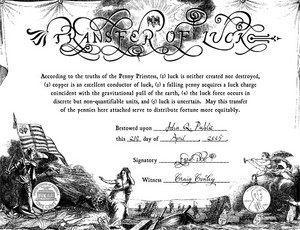
If you've stumbled upon a lucky penny and have a friend who may be down on his or her luck, print out our free, personalized Transfer of Luck Certificate (inspired by the Lucky Penny web site). Rendered in fine calligraphy, the certificate is easy to generate and completely free to print in high resolution. From the certificate:According to the truths of the Penny Priestess, (1) luck is neither created nor destroyed, (2) copper is an excellent conductor of luck, (3) a falling penny acquires a luck charge coincident with the gravitational pull of the earth, (4) the luck force occurs in discrete but non-quantifiable units, and (5) luck is uncertain. May this transfer of the pennies here attached serve to distribute fortune more equitably. Create your own Luck Transfer Certificate » |
|
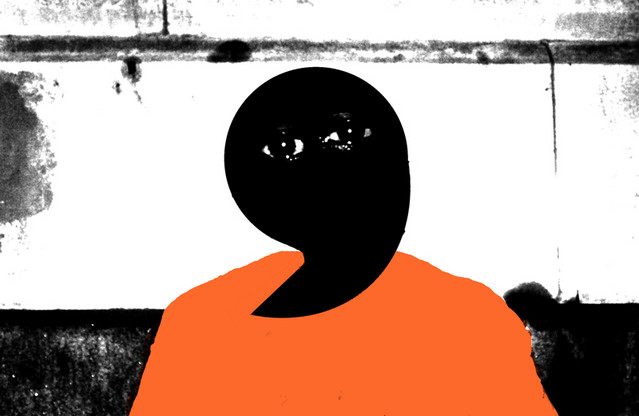
"The comma and the apostrophe are one. The comma punctuates the sentence, and the apostrophe punctuates the word." — Geof Huth |
|
|
|
|
|
| I Found a Penny Today, So Here's a Thought |
(permalink) |
|
|
|
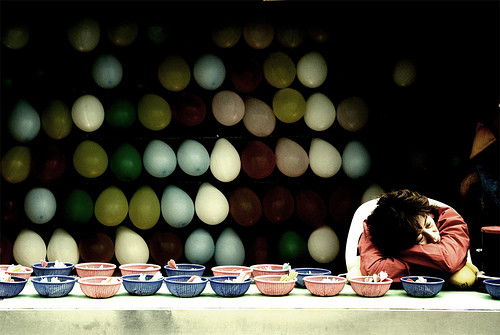
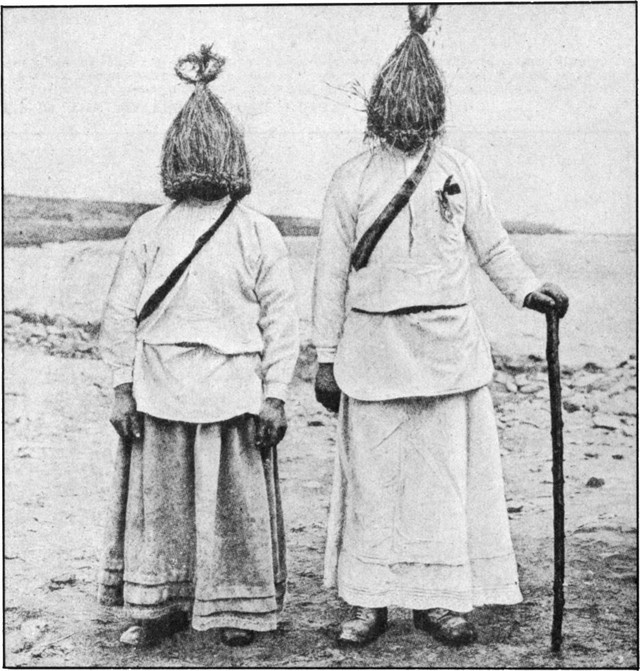
First came the mischievous Irish Straw Boys, the original party crashers. Now comes the rascally German "Zerrissen Jungen" (shredded boys), sporting masks of shredded paper.

This photo is actually by Frankfurt's Pixelgarten. We made up the stuff about "Zerrissen Jungen."
|
|
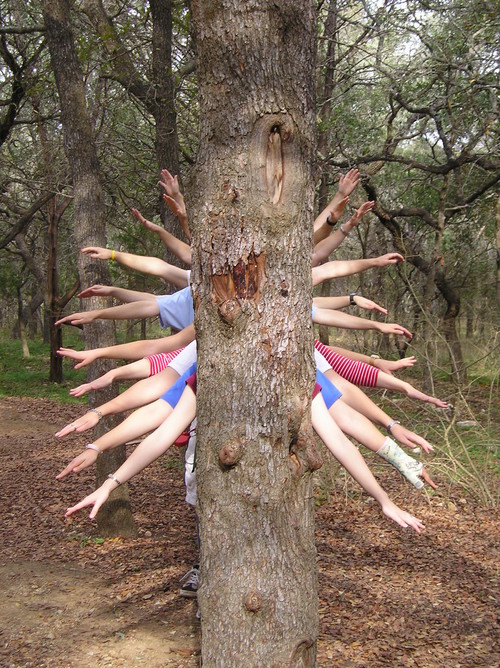
Piecing together the secret of the spider . . . |
|
At the bottom of the hill, the woods opened suddenly onto a pasture dotted here and there with black and white cows and sloping down, tier after tier, to a broad orange stream where the reflection of the sun was set like a diamond.
—Flannery O’Connor, The River, A Good Man Is Hard To Find And Other Stories, 1955.
|
|
|
|
|
|
We're proud (and somewhat astonished) to announce the World Premiere of Erik Satie's beguiling 18-hour composition "Vexations," performed in the style of a music box. The poet Chris Piuma requested this unprecedented performance, in anticipation of a cross-country train expedition.
Listener take note: Satie's composition is eerie, mind-bending, and hallucinatory. Please don't play while operating heavy machinery.
What does this highly unusual performance sound like? The first listener likened it to "the uncanny valley between creepy and pleasant, between soothing and agitating, between meditative and disturbing. And I'm sure 15 hours into it I will be in some other state entirely. . . . I've wanted to hear an uninterrupted performance of this piece for over a decade, and now here it is!"
The second listener praised music box maestro Ken Clinger for capturing "the continual, unrelieved dissonance, with no obvious sense of direction or tonal centre, and the total chromaticism. I think anyone listening to this for 18 hours and 40 minutes would definitely hallucinate. . . . I suppose it would be curious if for the next 18 hours I kept writing a response. I'm not sure if it would reveal the anguish over unreciprocated affection that I feel listening to this aural Auschwitz. Maybe I should instead podcast. . . . Hours have passed and my hands feel like balloons, my feet like stars, and my hair has turned gray. . . . The 17th repetition I have designated as the Schwarzschild radius. See how slowly I appear to move? Do not be fooled. . . . My elbows tingle in calliopeic sympathy (or that may just be an odd manifestation of the carpal tunnel). . . . I can't stop crying. And laughing."
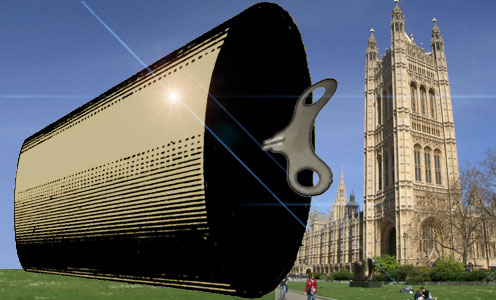
Fun fact: A music box cylinder containing the full score (with all 840 repetitions) would measure 4,032 inches in diameter (336 feet), which is the same height as the Victoria Tower at London’s Westminster Palace.
 |
In addition to streaming audio, a 63 MB mp3 of "Vexations" is available. --- Dankitti writes: 18 hours? The best I could do was Guru Sven, which is only 12 hours.
|
|
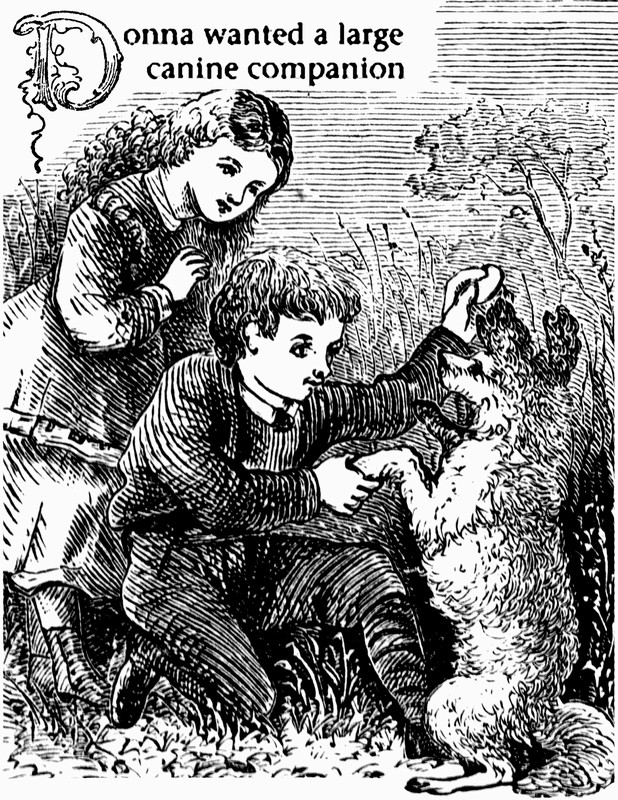
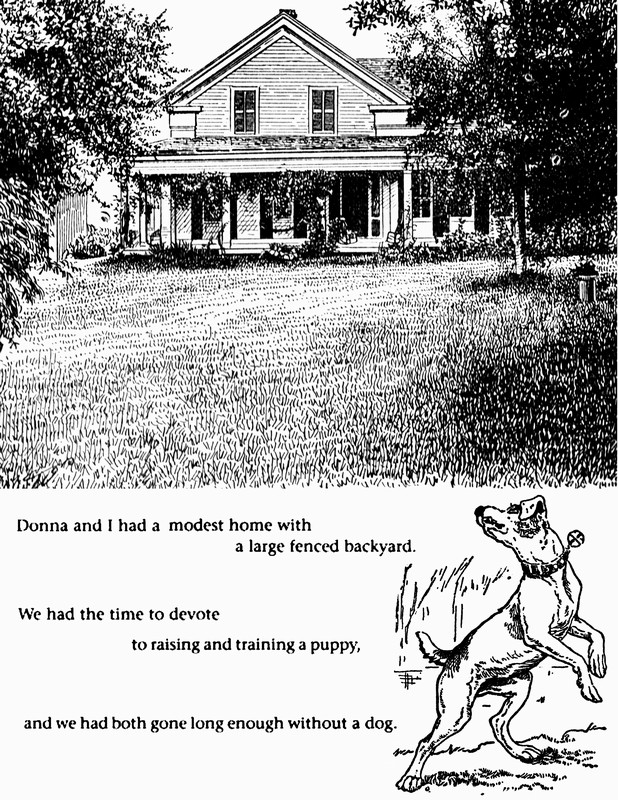
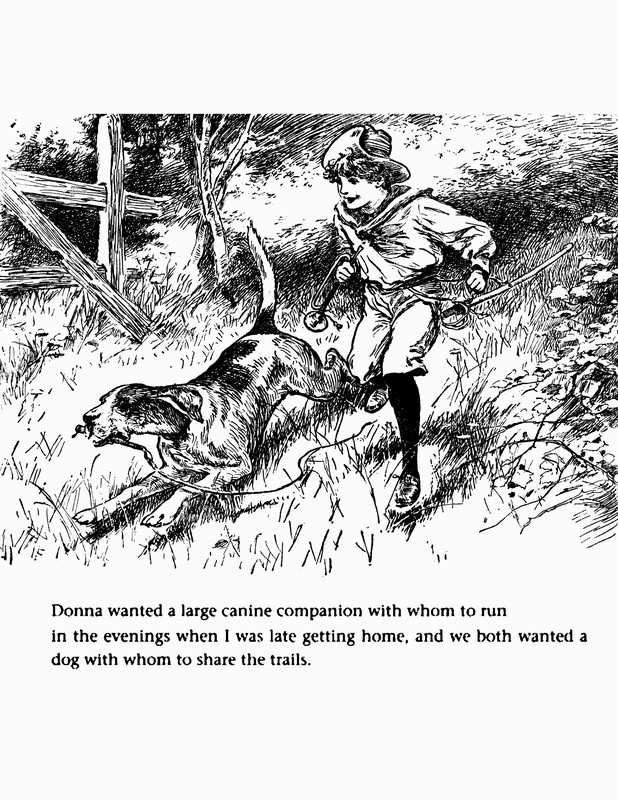
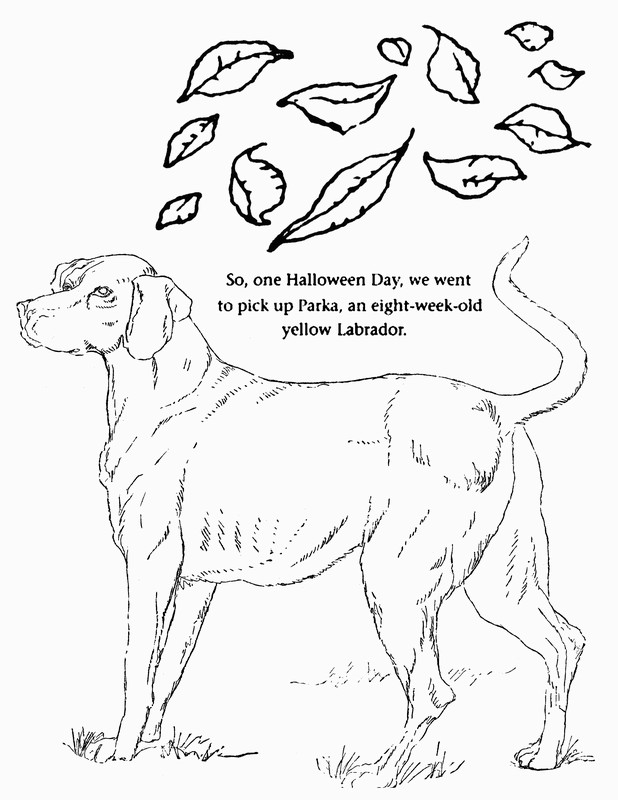
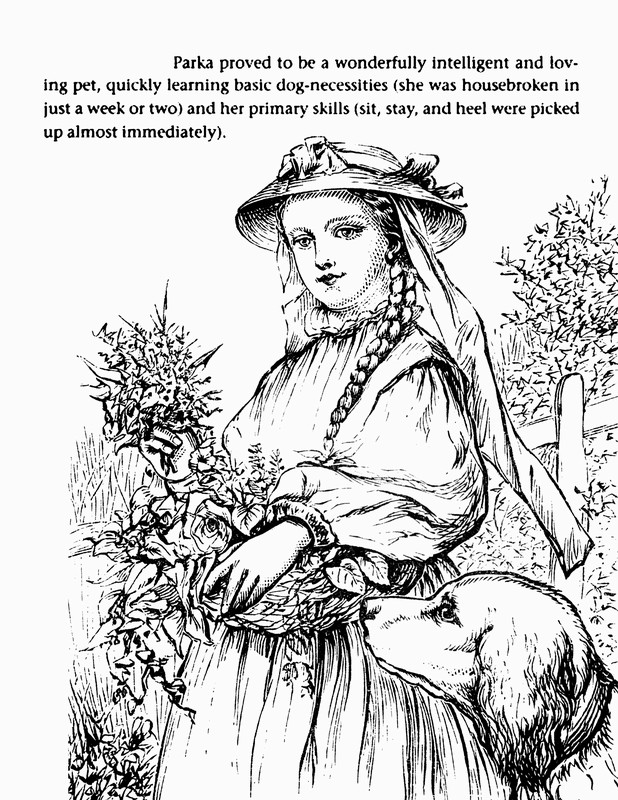
A collaged story we assembled for a singular Donna and henceforth dedicate to all the Donnas of the world. Click on the thumbnails below to view an enlarged version in a new window. |
|
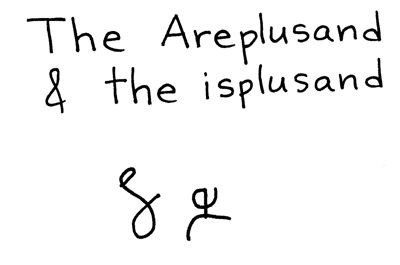
I dreamed that Geof Huth introduced me to the "areplusand" and the "isplusand." We gossiped together, but the ampersand's name never came up. |
|
Years pass by and leave things unaltered. The same narrow, red roads run through cotton- and cornfields. The same time- grayed cabins send up threads of smoke from their red- clay chimneys, doorways, and china- berry and crape- myrtle blossoms to drop gay petals on little half- clothed black children.
—Julia Peterkin (1880–1961), “Ashes,” from Green Thursday: Stories by Julia Peterkin, first published in 1924.
|
|
Her face lit up like a rainbow.
|
|
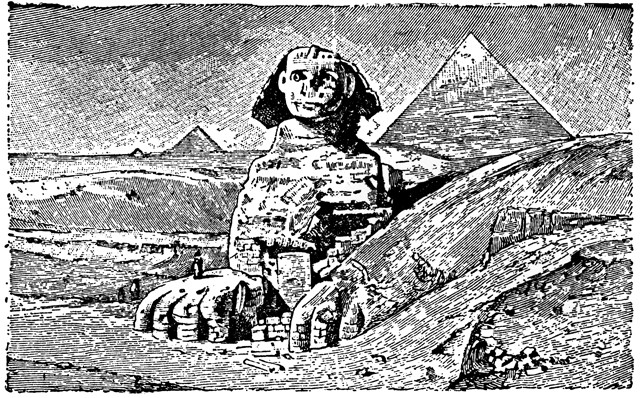
Piecing together the secret of the Sphinx . . . |
|
| I Found a Penny Today, So Here's a Thought |
(permalink) |
|
|
|
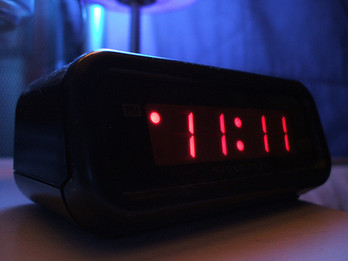
The poet Geof Huth offers this lovely commentary on why we notice and in fact need "11:11": 11:11 At certain points in measured time, the world seems to come into alignment, concepts tend to clarify, ideas gel. But we know in our hearts that this is false, that midnight is as meaningless a concept as the idea that a new year begins at a certain second after a particular midnight. We cannot believe fully in these ideas because we understand that we worship and are guided by arbitrary signs created by humans: sequences of numbers, sounds, or letters. ||:|| But we continue to follow these signs because they direct our lives so well. Their meaningless is the source of their meaning and their power. We imbue them with their significance, so we believe them. Even if they become twisted out of shape, we continue to believe them, we continue to see them, we continue to understand them. |||| We can reduce the information in a sign and still be able to read it, still be able to make sense of it, to add sense to it. We do this to eradicate ambiguity, to make sense. The world is a mass of contradictory signs, so we must choose the ones to read, how to read them, the ones to believe. :::: In the end, we have only ourselves to blame. We look for symmetry. It pleases us. That is what we like about architecture, a metrical poem, crossword puzzles, seemingly deft plotting in a story. And the only thing that makes the asymmetrical interesting is that it runs counter to an existing symmetry. We need symmetry. We need symmetry to give beauty to the surprisingly asymmetrical. .... We need 11:11 to find ourselves an idea to play with. We need 11:11 to feel our lives are temporarily in balance. We need 11:11 to feel human. Without 11:11, the world just runs away from us, untamed, untameable, even unsought. ---------- Sexy Girl responds: 11:11 is my fav time. To me it represents dimensional unity... like playing two octaves at once on the piano. Same but different. Somehow the harmonious moment is magnified when the two are played as one. Kinda like love relationships are meant to be ... yeah.
|
Page 4274 of 4337
Original Content Copyright © 2026 by Craig Conley. All rights reserved.
|











 by