|
|
 |
|
The poet Chris Piuma scours our Dictionary of All-Consonant Words for three obscure, vowelless words from Ezra Pound's " Canto IX" ( grnnh! rrnnh, pthg). Does he find them, or will Pound's curious expressions resist interpretation for another ninety years? Read about the spirited adventure here:------
There is a curious line in Ezra Pound's "Canto IX": grnnh! rrnnh, pthg.
The typical dictionary is not terribly helpful at elucidating this line, so we must consult a more specialized work. Craig Conley'sAll-Consonant Words Dictionaryoffers a more likely source for discovering the meanings of such obscure and vowelless words.
And yet, none of those three words appear. At first, it seems that yet another dictionary has failed us. But this is where we can use skills picked up by working with medieval texts: Perhaps these are scribal errors, mistakes in the transmission, or else they might be variants of already familiar words. Can we, then, find similar words in this dictionary?
- gnnnh.
- interj. a groan of pain.
<“Gnnnh!” he said, and drew himself up into a ball to escape the pain of his emergent teeth. —Diana Gabaldon,The Fiery Cross.
It is easy to misread a hastily written "n" for an "r", and we can posit with great confidence that "grnnh", especially with its exclamation point, is actually "gnnnh", this pain cry.
- rrrrrrrnnng.
- n. the ring of a telephone.
<When he woke up, the killer headache hadn’t gone away and the phone was ringing. A fourth ring. A fifth. He still made no move to pick it up. Rnnnnnnnnngagain. —Morrie Ruvinsky,Dream Keeper: Myth and Destiny in the Pacific Northwest.>
At first this seems an unlikely reading of "rrnnh", what with Pound's word having so fewer Rs, and an H instead of a G. But then we recall that this Canto would have been written in the late 1910s or early 1920s, when telephony was in its early stages, and ringer boxes -- which at that point weren't even in the telephones proper -- had not been perfected. There were, we can see, too few Rs. The final "ng", which we pronounce as a satisfying /ŋ/, was then the softer /ɲ/, which Pound spelt the Portuguese way, "nh".
- Pthr.
- n. the title of a work of art by Michael Paulus based upon illuminated eye charts of the 1800s but modified so that “clinical function is surpassed by style and frivolity” (MichaelPaulus.com).
This one is the most problematic. We can write off the capital P being in minuscule as Modernist poetic license. The "r" becoming a "g" -- it seems unlikely to be a scribal error, and you'd have to be Russian to hear those sounds as related. And, worst of all, this art work did not exist yet, and Ezra Pound's ability to foresee the future was demonstrably not that great. We must reject the dictionary's offering as untenable.
Instead I'd like to suggest that it is a transliteration, done to obscure its origins, as a kind of code. You can map "p" onto "π", "th" onto "θ", and "g" onto "γ". "πθγ", of course, isn't a word in Greek -- would that there were some Greek All-Consonant Words Dictionary that I could consult to confirm this! -- but capitalize those letters, "ΠΘΓ", and you get Pi Theta Gamma, perhaps nothing more than the name of some obscure fraternity.
Now, I am no Pound scholar, nor a member of any such fraternity, so the possible connections or the exactly meaning of this reference is still unclear. But the scenario being described in the Canto is now reasonably clear: Pound is in pain because the phone is ringing and he is sure it is just the boys down at the frat calling him again, perhaps hoping to get him to come by the house, have a few beers, whereas all he wants to do is work on his epic poem, the one that would change history, the one that would explain history, and yet he knows they will keep calling to try to get him to go, and so he cries out in pain. The birthing of an epic poem is like getting one's baby teeth in, a painful process that will change everything about how you interact with the world. But for Pound there was no one who cared enough to apply Anbesol on his tender gums -- certainly his fraternity brothers wouldn't! And so this deftly coded message was inserted into The Cantos and resisted interpretation for ninety years.
|
|
The Typographer and the Dingbat
One fine evening a strolling man heard an exclamation for help from the bottom of a deep well. "What's the matter?" he called down.
"I am a typographer," came the reply. "I was taking a slash, dropped my dagger, and descended into this grave."
"Calm down, dear sir, or you'll have a stroke," said the man.
"One moment, please!" called the typographer. "It's not a stroke; it's a virgule!"
"In that case, I'll go for a long dash," said the man.
"Ellipsis, you dingbat!" cried the typographer, but the man was long gone, and for good.
(We were inspired by a Sufi tale told by Rumi, as collected in Tales of the Dervishes by Idries Shah. Our retelling is dedicated to Paul Dean.)
|
|
|
|
|
|
The poet Chris Piuma offers this inflationary update to the Minutemen's album title "Double Nickels on the Dime": Double Bits on the Quarter
|
|
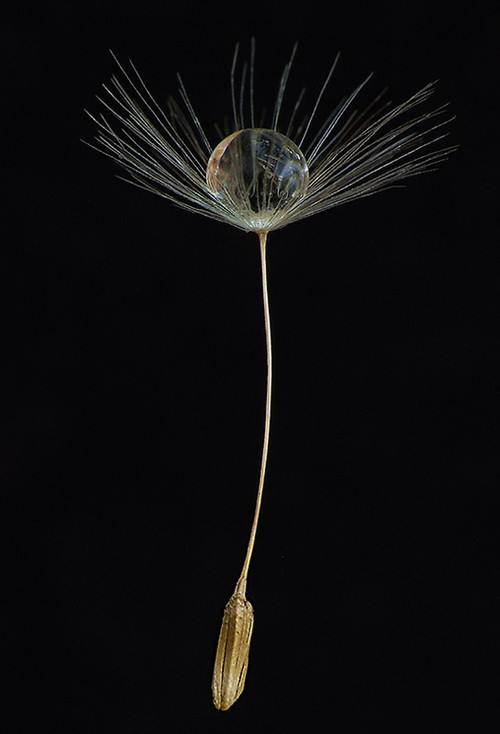
Piecing together the secret of the soul . . .
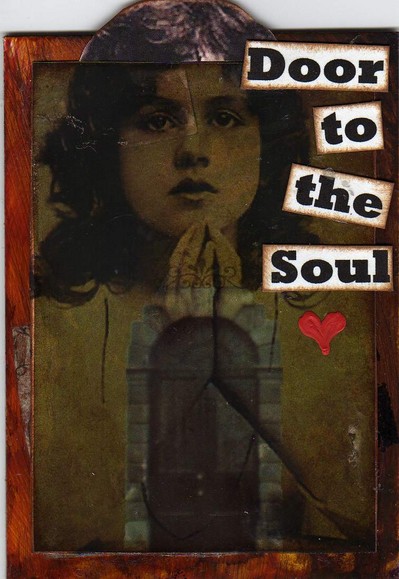
Artwork by Pamela Carriker. See full size image here.
|
|
|
|
|
|
| I Found a Penny Today, So Here's a Thought |
(permalink) |
|
|
|
  by jovikeThe Little-Known Meanings of Crazy Color NamesColors with seemingly incomprehensible names actually tell fascinating and humorous stories, at least to those who are willing to delve beneath the surface. Join me on a strange and wonderful adventure into the uncharted fringes of language, where we'll discover new "shades of meaning." The chilly blue color called brrrrrrr refers to the "Official State Motto of Alaska," according to humorist Dave Barry (Dave Barry’s Only Travel Guide You’ll Ever Need). 

by Dalephonics
With an additional "r," the watery color called brrrrrrrr conjures up the sound of someone shaking water out of his or her ears after crawling out from under a waterfall, as in Sacred Journey of the Peaceful Warrior by Dan Millman. 
The green color called bbbbbb echoes a vocal imitation of "a sailing boat in a tub of water," as discussed in Baby Talk: The Art of Communicating with Infants and Toddlers by Monica Devine. 
The orange color called "bssss bssss" refers to the German word for the buzzing of a bee. 
The electric green color called bzzt recalls the crackle of a security spotlight turning on, as in Revenge of the Lawn Gnomes by Teddy Marguiles. 
The bright yellow color called bzzz refers to a deliberately mumbled word, due to passive-aggression (Nancy Scheper-Hughes, Saints, Scholars, and Schizophrenics: Mental Illness in Rural Ireland, Twentieth Anniversary Edition). 
The sanguine color called ccc echoes an ambiguous sound made by someone paralyzed with fear, as in the novel Theo Slugg in Low Spirits by Simon Goswell. 
The tawny color called chchch refers to a sound that Guatemalan village children make to get attention (Jason A. Lubam, “Diary of a Jungle Acupuncturist,” Acupuncture Today). 
With an additional "ch," the smoky purple color called chchchch refers to a French word for musical percussion lacking a definite note (fr.AudioFanzine.com). 
Add yet another "ch," and the golden color called chchchchch echoes the “guttural unvoiced growl” of a tiger (Metamorphosism.com). 
All of these color name insights are derived from my Dictionary of Improbable Words, which is available for online reading. [Read the entire article in my guest blog at ColourLovers.com.]
|
|
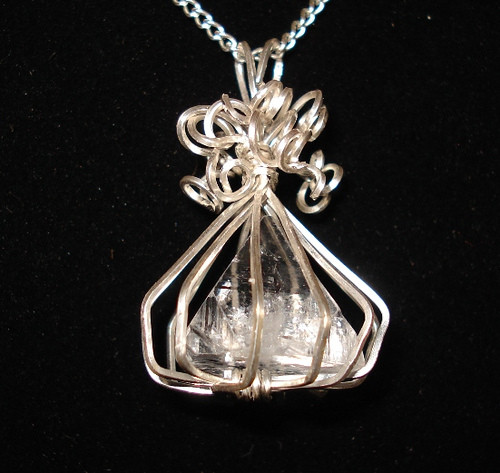
"The magic of any gem is dependent upon the magic of the light that gives it life and fire. Gems are complex things and handle light in complex ways. Light doesn’t just uneventfully flow through windows as it does through glass, or simple bounce back as from a black-hearted mirror. Instead it dances impatiently, refracts and reflects. It comes alive along with the gem. In a weird way, a gem is a crystal cage that traps the light and makes it fight to escape." — Diane Morgan, Fire and Blood; Rubies in Myth, Magic, and History, 2008 |
|
|
|
|
|
From A Surrealist Dictionary by J. Karl Bogartte: CHAOS: A fleshy, succulant fruit—the seeds of which are often used as umbrellas.
|
|
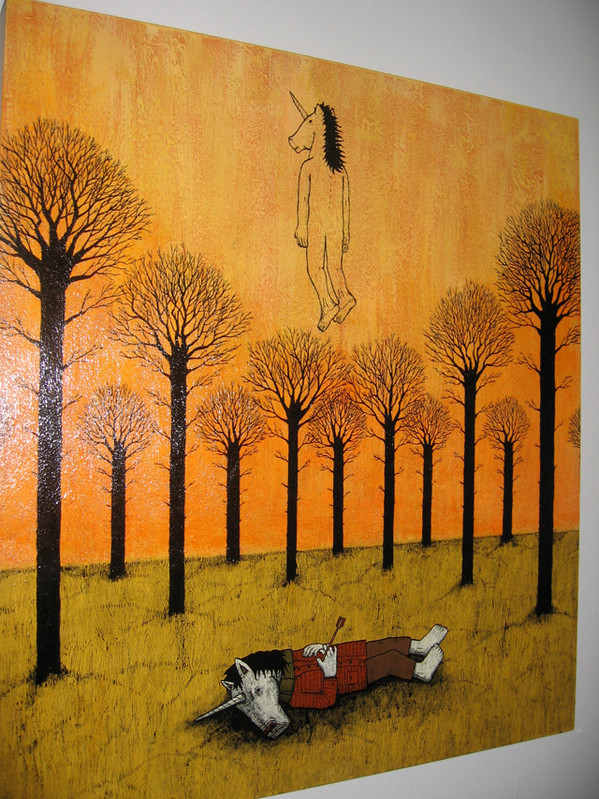
A unicorn soul, as depicted by Andy Kehoe:
|
|
|
|
|
|
| Did You Hear the One I Just Made Up? |
(permalink) |
|
|
|
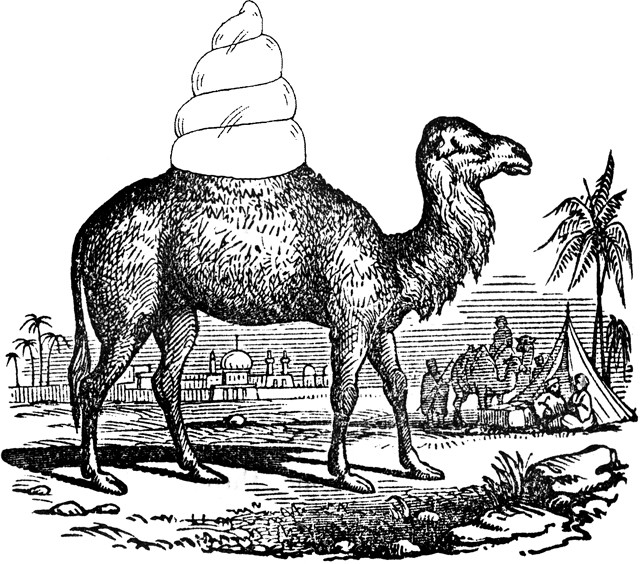
Fictional Movie Taglines: Tears in Your Camel Milk: A dromedary dairy drama (thanks, Mike!) Camel Milk Journal: A dromedary dairy diary (thanks, Jonathan!) |
|
One weekend Trout and Eel decided to paint their bedroom blue. The walls were the turquoise of the southern seas, the ceiling was cobalt, the floors indigo, the color of waters so deep and distant, no human had ever seen them before. Here in this room anyone could imagine the sound of waves breaking.
—Alice Hoffman, Indigo, 2002.
|
|
|
|
|
|
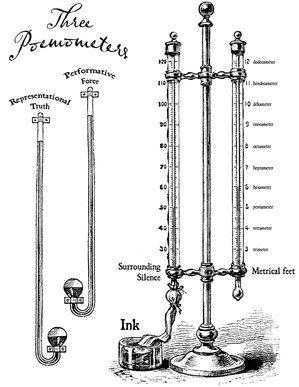
This piece is in honor of Geof Huth, who measures the value of a poem with a poemometer. Geof blogged his response: How Craig Conley (the author of One-Letter Words: A Dictionary) does this, I do not know, but here, after less than a day’s work, are diagrams of three poemometers (based on my reference to same last night). Note that the largest measures the metrical feet (the sounds) against the surrounding silence the poem always fights against. (This one device is not calibrated finely enough to allow for dimeter, but we will do without that as necessary). The other two poemometers measure performative force and representational truth. Even though being the more sophisticated devices, they are simpler in structure. I am not sure when Craig will have these ready for sale, but I expect it will be soon. |
|
Piecing together the secret of silence . . . ______ Sara Soares writes: Wise words.
|
|
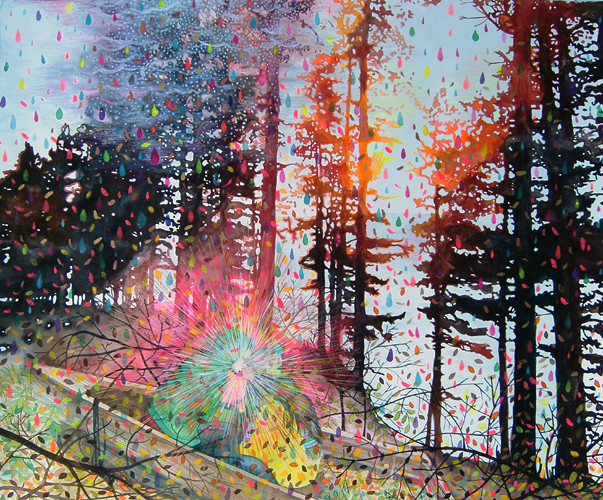
Artist Eric Nykamp strives "to create images of silence." |
|
|
|
|
|
The 19th-century visionary Andrew Jackson Davis predicted the typewriter in 1856, picturing it as a "soul-writer" for poets: I am almost moved to invent an automatic psychographer; that is, an artificial soul-writer. It may be constructed something like a piano; one brace or scale of keys to represent the elementary sounds; another and lower tier, to represent a combination; and still another, for a rapid recombination; so that a person, instead of playing a piece of music, may touch off a sermon or a poem!
For his vision of the future automobile, see Futility Closet. --- Sara Soares writes: What a brilliant idea!
I'm sure you are the right person to build such a thing.
|
|
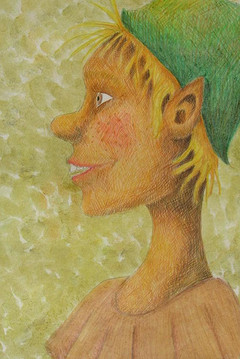
They live ’neath the curtain / Of fir woods and heather, / And never take hurt in / The wildest of weather, / But best they love Autumn — she’s brown as themselves — / And they are the brownest of all the brown elves.
—Patrick Chalmers, from "The Puk-Wudjies", a poem published in Punch in 1910.
|
Page 4275 of 4337
Original Content Copyright © 2026 by Craig Conley. All rights reserved.
|












 by