|
Obscured LocationThe oldest trick in the book is for the rootkit to obscure its own location on the disk.
—Anton Chuvakin, Security Warrior (2004)
|
|
|
|
|
|
When the " Weekly Rob" blog featured my " Inflationary Lyrics" project, BruceS commented: Are there pay phones that only take a quarter? Ours take two, so the tireless updaters would need to rhyme with "50 cents". Of course, few people use pay phones any more, since everyone (even cavemen, according to TV) now has a cell phone. Cell phones not only allow people to share their call with strangers, instead of having that annoying isolation of a pay phone box, they also allow us to make and receive calls while driving, sharing lunch with a friend, or disposing of that lunch later in a public facility. Try any of *that* with a pay phone!
WeeklyRob responded that "The job of an inflationary lyricist never ends." |
|
Now You See It, Now You Don’tThat is the oldest trick in the book. Now you see it — now you don’t.
—William N. Jackson, More than a Wish (2004)
|
|
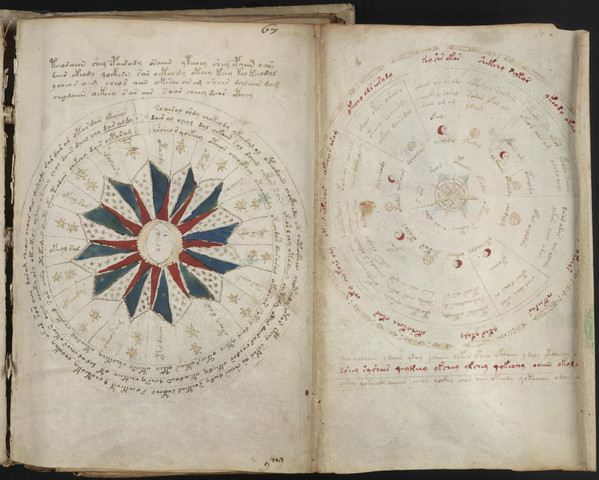
The Voynich Manuscript is "a mysterious illustrated book with incomprehensible contents. It is thought to have been written between approximately 1450 and 1520 by an unknown author in an unidentified script and unintelligible language" ( Wikipedia). Every few years, another scientist holds a press conference to declare the book a "hoax." The book (see high-resolution scans on flickr) is undoubtably an historical document, an artwork, and an insight into psychology (as the creator's brainstorm). To call it a " hoax" seems so dismissive. Indeed, it's like missing the forest for the trees. Whether or not the document encodes specific meaning, it exists and has significance. One is reminded of ancient petroglyphs, which could be a form of writing, or merely whimsical doodles/graffiti, but certainly "meaningful" and worthy of study (or at least appreciation). I'm all for computer scientists and cryptographers, but these so-called explanations of the Voynich Manuscript tell more about the tunnel vision of those fields than they do about the manuscript itself. And I thought only statisticians still cited statistical probabilities with a straight face, everyone else in the world having realized that statistics are, unfortunately, as useless as tomorrow's weather forecast!
|
|
|
|
|
|
| I Found a Penny Today, So Here's a Thought |
(permalink) |
|
|
|
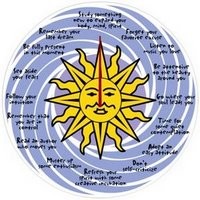
The Follow Your Bliss Compass is located here.
The La Dolce Vita blog got empowered by my Follow Your Bliss Compass. Here's an excerpt: While shopping, I was contemplating on making a large furniture purchase. Undecided, I kept finding reasons not to spend the money. The clerk then said to me "Before you purchase, follow your bliss." What?? How about room theme or color scheme, but bliss? What does bliss have to do with my purchase decision? Do you ever have the sense of being helped by hidden hands? Today I did... I need to go out and do what makes me come alive. I need to tap into the energy that makes me tick. Bliss comes from within, not from striving for outer appearances or outer circumstances. Living my own unique life in harmony with myself (and my son)... Now, that's bliss. I found this website ( www.oneletterwords.com/bliss) and may spin the wheel on a daily basis. Maybe, just maybe, this will help to keep me on the right track. My "Follow Your Bliss Compass" suggested that it is 'Time for some quiet contemplation'. The comment from the clerk and this compass have already made an empowering change in my life. |
|
| Puzzles and Games :: Letter Grids |
(permalink) |
|
|
|

This puzzle grid contains several big words. Can you find them?
• 7-letter words: 11
• 8-letter words: 2
One 7-letter word means "a stretch of land." All letters in the word must touch (in any direction), and no square may be reused.
Click to display solutions
|
| 7-letter words: |
• arbiter
• article
• auricle
• burkite
• daubier
• detrain |
• quirted
• retrain
• terrain
• tribade
• utricle |
| 8-letter words: |
| • articled |
• auricled |
|
|
|
Here's an excerpt from an article about how "the last semicolon gets the last laugh": Written language captures things that spoken language never could. Does anyone know, for example, what a semicolon sounds like?
Consider the sentence "Order your furniture on Monday, take it home on Tuesday." With a comma, it means that if you order your furniture on Monday, you can take it home on Tuesday. "Order your furniture on Monday; take it home on Tuesday" is different, however; it is a double command. But sometimes you can't tell the difference between the two sentences simply by hearing them read aloud. You need to see their punctuation to detect the difference.
If you look carefully, Mr. [Geoff] Nunberg said, the world of punctuation has its own rules of power politics. Commas are the weakest, semicolons are middleweight powers and colons are superpowers. Look more carefully and there is even a ranking among semicolons.
— The Middleweight of Punctuation Politics |
|
|
|
|
|
The Presence of AbsenceRich Haswell poses an intriguing question: When spoken, the word "silence" contradicts its meaning. Gomringer's concrete poem [below left] creates a new and better word for "silence": the void in the middle. That space, that absence, is now filled with an eloquent presence. So then what is the better representation of a dead person, a photograph displayed or no photograph available?
 The full size of this illustration is here. Also of interest, the artistry of Mark Mumford: "Nothing Ever Happened Here," 2002. Paper, ink, stainless steel, and vinyl.
|
|
"New"The oldest trick in the world is to put the word “new.” I mean nothing is older than the idea of the new.
—Christopher Hitchens, “Transcript of People in the News,” CNN (2003)
|
Page 4313 of 4337
Original Content Copyright © 2026 by Craig Conley. All rights reserved.
|