|
|
 |
|
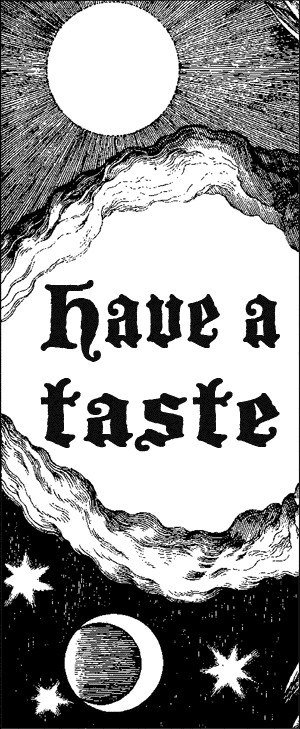
Imagine a game of "What's My Line," in which either a cherub or an imp whispers into a blindfolded panelist's ear.
Are the whispered words pictured on the right of an angelic or a diabolical nature?Answer: Diabolical. "Some Demon whispered, 'Visto! have a taste.'" —Alexander Pope, "Epistle IV," The Works of Alexander Pope Vol. III, 1881, p. 173. (The answer is in black text on the black background. Highlight it to view.) --- Gordon writes: Love this series!
|
|
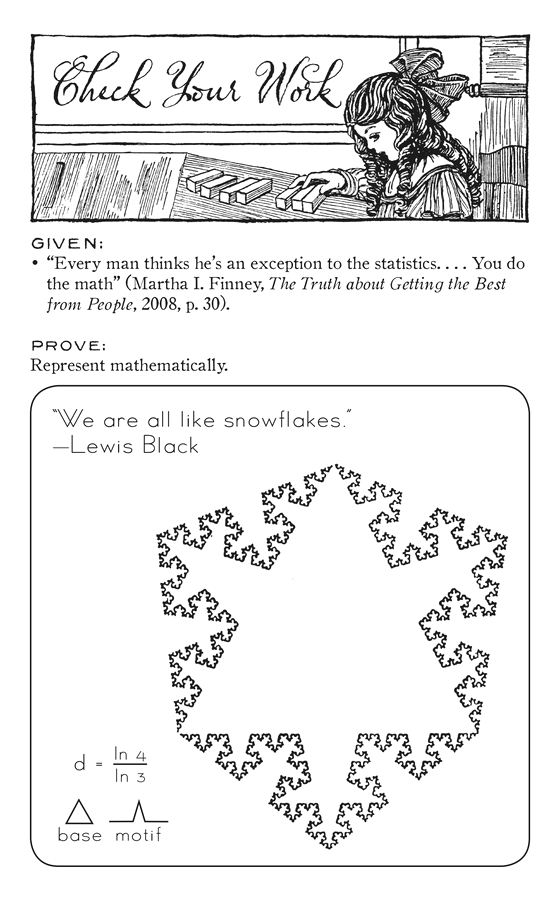
INSTRUCTIONS: Click on the puzzle image below to reveal one possible solution.
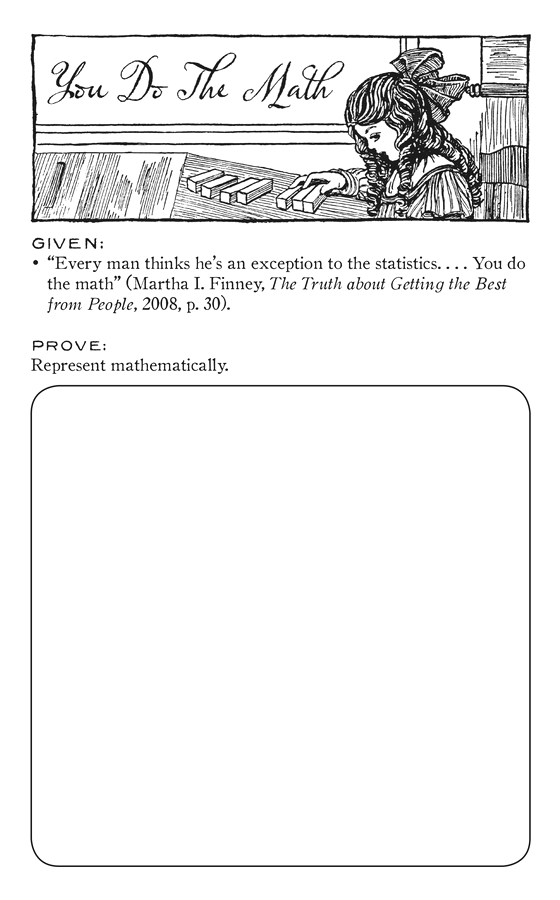
|
|
|
|
|
|
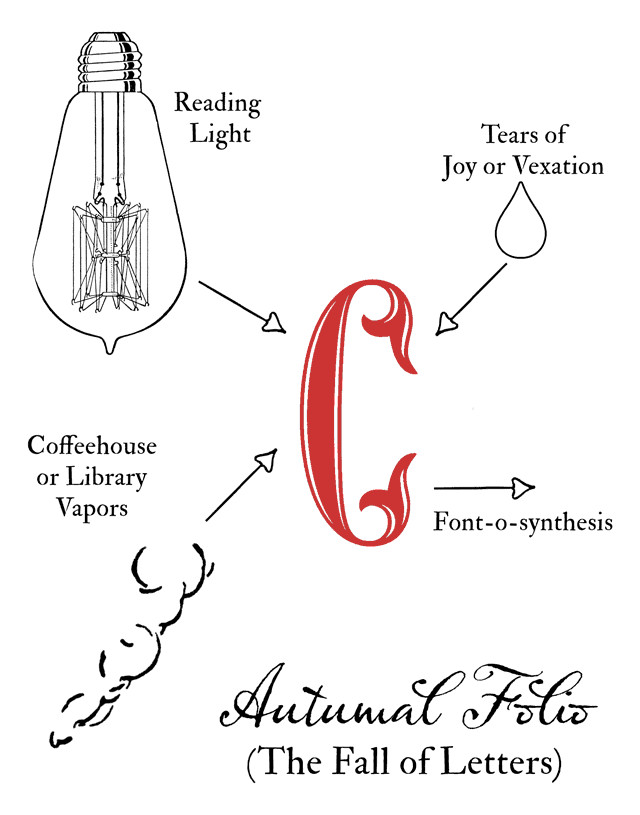
From Prof. Oddfellow's sketchbook: This piece was inspired by Andy Paik and Arcana Chaos. The red letter C is from the award-winning typeface created for our One-Letter Words: A Dictionary (HarperCollins) by Mucca Design. |
|
| The Ghost in the [Scanning] Machine |
(permalink) |
|
|
|
~ Classic Sightings ~

Portrait from Memoir and Correspondence of Caroline Herschel.
It’s not every day we meet a spirit who has been transferred to the University of Washington library.
To understand what's going on here, see The Ghost in the [Scanning] Machine.
|
|
“Be tenacious! One day your ship will come in.” —Ann Majchrzak
|
|
|
|
|
|
In the British comedy series " Absolutely Fabulous," a life coach gives this ridiculous "daily aim": "Have a great idea and write a pop song." We couldn't help but think back on that line when we saw this advice:
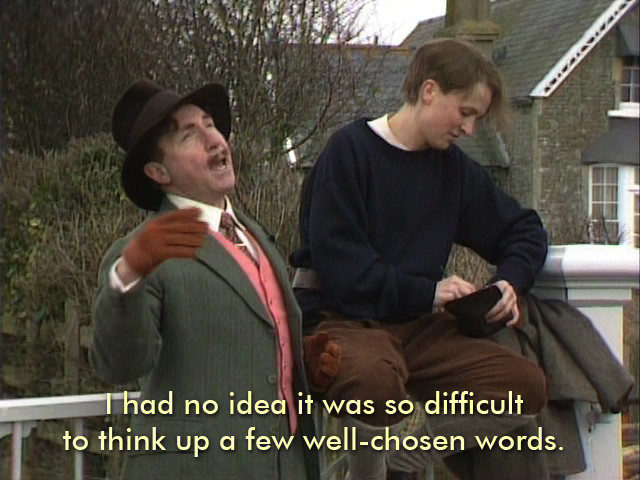
This frame is from the hilarious and endearing Mapp & Lucia series, based on E. F. Benson's novels. We agree with Nigel Hawthorne here — well-chosen words don't write themselves!
|
|
| The Ghost in the [Scanning] Machine |
(permalink) |
|
|
|
~ Classic Sightings ~

Portrait from Collected Poems of Rupert Brooke.
“A poet’s ghost is the only one that survives for his fellow-mortals, after his bones are in the dust.” —Nathaniel Hawthorne, Our Old Home
To understand what's going on here, see The Ghost in the [Scanning] Machine.
|
|
|
|
|
|
Philosopher G.E. Moore suggested that there must be such thing as a unicorn, since the human mind can think of it and can distinguish the thought of a unicorn from the thought of a griffin. H is convincing explanation:
When I think of a unicorn, what I am thinking of is certainly not nothing; if it were nothing, then, when I think of a griffin, I should also be thinking of nothing, and there would be no difference between thinking of a griffin and thinking of a unicorn. But there certainly is a difference; and what can the difference be except that in the one case what I am thinking of is a unicorn, and in the other a griffin? And if the unicorn is what I am thinking of, then there certainly must be a unicorn, in spite of the fact that unicorns are unreal. In other words, though in one sense of the words there certainly are no unicorns–that sense, namely, in which to assert that there are would be equivalent to asserting that unicorns are real–yet there must be some other sense in which there are such things; since, if there were not, we could not think of them. — G.E. Moore, Philosophical Studies, 1922
|
|
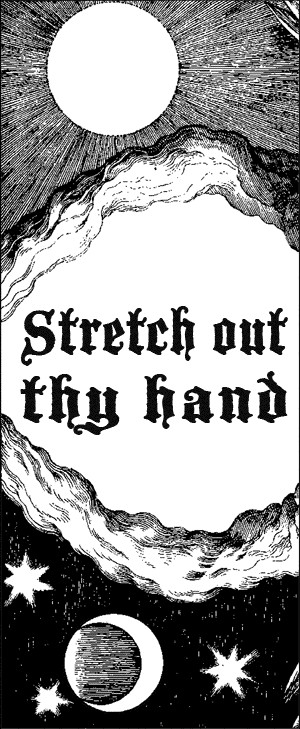
Imagine a game of "What's My Line," in which either a cherub or an imp whispers into a blindfolded panelist's ear.
Are the whispered words pictured on the right of an angelic or a diabolical nature?
Answer: Angelic. "An angel whispered in her ear, 'Stretch out thy hand.'" —Emanuel Geibel, "As It Often Happens,” The Ridpath Library of Universal Literature by John Clark Ridpath, 1898. (The answer is in black text on the black background. Highlight it to view.)
|
|
 Is it true, as Momus
suggests, that there are "few tales which would not be improved by the
addition of the phrase 'suddenly, a shot rang out'"? Decide for
yourself as we alter the opening lines of . . . THE SHADOW LINE by Joseph ConradOnly the young have such moments. I don't mean the very young. No. They very young have, properly speaking, no moments. It is the privilege of early youth to live in advance of its days in all the beautiful continuity of hope which knows no pauses and no introspection. One closes behind one the little gate of mere boyishness—and enters an enchanted garden. Its very shades glow with promise. Suddenly, a shot rings out.
|
|
|
|
|
|
Prof. Oddfellow goes into the field (in this case, an icy lake freezing around his precarious canoe) to listen for unicorns. Join the adventure on YouTube or the superior Vimeo. The next morning, only the canoe's wake remains unfrozen (see bottom photo).
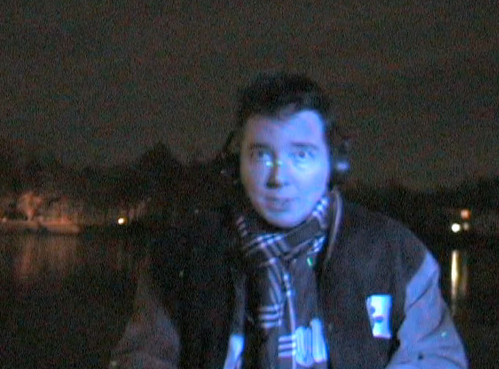
Discover Oddfellow's surprising tools for luring unicorns.
|
|
Nabokov suggests that the "ultimate vision is the incandescence of a book or a box grown completely transparent and hollow. This is, I believe, it: not the crude anguish of physical death but the incomparable pangs of the mysterious mental maneuver needed to pass from one state of being to another." (Transparent Things)
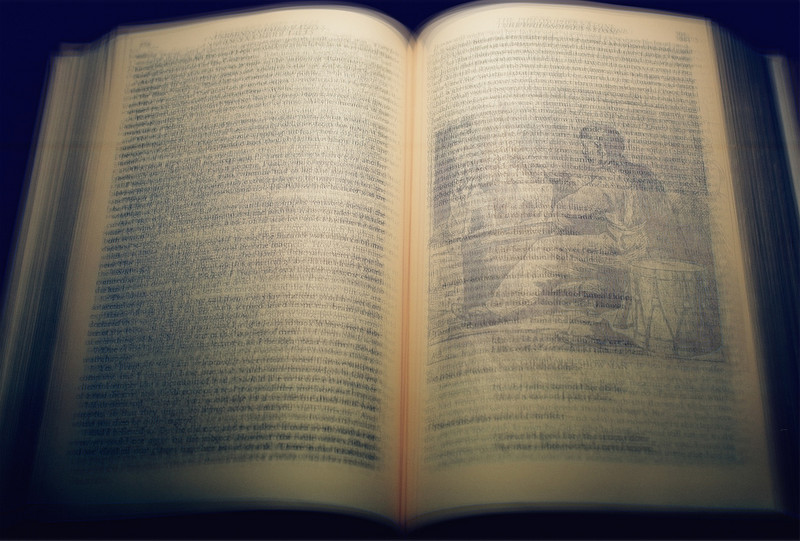
Hans Christian Anderson transparent book by Sam Provoas.
|
|
|
|
|
|
 "What most people don’t understand is that typography is the use of language that in itself is its own language – one that can take a lifetime to learn and perfect, and that few ever do." — Chip Kidd, The Learners, 2008, via DJMisc --- June adds: "As the saying goes, type is a beautiful group of letters, not a group of beautiful letters." —Matthew Carter
|
|
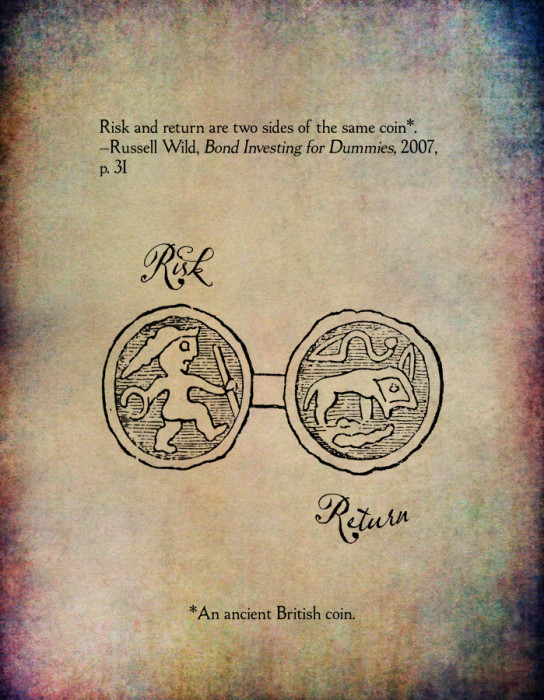
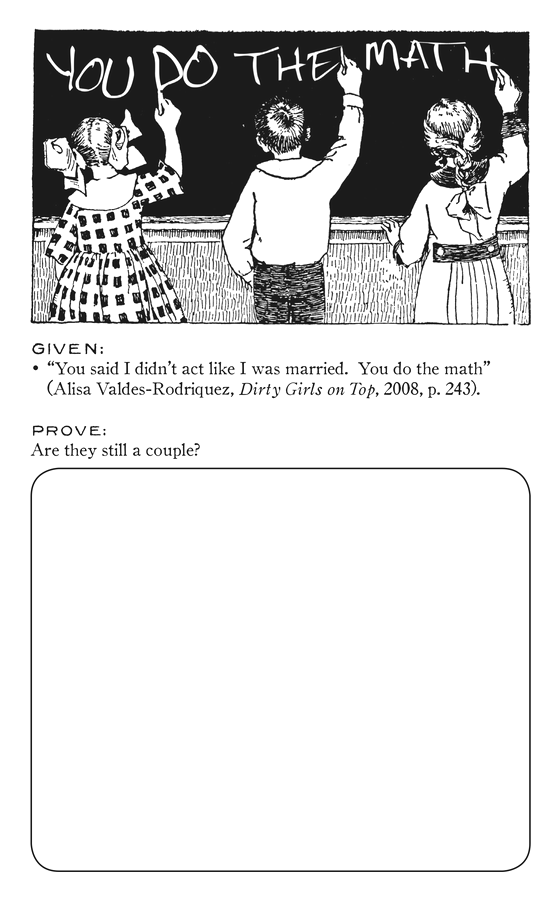
INSTRUCTIONS: Click on the puzzle image below to reveal one possible solution.
|
Page 2 of 4
> Older Entries...
Original Content Copyright © 2026 by Craig Conley. All rights reserved.
|