CRAIG CONLEY (Prof. Oddfellow) is recognized by Encarta as “America’s most creative and diligent scholar of letters, words and punctuation.” He has been called a “language fanatic” by Page Six gossip columnist Cindy Adams, a “cult hero” by Publisher’s Weekly, a “monk for the modern age” by George Parker, and “a true Renaissance man of the modern era, diving headfirst into comprehensive, open-minded study of realms obscured or merely obscure” by Clint Marsh. An eccentric scholar, Conley’s ideas are often decades ahead of their time. He invented the concept of the “virtual pet” in 1980, fifteen years before the debut of the popular “Tamagotchi” in Japan. His virtual pet, actually a rare flower, still thrives and has reached an incomprehensible size. Conley’s website is OneLetterWords.com.
KingDeathwasarareoldfellow!/Hesatewherenosuncouldshine;/Andheliftedhishandsoyellow,/Andpouredouthiscoal-blackwine/Hurrah!forthecoal-blackwine! —Thomas Morton, The School of Reform; or, How to Rule a Husband, A Comedy in Five Acts, 1805. As quoted in Artist of Wonderland: the Life, Political Cartoons, and Illustrations of Tenniel by Frank Morris, 2005.
Aroundthepale-bluedomeoftheheavensafewpearl-coloredcloudshungmotionless,asthoughthewindhadbeenwithdrawntootherskies.Notacrimsonleaffloateddownwardthroughthesoft,silverylightthatfilledtheatmosphereandcreatedthesenseoflonely,unimaginablespaces.Thislightoverhungthefar-rollinglandscapeoffieldandmeadowandwood,crowningwithfaintradiancetheremoterlow-swellinghill-topsanddeepeningintodreamyhalf-shadowsontheireasternslopes.Nearer,itfellinawhiteflakeonanunstirredsheetofwaterwhichlayalongtheedgeofamassofsombre-huedwoodland,andnearerstillittouchedtospring-likebrilliancyalevel,greenmeadowonthehitheredgeofthewater,whereagroupofDurhamcattlestoodwithreversedflanksnearthegleamingtrunksofsomeleaflesssycamores.Stillnearer,itcaughtthetopofthebrownfoliageofalittlebentoak-treeandburneditintoasilveryflame.Itlitonthebackandthewingsofacrowflyingheavilyinthepathofitsrays,andmadehisblacknessaswhiteasthebreastofaswan.Intheimmediateforeground,itsparkledinminutegleamsalongthestalksofthecoarse,deadweedsthatfellawayfromthelegsandtheflanksofawhitehorse,andslantedacrossthefaceoftheriderandthroughtheendsofhisgrayhair,whichstraggledfrombeneathhissoftblackhat. —James Lane Allen, "Two Gentlemen of Kentucky," originally published in The Century Magazine, April 1888.
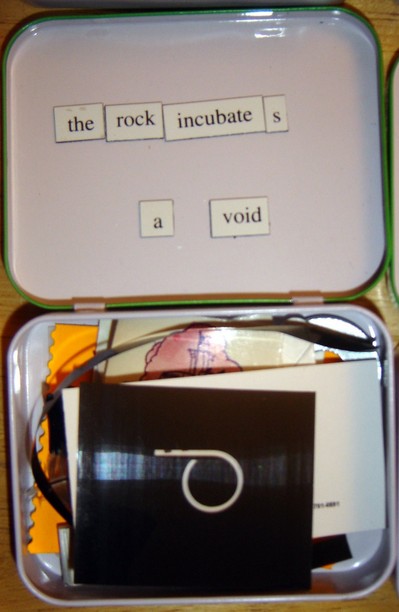
Mine has the poem: show the sausage/to a peach/sweaty white flood. Although the peaches and cream implication is, well, disgusting here, I like the poem above better. I particularly like the way "a void" is created between the words that could otherwise be read as avoid. Thus, I offer:
Bigdiamonds,bigbluediamonds,howtheysparkle/Butwhatcantheydotowarmyoursoul?/Whenyou’relonesomeinthemoonlight,andneedsomelovin’/Bigdiamonds,bigbluediamonds,aresocold. —Earl J. Carson, "Big Blue Diamonds," first recorded by Little Willie John in 1962.
Did the Beatles cross the Atlantic for an appearance on "The Ed Sullivan Show" in 1964?
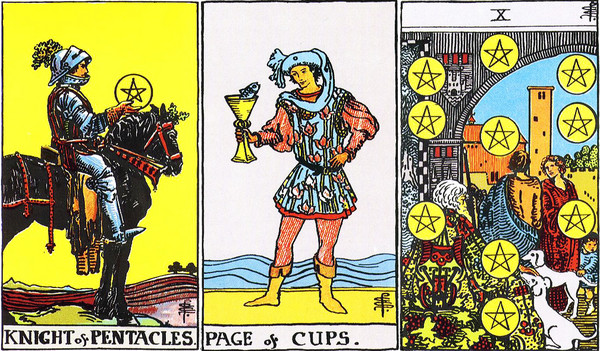
With hindpsych, the answer is "yes"! In our Tarot spread, the card on the left is the Knight of Pentacles. A hard worker who is dedicated to his chosen course, this knight symbolizes the Beatles. The knight is face to face with the center card, the Page of Cups. The Page of Cups is a symbol of an outpouring of emotions and a new love affair. The page represents America's reception of the Beatles. Note that behind the page is a body of water, symbolic of the Atlantic Ocean. The final card in our spread is the Ten of Pentacles. This is a symbol of affluence—supreme business success, long-term abundance, and all-around good fortune. Note that the knight begins with a single coin and ends with a tenfold bounty. We can say with confidence that the Beatles cross the Atlantic for an appearance on "The Ed Sullivan Show" in 1964, and that it is a pivotal moment in their career. We can now move on.
Is it humanly possible to invent a new color? Rochester Institute of Technology Professor Mark Fairchild says "yes"! In fact, he suggests that all observant people invent new colors at various times of their lives. Dr. Fairchild explains: "As a color scientist, I think of colors as perceptions, that is things that we see. Of course those perceptions are not just caused by our brain (except when we are dreaming); they are caused by how our eyes and brain respond to the world around us. For color it is the light and objects that we are responding to. Most people would take this question to mean 'has anyone invented a light or object of a new color?' Personally, I have not, but I have invented new ways to understand and describe how we perceive and produce colors in places like the movies. Other people certainly have invented new materials that produce colors that people couldn't make before. Things like new paints, new inks, new kinds of televisions. That has happened often through the history of science. But, if we come back to color being a perception, then it is even easier to say that we invent new colors. I think we all do it quite often if we pay attention to the world around us. Have you ever had a time when you looked at something and it seemed like a totally new experience? Maybe a special rainbow, or a peculiar bird, or a strange way the light bounces around your room? If you have noticed a new experience like that, then I think you could say you have invented a new color. That is because color is truly a perception that is unique to you and any new color experiences could be considered 'inventions.' I like to just think of them as interesting parts of our world that make it fun to study science; in my case color science."
You can explore Dr. Fairchild's research on color perception and imaging at his website.
[Read the entire article in my guest blog at ColourLovers.com.]
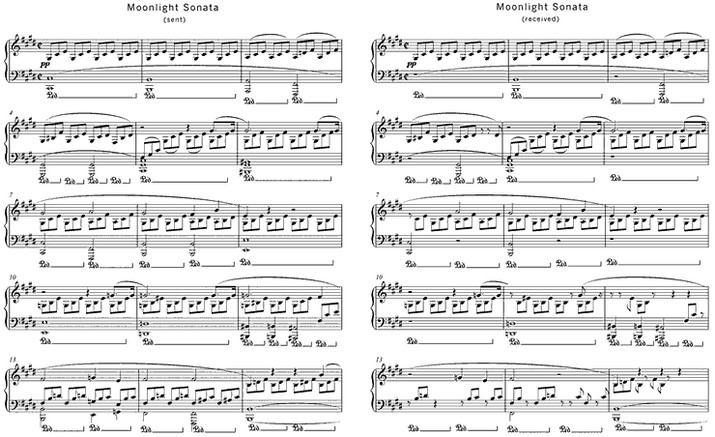
Earth–Moon–Earth (Moonlight Sonata Reflected from the Surface of the Moon)
Earth-Moon-Earth "is a form of radio transmission whereby messages are sent in morse–code from earth, reflected from the surface of the moon, and then received back on earth. The moon reflects only part of the information back – some is absorbed in its shadows, 'lost' in its craters. Beethoven’s Moonlight Sonata has been translated into morse-code and sent to the moon via E.M.E. Returning to earth 'fragmented' by the moon’s surface, it has been re-translated into a new score, the gaps and absences becoming intervals and rests."
View the sent score and the crater-filled score received back, and hear excerpts of the score here.
Bluebirdblueasthesky-blueheart/Ofmygirlwhoseheartisthesky —Guillaume Apollinaire (1880–1918), "A Bird is Singing," from The Self-Dismembered Man: Selected Later Poems of Guillaume Apollinaire, translated by Donald Revell, 2004.







 by
by 











 by
by